
BuddhistCatholicContemplativeEvangelicalGeneral ChristianHinduJewishLatter-day SaintMuslimNew VisionsProgressive Christian
Beliefs
- Buddhist
- Catholic
- Contemplative
- Evangelical
- General Christian
- Hindu
- Jewish
- Latter-day Saint
- More Voices
- Muslim
- New Visions
- Pagan
- Progressive Christian
Topics
- Religion News
- Food and Religion
- Sports and Religion
- Religious Art
- Religious Music and Entertainment
- Religious Events
- History and Religion
- Style and Religion
- Politics and Religion
- Women in Religion
- Recreation Outdoors and Religion
- Business Finance and Religion
- Careers Workplace and Religion
- Education and Religion
- Family Parenting and Religion
- Health Fitness and Religion
- Home and Religion
- Relationships and Religion
- Technology and Religion
- Travel and Religion
Columnists
- Buddhist Columnists
- Business Finance and Religion Columnists
- Careers Workplace and Religion Columnists
- Catholic Columnists
- Contemplative Columnists
- Education and Religion Columnists
- Evangelists Columnists
- Family Parenting and Religion Columnists
- General Christian Columnists
- Health Fitness and Religion Columnists
- Hindu Columnists
- History and Religion Columnists
- Home and Religion Columnists
- Jewish Columnists
- More Voices Columnists
- Latter Day Columnists
- Muslim Columnists
- New Visions Columnists
- Nonreligious Columnists
- Pagan Columnists
- Politics and Religion Columnists
- Progressive Columnists
- Recreation Outdoors and Religion Columnists
- Relationships and Religion Columnists
- Religion News Columnists
- Religious Art Columnists
- Religious Events Columnists
- Religious Music and Entertainment Columnists
- Sports and Religion Columnists
- Style and Religion Columnists
- Technology and Religion Columnists
- Travel and Religion Columnists
- Women in Religion Columnists
Resource Library
- 2026 Calendar
- Library of World Religions
- The 100 Most Holy Places on Earth
- Patheos Answers
- Podcasts
- Videos
- Faith Leaders Database
- Anglican Episcopalian
- Bahai
- Baptist
- Buddhism
- Christianity
- Confucianism
- Eastern Orthodoxy
- Hinduism
- Holiness and Pentecostal
- ISKCON
- Islam
- Judaism
- Lutheran
- Methodist
- The Church of Jesus Christ of Latter-day Saints
- New Age
- Paganism
- Presbytarian and Reformed
- Protestantism
- Religion Behind the Scenes
- Roman Catholic
- Scientology
- Shia Islam
- Sikhism
- Sufism
- Sunni Islam
- Taoism
- Zen
- See all religions
Research Tools
 Ad-Free & Subscriber Log-In Subscription Support
Ad-Free & Subscriber Log-In Subscription Support
Follow Patheos 

- Trending:
- Forgiveness
- |
- Marriage
- |
- Consciousness
- |
- Death Penalty
- |
- Election
- |
- Halloween
 Rebecca Florence Miller
- Home
- Evangelical
- Babette’s Feast: New Creation and Easter’s Resurrection
Babette’s Feast: New Creation and Easter’s Resurrection
Last updated on: March 26, 2016 at 4:58 pm by Rebecca Florence Miller
Babette’s Feast: New Creation and Easter’s Resurrection 2016-03-26T16:58:53-06:00 Rebecca Florence Miller
Patheos Explore the world's faith through different perspectives on religion and spirituality! Patheos has the views of the prevalent religions and spiritualities of the world.
Does Babette develop her masterful plan with this context in mind? Probably more than likely. She orders a great deal of fine china, glassware, and gourmet ingredients from France, leaving the sisters horrified. This wasn’t what they had envisioned at all! And the wine! How can they, intemperates that they are, drink wine? One sister has a terrible nightmare in which the poor turtle (shipped alive from France and soon to be made into turtle soup) rears its head, and blood-like wine is spilled out on a table while the flames of hell rise amidst all of this strange, surely devilish, food. Wrought in spirit, the sister confesses to the community her error in allowing Babette to make this meal. Astonishingly, they respond that they will eat the meal and not say a word about it. This is their attempt to be gracious, even though they worry the meal might not be according to their faith. Being gracious to Babette is placed above strict adherence to legalism.
(An aside: This strikes me as an amazing concession from such austere, pious people. They will be good guests and trust God to sort it out. I wonder how this approach might be helpful to the baking of certain cakes for certain kinds of weddings–and other comparable examples. Perhaps Presidential candidate John Kerry was right when he advised Christian business owners to serve customers that they disagree with and to simply silently pray for them as they leave the business. This film makes me ask: How can Christians still live by our principles in this day and age, and yet also remain hospitable and gracious toward those around us who might have other beliefs or practices?)
The truly wonderful thing about this film is that it doesn’t make fun of the villagers or insist that their sacrifices are unimportant (they do, after all, work hard to serve those in need). In fact, the sisters’ old suitors testify that they went on to live lives of success and prestige, only to find those pursuits ultimately wanting. They testify that the sisters chose a better way.
So, it is from a place of deep respect of the sisters’ faith that the film proceeds with its critique. Mark Le Fanu writes, “The feast given by Babette to the pious townspeople opens their minds to the notion that the pleasures of the senses aren’t necessarily sinful, but the satire involved here is very gentle, and it would be false to interpret the great sequence we are talking about as some simple endorsement of epicureanism.” Sacrifice on behalf of God and neighbor is valued in this film, but so is the appreciation of all of the created order which divine largesse has made. Rightly appreciated, the smell, taste, touch, sound, and sight of this beautiful world need not be something to be feared, but rather something to be embraced, as a reminder of the graciousness of our Creator, and as a hope of the resurrection and new creation to come.
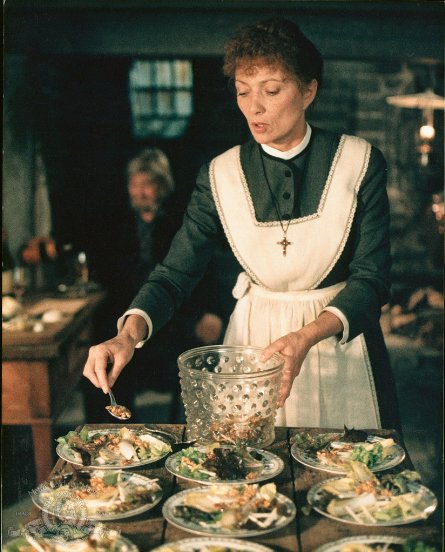 As the guests gather around Babette’s table, initially they are cautious of all of these rich delicacies. But slowly, as they acclimate to the lavish grace being bestowed upon them, they begin to become more comfortable with its joy. And in the midst of the sharing of the meal together, reconciliation begins to happen and brotherhood and sisterhood is rekindled. A meal can do this and hospitality in general can do this, creating warmth of heart and unity. In one church I have been a part of, we were at one time experiencing some conflict and stress among our members. As we gathered for a meeting with aggrieved members, there was some tension and stress among some of us. There was fear too. Then, one of our council members with a particular flair for hospitality came and began to make some coffee. She poured it into our white carafes and moved around from member to member, smiling warmly and offering them coffee to drink. Among Lutherans, coffee is a bit of a sacrament, of course. It was night and not everyone partook, but everyone was warmed by her hospitable presence and by the community she created around the coffee pot. I believe her gift greatly contributed to the positive, constructive spirit with which the gathered members began to talk. We were not separate people, alienated from one another; we were a gathered family. This is only one of a great number of things I have seen this woman do to bring community, love, and warmth to the room when she enters. Such simple things, yet such great blessing.
The film concludes with the surprise that Babette’s lavish gift has in fact been the giving of all. There is nothing left and she will not be returning to Paris–but never fear, for “an artist is never poor.” Like Jesus, Babette gives the full measure, her very being, not fearing loss but daring greatly. She dares to spread every last bit of love and grace.
Playing it safe is not Divine. … Love is the widest, choicest door into the Passion. God saved the world not by sitting up in heaven and issuing antiseptic directives, but by becoming man, and vulnerable, in Jesus. He died, not because He despised the earth, but because He loved it as a man loves it–out of all proportion and sense. And when He rose again, He stood up like a man indeed: with glorious scars–and with flesh, bones, and all things appertaining to the perfection of man’s nature.
It is through that Sacred Humanity–and through the mighty working whereby He is able to subdue all things to Himself–that He will, at the last day, change these corruptible bodies of ours, make them like His own glorious Body and, through them, draw all things into the last City of their being.–Robert Farrar Capon, The Supper of the Lamb (190)
There is nothing like a feast to open our eyes to the new creation to come. A creation in which we are once again rightly oriented toward one another, reconciled, restored. A creation in which there is rejoicing, community, and unity. This Easter, I wish for you such a good feast that it not only satisfies your body now but also makes you hunger and thirst for the Feast to come.
On what are you feasting this Easter?
How does the idea of the coming kingdom of God as a feast strike you?
——————-
Community discussion guidelines:
Because this is a Christian blog, the things I’m talking about will obviously be topics that people feel strongly about in one direction or another. Please keep in mind that this is a place for substantive, respectful, constructive conversation. All perspectives are welcome to discuss here as long as all can treat each other with kindness and respect. Please ignore trolls, refuse to engage in personal attacks, try not to derail the conversation into divisive rabbit trails, and observe the comment policy listed on the right side of the page. Comments that violate these guidelines may be deleted. Vulgar remarks may result in immediate blacklisting. For those who clearly violate these policies repeatedly, my policy is to issue a warning which, if not regarded, may lead to blacklisting. This is not about censorship, but about creating a healthy, respectful environment for discussion.
P.S. Please also note that I am not a scientist, but a person with expertise in theology and the arts. While I am very interested in the relationship between science and faith, I do not believe I personally will be able to adequately address the many questions that inevitably come up related to science and religion. I encourage you to seek out the writings of theistic or Christian scientists to help with those discussions.
———————-
Image credit: Still of Stéphane Audran in Babette’s Feast (1987). © 1987 Metro-Goldwyn-Mayer Studios Inc. All Rights Reserved. Source: IMDB.com.
Image credit: Still of Vibeke Hastrup in Babette’s Feast (1987) . © 1987 Metro-Goldwyn-Mayer Studios Inc. All Rights Reserved. Source: IMDB.com.
Image credit: Still of Stéphane Audran in Babette’s Feast (1987). © 1987 Metro-Goldwyn-Mayer Studios Inc. All Rights Reserved. Source: IMDB.com.
Previous Post

March 18, 2016
Ozu's Tokyo Story and the Struggle to Honor Our Parents
Next Post

April 21, 2016 Revised Blogging Schedule for Film Series
Browse Our Archives
Select a Category Books Charis Christian Witness Church Year Conversation Creativity Cultural Engagement Curiosity Current Events Film Jesus Lectionary Message Literature Lutheran Theology Politics Story Television Theology Uncategorized
Select a Month December 2017 November 2017 October 2017 September 2017 August 2017 July 2017 June 2017 May 2017 April 2017 March 2017 February 2017 December 2016 October 2016 August 2016 July 2016 June 2016 May 2016 April 2016 March 2016 February 2016 January 2016 December 2015 November 2015 October 2015 September 2015 August 2015 July 2015 June 2015 May 2015 April 2015 March 2015 February 2015 January 2015 December 2014 November 2014 October 2014
Follow Us!
TAKE THE
Religious Wisdom Quiz
What was the primary beverage in biblical times?
Select your answer to see how you score.
Wine Water Milk Beer
Related posts from Rebecca Florence Miller

A New Normal: Grief and Facing the Brokenness...

An Interview with the Christian and Atheist Friends...

#Loser: How the Call of Christ Is Antithetical...

Conflict and Challenge, instead of Cheap Grace
TRENDING AT PATHEOS Evangelical

The REST of Your Life: A Creative Wrestles...
This week I had a conversation with a good friend from church....

How the author of the world's best hymn...
I've been working with John Newton for a while now. This makes...

Long before this Lectio Divina, Psalm 130 - the song - started...

What About the Trees? Another Living Parable
After I finished writing the last article about falling leaves as a...

Why Classical Education Is a Conversation, Not a...
Come and Read: Joy in Classical Education When I was a little...

Cornell University has received a great deal of negative publicity and intense...
view all Evangelical blogs
Ad-Free & Subscriber Log-In Subscription Support
- About Us
- 2026 Calendar
- Videos
- Podcasts
- Library of World Religions
- Faith In Media Tracker
- Advertise With Us
- Write for Us
- Privacy Policy
- Terms of Service
- Do Not Sell My Data
- Contact Us
- Radiant Digital
- Manage Newsletter Subscriptions
- Unsubscribe From Notifications
- Sitemap
Copyright 2008-2026, Patheos. All rights reserved.
Subscription Support Ad-Free & Subscriber Log-In
Follow Patheos