
BuddhistCatholicContemplativeEvangelicalGeneral ChristianHinduJewishLatter-day SaintMuslimNew VisionsProgressive Christian
Beliefs
- Buddhist
- Catholic
- Contemplative
- Evangelical
- General Christian
- Hindu
- Jewish
- Latter-day Saint
- More Voices
- Muslim
- New Visions
- Pagan
- Progressive Christian
Topics
- Religion News
- Food and Religion
- Sports and Religion
- Religious Art
- Religious Music and Entertainment
- Religious Events
- History and Religion
- Style and Religion
- Politics and Religion
- Women in Religion
- Recreation Outdoors and Religion
- Business Finance and Religion
- Careers Workplace and Religion
- Education and Religion
- Family Parenting and Religion
- Health Fitness and Religion
- Home and Religion
- Relationships and Religion
- Technology and Religion
- Travel and Religion
Columnists
- Buddhist Columnists
- Business Finance and Religion Columnists
- Careers Workplace and Religion Columnists
- Catholic Columnists
- Contemplative Columnists
- Education and Religion Columnists
- Evangelists Columnists
- Family Parenting and Religion Columnists
- General Christian Columnists
- Health Fitness and Religion Columnists
- Hindu Columnists
- History and Religion Columnists
- Home and Religion Columnists
- Jewish Columnists
- More Voices Columnists
- Latter Day Columnists
- Muslim Columnists
- New Visions Columnists
- Nonreligious Columnists
- Pagan Columnists
- Politics and Religion Columnists
- Progressive Columnists
- Recreation Outdoors and Religion Columnists
- Relationships and Religion Columnists
- Religion News Columnists
- Religious Art Columnists
- Religious Events Columnists
- Religious Music and Entertainment Columnists
- Sports and Religion Columnists
- Style and Religion Columnists
- Technology and Religion Columnists
- Travel and Religion Columnists
- Women in Religion Columnists
Resource Library
- 2026 Calendar
- Library of World Religions
- The 100 Most Holy Places on Earth
- Patheos Answers
- Podcasts
- Videos
- Faith Leaders Database
- Anglican Episcopalian
- Bahai
- Baptist
- Buddhism
- Christianity
- Confucianism
- Eastern Orthodoxy
- Hinduism
- Holiness and Pentecostal
- ISKCON
- Islam
- Judaism
- Lutheran
- Methodist
- The Church of Jesus Christ of Latter-day Saints
- New Age
- Paganism
- Presbytarian and Reformed
- Protestantism
- Religion Behind the Scenes
- Roman Catholic
- Scientology
- Shia Islam
- Sikhism
- Sufism
- Sunni Islam
- Taoism
- Zen
- See all religions
Research Tools
 Ad-Free & Subscriber Log-In Subscription Support
Ad-Free & Subscriber Log-In Subscription Support
Follow Patheos 

- Trending:
- Forgiveness
- |
- Marriage
- |
- Consciousness
- |
- Death Penalty
- |
- Election
- |
- Halloween
 Rebecca Florence Miller
- Home
- Evangelical
- Redeeming Sex by Debra Hirsch
Redeeming Sex by Debra Hirsch
Last updated on: May 6, 2015 at 10:28 am by Rebecca Florence Miller
Redeeming Sex by Debra Hirsch 2015-05-06T10:28:32-06:00 Rebecca Florence Miller
Patheos Explore the world's faith through different perspectives on religion and spirituality! Patheos has the views of the prevalent religions and spiritualities of the world.
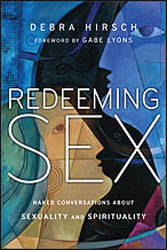 I opened my review copy of Debra Hirsch’s Redeeming Sex: Naked Conversations about Sexuality and Spirituality with trepidation. Would this just be one more awkward Christian book about sex? Would I want to throw it across the room? Would I be uncomfortable to write about it?
The discussion of the intersection of sexuality and Christianity is littered with minefields. What’s been missing, oftentimes, is an approach to sexuality that is able to function in a bridge-building way. What I appreciated most about Hirsch’s book was this open, unafraid willingness to engage relationally with the LGBT community in a noncoercive way–and this from a woman who herself feels conscience bound against same-sex genital sexual expression. Her personal ethical practice and her ability to reach out to anybody with welcome and love positions her as a really helpful reconciling agent between the Christian community and the the LGBT community.
Hirsch once identified as a lesbian herself. She sees female sexuality as more fluid than men’s, though, and while acknowledging that her story is not everybody’s story, she seems to have now found a happy, stable relationship with her husband, Alan. I don’t remember her definitively labeling herself now, but it seems as if she may identify more as bisexual than gay these days. She has worked with the LGBT community in Australia and America for 20 years now, and as a result of her own story and of deep listening to and relationships with others in this community, she has come to a beautiful, open-hearted, warm, grace-giving, and deeply pastoral approach to her ministry.
I will say that Hirsch’s book gets off to a somewhat slow start. But about one-third or one-half of the way through, she really gets humming. One other minor critique, too, would be that Hirsch’s chapter titles are a bit “Christian awkward.” I’m not sure if she’s trying to be trendy, but a glance through these titles gave me a bit of a Mark Driscoll vibe. This is unfortunate because the book itself is really not Driscoll-esque at all. Sometimes editors rather than writers title chapters so this may not be Hirsch’s work at all.
There are a lot of wise insights in this book. I will focus on just a few.
1. It does violence to the diversity of human experience to suggest that sexuality and gender exist in polarities instead of on a continuum.
Personally, I’m always trying to better understand what the experience of the LGBT community is in regard to gender and orientation. Hirsch’s discussion proved helpful in understanding better. I’d be interested to know what those who have different experiences of orientation and gender thought about her discussion and if they felt it was accurate.
Hirsch’s discussion of the continuums of gender and orientation was a helpful framework. She suggests that it is more helpful to refer to “homosexualities” rather than “homosexuality.” She describes two of the most common types of homosexualities that she has encountered or experienced. The first is “obligatory/definitive homosexuality.” She says, “For these individuals, as long as they can remember they have always been drawn to members of the same sex.” She adds, “in my experience, almost all of the men I know, and only some of the women I’ve known over the years, identify with this type of homosexuality. I have always thought that if research did uncover some genetic component to one’s orientation, this would be the type it would be referring to, given that it is the most innate of all” (109-10). The second of the homosexualities that she mentions is “preferential homosexuality.” For this group, there seems to be more choice involved than with with first group. This group may be more influenced by external factors. This was true of Hirsch; that she can acknowledge her own experience without universalizing it or utilizing it coercively and that she can do so while still acknowledging a sense of mystery about sexuality says a lot about her integrity and graciousness. At one point, she does make what I feel is an overly broad statement (“No one is simply born gay”), but she goes on to explain this statement in such a manner that I think the emphasis might be better put on the “simply” rather than the “born.” Her point is not to deny that many, many gay people experience lack of choice when it comes to their orientation, but rather that orientation is deeply complex and that everyone’s experience is a bit different along the continuum.
2. Hirsch is able to articulate the problems with reparative therapy ministries such as the now-disbanded Exodus International.
Hirsch used to be involved with Exodus, but she recounts her increasing discomfort with the ministry’s approach to the gay community. She writes, “Some of the claims they were making–particularly as it related to what healing looked like, and what one could realistically expect from God–didn’t equate to what we were seeing” (119). After communicating her concerns to Exodus, Hirsch eventually parted ways with them. She points out that while she was able to find her way back to some experience of heterosexuality from her past, many in the gay community had never experienced heterosexuality at all. To what are they supposed to find their way back? She compares the situation to her sister’s experience as a disabled person from birth, “Based on the logic of Exodus, in Jesus my sister (and anybody else with one leg) should be able to return to God’s original intention (i.e., grow another leg). If we can make a case for biblical sexuality, then we should be able to make a case for biblical physicality” (119). This is an excellent point. There might be a few Pentecostal ministries today that would still insist that a Christian with enough faith could grow a new leg, but most of us would point to ultimate healing in the resurrection. Why can’t we apply this same principle to sexuality?
Previous Post

May 2, 2015
How God Changed My Heart about Systemic Racism
Next Post
May 11, 2015 An Open Letter of Gratitude to Police Officers
Browse Our Archives
Select a Category Books Charis Christian Witness Church Year Conversation Creativity Cultural Engagement Curiosity Current Events Film Jesus Lectionary Message Literature Lutheran Theology Politics Story Television Theology Uncategorized
Select a Month December 2017 November 2017 October 2017 September 2017 August 2017 July 2017 June 2017 May 2017 April 2017 March 2017 February 2017 December 2016 October 2016 August 2016 July 2016 June 2016 May 2016 April 2016 March 2016 February 2016 January 2016 December 2015 November 2015 October 2015 September 2015 August 2015 July 2015 June 2015 May 2015 April 2015 March 2015 February 2015 January 2015 December 2014 November 2014 October 2014
Follow Us!
TAKE THE
Religious Wisdom Quiz
What worldwide Christian youth movement was started by Robert Baden-Powell with a focus on outdoor activities and morality?
Select your answer to see how you score.
Young Life Boy Scouts Wesley Guild Sisters of Charity
Related posts from Rebecca Florence Miller


A New Normal: Grief and Facing the Brokenness...

An Interview with the Christian and Atheist Friends...

Our Response to Sexual Abuse Should Not Be...
TRENDING AT PATHEOS Evangelical

How the author of the world's best hymn...
I've been working with John Newton for a while now. This makes...

Long before this Lectio Divina, Psalm 130 - the song - started...

What About the Trees? Another Living Parable
After I finished writing the last article about falling leaves as a...

Why Classical Education Is a Conversation, Not a...
Come and Read: Joy in Classical Education When I was a little...

Falling Leaves: A Living Parable on Letting Go
I’ve spent the vast majority of my life in the southeast corner...

Cornell University has received a great deal of negative publicity and intense...
view all Evangelical blogs
Ad-Free & Subscriber Log-In Subscription Support
- About Us
- 2026 Calendar
- Videos
- Podcasts
- Library of World Religions
- Faith In Media Tracker
- Advertise With Us
- Write for Us
- Privacy Policy
- Terms of Service
- Do Not Sell My Data
- Contact Us
- Radiant Digital
- Manage Newsletter Subscriptions
- Unsubscribe From Notifications
- Sitemap
Copyright 2008-2026, Patheos. All rights reserved.
Subscription Support Ad-Free & Subscriber Log-In
Follow Patheos