
BuddhistCatholicContemplativeEvangelicalGeneral ChristianHinduJewishLatter-day SaintMuslimNew VisionsProgressive Christian
Beliefs
- Buddhist
- Catholic
- Contemplative
- Evangelical
- General Christian
- Hindu
- Jewish
- Latter-day Saint
- More Voices
- Muslim
- New Visions
- Pagan
- Progressive Christian
Topics
- Religion News
- Food and Religion
- Sports and Religion
- Religious Art
- Religious Music and Entertainment
- Religious Events
- History and Religion
- Style and Religion
- Politics and Religion
- Women in Religion
- Recreation Outdoors and Religion
- Business Finance and Religion
- Careers Workplace and Religion
- Education and Religion
- Family Parenting and Religion
- Health Fitness and Religion
- Home and Religion
- Relationships and Religion
- Technology and Religion
- Travel and Religion
Columnists
- Buddhist Columnists
- Business Finance and Religion Columnists
- Careers Workplace and Religion Columnists
- Catholic Columnists
- Contemplative Columnists
- Education and Religion Columnists
- Evangelists Columnists
- Family Parenting and Religion Columnists
- General Christian Columnists
- Health Fitness and Religion Columnists
- Hindu Columnists
- History and Religion Columnists
- Home and Religion Columnists
- Jewish Columnists
- More Voices Columnists
- Latter Day Columnists
- Muslim Columnists
- New Visions Columnists
- Nonreligious Columnists
- Pagan Columnists
- Politics and Religion Columnists
- Progressive Columnists
- Recreation Outdoors and Religion Columnists
- Relationships and Religion Columnists
- Religion News Columnists
- Religious Art Columnists
- Religious Events Columnists
- Religious Music and Entertainment Columnists
- Sports and Religion Columnists
- Style and Religion Columnists
- Technology and Religion Columnists
- Travel and Religion Columnists
- Women in Religion Columnists
Resource Library
- 2026 Calendar
- Library of World Religions
- The 100 Most Holy Places on Earth
- Patheos Answers
- Podcasts
- Videos
- Faith Leaders Database
- Anglican Episcopalian
- Bahai
- Baptist
- Buddhism
- Christianity
- Confucianism
- Eastern Orthodoxy
- Hinduism
- Holiness and Pentecostal
- ISKCON
- Islam
- Judaism
- Lutheran
- Methodist
- The Church of Jesus Christ of Latter-day Saints
- New Age
- Paganism
- Presbytarian and Reformed
- Protestantism
- Religion Behind the Scenes
- Roman Catholic
- Scientology
- Shia Islam
- Sikhism
- Sufism
- Sunni Islam
- Taoism
- Zen
- See all religions
Research Tools
 Ad-Free & Subscriber Log-In Subscription Support
Ad-Free & Subscriber Log-In Subscription Support
Follow Patheos 

- Trending:
- Forgiveness
- |
- Marriage
- |
- Consciousness
- |
- Death Penalty
- |
- Election
- |
- Halloween
 Rebecca Florence Miller
- Home
- Evangelical
- Beats of the Antonov (Seattle International Film Festival)
Beats of the Antonov (Seattle International Film Festival)
Last updated on: May 28, 2015 at 11:12 am by Rebecca Florence Miller
Beats of the Antonov (Seattle International Film Festival) 2015-05-28T11:12:29-06:00 Rebecca Florence Miller
Patheos Explore the world's faith through different perspectives on religion and spirituality! Patheos has the views of the prevalent religions and spiritualities of the world.
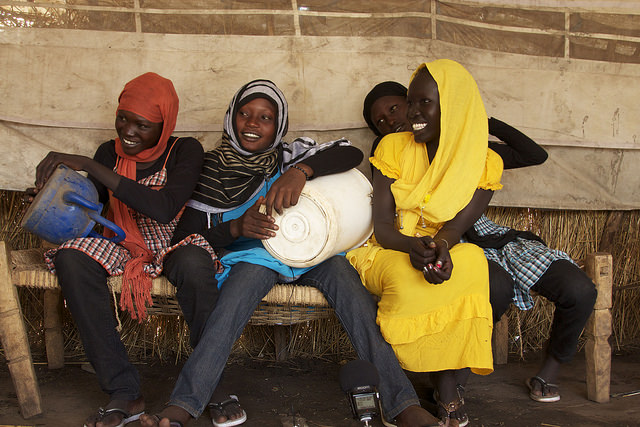
Muna Abdallah and friends perform Girls’ Music
While in Seattle last week, I had the opportunity to visit the Seattle International Film Festival and see a moving African film. Beats of the Antonov celebrates how music enables human beings in severe straits to be resilient and joyful.
Director Hajooj Kuka has made a film about a besieged community that is fresh, visceral, and alive. In Sudan’s Nuba Mountains, right at the border between Sudan and South Sudan, the people of the Blue Nile are daily threatened by the Russian-made Antonov bombers operated by the Sudanese government.
As the film opens, we see the planes buzzing above, the camera work shaky and chaotic as people shelter themselves in holes in the ground. In the chaos of this and other bombing scenes, we are entered into the action of the film from the perspective of those on the ground. We feel as if we too are hiding in holes in the ground, shielding ours head from the bombs, huddling together with our neighbors.
Then, suddenly we hear giggles and laughter, set in wild juxtaposition to the chaos of the explosions. What can this laughter mean? Who could be laughing in such an environment? Why isn’t there wailing instead? Our attention is instantly seized. “Laughter is always there,” we are told. This is a people whose formidable strength and spirit cannot be destroyed. This is a people whose joy, found especially in their music, continues to sustain them through the attempts of the al-Bashir Sudanese government to destroy them.
From their inventive use of common items such as a bowl and pipe to create musical instruments to their seeming ability to devise song and dance for any circumstance, these communities adapt to the harsh circumstances they have been dealt and emerge with greater strength. One refugee points out that good can come even from war because in the onslaught, people become more attached to their culture.
Some of the best insights that emerged in the film had to do with the identity crisis going on in Africa–in Sudan in particular. Because Sudan is a Muslim country and has strong ties to Arab culture, there is a conflict going on between black African identity (about which many in Sudan feel illogically shameful) and Arab culture (which is often viewed as superior or imposed on black African culture). The argument of several people in the film is that the destruction of indigenous tribes in Sudan has to do with the al-Bashir government’s desire to wipe out African identity and elevate Arab identity. This extends even to the way black Africans in this region will try to lighten their skin in order to identify with a more Arab appearance. This is less about Islam vs. other religions, in the argument of the film, and more about cultural identity. There is a movement among the Christians and Muslims who live in the Nuba Mountains to express their religions within a more indigenous African culture. One person said that Mohammed was sent to all cultures, not just to the Arabs, adding, “Arabic culture does not give you a better understanding of Islam.” (This statement I found surprising since my understanding is that the the Qu’ran is to be read in Arabic and that, therefore, Islam is, in fact, rather formed around Arab culture. It is interesting to note the ways in which Blue Nile-region Muslims are attempting to adapt their religion to the needs of the culture in which they find themselves.)
Interspersed throughout the commentary and stories and bombings, harmonious, joyful music bursts forth. The music is the center of this film. It is alive and full of heart. We hear traditional music, “girls’ music” (telling simple stories of women’s everyday life), songs preparing warriors for battle (this community after a long patience with the Sudanese government is now fighting back).
Director Hajooj Kuka, who hails originally from Sudan, spent two years in the region. He had some previous relationships with people in the area that helped pave the way for the making of documentary. He brought a friend who is an ethnomusicologist to the region to join in the project as well. During the post-film discussion, he said that he had thought living with refugees would be depressing but that instead he found great joy being with them. He added that, in this film, he hoped to provide an outlet for marginalized voices.
The only criticism that I have of the film was that at times the documentary subjects were more visibly aware of the cameras than I prefer to see. This may have been a stylistic decision (let the audience see that the subjects know the camera is there), and certainly it is difficult to completely eliminate the influence of camera presence on a group. I did feel I saw the real culture, but I personally prefer a more invisible camera in documentary film.
Kuka, a new African filmmaker, certainly has a vibrant, powerful talent. I hope he will be making many films in the future and continuing his good work of training other Africans in the art of filmmaking.
If you don’t have an international film festival near you, you can find this film on PBS’s POV series on August 3. It is very much worth your time.
Photo credit: Hajooj Kuka.
——————-
Community discussion guidelines:
Because this is a Christian blog, the things I’m talking about will obviously be topics that people feel strongly about in one direction or another. Please keep in mind that this is a place for substantive, respectful conversation. All perspectives are welcome to discuss here as long as all can treat each other with kindness and respect. Please ignore trolls, refuse to engage in personal attacks, and observe the comment policy listed on the right side of the page. Comments that violate these guidelines may be deleted. For those who clearly violate these policies repeatedly, my policy is to issue a warning which, if not regarded, may lead to blacklisting. This is not about censorship, but about creating a healthy, respectful environment for discussion.
P.S. Please also note that I am not a scientist, but a person with expertise in theology and the arts. While I am very interested in the relationship between science and faith, I do not believe I personally will be able to adequately address the many questions that inevitably come up related to science and religion. I encourage you to seek out the writings of theistic or Christian scientists to help with those discussions.
———————-
Previous Post

May 27, 2015
Follow-up Interview with Debra Hirsch
Next Post
May 29, 2015 Leah Libresco's Arriving at Amen: Tradition, Freshly Articulated
Browse Our Archives
Select a Category Books Charis Christian Witness Church Year Conversation Creativity Cultural Engagement Curiosity Current Events Film Jesus Lectionary Message Literature Lutheran Theology Politics Story Television Theology Uncategorized
Select a Month December 2017 November 2017 October 2017 September 2017 August 2017 July 2017 June 2017 May 2017 April 2017 March 2017 February 2017 December 2016 October 2016 August 2016 July 2016 June 2016 May 2016 April 2016 March 2016 February 2016 January 2016 December 2015 November 2015 October 2015 September 2015 August 2015 July 2015 June 2015 May 2015 April 2015 March 2015 February 2015 January 2015 December 2014 November 2014 October 2014
Follow Us!
TAKE THE
Religious Wisdom Quiz
What is the first book of the Bible?
Select your answer to see how you score.
Matthew Psalms Exodus Genesis
Related posts from Rebecca Florence Miller


An Interview with the Christian and Atheist Friends...

Our Response to Sexual Abuse Should Not Be...

Conflict and Challenge, instead of Cheap Grace
TRENDING AT PATHEOS Evangelical

How the author of the world's best hymn...
I've been working with John Newton for a while now. This makes...

Long before this Lectio Divina, Psalm 130 - the song - started...

What About the Trees? Another Living Parable
After I finished writing the last article about falling leaves as a...

Why Classical Education Is a Conversation, Not a...
Come and Read: Joy in Classical Education When I was a little...

Falling Leaves: A Living Parable on Letting Go
I’ve spent the vast majority of my life in the southeast corner...

Cornell University has received a great deal of negative publicity and intense...
view all Evangelical blogs
Ad-Free & Subscriber Log-In Subscription Support
- About Us
- 2026 Calendar
- Videos
- Podcasts
- Library of World Religions
- Faith In Media Tracker
- Advertise With Us
- Write for Us
- Privacy Policy
- Terms of Service
- Do Not Sell My Data
- Contact Us
- Radiant Digital
- Manage Newsletter Subscriptions
- Unsubscribe From Notifications
- Sitemap
Copyright 2008-2026, Patheos. All rights reserved.
Subscription Support Ad-Free & Subscriber Log-In
Follow Patheos