
BuddhistCatholicContemplativeEvangelicalGeneral ChristianHinduJewishLatter-day SaintMuslimNew VisionsProgressive Christian
Beliefs
- Buddhist
- Catholic
- Contemplative
- Evangelical
- General Christian
- Hindu
- Jewish
- Latter-day Saint
- More Voices
- Muslim
- New Visions
- Pagan
- Progressive Christian
Topics
- Religion News
- Food and Religion
- Sports and Religion
- Religious Art
- Religious Music and Entertainment
- Religious Events
- History and Religion
- Style and Religion
- Politics and Religion
- Women in Religion
- Recreation Outdoors and Religion
- Business Finance and Religion
- Careers Workplace and Religion
- Education and Religion
- Family Parenting and Religion
- Health Fitness and Religion
- Home and Religion
- Relationships and Religion
- Technology and Religion
- Travel and Religion
Columnists
- Buddhist Columnists
- Business Finance and Religion Columnists
- Careers Workplace and Religion Columnists
- Catholic Columnists
- Contemplative Columnists
- Education and Religion Columnists
- Evangelists Columnists
- Family Parenting and Religion Columnists
- General Christian Columnists
- Health Fitness and Religion Columnists
- Hindu Columnists
- History and Religion Columnists
- Home and Religion Columnists
- Jewish Columnists
- More Voices Columnists
- Latter Day Columnists
- Muslim Columnists
- New Visions Columnists
- Nonreligious Columnists
- Pagan Columnists
- Politics and Religion Columnists
- Progressive Columnists
- Recreation Outdoors and Religion Columnists
- Relationships and Religion Columnists
- Religion News Columnists
- Religious Art Columnists
- Religious Events Columnists
- Religious Music and Entertainment Columnists
- Sports and Religion Columnists
- Style and Religion Columnists
- Technology and Religion Columnists
- Travel and Religion Columnists
- Women in Religion Columnists
Resource Library
- 2026 Calendar
- Library of World Religions
- The 100 Most Holy Places on Earth
- Patheos Answers
- Podcasts
- Videos
- Faith Leaders Database
- Anglican Episcopalian
- Bahai
- Baptist
- Buddhism
- Christianity
- Confucianism
- Eastern Orthodoxy
- Hinduism
- Holiness and Pentecostal
- ISKCON
- Islam
- Judaism
- Lutheran
- Methodist
- The Church of Jesus Christ of Latter-day Saints
- New Age
- Paganism
- Presbytarian and Reformed
- Protestantism
- Religion Behind the Scenes
- Roman Catholic
- Scientology
- Shia Islam
- Sikhism
- Sufism
- Sunni Islam
- Taoism
- Zen
- See all religions
Research Tools
 Ad-Free & Subscriber Log-In Subscription Support
Ad-Free & Subscriber Log-In Subscription Support
Follow Patheos 

- Trending:
- Forgiveness
- |
- Marriage
- |
- Consciousness
- |
- Death Penalty
- |
- Election
- |
- Halloween
 Rebecca Florence Miller
- Home
- Evangelical
- Runaway Radical: A Young Man’s Reckless Journey to Save the World
Runaway Radical: A Young Man’s Reckless Journey to Save the World
Last updated on: April 8, 2015 at 4:37 pm by Rebecca Florence Miller
Runaway Radical: A Young Man’s Reckless Journey to Save the World 2015-04-08T16:37:28-06:00 Rebecca Florence Miller
Patheos Explore the world's faith through different perspectives on religion and spirituality! Patheos has the views of the prevalent religions and spiritualities of the world.
 I get the draw of world missions. I grew up on Christian missionary biographies. These folks were my biggest heroes: they were people who sacrificed comfort and possessions in order to live in real surrender to God and in order to go share God’s love with those who had never heard His name. Whether a missionary was going to a jungle that was untouched by time and modernization, to the far East, or to the former Soviet Union, I was in awe of those who willingly sacrificed their time, their money, their possessions because they were so very compelled by the beauty of Christ and longed to share Him with others. I dreamed of being a Bible translator for a group of people who had never heard of Jesus: what could be more amazing? (Especially for a “words girl.”)
My missionary heroes often did much to ease the suffering of the people to whom they went. They endured hardships for the sake of others. They were lit up with the fire of God’s love. In one case, they even went to the murderers of their family members, forgave them, befriended them, and led them into faith in Christ. Surely God was more alive and more powerfully seen in other parts of the world. I saw these stories through rose-colored glasses.
These stories had a lot to do with my family deciding to go to the mission field when I was a kid. I’ve always felt a little sad and embarrassed about how it all ended. Dad was called to be a missionary pilot–a perfect uniting of his love of airplanes and his love for the Gospel. We had a garage sale and sold a large amount of our worldly possessions. My parents went into missionary training and then to Spanish language school. And then to Haiti for a few months. And finally to Baja, Mexico where my Dad’s dream to start a new program there was launched. But it only lasted months. Mom and Dad’s marriage was unraveling fast. We left Dad and my parents’ marriage ended. This wasn’t the triumphant ending I imagine the donors had in mind when they wrote their checks to support our family. Our family had lots of potential, but it was never fully realized. I have many wonderful memories of living overseas, but also a latent sadness. What do we do with this story? Where was the purpose in it? Why weren’t our radical efforts enough?
I have a tendency toward radicalism. I’ve balanced out a lot in recent years; this tendency used to be far worse. As a teenager, I went through a stage where I attempted to make myself perfect and “fully committed” to God. A combination of family struggle, puberty, my own tendencies to anxiety and depression, and religious legalism combined in a toxic mix and triggered a two-year bout with OCD that led me to frantically and obsessively monitor my thoughts, my possessions, my behavior with scrupulous attention in order to finally, finally be truly surrendered to God. But no matter how much I tried to be perfect, it was NEVER enough. I drove myself unrelentingly. I was distraught and a shell of a person. I wasn’t suicidal, but I was so miserable that I barely wanted to live. The only thing that kept me going was the hope that there was an answer, even if I didn’t know what it was yet. I would keep trying to find the answer.
The answer that emerged was grace. Not doing more and running the hamster wheel. It was the freedom of seeing what Christ had already done for me.
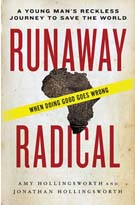
This background is why I recognize the narrative in Runaway Radical, a current featured book in the Patheos Book Club. This book is a memoir-style true story written by Jonathan Hollingsworth and his mother, Amy. It is artful and insightful and beautiful and painful. It is the story that doesn’t usually get told. It is the story that Christian ministries often try to control: the narrative that is dark and lonely and sad and might not reflect well on a particular ministry. The story that just doesn’t stay on message for the organization. It is a triumph of truth-telling, though. And it is a gently unfolding blossom of grace.
We see the narrative through the eyes of Jonathan and his mother, individually. We see his growing radicalism, her slow realization of the unhealthy tendencies beginning to take hold, and then her increasing concern for his well-being and emotional health. We see an unusually close bond between mother and son, as well. And we see the fierce love of a parent, willing to move heaven and earth to rescue their child (there is something of Gospel here in Amy Hollingsworth).
Jonathan Hollingsworth grew up as a young man who was unusually sensitive to those who were suffering–the poor, the homeless, the troubled teen. He was also addicted to the literature of radical Christianity, a Christianity that seeks to literally follow the teachings of Jesus and sacrifice everything to follow Him. He believed that if he could only follow Jesus perfectly, He could get God to notice him and use him mightily (these attempts to get God to notice him reminds me of similar themes found in Tony Kriz’s Aloof). So even as a teen, he got rid of his possessions, slept on the floor of his room, wrote quotes of radical Christianity on his walls. It still wasn’t enough, so he went to Cameroon, Africa, convinced that once he escaped consumeristic American Christianity, he would discover pure, unadulterated Christianity in its nascent form and be able to just love people with God’s love, finally unfettered.
Previous Post

April 6, 2015
Mad Men: Our Ontological Brokenness

Browse Our Archives
Select a Category Books Charis Christian Witness Church Year Conversation Creativity Cultural Engagement Curiosity Current Events Film Jesus Lectionary Message Literature Lutheran Theology Politics Story Television Theology Uncategorized
Select a Month December 2017 November 2017 October 2017 September 2017 August 2017 July 2017 June 2017 May 2017 April 2017 March 2017 February 2017 December 2016 October 2016 August 2016 July 2016 June 2016 May 2016 April 2016 March 2016 February 2016 January 2016 December 2015 November 2015 October 2015 September 2015 August 2015 July 2015 June 2015 May 2015 April 2015 March 2015 February 2015 January 2015 December 2014 November 2014 October 2014
Follow Us!
TAKE THE
Religious Wisdom Quiz
According to Hebrews 11, what is the correct chronological order of these faith heroes?
Select your answer to see how you score.
Abraham, Noah, Enoch, Abel Noah, Abraham, Abel, Enoch Abel, Enoch, Noah, Abraham Enoch, Abel, Abraham, Noah
Related posts from Rebecca Florence Miller


A New Normal: Grief and Facing the Brokenness...

#Loser: How the Call of Christ Is Antithetical...

Conflict and Challenge, instead of Cheap Grace
TRENDING AT PATHEOS Evangelical

How the author of the world's best hymn...
I've been working with John Newton for a while now. This makes...

Long before this Lectio Divina, Psalm 130 - the song - started...

What About the Trees? Another Living Parable
After I finished writing the last article about falling leaves as a...

Why Classical Education Is a Conversation, Not a...
Come and Read: Joy in Classical Education When I was a little...

Falling Leaves: A Living Parable on Letting Go
I’ve spent the vast majority of my life in the southeast corner...

Cornell University has received a great deal of negative publicity and intense...
view all Evangelical blogs
Ad-Free & Subscriber Log-In Subscription Support
- About Us
- 2026 Calendar
- Videos
- Podcasts
- Library of World Religions
- Faith In Media Tracker
- Advertise With Us
- Write for Us
- Privacy Policy
- Terms of Service
- Do Not Sell My Data
- Contact Us
- Radiant Digital
- Manage Newsletter Subscriptions
- Unsubscribe From Notifications
- Sitemap
Copyright 2008-2026, Patheos. All rights reserved.
Subscription Support Ad-Free & Subscriber Log-In
Follow Patheos