
BuddhistCatholicContemplativeEvangelicalGeneral ChristianHinduJewishLatter-day SaintMuslimNew VisionsProgressive Christian
Beliefs
- Buddhist
- Catholic
- Contemplative
- Evangelical
- General Christian
- Hindu
- Jewish
- Latter-day Saint
- More Voices
- Muslim
- New Visions
- Pagan
- Progressive Christian
Topics
- Religion News
- Food and Religion
- Sports and Religion
- Religious Art
- Religious Music and Entertainment
- Religious Events
- History and Religion
- Style and Religion
- Politics and Religion
- Women in Religion
- Recreation Outdoors and Religion
- Business Finance and Religion
- Careers Workplace and Religion
- Education and Religion
- Family Parenting and Religion
- Health Fitness and Religion
- Home and Religion
- Relationships and Religion
- Technology and Religion
- Travel and Religion
Columnists
- Buddhist Columnists
- Business Finance and Religion Columnists
- Careers Workplace and Religion Columnists
- Catholic Columnists
- Contemplative Columnists
- Education and Religion Columnists
- Evangelists Columnists
- Family Parenting and Religion Columnists
- General Christian Columnists
- Health Fitness and Religion Columnists
- Hindu Columnists
- History and Religion Columnists
- Home and Religion Columnists
- Jewish Columnists
- More Voices Columnists
- Latter Day Columnists
- Muslim Columnists
- New Visions Columnists
- Nonreligious Columnists
- Pagan Columnists
- Politics and Religion Columnists
- Progressive Columnists
- Recreation Outdoors and Religion Columnists
- Relationships and Religion Columnists
- Religion News Columnists
- Religious Art Columnists
- Religious Events Columnists
- Religious Music and Entertainment Columnists
- Sports and Religion Columnists
- Style and Religion Columnists
- Technology and Religion Columnists
- Travel and Religion Columnists
- Women in Religion Columnists
Resource Library
- 2026 Calendar
- Library of World Religions
- The 100 Most Holy Places on Earth
- Patheos Answers
- Podcasts
- Videos
- Faith Leaders Database
- Anglican Episcopalian
- Bahai
- Baptist
- Buddhism
- Christianity
- Confucianism
- Eastern Orthodoxy
- Hinduism
- Holiness and Pentecostal
- ISKCON
- Islam
- Judaism
- Lutheran
- Methodist
- The Church of Jesus Christ of Latter-day Saints
- New Age
- Paganism
- Presbytarian and Reformed
- Protestantism
- Religion Behind the Scenes
- Roman Catholic
- Scientology
- Shia Islam
- Sikhism
- Sufism
- Sunni Islam
- Taoism
- Zen
- See all religions
Research Tools
 Ad-Free & Subscriber Log-In Subscription Support
Ad-Free & Subscriber Log-In Subscription Support
Follow Patheos 

- Trending:
- Forgiveness
- |
- Marriage
- |
- Consciousness
- |
- Death Penalty
- |
- Election
- |
- Halloween
 Rebecca Florence Miller
- Home
- Evangelical
- N.T. Wright’s Simply Good News Filled Me with Joy and Confidence in the Gospel
N.T. Wright’s Simply Good News Filled Me with Joy and Confidence in the Gospel
Last updated on: April 13, 2015 at 7:34 pm by Rebecca Florence Miller
N.T. Wright’s Simply Good News Filled Me with Joy and Confidence in the Gospel 2015-04-13T19:34:36-06:00 Rebecca Florence Miller
Patheos Explore the world's faith through different perspectives on religion and spirituality! Patheos has the views of the prevalent religions and spiritualities of the world.
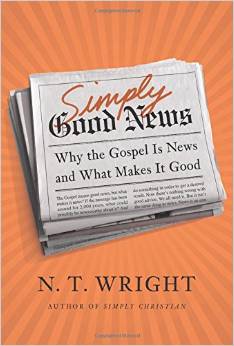 There’s not really words to describe the joy and confidence I experienced as I read New Testament scholar N.T. Wright’s latest book, Simply Good News. In it, Wright argues that too many people (Christians and nonbelievers) think that the Gospel is “good advice” (how to live or get eternal life or be successful or whatever), but that in fact it is “good news“: “It is the news that something has happened as a result of which the world is a different place” (16). Wright points to the Roman world’s understanding of Gospel (an emperor’s proclamation of victory for the nation) in order to provide context for how the early Christians’ proclamation would be heard:
Starting with Octavian, the Roman emperors regularly used the words good news to describe both what they had already achieved and what life would be like as a consequence. When the early Christians used this language, they used it in a similar way (12).
Wright goes on to argue convincingly that the resurrection was in fact a real event that actually took place. He offers careful reasoning for why he believes Jesus’s resurrection was an actual event (and has made his argument in longer form in such works as the 800-page book , The Resurrection of the Son of God). One element that I found particularly helpful in his argument was his careful parsing of the difference between history and science as disciplines. In answering questions from readers, I think I have frequently missed that we can know the truth of the resurrection today through use of the discipline of history more than through use of the discipline of science. After stating that he regards the Gospels as basically trustworthy (another claim that he has substantiated in longer tomes), Wright says:
This isn’t to say that we can “prove” everything in them. Of course we can’t. Hardly anything in history works like that. The demand for proof often comes from people who have scientific proof in mind. But that’s not how history works. Science normally studies things that we can repeat: experiments, observations, laboratory tests. History necessarily studies things that cannot be repeated. It works from evidence and looks for high probability about what caused that evidence. Like science, however, history works by hypothesis and verification.
Wright argues that you can have a historical kind of certainty about the resurrection more than a scientific kind. He makes a number of other convincing points, but I found this one in particular tremendously helpful.

Next Post

April 15, 2015 On This Tax Day, I Choose to Give Thanks
Browse Our Archives
Select a Category Books Charis Christian Witness Church Year Conversation Creativity Cultural Engagement Curiosity Current Events Film Jesus Lectionary Message Literature Lutheran Theology Politics Story Television Theology Uncategorized
Select a Month December 2017 November 2017 October 2017 September 2017 August 2017 July 2017 June 2017 May 2017 April 2017 March 2017 February 2017 December 2016 October 2016 August 2016 July 2016 June 2016 May 2016 April 2016 March 2016 February 2016 January 2016 December 2015 November 2015 October 2015 September 2015 August 2015 July 2015 June 2015 May 2015 April 2015 March 2015 February 2015 January 2015 December 2014 November 2014 October 2014
Follow Us!
TAKE THE
Religious Wisdom Quiz
In the Parable of the Pearl of Great Price, what does the merchant do?
Select your answer to see how you score.
Builds a bigger barn Finds a lost coin Buys many pearls Sells all to buy the pearl
Related posts from Rebecca Florence Miller


A New Normal: Grief and Facing the Brokenness...

#Loser: How the Call of Christ Is Antithetical...

Conflict and Challenge, instead of Cheap Grace
TRENDING AT PATHEOS Evangelical

How the author of the world's best hymn...
I've been working with John Newton for a while now. This makes...

Long before this Lectio Divina, Psalm 130 - the song - started...

What About the Trees? Another Living Parable
After I finished writing the last article about falling leaves as a...

Why Classical Education Is a Conversation, Not a...
Come and Read: Joy in Classical Education When I was a little...

Falling Leaves: A Living Parable on Letting Go
I’ve spent the vast majority of my life in the southeast corner...

Cornell University has received a great deal of negative publicity and intense...
view all Evangelical blogs
Ad-Free & Subscriber Log-In Subscription Support
- About Us
- 2026 Calendar
- Videos
- Podcasts
- Library of World Religions
- Faith In Media Tracker
- Advertise With Us
- Write for Us
- Privacy Policy
- Terms of Service
- Do Not Sell My Data
- Contact Us
- Radiant Digital
- Manage Newsletter Subscriptions
- Unsubscribe From Notifications
- Sitemap
Copyright 2008-2026, Patheos. All rights reserved.
Subscription Support Ad-Free & Subscriber Log-In
Follow Patheos