
BuddhistCatholicContemplativeEvangelicalGeneral ChristianHinduJewishLatter-day SaintMuslimNew VisionsProgressive Christian
Beliefs
- Buddhist
- Catholic
- Contemplative
- Evangelical
- General Christian
- Hindu
- Jewish
- Latter-day Saint
- More Voices
- Muslim
- New Visions
- Pagan
- Progressive Christian
Topics
- Religion News
- Food and Religion
- Sports and Religion
- Religious Art
- Religious Music and Entertainment
- Religious Events
- History and Religion
- Style and Religion
- Politics and Religion
- Women in Religion
- Recreation Outdoors and Religion
- Business Finance and Religion
- Careers Workplace and Religion
- Education and Religion
- Family Parenting and Religion
- Health Fitness and Religion
- Home and Religion
- Relationships and Religion
- Technology and Religion
- Travel and Religion
Columnists
- Buddhist Columnists
- Business Finance and Religion Columnists
- Careers Workplace and Religion Columnists
- Catholic Columnists
- Contemplative Columnists
- Education and Religion Columnists
- Evangelists Columnists
- Family Parenting and Religion Columnists
- General Christian Columnists
- Health Fitness and Religion Columnists
- Hindu Columnists
- History and Religion Columnists
- Home and Religion Columnists
- Jewish Columnists
- More Voices Columnists
- Latter Day Columnists
- Muslim Columnists
- New Visions Columnists
- Nonreligious Columnists
- Pagan Columnists
- Politics and Religion Columnists
- Progressive Columnists
- Recreation Outdoors and Religion Columnists
- Relationships and Religion Columnists
- Religion News Columnists
- Religious Art Columnists
- Religious Events Columnists
- Religious Music and Entertainment Columnists
- Sports and Religion Columnists
- Style and Religion Columnists
- Technology and Religion Columnists
- Travel and Religion Columnists
- Women in Religion Columnists
Resource Library
- 2026 Calendar
- Library of World Religions
- The 100 Most Holy Places on Earth
- Patheos Answers
- Podcasts
- Videos
- Faith Leaders Database
- Anglican Episcopalian
- Bahai
- Baptist
- Buddhism
- Christianity
- Confucianism
- Eastern Orthodoxy
- Hinduism
- Holiness and Pentecostal
- ISKCON
- Islam
- Judaism
- Lutheran
- Methodist
- The Church of Jesus Christ of Latter-day Saints
- New Age
- Paganism
- Presbytarian and Reformed
- Protestantism
- Religion Behind the Scenes
- Roman Catholic
- Scientology
- Shia Islam
- Sikhism
- Sufism
- Sunni Islam
- Taoism
- Zen
- See all religions
Research Tools
 Ad-Free & Subscriber Log-In Subscription Support
Ad-Free & Subscriber Log-In Subscription Support
Follow Patheos 

- Trending:
- Forgiveness
- |
- Marriage
- |
- Consciousness
- |
- Death Penalty
- |
- Election
- |
- Halloween
 Rebecca Florence Miller
- Home
- Evangelical
- Calvary: A Film That Wrestles with the Cruciform Life
Calvary: A Film That Wrestles with the Cruciform Life
Last updated on: March 16, 2015 at 12:02 pm by Rebecca Florence Miller
Calvary: A Film That Wrestles with the Cruciform Life 2015-03-16T12:02:35-06:00 Rebecca Florence Miller
Patheos Explore the world's faith through different perspectives on religion and spirituality! Patheos has the views of the prevalent religions and spiritualities of the world.
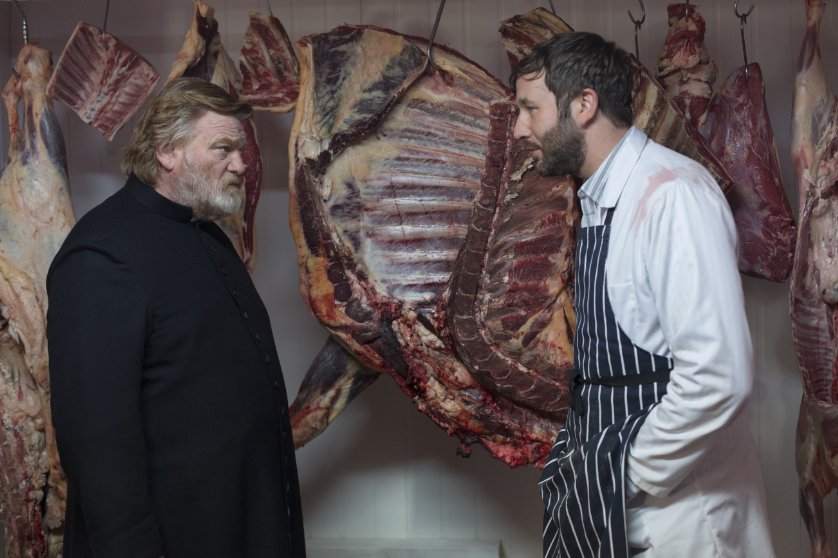
Still of Brendan Gleeson and Chris O’Dowd in Calvary (2014).
(Trigger warning: this review contains some non-explicit references to sexual abuse. The film itself speaks more graphically of the abuse.)
At first glance, Calvary is a deceptively simple film built around a very simple plot device: Father James (Brendan Gleeson), a Catholic priest in Ireland, is taking confessions one day when a man tells him that he was horrifically sexually abused many times a week for years as a young child…and that this abuse was committed by a Catholic priest. The man tells Father James that going and killing pedophile priests would accomplish nothing; everyone would understand that action. But his rage drives him to instead kill an innocent Catholic priest: that action would drive terror into people’s hearts. And then the man tells Father James that he plans to kill him in a week’s time. He tells Father James to meet him on the beach at a set time. The rest of the film unfolds over the course of the week between the confession and the proposed meeting.
Father James reports the threat to his superior; since it is a planned future sin and not the confession of a past sin, Father James is not bound by the sacramental seal and is free to report the threat to the police. A quiet tension circulates through the film as Father James tries to decide what to do. Like Jesus at Gethsemane, he is torn between both his personal wish to survive and the need of a man in pain. Father James is a flawed person: he swears, drinks too much sometimes, neglects his adult daughter (conceived with his late wife before he became a priest), sometimes is impatient with people, sometimes gives terribly bad advice. But he marches onward, informed largely by the cross at the center of his faith.
The key point revealed early in the film is that Father James actually knows who the threatener is. We the viewers don’t know who the person is until the final few moments of the film, however. This infuses each pastoral interaction with a cruciform energy. To us, every person Father James encounters is his potential murderer. Will he love them anyway, as he is called to love them? Will he flee? Kill his threatener? Unmask him? What would you do?
Somewhere in the film, he speaks this sentence: “No one is a lost cause.” To Father James, even a man who threatens him with murder is someone loved by God. In particular, this person is loved by God when one considers how he has been so deeply wounded by the Church.
And that brings me to the specter that haunts the whole of the film: the specter of clergy sexual abuse. It is as if an atomic bomb has gone off in the Church–both local and universal–and this film is showing us the fallout. Throughout the film, as Father James attempts to minister to his congregation, he encounters sin after sin. My husband described his character as “bearing the sin” of so many people in the film. I agree that that is the filmmaker’s intent and I also think many of the manifestations of sin that we see in the film are a direct result of the shattered relationship that most of the people in the film have with the Church and with clergy.
Clergy sexual abuse is among the most horrific sins that can be committed. For religious people, a pastor or priest represents God to them. They don’t worship the religious leader, but he embodies God’s presence among them. And so when such a leader abuses the flock, it is as if people perceive God Himself as abusing them. Many people who have been harmed by religious abuse of one kind or another (sexual, emotional, physical, verbal) are nearly permanently damaged in their ability to relate to God and to other people in trust.
Next Post

March 19, 2015 If Tony Kriz's ALOOF Interested You, Go Read This Immediately
Browse Our Archives
Select a Category Books Charis Christian Witness Church Year Conversation Creativity Cultural Engagement Curiosity Current Events Film Jesus Lectionary Message Literature Lutheran Theology Politics Story Television Theology Uncategorized
Select a Month December 2017 November 2017 October 2017 September 2017 August 2017 July 2017 June 2017 May 2017 April 2017 March 2017 February 2017 December 2016 October 2016 August 2016 July 2016 June 2016 May 2016 April 2016 March 2016 February 2016 January 2016 December 2015 November 2015 October 2015 September 2015 August 2015 July 2015 June 2015 May 2015 April 2015 March 2015 February 2015 January 2015 December 2014 November 2014 October 2014
Follow Us!
TAKE THE
Religious Wisdom Quiz
How many friends came to speak with Job?
Select your answer to see how you score.
Four Three Five Two
Related posts from Rebecca Florence Miller

A New Normal: Grief and Facing the Brokenness...

An Interview with the Christian and Atheist Friends...

#Loser: How the Call of Christ Is Antithetical...

Conflict and Challenge, instead of Cheap Grace
TRENDING AT PATHEOS Evangelical

How the author of the world's best hymn...
I've been working with John Newton for a while now. This makes...

Long before this Lectio Divina, Psalm 130 - the song - started...

What About the Trees? Another Living Parable
After I finished writing the last article about falling leaves as a...

Why Classical Education Is a Conversation, Not a...
Come and Read: Joy in Classical Education When I was a little...

Falling Leaves: A Living Parable on Letting Go
I’ve spent the vast majority of my life in the southeast corner...

Cornell University has received a great deal of negative publicity and intense...
view all Evangelical blogs
Ad-Free & Subscriber Log-In Subscription Support
- About Us
- 2026 Calendar
- Videos
- Podcasts
- Library of World Religions
- Faith In Media Tracker
- Advertise With Us
- Write for Us
- Privacy Policy
- Terms of Service
- Do Not Sell My Data
- Contact Us
- Radiant Digital
- Manage Newsletter Subscriptions
- Unsubscribe From Notifications
- Sitemap
Copyright 2008-2026, Patheos. All rights reserved.
Subscription Support Ad-Free & Subscriber Log-In
Follow Patheos