
BuddhistCatholicContemplativeEvangelicalGeneral ChristianHinduJewishLatter-day SaintMuslimNew VisionsProgressive Christian
Beliefs
- Buddhist
- Catholic
- Contemplative
- Evangelical
- General Christian
- Hindu
- Jewish
- Latter-day Saint
- More Voices
- Muslim
- New Visions
- Pagan
- Progressive Christian
Topics
- Religion News
- Food and Religion
- Sports and Religion
- Religious Art
- Religious Music and Entertainment
- Religious Events
- History and Religion
- Style and Religion
- Politics and Religion
- Women in Religion
- Recreation Outdoors and Religion
- Business Finance and Religion
- Careers Workplace and Religion
- Education and Religion
- Family Parenting and Religion
- Health Fitness and Religion
- Home and Religion
- Relationships and Religion
- Technology and Religion
- Travel and Religion
Columnists
- Buddhist Columnists
- Business Finance and Religion Columnists
- Careers Workplace and Religion Columnists
- Catholic Columnists
- Contemplative Columnists
- Education and Religion Columnists
- Evangelists Columnists
- Family Parenting and Religion Columnists
- General Christian Columnists
- Health Fitness and Religion Columnists
- Hindu Columnists
- History and Religion Columnists
- Home and Religion Columnists
- Jewish Columnists
- More Voices Columnists
- Latter Day Columnists
- Muslim Columnists
- New Visions Columnists
- Nonreligious Columnists
- Pagan Columnists
- Politics and Religion Columnists
- Progressive Columnists
- Recreation Outdoors and Religion Columnists
- Relationships and Religion Columnists
- Religion News Columnists
- Religious Art Columnists
- Religious Events Columnists
- Religious Music and Entertainment Columnists
- Sports and Religion Columnists
- Style and Religion Columnists
- Technology and Religion Columnists
- Travel and Religion Columnists
- Women in Religion Columnists
Resource Library
- 2026 Calendar
- Library of World Religions
- The 100 Most Holy Places on Earth
- Patheos Answers
- Podcasts
- Videos
- Faith Leaders Database
- Anglican Episcopalian
- Bahai
- Baptist
- Buddhism
- Christianity
- Confucianism
- Eastern Orthodoxy
- Hinduism
- Holiness and Pentecostal
- ISKCON
- Islam
- Judaism
- Lutheran
- Methodist
- The Church of Jesus Christ of Latter-day Saints
- New Age
- Paganism
- Presbytarian and Reformed
- Protestantism
- Religion Behind the Scenes
- Roman Catholic
- Scientology
- Shia Islam
- Sikhism
- Sufism
- Sunni Islam
- Taoism
- Zen
- See all religions
Research Tools
 Ad-Free & Subscriber Log-In Subscription Support
Ad-Free & Subscriber Log-In Subscription Support
Follow Patheos 

- Trending:
- Forgiveness
- |
- Marriage
- |
- Consciousness
- |
- Death Penalty
- |
- Election
- |
- Halloween
 Rebecca Florence Miller
- Home
- Evangelical
- The Overnighters: A Documentary about the Bakken Oil Fields, a Lutheran Pastor, Sin, and Service
The Overnighters: A Documentary about the Bakken Oil Fields, a Lutheran Pastor, Sin, and Service
Last updated on: February 18, 2015 at 4:06 pm by Rebecca Florence Miller
The Overnighters: A Documentary about the Bakken Oil Fields, a Lutheran Pastor, Sin, and Service 2015-02-18T16:06:34-06:00 Rebecca Florence Miller
Patheos Explore the world's faith through different perspectives on religion and spirituality! Patheos has the views of the prevalent religions and spiritualities of the world.
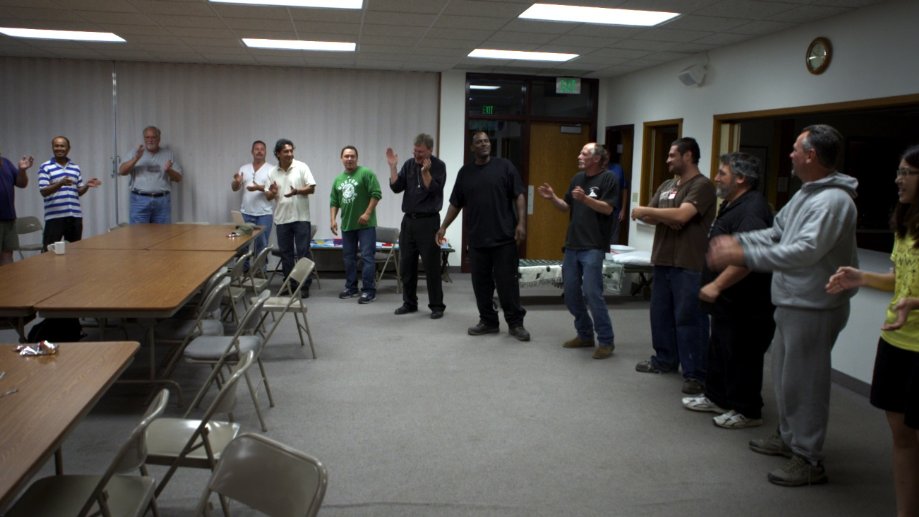
The Overnighters (2014) is writer/director Jesse Moss’s documentary film, centered around the men who seek a fresh start in the Bakken oil fields of western North Dakota–and the pastor (Jay Reinke) who tries to welcome them.
This film exemplifies what engagement with faith in film can be–honest, messy, conflicted, and human. As The Overnighters begins, we are given a hint that Reinke is far more complicated mere outward appearances may suggest. Through his own narration, he hints to us that everything about him is not necessarily as it appears. He hints at the difference between public persona and private character. And we know we are in for a more real, engaged tale of what it means to be a Christian in the world than the neatly polished “Christian movie” we have experienced in the past.
As the film begins to unfurl, we see Reinke championing the dusty, tired, hopeful men who come to Williston, North Dakota where there are high-paying jobs to be had in the massive Bakken oil field. Even fast food workers are paid well in Williston. In the midst of a nation-wide recession, men (and sometimes women) are driven from every corner of the country to find work, prove themselves, and make a new life for their families. Sadly, when they arrive, they often have nowhere to go. Wages are high, but rent is astronomical and it is nearly impossible to find places to live. Even if workers bring motor homes and get permission to park them on private property, city ordinances are beginning to push even such accommodations out. Men who travel to Williston have often spent their last penny to get there, and when they can’t find somewhere to live or a job, they are desperate and vulnerable.
Pastor Jay Reinke of Concordia Lutheran Church in Williston believes that God has brought these men to the church’s door. “What a profound thing that we have people literally walking up to our door from all over the world, saying, ‘Can you help me?'” he says. But Williston is nothing if not a small town in the midst of tumultuous change. Outside influences have not always been welcome, and sometimes bring dangers real and imagined (think of the well-publicized Sherry Arnold murder). Reinke establishes the church as a shelter for men who have come to town to work, believing that the men who have come to the church’s door in need are his “neighbor.” He argues, “A Christian ethic is now, ‘Who is my neighbor and how do I serve him?'”
Reinke is a visionary and argues persuasively that Christians should not yield to fear of the other, but should receive the other as “gift,” even when the gift comes with the burden of doing things that are challenging. He works to love even his adversarial congregation members (who he says are also his neighbors), even as he struggles to understand their and the community’s resistance to the church’s work providing shelter to these neighbors. (“It does amaze me that giving people floor space is provocative,” he says.)
 But then the narrative begins to turn. Things happen that begin to reveal that Reinke is every bit as much both saint and sinner as Lutheran theology claims. He overrides wise cautions and boundaries that really do need to be set up. He rushes forward in idealistic fervor, sometimes neglecting his family and even exposing them to potential harm. He sometimes lords his power over others when they try to tell him the truth. He teaches some powerful truths, but he is also a very, very flawed man. He tells a drug addict at one point, “We’re more alike than we are different. I’m broken. You’re broken. We’re all broken.” This truth reverberates through the final moments of the film.
In many ways–and in more ways than I’ll reveal here–Pastor Reinke’s pursuit of unrelenting, pell-mell service to the workers of the oil fields seems to be not only coming from the motivation of caring for others, but also from a deep need to be so busy that he does not have time to listen to the haunting voices within. If he slows down, he might have to face some very real truths about himself that are difficult and painful. And so he goes and goes and goes. He runs his family into the ground. He ends up disillusioning some of his dearest friends and co-workers. He hides significant truths from people who need to know them. He gets angry with friends who don’t tell the truth, even as he fails to tell the truth. (Perhaps their flaws are too much like looking into a mirror at his own.)
The film ends with a shocking confession made to Reinke’s long-suffering wife. I am conflicted that the filmmaker included this very personal moment. While it was powerful, I felt myself wishing for her sake that it was not put in the movie. Are not pastors’ families enough on display that their most private moments also must be broadcast? Surely there was another way to convey the information of the scene with more compassion for those involved.
I am also conflicted about abruptness of the ending. While the majority of the film is exceedingly well-crafted, the ending raises significant questions about Reinke’s role as leader and about boundary issues in ministry. While the nitty-gritty details of the confession are not fully unpacked–probably out of respect for the Reinke family–the viewer is left wondering which of Pastor Reinke’s natures is the dominant one: saint or sinner? Perhaps the discomfort of that ambiguity is where the filmmaker wishes to leave us, contemplating our own mixed motives even in our shining moments of service. Certainly life does not wrap itself up neatly with a bow–and false closure has been a big flaw of past faith-oriented films. This is not a “Christian film” in terms of genre, but a mainstream documentary that features a profoundly religious man. But I did wish for at least a bit more understanding, if not closure, when it came to the ending.
But even if the ending of The Overnighters is imperfect and leaves more questions than answers, I still found the film to be an extremely important, human, and real engagement with what it means to be a human being who is a person of faith. It made me think of the many times in my experience that church leaders attempted to get congregations to reach out to the “other” with God’s love, only to meet resistance from powerful members of the congregation. It made me think of how my own experience of life in small town North Dakota was an experience of sameness upon sameness, and how difficult it is for entrenched communities to embrace outsiders or even begin to understand their experience. It made me think of my own struggle to welcome the “other,” particularly when the other appears unexpectedly and without the context of relationship. It made me think that all too often, my response to new neighbors is fear instead of welcome. And it made me consider that good boundaries in a community are important–and while naysayers and resistant people may have selfish motives, sometimes beneath their self-focused words is a kernel of truth and wisdom which should not be disregarded. Sometimes God uses grouchy, resistant people to put the breaks on leaders who are nearing dangerous cliffs.
And despite all of Pastor Reinke’s flaws and sins, the film challenged me to more commitment to serving my neighbor. Though Pastor Reinke lacked balance and boundaries in his life and though he sinned against his community and family, his vision of church as a place where we serve our neighbors in Jesus’s name was compelling to me. I wouldn’t call him my hero (he did some very bad things), but I would say there is a lot I admire about what he tried to do. I pray that God continues to heal him, his family, his church, and his community from the times when he failed them and hurt them.
The point is, nobody’s good at loving, but we need to do it anyway. Broken people need love.–Pastor Jay Reinke
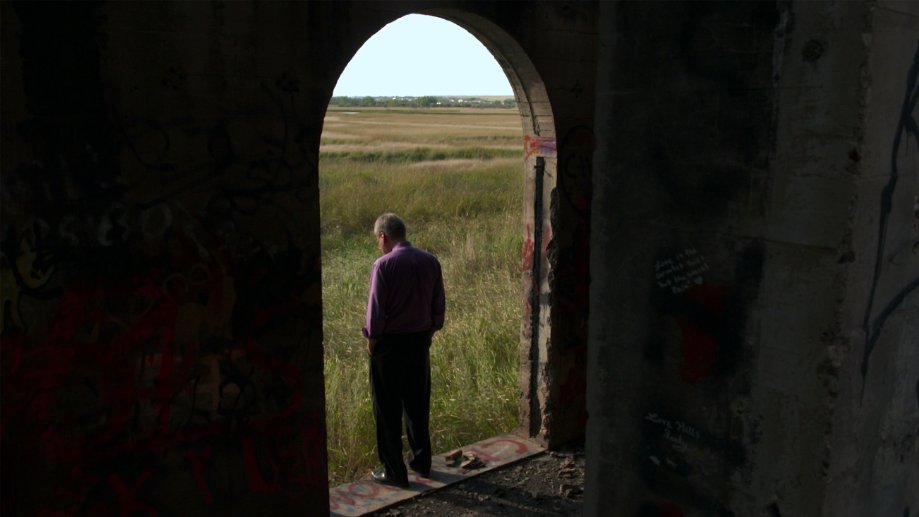
What do you think? Is there anything in the Christian message that is inspiring to you when it comes to serving your neighbors, particularly those who are very different from you? Can people be terribly flawed, and yet–at the same time–able to do really noble things? When someone betrays your trust, are you able to forgive them, or do you feel they are forever damaged by that failure?
Photo source: IMDB.com. © 2014 – Drafthouse Films.
——————-
Community discussion guidelines:
Because this is a Christian blog, the things I’m talking about will obviously be topics that people feel strongly about in one direction or another. Please keep in mind that this is a place for substantive, respectful conversation. All perspectives are welcome to discuss here as long as all can treat each other with kindness and respect. Please ignore trolls, refuse to engage in personal attacks, and observe the comment policy listed on the right side of the page. Comments that violate these guidelines may be deleted. For those who clearly violate these policies repeatedly, my policy is to issue a warning which, if not regarded, may lead to blacklisting. This is not about censorship, but about creating a healthy, respectful environment for discussion.
P.S. Please also note that I am not a scientist, but a person with expertise in theology and the arts. While I am very interested in the relationship between science and faith, I do not believe I personally will be able to adequately address the many questions that inevitably come up related to science and religion. I encourage you to seek out the writings of theistic or Christian scientists to help with those discussions.
———————-
Previous Post

February 18, 2015
The Good News of Ash Wednesday
Browse Our Archives
Select a Category Books Charis Christian Witness Church Year Conversation Creativity Cultural Engagement Curiosity Current Events Film Jesus Lectionary Message Literature Lutheran Theology Politics Story Television Theology Uncategorized
Select a Month December 2017 November 2017 October 2017 September 2017 August 2017 July 2017 June 2017 May 2017 April 2017 March 2017 February 2017 December 2016 October 2016 August 2016 July 2016 June 2016 May 2016 April 2016 March 2016 February 2016 January 2016 December 2015 November 2015 October 2015 September 2015 August 2015 July 2015 June 2015 May 2015 April 2015 March 2015 February 2015 January 2015 December 2014 November 2014 October 2014
Follow Us!
TAKE THE
Religious Wisdom Quiz
Who gave birth to Isaac at a very old age?
Select your answer to see how you score.
Sarah Leah Rachel Rebekah
Related posts from Rebecca Florence Miller


A New Normal: Grief and Facing the Brokenness...

An Interview with the Christian and Atheist Friends...

Our Response to Sexual Abuse Should Not Be...
TRENDING AT PATHEOS Evangelical

How the author of the world's best hymn...
I've been working with John Newton for a while now. This makes...

Long before this Lectio Divina, Psalm 130 - the song - started...

What About the Trees? Another Living Parable
After I finished writing the last article about falling leaves as a...

Why Classical Education Is a Conversation, Not a...
Come and Read: Joy in Classical Education When I was a little...

Falling Leaves: A Living Parable on Letting Go
I’ve spent the vast majority of my life in the southeast corner...

Cornell University has received a great deal of negative publicity and intense...
view all Evangelical blogs
Ad-Free & Subscriber Log-In Subscription Support
- About Us
- 2026 Calendar
- Videos
- Podcasts
- Library of World Religions
- Faith In Media Tracker
- Advertise With Us
- Write for Us
- Privacy Policy
- Terms of Service
- Do Not Sell My Data
- Contact Us
- Radiant Digital
- Manage Newsletter Subscriptions
- Unsubscribe From Notifications
- Sitemap
Copyright 2008-2026, Patheos. All rights reserved.
Subscription Support Ad-Free & Subscriber Log-In
Follow Patheos