
BuddhistCatholicContemplativeEvangelicalGeneral ChristianHinduJewishLatter-day SaintMuslimNew VisionsProgressive Christian
Beliefs
- Buddhist
- Catholic
- Contemplative
- Evangelical
- General Christian
- Hindu
- Jewish
- Latter-day Saint
- More Voices
- Muslim
- New Visions
- Pagan
- Progressive Christian
Topics
- Religion News
- Food and Religion
- Sports and Religion
- Religious Art
- Religious Music and Entertainment
- Religious Events
- History and Religion
- Style and Religion
- Politics and Religion
- Women in Religion
- Recreation Outdoors and Religion
- Business Finance and Religion
- Careers Workplace and Religion
- Education and Religion
- Family Parenting and Religion
- Health Fitness and Religion
- Home and Religion
- Relationships and Religion
- Technology and Religion
- Travel and Religion
Columnists
- Buddhist Columnists
- Business Finance and Religion Columnists
- Careers Workplace and Religion Columnists
- Catholic Columnists
- Contemplative Columnists
- Education and Religion Columnists
- Evangelists Columnists
- Family Parenting and Religion Columnists
- General Christian Columnists
- Health Fitness and Religion Columnists
- Hindu Columnists
- History and Religion Columnists
- Home and Religion Columnists
- Jewish Columnists
- More Voices Columnists
- Latter Day Columnists
- Muslim Columnists
- New Visions Columnists
- Nonreligious Columnists
- Pagan Columnists
- Politics and Religion Columnists
- Progressive Columnists
- Recreation Outdoors and Religion Columnists
- Relationships and Religion Columnists
- Religion News Columnists
- Religious Art Columnists
- Religious Events Columnists
- Religious Music and Entertainment Columnists
- Sports and Religion Columnists
- Style and Religion Columnists
- Technology and Religion Columnists
- Travel and Religion Columnists
- Women in Religion Columnists
Resource Library
- 2026 Calendar
- Library of World Religions
- The 100 Most Holy Places on Earth
- Patheos Answers
- Podcasts
- Videos
- Faith Leaders Database
- Anglican Episcopalian
- Bahai
- Baptist
- Buddhism
- Christianity
- Confucianism
- Eastern Orthodoxy
- Hinduism
- Holiness and Pentecostal
- ISKCON
- Islam
- Judaism
- Lutheran
- Methodist
- The Church of Jesus Christ of Latter-day Saints
- New Age
- Paganism
- Presbytarian and Reformed
- Protestantism
- Religion Behind the Scenes
- Roman Catholic
- Scientology
- Shia Islam
- Sikhism
- Sufism
- Sunni Islam
- Taoism
- Zen
- See all religions
Research Tools
 Ad-Free & Subscriber Log-In Subscription Support
Ad-Free & Subscriber Log-In Subscription Support
Follow Patheos 

- Trending:
- Forgiveness
- |
- Marriage
- |
- Consciousness
- |
- Death Penalty
- |
- Election
- |
- Halloween
 Rebecca Florence Miller
- Home
- Evangelical
- Somm: A Documentary about Wine, Meditation, Culture, and Community
Somm: A Documentary about Wine, Meditation, Culture, and Community
Last updated on: November 17, 2014 at 1:25 pm by Rebecca Florence Miller
Somm: A Documentary about Wine, Meditation, Culture, and Community 2014-11-17T13:25:50-06:00 Rebecca Florence Miller
Patheos Explore the world's faith through different perspectives on religion and spirituality! Patheos has the views of the prevalent religions and spiritualities of the world.
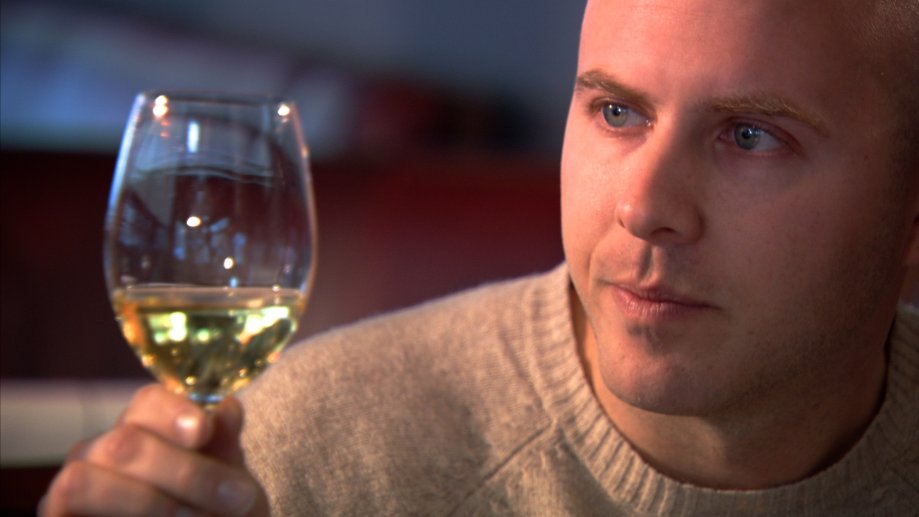
Dustin Wilson in Somm (2012).
Documentaries are a gift because they open our eyes to worlds that we would have no access to otherwise–only to find how many similarities we share with their subjects. As the closing credits roll, we leave with more knowledge and more empathy and more insight than we had previously. Stories of real people resonate with real life.
One such documentary is the gently-paced Somm (2012), the story of a handful of candidates who are preparing for the Master Sommelier exam. This exam is so notoriously difficult that since its establishment as a professional certification in 1969, less than 200 candidates have passed. It is made up of three parts. First, candidates must know wine theory. Second, they must practice excellent, professional service during a segment of the exam in which they are sorely tested by difficult customers. Third–and most difficult of all–they must pass the tasting exam. The tasting exam requires them to blind taste three white wines and three red wines. They get just over four minutes for each wine. They must describe its structure and body, what climate its grapes were grown in, whether it is new or old world wine, its varietals, and its age range. After all of this, they must make a guess as to which specific wine it is. Even for the most well-schooled sommelier, this is an almost-impossible feat!
Along the way, we get to know Brian McClintic, Ian Cauble, DLynn Proctor and Dustin Wilson. Each is fiercely competitive, but they are also friends and form a support group with each other. They talk of how athletes are often attracted to the competitive world of Master Sommeliers. They wrestle with the time they put into their obsession–often struggling to maintain relationships with spouses and girlfriends. They worry that some of them will pass, and some will fail, thus breaking up their tight group unity. And they manage to teach us a lot about the way wine is a lens through which to see the world.
Somm is not a religious film, but since I do look at the world through a lens of faith, this film left me with three faith-related engagements with its subject matter.
1. We need “content-full” meditation that centers on something outside ourselves.
As the film opens, Ian Cauble (the most obsessive of the candidates) tells us that wine is a way that he finds himself able to stop the busyness of life and zero in meditatively on one thing, the liquid in the cup. In a world of information frenzy and desperate obsession to keep up with the latest gadget or new idea, this meditative energy struck me as a helpful way to approach faith as well. We all need that quiet center in our lives, that place where the wild, careening world becomes fuzzy and out-of-focus for just a short time while we experience the peace of focus. For me, the arts produce this in some ways. I find that watching foreign films, in particular, requires me to meditatively focus. There is no way to multi-task while reading subtitles. Television, film, and books that capture my attention fully also produce this meditative state, a meditation that is content-full, not content-less. But more than this, I am finding that liturgy produces this kind of meditative state for me. As I listen to and participate in liturgy and the reading of Scripture, I am reminded that there is something and Someone much larger and more wondrous than me. I am captured, transported. I am sustained and fed. There is a Word outside of me.
2. We should find non-polarizing ways to explore and learn about the peoples and cultures of the world.
Somm also points to the truth that wine is a way to travel the world. The Master Sommelier candidates come to intimately know peoples and regions and cultures as they prepare for their exams. They tell us that wine is so important that it is even threaded through religion as in the sacrament of Holy Communion or the Biblical miracle in which Jesus turns water into wine. They remind us of its historical connections; the Romans drank it because it was essentially purified water (local water was always safe to drink). This view of wine as a way to understand the peoples and cultures of the world reminds me of a similar approach taken by TV host Anthony Bourdain. As Bourdain enters into different cultures, he uses the food of that place to understand the people he visits better. Bourdain loves good food, but, honestly, food is just an entry point for him. What he really wants is to satisfy a deep desire to understand people better. He uses the occasion of meals (and his favorites are always in locals’ homes) to ask questions with curiosity and interest and seek to understand more than to be understood.
I think this is a truly wonderful approach to understanding peoples and cultures and even belief systems better. Food and wine are two of the most wonderful ways to engage in such learning because they are not generally very polarizing (although there are certainly times they can be). Everybody loves good things to eat and drink. Eating together breaks down barriers and helps us to see each other as fellow human beings. Art is, of course, another way to approach this as well.
3. The challenges of life are difficult; we need community to sustain us.
Other than the superhuman knowledge these men manage to achieve, the most striking element of Somm is the way in which the candidates come together to support each other through one of the greatest challenges of their lives. They certainly do feel a certain understandable competition toward each other, but at the same time, they also feel great consideration for each other, particularly in their concern that some from their group will pass the test and others will not. Humility requires each of to admit that the person who does not make the cut may be oneself. The thought of losing their community is a frightening one; they need each other, and these men clearly are better known by each other than by their significant others. There is a brotherhood here.
And when, inevitably, somebody doesn’t make the cut, there is no gloating, but a compassionate recognition of how difficult it must be for that one who is left behind.
Let’s face it: the life of faith is difficult too. We may not have to memorize intricate details about individual wines, but we all have to do and face hard things. We need people who know us well and walk through the difficulties of life together with us. We need friends who are empathetic and compassionate about the challenges we face. We need to give those things to our friends as well. As a Christian, I find great support and encouragement in my community of fellow Christian friends. They live throughout the country, and I often have to connect with them through email and social media (although some live close by). Each of these people is crucial to my growth and health in faith and life. They understand the kinds of struggles I face. They encourage me, provoke my mind, and even challenge me when needed. The life of faith can be rigorous at times. Commands like “Take up your cross and follow me” are perhaps even more challenging than Master Sommelier exams, but they require whole life commitment in a similar way. I’m grateful for Christian community and for those who help me along this path. I’m grateful, too, that we are not competing as the Somm candidates were, but rather that we are all working together to achieve a common goal of discipleship!
Somm is currently streaming on Netflix.
What insights about life or faith have you gleaned from watching documentaries?
——————-
Community discussion guidelines:
Because this is a Christian blog, the things I’m talking about will obviously be topics that people feel strongly about in one direction or another. Please keep in mind that this is a place for substantive, respectful conversation. All perspectives are welcome to discuss here as long as all can treat each other with kindness and respect. Please ignore trolls, refuse to engage in personal attacks, and observe the comment policy listed on the right side of the page. Comments that violate these guidelines may be deleted. For those who clearly violate these policies repeatedly, my policy is to issue a warning which, if not regarded, may lead to blacklisting. This is not about censorship, but about creating a healthy, respectful environment for discussion.
P.S. Please also note that I am not a scientist, but a person with expertise in theology and the arts. While I am very interested in the relationship between science and faith, I do not believe I personally will be able to adequately address the many questions that inevitably come up related to science and religion. I encourage you to seek out the writings of theistic or Christian scientists to help with those discussions.
———————-
Photo source: IMDB.com. © Samuel Goldwyn Films.
Previous Post
November 13, 2014
Follow-up on "Why Christians Should Stand Up for Atheists"

Browse Our Archives
Select a Category Books Charis Christian Witness Church Year Conversation Creativity Cultural Engagement Curiosity Current Events Film Jesus Lectionary Message Literature Lutheran Theology Politics Story Television Theology Uncategorized
Select a Month December 2017 November 2017 October 2017 September 2017 August 2017 July 2017 June 2017 May 2017 April 2017 March 2017 February 2017 December 2016 October 2016 August 2016 July 2016 June 2016 May 2016 April 2016 March 2016 February 2016 January 2016 December 2015 November 2015 October 2015 September 2015 August 2015 July 2015 June 2015 May 2015 April 2015 March 2015 February 2015 January 2015 December 2014 November 2014 October 2014
Follow Us!
TAKE THE
Religious Wisdom Quiz
True or False: John's Gospel identifies Jesus as 'the Lamb of God' in the first chapter.
Select your answer to see how you score.
TRUE FALSE
Related posts from Rebecca Florence Miller

An Interview with the Christian and Atheist Friends...

Conflict and Challenge, instead of Cheap Grace
OCD, Stephen King's IT, and Facing Our Fear
Christian Superiority Complexes and the Parable of the...
TRENDING AT PATHEOS Evangelical

How the author of the world's best hymn...
I've been working with John Newton for a while now. This makes...

Long before this Lectio Divina, Psalm 130 - the song - started...

What About the Trees? Another Living Parable
After I finished writing the last article about falling leaves as a...

Why Classical Education Is a Conversation, Not a...
Come and Read: Joy in Classical Education When I was a little...

Falling Leaves: A Living Parable on Letting Go
I’ve spent the vast majority of my life in the southeast corner...

Cornell University has received a great deal of negative publicity and intense...
view all Evangelical blogs
Ad-Free & Subscriber Log-In Subscription Support
- About Us
- 2026 Calendar
- Videos
- Podcasts
- Library of World Religions
- Faith In Media Tracker
- Advertise With Us
- Write for Us
- Privacy Policy
- Terms of Service
- Do Not Sell My Data
- Contact Us
- Radiant Digital
- Manage Newsletter Subscriptions
- Unsubscribe From Notifications
- Sitemap
Copyright 2008-2026, Patheos. All rights reserved.
Subscription Support Ad-Free & Subscriber Log-In
Follow Patheos