
BuddhistCatholicContemplativeEvangelicalGeneral ChristianHinduJewishLatter-day SaintMuslimNew VisionsProgressive Christian
Beliefs
- Buddhist
- Catholic
- Contemplative
- Evangelical
- General Christian
- Hindu
- Jewish
- Latter-day Saint
- More Voices
- Muslim
- New Visions
- Pagan
- Progressive Christian
Topics
- Religion News
- Food and Religion
- Sports and Religion
- Religious Art
- Religious Music and Entertainment
- Religious Events
- History and Religion
- Style and Religion
- Politics and Religion
- Women in Religion
- Recreation Outdoors and Religion
- Business Finance and Religion
- Careers Workplace and Religion
- Education and Religion
- Family Parenting and Religion
- Health Fitness and Religion
- Home and Religion
- Relationships and Religion
- Technology and Religion
- Travel and Religion
Columnists
- Buddhist Columnists
- Business Finance and Religion Columnists
- Careers Workplace and Religion Columnists
- Catholic Columnists
- Contemplative Columnists
- Education and Religion Columnists
- Evangelists Columnists
- Family Parenting and Religion Columnists
- General Christian Columnists
- Health Fitness and Religion Columnists
- Hindu Columnists
- History and Religion Columnists
- Home and Religion Columnists
- Jewish Columnists
- More Voices Columnists
- Latter Day Columnists
- Muslim Columnists
- New Visions Columnists
- Nonreligious Columnists
- Pagan Columnists
- Politics and Religion Columnists
- Progressive Columnists
- Recreation Outdoors and Religion Columnists
- Relationships and Religion Columnists
- Religion News Columnists
- Religious Art Columnists
- Religious Events Columnists
- Religious Music and Entertainment Columnists
- Sports and Religion Columnists
- Style and Religion Columnists
- Technology and Religion Columnists
- Travel and Religion Columnists
- Women in Religion Columnists
Resource Library
- 2026 Calendar
- Library of World Religions
- The 100 Most Holy Places on Earth
- Patheos Answers
- Podcasts
- Videos
- Faith Leaders Database
- Anglican Episcopalian
- Bahai
- Baptist
- Buddhism
- Christianity
- Confucianism
- Eastern Orthodoxy
- Hinduism
- Holiness and Pentecostal
- ISKCON
- Islam
- Judaism
- Lutheran
- Methodist
- The Church of Jesus Christ of Latter-day Saints
- New Age
- Paganism
- Presbytarian and Reformed
- Protestantism
- Religion Behind the Scenes
- Roman Catholic
- Scientology
- Shia Islam
- Sikhism
- Sufism
- Sunni Islam
- Taoism
- Zen
- See all religions
Research Tools
 Ad-Free & Subscriber Log-In Subscription Support
Ad-Free & Subscriber Log-In Subscription Support
Follow Patheos 

- Trending:
- Forgiveness
- |
- Marriage
- |
- Consciousness
- |
- Death Penalty
- |
- Election
- |
- Halloween
 Rebecca Florence Miller
- Home
- Evangelical
- Interstellar: Provoking Questions, Love, and Awe-Inspiring Beauty
Interstellar: Provoking Questions, Love, and Awe-Inspiring Beauty
Last updated on: November 10, 2014 at 3:29 pm by Rebecca Florence Miller
Interstellar: Provoking Questions, Love, and Awe-Inspiring Beauty 2014-11-10T15:29:39-06:00 Rebecca Florence Miller
Patheos Explore the world's faith through different perspectives on religion and spirituality! Patheos has the views of the prevalent religions and spiritualities of the world.
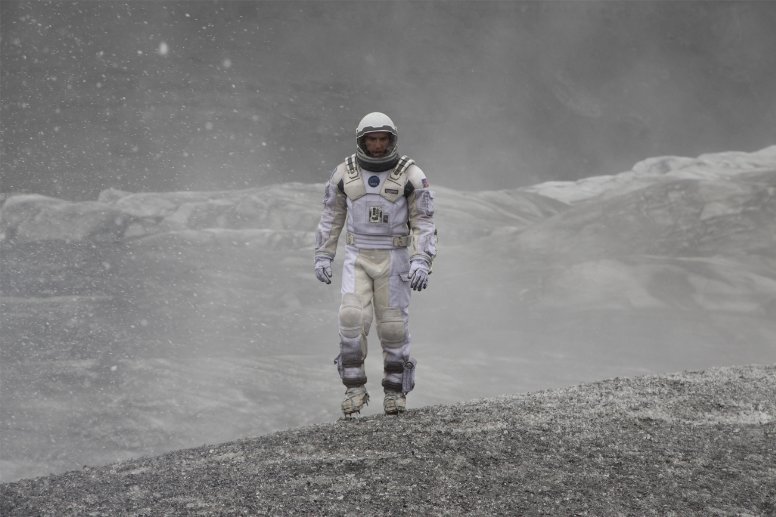 The scope and scale of achievement in Christopher Nolan’s Interstellar is dizzying, mind-boggling, baffling, and–ultimately–awe-inspiring.
As Interstellar begins, we see a ruined earth. We aren’t told if this ruination is caused by humans or by something outside their control, but we are told that life is fast becoming unlivable on this planet. Nolan makes lets elderly folks who lived through the worst days of Planet Earth narrate the history of its demise. They tell us there was dust everywhere. They tell us this dust even permeated people’s homes so that when a table was set, plates must be laid face-down to stay clean. They tell us blight had killed the wheat. They tell us there was rapidly getting to be little to eat. One old woman expresses her bafflement that dirt would “turn on you and destroy you like that.”
As earth heads into a dead end fast, a rural farmer and widower named Cooper (Matthew McConaughey) is depressed and frustrated. He hasn’t always been a farmer, you see. He used to be the best NASA pilot there was, but there’s no money for space exploration anymore. When a planet is starving, funding space travel seems like a frivolity. So, even as wheat and okra go extinct, Cooper miserably works his bumper crop of corn even as he yearns to fulfill his calling to explore. “We used to look up at the sky and wonder at our place in the stars, now we just look down and worry about our place in the dirt,” he laments.
When geographical coordinates are left in the dust in Cooper’s daughter’s room, she thinks a “ghost” or personal presence has left them, but Cooper says they are caused by gravity. He follows the coordinates, and they lead him to a secret NASA facility which has been working on finding a way to save the human species. Cooper’s former teacher, Professor Brand (Michael Caine) is head of this facility and prevails upon Cooper to join them in their mission. This will mean piloting a spacecraft into deep space, hibernating until they reach a recently discovered wormhole near Saturn, and then entering the wormhole in order to access still deeper space. In this deep space, they will be able to explore other worlds which humanity may be able to colonize.
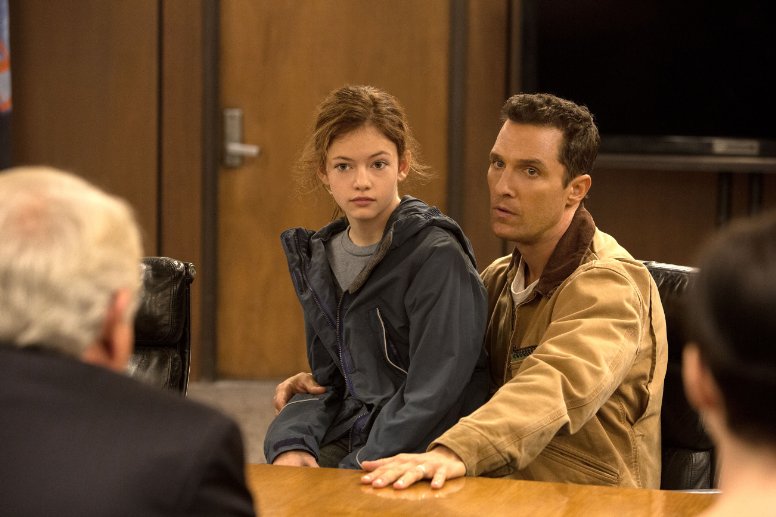
There’s one problem: no one knows for sure if it will work, and no one knows for sure if Cooper and his crew will ever return. And he has two children–a teen boy and his ten-year-old daughter. His level-headed son, Tom, will be fine shouldering his duty as the oldest while Cooper is gone. His daughter, Murph (played as a child by Mackenzie Foy and as an adult by Jessica Chastain and Ellen Burstyn)–although a bit of an explorer and wonderer herself–is heartbroken. Cooper, in a wish to keep her feeling safe, does not tell her that the earth is bent on extinction (although I had to ask if this would be so hard for Murph to deduce, given her intelligence and the obvious state of things), but just that he needs to go to fulfill his calling. Despite his pleas for Murph to understand, he has to leave with her still angry at him. For some reason, as soon as he is recruited by NASA, he is required to go immediately into space. I felt the film became a bit less believable for me here; no matter how good a pilot Cooper was, surely he would need some training before going into deep space? Perhaps Nolan simply wanted to avoid weighing down an already very lengthy film with even more beef, and perhaps he wanted to maintain the emotional tension between Murph and Cooper–a tension which is at the very center of the story. Nevertheless, a mild gesture toward the training process would have been helpful to the plot.
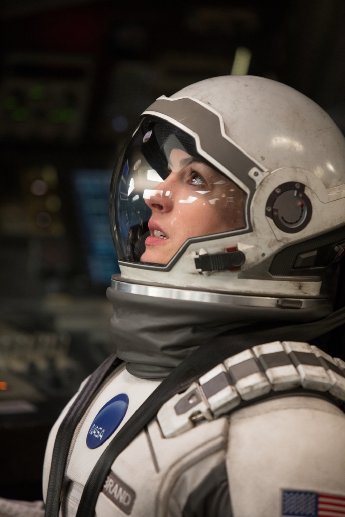
 As the astronauts (who include Professor’s Brand’s daughter, also referred to as Brand and played by Anne Hathaway) plunge and jolt and shudder into space and say goodbye to the planet they call home, the organ swells against the glorious beauty of the scenery while Michael Caine’s majestic voice narrates a famous poem by Dylan Thomas:
Do not go gentle into that good night,
Old age should burn and rave at close of day;
Rage, rage against the dying of the light.
Do not go gentle into that good night,
Old age should burn and rave at close of day;
Rage, rage against the dying of the light. – See more at: http://allpoetry.com/Do-Not-Go-Gentle-Into-That-Good-Night#sthash.wdYsKy0L.dpuf
Do not go gentle into that good night,
Old age should burn and rave at close of day;
Rage, rage against the dying of the light. – See more at: http://allpoetry.com/Do-Not-Go-Gentle-Into-That-Good-Night#sthash.wdYsKy0L.dpufAs the space exploration proceeds, there are many twists and turns in the plot and plenty of seat-gripping tension. Not to mention stunning visuals. Time flows differently in space (a visit of several hours to one planet is all of 23 years in Earth time) so although messages can be sent from earth to the spacecraft, long lapses occur in between. We see the most important events of the lives of the astronauts’ family members occur through the medium of a screen–grainy, flickering picture and all. The human factor here is heart-rending, and as viewers we can feel Cooper’s longing to be with his children palpably through our own movie theater screen.
Great art provokes us to think more about the “big questions” of life. Without giving away too much of the plot, here are three ways Interstellar provoked me:
1. The reality of human evil.
As the crew launches into space, Hathaway’s Brand contends that what she loves most about space travel is that it is travel away from the evils of earth and toward the “best of humanity” represented by brave astronaut leader Dr. Mann (Matt Damon). In her view, the astronauts who traveled into deep space already have engaged in uncommon sacrifice. Since she is thrusting herself into the heart of unexplored nature, she is asked whether she believes nature can be evil. No, she says, it can be dangerous, but not evil.
And yet–when the astronauts visit Dr. Mann’s planet and bring him out of deep hibernation, his actions cast a different light on these assumptions (nature is just nature, but humans are capable of great good if given a fresh start and led by their noblest examples). It might be possible to see what happens next as simply nature being “red in tooth and claw” and seeking its own survival. But if that is true, then any evil and violence against other humans may be excused. This interpretation would also ignore Brand’s obvious belief that humanity is guilty of some evil on earth, and her obvious desire for a fresh start for humanity. I feel a better interpretation of what happens next is that humanity has a self-seeking nature at its core that is always battling against altruism. This final focus on self instead of neighbor is described in the Christian faith as original sin. Launching human beings into space will not destroy evil inclinations. A change of location does not change humanity’s fundamental nature: the imago Dei and the sinful nature existing simultaneously side-by-side.
 2. The transcendence of love.
Throughout the story arc, there are a number of seemingly supernatural or transcendent occurrences along the way. Murph’s “ghost” is one. There are some beings spoken of as “they” who seemingly “choose” Cooper for this task and place the wormhole (which does not occur naturally) in space just when humanity needs it. While I was hopeful that the revelation of who “they” were would allow for a supernatural interpretation and was disappointed when it did not, and while I felt the ending conclusions tried a little too hard to resolve mystery in a materialistic manner, the film still spoke to me. The ending finds itself grasping a bit, but, nonetheless it is impossible to view Nolan’s film without some sense of awe. The sheer grandeur of space is flawlessly executed on the screen. I frequently caught my breath in wonder and awe, only helped to these emotions by the almost-religious, swelling organ score by Hans Zimmer (and, seriously, when is the last time you heard an organ used in a movie score?).
Ultimately, though, the film’s main point about transcendence relates to love. When the crew is faced with the choice between logic and love, Brand argues to make the decision based on love (“Maybe we’ve spent too long trying to figure all this out with theory”) . Surprisingly, for a film with a pretty materialistic viewpoint, Brand argues against mere materialism when she says, “We love people who have died. Where’s the social utility in that?” A compelling point! If humanity is only motivated by its own survival, how do we explain love for those who have died? She goes on to add, “Love is the one thing we’re capable of perceiving that transcends dimensions of time and space.”
Love is transcendent. There is something of love at the heart of the universe and at the heart of the human race, despite all of the human evil of which we are capable.
As the plot turns out, there might just be something to this insight. Perhaps if the crew had taken her advice, they could have avoided some misfortune along the way. And in the end, Cooper’s story will find resolution through the transcendence of love.
3. Provoking of questions.
An ambitious and beautifully-executed film like this can provoke us to think about the big questions of life. Although the film’s conclusions are pretty philosophically materialistic, I still think they provoke us to thought about transcendence. Here are some of the questions that came to my mind as I watched:
Why is there something and not nothing?
Why is there beauty?
Where did this gorgeous, seemingly endless universe come from?
Why do humans find it so impossible thus far to evolve beyond evil?
And chiefly–Why is there love at the center of the universe? Why does this include self-sacrificial love?
Have you seen Interstellar? Did it provoke you to wonder, to awe, or to consider questions of transcendence?
——–
Because this is a religious blog, the things I’m talking about will obviously be topics that people feel strongly about in one direction or another. Please keep in mind that this is a place for substantive, respectful conversation. All perspectives are welcome to talk and share and question here as long as all can treat each other with kindness and respect. Please ignore trolls, refuse to engage in personal attacks, and observe the comment policy listed on the right side of the page. Thanks!
——–
Photo credit for first two images: Melinda Sue Gordon – © 2014 Warner Bros. Entertainment, Inc. and Paramount Pictures Corporation. All Rights Reserved.
Photo credit for third image: © 2014 – Paramount Pictures
Previous Post

November 5, 2014
Why Christians Should Stand Up for Atheists
Next Post

November 13, 2014 Follow-up on "Why Christians Should Stand Up for Atheists"
Browse Our Archives
Select a Category Books Charis Christian Witness Church Year Conversation Creativity Cultural Engagement Curiosity Current Events Film Jesus Lectionary Message Literature Lutheran Theology Politics Story Television Theology Uncategorized
Select a Month December 2017 November 2017 October 2017 September 2017 August 2017 July 2017 June 2017 May 2017 April 2017 March 2017 February 2017 December 2016 October 2016 August 2016 July 2016 June 2016 May 2016 April 2016 March 2016 February 2016 January 2016 December 2015 November 2015 October 2015 September 2015 August 2015 July 2015 June 2015 May 2015 April 2015 March 2015 February 2015 January 2015 December 2014 November 2014 October 2014
Follow Us!
TAKE THE
Religious Wisdom Quiz
What famous prophecy is given in Isaiah 53?
Select your answer to see how you score.
Destruction of Edom Plague in Egypt Cyrus the Great's reign The suffering servant Messiah
Related posts from Rebecca Florence Miller


An Interview with the Christian and Atheist Friends...

Conflict and Challenge, instead of Cheap Grace

OCD, Stephen King's IT, and Facing Our Fear
TRENDING AT PATHEOS Evangelical

The REST of Your Life: A Creative Wrestles...
This week I had a conversation with a good friend from church....

How the author of the world's best hymn...
I've been working with John Newton for a while now. This makes...

Long before this Lectio Divina, Psalm 130 - the song - started...

What About the Trees? Another Living Parable
After I finished writing the last article about falling leaves as a...

Why Classical Education Is a Conversation, Not a...
Come and Read: Joy in Classical Education When I was a little...

Cornell University has received a great deal of negative publicity and intense...
view all Evangelical blogs
Ad-Free & Subscriber Log-In Subscription Support
- About Us
- 2026 Calendar
- Videos
- Podcasts
- Library of World Religions
- Faith In Media Tracker
- Advertise With Us
- Write for Us
- Privacy Policy
- Terms of Service
- Do Not Sell My Data
- Contact Us
- Radiant Digital
- Manage Newsletter Subscriptions
- Unsubscribe From Notifications
- Sitemap
Copyright 2008-2026, Patheos. All rights reserved.
Subscription Support Ad-Free & Subscriber Log-In
Follow Patheos