
BuddhistCatholicContemplativeEvangelicalGeneral ChristianHinduJewishLatter-day SaintMuslimNew VisionsProgressive Christian
Beliefs
- Buddhist
- Catholic
- Contemplative
- Evangelical
- General Christian
- Hindu
- Jewish
- Latter-day Saint
- More Voices
- Muslim
- New Visions
- Pagan
- Progressive Christian
Topics
- Religion News
- Food and Religion
- Sports and Religion
- Religious Art
- Religious Music and Entertainment
- Religious Events
- History and Religion
- Style and Religion
- Politics and Religion
- Women in Religion
- Recreation Outdoors and Religion
- Business Finance and Religion
- Careers Workplace and Religion
- Education and Religion
- Family Parenting and Religion
- Health Fitness and Religion
- Home and Religion
- Relationships and Religion
- Technology and Religion
- Travel and Religion
Columnists
- Buddhist Columnists
- Business Finance and Religion Columnists
- Careers Workplace and Religion Columnists
- Catholic Columnists
- Contemplative Columnists
- Education and Religion Columnists
- Evangelists Columnists
- Family Parenting and Religion Columnists
- General Christian Columnists
- Health Fitness and Religion Columnists
- Hindu Columnists
- History and Religion Columnists
- Home and Religion Columnists
- Jewish Columnists
- More Voices Columnists
- Latter Day Columnists
- Muslim Columnists
- New Visions Columnists
- Nonreligious Columnists
- Pagan Columnists
- Politics and Religion Columnists
- Progressive Columnists
- Recreation Outdoors and Religion Columnists
- Relationships and Religion Columnists
- Religion News Columnists
- Religious Art Columnists
- Religious Events Columnists
- Religious Music and Entertainment Columnists
- Sports and Religion Columnists
- Style and Religion Columnists
- Technology and Religion Columnists
- Travel and Religion Columnists
- Women in Religion Columnists
Resource Library
- 2026 Calendar
- Library of World Religions
- The 100 Most Holy Places on Earth
- Patheos Answers
- Podcasts
- Videos
- Faith Leaders Database
- Anglican Episcopalian
- Bahai
- Baptist
- Buddhism
- Christianity
- Confucianism
- Eastern Orthodoxy
- Hinduism
- Holiness and Pentecostal
- ISKCON
- Islam
- Judaism
- Lutheran
- Methodist
- The Church of Jesus Christ of Latter-day Saints
- New Age
- Paganism
- Presbytarian and Reformed
- Protestantism
- Religion Behind the Scenes
- Roman Catholic
- Scientology
- Shia Islam
- Sikhism
- Sufism
- Sunni Islam
- Taoism
- Zen
- See all religions
Research Tools
 Ad-Free & Subscriber Log-In Subscription Support
Ad-Free & Subscriber Log-In Subscription Support
Follow Patheos 

- Trending:
- Forgiveness
- |
- Marriage
- |
- Consciousness
- |
- Death Penalty
- |
- Election
- |
- Halloween
 RDC: Reverend - Doctor - Coach
- Home
- Progressive Christian
- I Am Not Not a Racist, and So Are You, Part 2 – Gator Babies
I Am Not Not a Racist, and So Are You, Part 2 – Gator Babies
Last updated on: September 24, 2019 at 4:40 pm by Craig Morton
I Am Not Not a Racist, and So Are You, Part 2 – Gator Babies 2019-09-24T16:40:16-07:00 Craig Morton
Patheos Explore the world's faith through different perspectives on religion and spirituality! Patheos has the views of the prevalent religions and spiritualities of the world.
I got an unexpected education from my friend about gator bait. It was one more wake-up call to the fact that I am white and he is black and we see the world differently. The racial blinders I have inherited as a member of the majority culture can make me racist, or at least racially insensitive. I found that we experience events in the news with a different set of assumptions. And in this case, he possessed an epistemological advantage.
Warning: This article contains historical racially offensive images and descriptions.
Being white means missing connections
We don’t often talk about politics. Usually we talk about high jump, sprint form, and lawn care. However, if we do get around to discussing politics, he and I share many similar convictions. We both tend to be on the left-leaning side about education, economic opportunity, immigration justice, and issues about race.
Last year, my friend made a comment about “45”, referring to the US president. We talked a little about the investigations and the lies. When the conversation turned to the missing children separated from their parents when crossing the border, my friend then asked if I knew about “gator bait babies”. It was a phrase with which I was unfamiliar. He saw a connection with the present mistreatment of children and a dreadful past.
He was connecting dots. I didn’t even know these dots existed.
I had never heard of “gator babies,” or “gator bait babies.” But this was the first thing that came to his mind when he heard of our administration’s unyielding mistreatment of children at the border. These were children of color. Growing up black in the south, he knew something about the disregard white culture had toward people of color, including children.
Searching for “gator babies”
Offensive images abound under the image search of “gator babies”. Generally, they are not gruesome. But the startling offense is in their apparent irony. Images of fearful violence, with heartless humor. It is incongruous to me that these images were interpreted as innocent, even funny.
In one image, an advertisement from a soap company, The Kendall-Davis Company, a crawling baby is in the center of the picture. The soap, Stainilgo, may not have a racial angle, but the image they used to sell the soap did. The image depicts a surprised child crawling away from an apparently smiling alligator.

Stainilgo Soap
Gator babies demonstrate the spirit of evil and death which so easily infiltrates our world. The moral and cognitive dissonance is astounding. During the period of slavery, children were chained or tied near shorelines of marshes and rivers.
Even after slavery
Yet, while the end of slavery brought emancipation, it wasn’t necessarily freedom. This form of abuse in attracting alligators, the practices survived after the end of slavery, partially because of desperation and the need for making money. These children would be used as bait to attract alligators, whose hides were valuable for producing leather goods.
The callous abuse of children was even popularized by “humorous” postcards during the age of slavery and after.
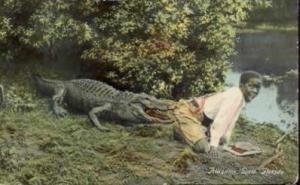
A racist postcard depicting a child used as a alligator bait.
Ferris State University, in its Jim Crow Museum, maintains a historical archive of American racism. The Jim Crow Museum provides the following description of gator babies being used as late as 1923:
“The headline in the September 21, 1923 Oakland Tribune reads “PICKANINNY BAIT LURES VORACIOUS ‘GATOR TO DEATH. And Mother Gets Her Baby Back in Perfect Condition; Also $2”. In the article T.W. Villiers chronicles the entire process of using black babies as bait and how “these little black morsels are more than glad to be led to the ‘sacrifice’ and do their part in lurking the big Florida gators to their fate without suffering so much as a scratch.” Villiers is quick to point out that the babies are brought out of the “water alive and whole and come out wet and laughing” and that “there is nothing terrible about it, except that it is spelling death for the alligators.” In a strange twist, Villiers reports on the hunter’s attempts to rationalize the motivation of the alligators to ‘jeopardize every hope of life for a live baby, and in the matter of color, the additional information is vouchsafed that black babies, in the estimation of the alligators, are far more refreshing, as it were, than white ones.’
The terrorizing of small children has cultural precedence
How deep is our antipathy toward the non-white, non-European, and non-affluent? The opportunity to keep learning from my friend, his experiences and perspectives. There’s a deeper history behind the associations and connections he makes. And wishing that our government could not treat children so badly, or that white privilege is not so blind is missing the historical point. My friend, from a different perspective, grew up in a different cultural history, found the mistreatment of children as part of a larger historical theme, as not actually surprising at all. It was all part of a familiar story.
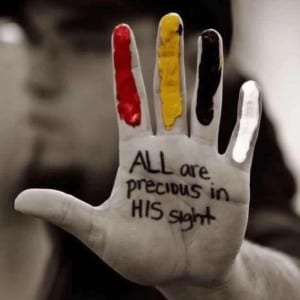
All are precious in his sight. Shepherdcommunity.org
“Jesus loves the little children
All the children of the world
Red and yellow, black and white
They are precious in His sight
Jesus loves the little children of the world
Jesus cares for all the children
All the children of the world
Red and yellow, black and white
They are precious in His sight
Jesus cares for the children of the world
Jesus came to save the children
All the children of the world
Red and yellow, black and white
They’re all precious in His sight
Jesus came to save the children of the world.
Some might speak of white privilege, identity politics, “playing the race card” and similar politically charged terms. And when we play these games, we speak past each other. We don’t hear what each person and community is saying and where their ideas come from. But the news looks different from the point of view of a community, a culture with a history of children being abused, denied dignity, and violently mistreated. And we who are not a part of those communities need to listen and learn.
Previous Post

September 5, 2019
I Am Not Not a Racist, and So Are You, Part 1
Next Post

September 11, 2019 Joyfully Not-Knowing
Browse Our Archives
Select a Category Advent Athletics Bible Bonhoeffer christianity church Coach Coaching common ground conflict devotional Doctor Faith Gospel of Luke Gospel of Matthew Hebrew Bible Hippies hospitality Immigration Jesus liturgical year loss memorial Missional music parish Politicians Politics pop music Preaching protest Racism Reverend self-image social cohesion social justice spirituality sterotypes theological Uncategorized welcome Wendy Wright workout mix
Select a Month January 2022 December 2021 November 2021 October 2021 September 2021 April 2021 December 2020 November 2020 October 2020 February 2020 January 2020 December 2019 November 2019 October 2019 September 2019 August 2019
Follow Us!
TAKE THE
Religious Wisdom Quiz
In the Parable of the Wedding Banquet, who accepts the invitation?
Select your answer to see how you score.
Only the king Nobles Unexpected guests Priests
Related posts from RDC: Reverend - Doctor - Coach

Gaudete Sunday, the Third Week of Advent
RDC: Reverend – Doctor – Coach

RDC: Reverend – Doctor – Coach

RDC: Reverend – Doctor – Coach
RDC: Reverend – Doctor – Coach
TRENDING AT PATHEOS Progressive Christian

Why Christians Have a Sacred Duty to Vote:...
The Bible offers strong support for the sacred duty to vote. Here...

What Being a Modern-Day Apostle Means to Me
In my last column, I discussed the ins and outs of modern-day...

Did Ancient China Once Worship the God of...
Across human history, a common thread weaves through the origins of the...

Love Your Neighbor – Including Earth-Kin: Lev. 19,...
God’s command to love your neighbor means acting in an ethical and...

Lead a Church Study of “Jesus and Lao...
Guest writer Jack Thomas (The Irreverent Reverend) reflects on leading his church...

Principles for Understanding the Apostolic Ministry Today
Whenever people discover that my formal ministry title is "apostle," as in...
view all Progressive Christian blogs
Ad-Free & Subscriber Log-In Subscription Support
- About Us
- 2026 Calendar
- Videos
- Podcasts
- Library of World Religions
- Faith In Media Tracker
- Advertise With Us
- Write for Us
- Privacy Policy
- Terms of Service
- Do Not Sell My Data
- Contact Us
- Radiant Digital
- Manage Newsletter Subscriptions
- Unsubscribe From Notifications
- Sitemap
Copyright 2008-2026, Patheos. All rights reserved.
Subscription Support Ad-Free & Subscriber Log-In
Follow Patheos