
BuddhistCatholicContemplativeEvangelicalGeneral ChristianHinduJewishLatter-day SaintMuslimNew VisionsProgressive Christian
Beliefs
- Buddhist
- Catholic
- Contemplative
- Evangelical
- General Christian
- Hindu
- Jewish
- Latter-day Saint
- More Voices
- Muslim
- New Visions
- Pagan
- Progressive Christian
Topics
- Religion News
- Food and Religion
- Sports and Religion
- Religious Art
- Religious Music and Entertainment
- Religious Events
- History and Religion
- Style and Religion
- Politics and Religion
- Women in Religion
- Recreation Outdoors and Religion
- Business Finance and Religion
- Careers Workplace and Religion
- Education and Religion
- Family Parenting and Religion
- Health Fitness and Religion
- Home and Religion
- Relationships and Religion
- Technology and Religion
- Travel and Religion
Columnists
- Buddhist Columnists
- Business Finance and Religion Columnists
- Careers Workplace and Religion Columnists
- Catholic Columnists
- Contemplative Columnists
- Education and Religion Columnists
- Evangelists Columnists
- Family Parenting and Religion Columnists
- General Christian Columnists
- Health Fitness and Religion Columnists
- Hindu Columnists
- History and Religion Columnists
- Home and Religion Columnists
- Jewish Columnists
- More Voices Columnists
- Latter Day Columnists
- Muslim Columnists
- New Visions Columnists
- Nonreligious Columnists
- Pagan Columnists
- Politics and Religion Columnists
- Progressive Columnists
- Recreation Outdoors and Religion Columnists
- Relationships and Religion Columnists
- Religion News Columnists
- Religious Art Columnists
- Religious Events Columnists
- Religious Music and Entertainment Columnists
- Sports and Religion Columnists
- Style and Religion Columnists
- Technology and Religion Columnists
- Travel and Religion Columnists
- Women in Religion Columnists
Resource Library
- 2026 Calendar
- Library of World Religions
- The 100 Most Holy Places on Earth
- Patheos Answers
- Podcasts
- Videos
- Faith Leaders Database
- Anglican Episcopalian
- Bahai
- Baptist
- Buddhism
- Christianity
- Confucianism
- Eastern Orthodoxy
- Hinduism
- Holiness and Pentecostal
- ISKCON
- Islam
- Judaism
- Lutheran
- Methodist
- The Church of Jesus Christ of Latter-day Saints
- New Age
- Paganism
- Presbytarian and Reformed
- Protestantism
- Religion Behind the Scenes
- Roman Catholic
- Scientology
- Shia Islam
- Sikhism
- Sufism
- Sunni Islam
- Taoism
- Zen
- See all religions
Research Tools
 Ad-Free & Subscriber Log-In Subscription Support
Ad-Free & Subscriber Log-In Subscription Support
Follow Patheos 

- Trending:
- Forgiveness
- |
- Marriage
- |
- Consciousness
- |
- Death Penalty
- |
- Election
- |
- Halloween

- Home
- Progressive Christian
- Relationships and Religion
- Plowing the Heart: How the Spirit Reveals Truth
Plowing the Heart: How the Spirit Reveals Truth
Last updated on: September 30, 2026 at 10:22 am by Benjamin Raven Pressley
Plowing the Heart: How the Spirit Reveals Truth 2026-09-30T10:22:05-04:00 Benjamin Raven Pressley
Patheos Explore the world's faith through different perspectives on religion and spirituality! Patheos has the views of the prevalent religions and spiritualities of the world.
The Parable of the Sower (found in Matthew 13:1–23, Mark 4:1–20, and Luke 8:4–15) is unique because Jesus not only tells the story publicly but interprets it in private for His disciples. Though it is not the only parable he explicitly interprets, this parable seems to be used by Jesus to teach his disciples to learn to look a little deeper and to understand the metaphors he uses in his parables- a Rosetta Stone, if you will. In Mark 4:13, right before Jesus explains the Parable of the Sower, He asks His disciples, “Do you not understand this parable? How then will you understand all the parables?”
He was explaining to them something about the way he teaches and that they were expected to apply that spiritual logic to the rest of His teachings without needing Him to decode every single story line by line. And just as Jesus was challenging his disciples, he is also challenging us modern-day disciples to take time to dig a little deeper and not just read the Bible but also to study it. Just like we don’t swallow food whole, we chew it a while before swallowing so we can digest it more efficiently.
How do you ‘chew on’/dig deeper into what the Bible is teaching?
- Take time to pray and ask the Holy Spirit to teach you and help you understand. Jesus promised that the Holy Spirit would indeed help us to understand and would teach us (John 16:13).
- Consider the context of what is being taught, keeping in mind the culture and technology of the time he is teaching. For example, in this parable we may not relate to the imagery used here of plows and soil because we are not farmers and we don’t even use the same kind of plows they used back then.
- Consider the character of God being taught. If you were raised in a church where they constantly taught about an angry, judgmental God, you might miss what Jesus was teaching about a loving God full of grace and mercy.
- I have always been of the persuasion that the scriptures have a literal meaning and a deeper spiritual meaning. Consider even the accounts of people who failed God so much that perhaps the story was allowed to be in the Bible was so we could learn from their mistakes. Or, as in this parable, as we shall see, that beyond the story of a farmer sowing seed there is deep spiritual truth to be learned.
- Consider also that the Old Testament was originally written in Hebrew and Aramaic and the New Testament was originally written in Greek and that these languages don’t always translate into English well. Knowing this, you may have to look into the original language to completely understand. And you don’t have to learn Hebrew and Greek to do this in this modern day and time. We have the Strong’s Concordance for one study help. If you don’t know how to use one, learn. You won’t regret it. It will open up a whole new, fresh realm of spiritual understanding for you. Not to mention, with resources like the internet and AI it is made even easier.
Listen to this article:
https://wp-media.patheos.com/blogs/sites/2216/2026/09/Sower-and-Seed.mp3
Why did Jesus even use parables to teach? Why didn’t he just say what he meant?
There was definitely a purpose to why he taught this way.
- In Matthew 13:34–35, Matthew pauses his narrative of Jesus’ kingdom parables to explain why Jesus taught this way: “Jesus spoke all these things to the crowd in parables; he did not say anything to them without using a parable. So was fulfilled what was spoken through the prophet: ‘I will open my mouth in parables, I will utter things hidden since the creation of the world.'” He was quoting Psalm 78:2, fulfilling prophecy that when the Messiah comes, one of the ways he could be recognized is that he would teach in parables.
- Secondly, Jesus knew that some who would come to hear him had no intention of learning anything and had their mind already made up and that there would be some who would come to hear and understand what he had to teach. Parables simultaneously reveal truth to receptive hearts and conceal truth from hardened hearts. Jesus states in Matthew 13:11: “To you it has been given to know the secrets of the kingdom of heaven, but to them it has not been given.” For those who approached Him with cynicism, hostility, or mere curiosity, the parable functioned as a riddle and protected sacred truth from being trampled on by those who had no intention of obeying it. But for those who sought Him, stayed with Him, and asked questions in private, the parable was an invitation to dig deeper. It unlocked the “mysteries” or “secrets” of the Kingdom of God. And so it is for us modern-day disciples of Christ. God is willing and desires those who seek him to reveal the deeper things of the Spirit and how it applies to our daily life. “Blessed are those who hunger and thirst for righteousness, for they will be filled” (Matthew 5:6). We all must decide which category we fit in. It is so easy to dismiss and shirk our responsibility by just saying ‘the Bible is just too complicated to understand’ when the Holy Spirit is more than willing to teach us and help us to understand.
Jesus wasn’t trying to prevent people from being saved by speaking in what seemed like riddles. There is an ancient Hebrew idiom and prophetic tradition that expresses judicial hardening—a judgment on a heart that has already chosen to reject God. Consider the evidence:
- People of that time consistently hardened their own hearts. The religious leaders and crowds had already witnessed countless miracles and heard clear teaching, yet they attributed His power to Beelzebul (Matthew 12).
- They repeatedly closed their eyes and stopped their ears, so God gave them over to their spiritual blindness. Romans 1:28 speaks of how He “gave them over to a reprobate mind.” and 2 Thessalonians 2:11 says he would even “send them a strong delusion”, describing a spiritual state where people who repeatedly reject God are allowed to follow their own distorted judgment and believe lies.
- Matthew 13:15 makes the human responsibility explicit: “For this people’s heart has grown dull, and with their ears they can barely hear, and their eyes they have closed…”
Psalm 78:2 speaks of uttering “dark sayings of old”—things from the past that were hard to understand. Matthew adapts this phrase to: “things hidden since the creation of the world”. God’s eternal plan for the salvation of humanity was veiled during Old Testament times. Jesus came to reveal these ancient mysteries. He is making known what God intended from the very beginning of creation—specifically, that the Kingdom of God would enter the world quietly, grow alongside evil, and welcome all who receive it. It is the same even today. If you truly want understanding and you seek it with all your heart, he will teach you. James 4:8, says, “Draw near to God, and he will draw near to you”.
So, let’s see what deeper truths we can learn by looking deeper into this important parable of Jesus.
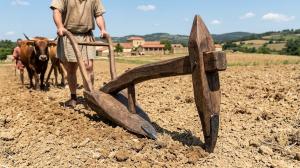
1st c. Mediterranean scratch plow
In this parable Jesus speaks about a sower who scattered his seed and as he was scattering the seed, some fell along the path, and the birds came and ate it up. Some fell on rocky places, where it did not have much soil. Now, I’m not a farmer, but I have planted a few gardens in my time, so this made me think for a minute. The first thing I did before I planted a garden was clear the ground and plow it under before planting any seed. And I got to thinking: why did this farmer just go out and scatter seed around on unplowed ground? So I had to dig a little deeper and consider the context and planting methods of this time. And I found out something very interesting. 1st-century Mediterranean agriculture: scattering seed before plowing was actually the most practical, labor-saving, and efficient method for them. Throughout the hot, dry summer, the ground in Palestine was baked into a concrete-like hardness. Ancient farmers used light scratch-plows which were made of wood and sometimes tipped with a small point of iron. These plows did not have heavy steel to turn over thick, hard sod as modern farm tractors do. Furthermore, they had to wait for the rain to soften the ground. If a farmer attempted to plow the dry, hardened ground and plant seeds before the rains, the fragile plow point would get dull or snap off. After the rains softened the earth, the scattered seed could lie on top while the scratch-plow easily cut through the top layer of dirt, turning the soil over the seed in a single pass. It saved double labor in a short planting window. The window for planting in the ancient Middle East was tight—farmers had to get their crops in the ground quickly once the autumn rains began, before heavy winter downpours flooded the fields or washed away the soil. Plowing the entire field first, walking it again to broadcast the seed, and then dragging a heavy log or branch over the field a second time to cover the seed required three separate passes across the land. Broadcasting the seed over the unplowed land and immediately plowing it under accomplished two critical jobs at once: it broke up the soil and buried the seed in a single pass. Makes sense.
The downside, though, by scattering the seed first, then plowing it under, the sower had no idea what the ground was like it was falling on. Jesus spelled it out and described the four types of ground the seed would fall on.
- One he described as the path. These were footpaths that ran across or alongside shared fields. Since they were footpaths, they became very hard-packed from walking on them like a well-worn trail. Seed landing on these hard-packed paths sat exposed on top of hard earth, making it hard for seeds to cut through with their roots, not to mention they made an easy snack for birds if they could get to it before the plow.
- Then there was the shallow, rocky soil. This wasn’t just scattered stone and soil. It was often limestone bedrock sitting just an inch or two under a thin layer of soil. To someone casting seed, the top looked like normal ground. But later, the plow would scrape right over this hidden shelf of rock without turning up deep soil and dulling down the iron tip of the plow or breaking it off.
- Some fell on thorny ground. During the dry season, weeds and thorny bushes withered above ground, but their deep roots remained alive beneath the surface. Scattering seed on unplowed land meant the wheat and the unseen thorn roots started in the exact same soil, choking out the roots of the wheat.
- But some would also fall on good soil that was deep, free of bedrock, and clear of weed roots. When plowed, the seeds were buried perfectly, taking root without obstruction.
Jesus makes it clear that the soil represents our heart and the seed represents the gospel, his Word going forth. Again, understanding that the sower scattered seed before plowing changes how we read the parable. If a farmer cleared, weeded, and plowed before planting, scattering seed on hard paths or thornbushes would look reckless, foolish, or wasteful. But this method of scattering seed everywhere is a picture of the lavishness of grace. God doesn’t pick and choose whom he wants to hear the gospel, but initially it is given to all, regardless of the state of their heart. Then it is up to the receiver to process the message, plow it into his heart and receive or reject it. The receiver has to be willing for the Holy Spirit to reveal to them the hardened places in their heart and to remove the stoniness of their past and be willing to repent and accept that God’s way is better than their old way. It is the Holy Spirit that turns our hearts like hardened soil and convicts of sin and draws us to confess our sin and receive his salvation. Ezekiel 36:26 says, “I will give you a new heart and put a new spirit in you; I will remove from you your heart of stone and give you a heart of flesh.” Only he can plow through our arguments and sins and turn our stony ground into good ground that can receive the seed of his Word. God is so good and loving and does not withhold His Word, grace, or love until a human heart is “proven” worthy or worked. He broadcasts truth generously across every life—even to hearts that appear hardened, shallow, or compromised—giving every part of the field an equal opportunity to receive the seed, not willing that any should perish. (2 Peter 3:9). “But God commendeth his love toward us, in that, while we were yet sinners, Christ died for us.” Romans 5:8**.**
Only God sees the true state of our heart.
 He isn’t fooled by a person sitting in a pew looking like “good soil,” but beneath the surface lies unplowed rock or suppressed sin and anxieties. The condition of your heart is not always obvious during calm times. It is the plow of trial and the heat of daily life that reveal what is hidden beneath the surface. Rather than asking, “Am I good soil?” perhaps we should ask, “What hidden bedrock or thorn roots am I keeping concealed from God’s plow?” Yes, the plow can be painful, but when the ground of our heart has been fallow for so long, it is the only way that his Word can grow. “Break up your unplowed ground and do not sow among thorns” (Jeremiah 4:3, Hosea 10:12). True conversion and spiritual maturity require the “plow” of repentance, conviction, and humility. Plowing hurts—it tears open the settled dirt and churns up hidden roots—but without that brokenness, the seed remains exposed on the surface and cannot endure. And on the surface it will be scorched by the sun of the trials and bitterness of life, or taken away by the birds like people that discourage you and try to draw you back to your old ways.
This perspective should also cause us to rethink how we as evangelists spread the gospel. When believers share their faith, they often try to pre-judge who is “ready” or “worthy” to hear the Gospel, attempting to pre-sort the soil. Yet, as in this parable, the sower casts seed across the whole field because the plow hasn’t exposed the true heart conditions yet; it is not our job to pre-assess the soil. So often the way some people witness to others makes no more sense than telling someone they must clean up before taking a bath! We are called to share truth generously and impartially—to the cynical (hard path), the impulsive (rocky ground), the overwhelmed (thorny ground), and the receptive alike. We must leave the breaking up of the ground and the hidden evaluation of the heart to God. Jesus called us to be ‘fishers of men’ (Matthew 4:19). We are supposed to catch the fish and let him clean them.
As Jesus interprets this parable in Matthew 13:19-23:
“When any one heareth the word of the kingdom, and understandeth it not, then cometh the wicked one, and catcheth away that which was sown in his heart. This is he which received seed by the way side.
20 But he that received the seed into stony places, the same is he that heareth the word, and anon with joy receiveth it;
21 Yet hath he not root in himself, but dureth for a while: for when tribulation or persecution ariseth because of the word, by and by he is offended.
22 He also that received seed among the thorns is he that heareth the word; and the care of this world, and the deceitfulness of riches, choke the word, and he becometh unfruitful.
23 But he that received seed into the good ground is he that heareth the word, and understandeth it; which also beareth fruit, and bringeth forth, some an hundredfold, some sixty, some thirty.”
Did you know that it was considered a good harvest to receive a ten-fold yield for what was planted? Yet Jesus says if we allow the Holy Spirit to work in us and as we yield to his way, we can receive abundantly above all our expectations. God’s ways are above our ways and sometimes make no sense to us, but the more we yield to his ways, the more it will make sense to us, for it is he who molds us and makes us into who we can truly be.
Ultimately, the Parable of the Sower serves as much more than a story about seed and soil—it is an invitation from Jesus to move past surface-level reading and allow the Holy Spirit to cultivate the ground of our hearts. True spiritual understanding is not gained by mere human intellect, but by humbly yielding to the Spirit’s plow through prayer, contextual study, and repentance. As we invite God to break up our unplowed places and share His Word impartially with others, the Holy Spirit unlocks the mysteries of Scripture, transforming our lives to bear fruit far beyond our expectations.
Thank you for reading this week’s study. I hope you were blessed and enlightened. Please share it with your friends and social media. And, if you would, please check out the books and other resources I have available and consider donating. Thanks.

My staff is hard at work to provide many useful resources to you, our readers. Please consider making a donation of any amount. Thanks.

Books, Video, Resources

FREE BIBLE STUDY COURSE!

About Benjamin Raven Pressley
Benjamin Raven Pressley is an author, teacher and spiritual guide. He is of Cherokee heritage. He has been a follower of the teachings of Jesus Christ and the apostles since 1975. His independent studies include the Holy Bible as well as other holy books of other religions. He is ordained by the Universal Life Church. He is a self-taught naturalist and his love and respect for nature is evident in many of the things he writes. He has authored several books on spirituality as well as a fantasy series and books on survival skills. He does not consider himself to be a religious person but believes true spirituality is an all-encompassing view of life and invites open discussion on matters of spirituality. You can read more about the author here.
Previous Post

September 23, 2026
Doing Enough for God? Why the Small Things Matter Most
Next Post

October 7, 2026 Did God Speak To The World Before Jesus Came?
Browse Our Archives
Select a Category balance body soul spirit born again occult organized religion reconnecting our spirit self-improvement Uncategorized walking spiritually
Select a Month October 2026 September 2026 August 2026 July 2026 June 2026 May 2026 April 2026 March 2026 February 2026 January 2026 December 2025 November 2025 October 2025 September 2025 August 2025 July 2025 June 2025 May 2025 April 2025 March 2025 February 2025 January 2025 December 2024 November 2024 October 2024 September 2024 August 2024 July 2024 June 2024 May 2024 April 2024 March 2024
TAKE THE
Religious Wisdom Quiz
Who is Abraham’s wife?
Select your answer to see how you score.
Ruth Naomi Esther Sarah
Books by This Author Books by Raven's Writing Desk
Related posts from Raven's Writing Desk

Correction, Not Punishment: A Parent's Field Guide

Beyond Blind Submission: Building a True Partnership

The Missing Peace: What Love Really Means

What It Means to Be Born Again in...
TRENDING AT PATHEOS Progressive Christian

What Being a Modern-Day Apostle Means to Me
In my last column, I discussed the ins and outs of modern-day...

Did Ancient China Once Worship the God of...
Across human history, a common thread weaves through the origins of the...

Love Your Neighbor – Including Earth-Kin: Lev. 19,...
God’s command to love your neighbor means acting in an ethical and...

Lead a Church Study of “Jesus and Lao...
Guest writer Jack Thomas (The Irreverent Reverend) reflects on leading his church...

Pastoral Wisdom for Responding to Sermon Pushback
Getting sermon pushback on your social justice sermon? Learn practical, Proverbs-based strategies...

Principles for Understanding the Apostolic Ministry Today
Whenever people discover that my formal ministry title is "apostle," as in...
view all Progressive Christian blogs
Ad-Free & Subscriber Log-In Subscription Support
- About Us
- 2026 Calendar
- Videos
- Podcasts
- Library of World Religions
- Faith In Media Tracker
- Advertise With Us
- Write for Us
- Privacy Policy
- Terms of Service
- Do Not Sell My Data
- Contact Us
- Radiant Digital
- Manage Newsletter Subscriptions
- Unsubscribe From Notifications
- Sitemap
Copyright 2008-2026, Patheos. All rights reserved.
Subscription Support Ad-Free & Subscriber Log-In
Follow Patheos