
BuddhistCatholicContemplativeEvangelicalGeneral ChristianHinduJewishLatter-day SaintMuslimNew VisionsProgressive Christian
Beliefs
- Buddhist
- Catholic
- Contemplative
- Evangelical
- General Christian
- Hindu
- Jewish
- Latter-day Saint
- More Voices
- Muslim
- New Visions
- Pagan
- Progressive Christian
Topics
- Religion News
- Food and Religion
- Sports and Religion
- Religious Art
- Religious Music and Entertainment
- Religious Events
- History and Religion
- Style and Religion
- Politics and Religion
- Women in Religion
- Recreation Outdoors and Religion
- Business Finance and Religion
- Careers Workplace and Religion
- Education and Religion
- Family Parenting and Religion
- Health Fitness and Religion
- Home and Religion
- Relationships and Religion
- Technology and Religion
- Travel and Religion
Columnists
- Buddhist Columnists
- Business Finance and Religion Columnists
- Careers Workplace and Religion Columnists
- Catholic Columnists
- Contemplative Columnists
- Education and Religion Columnists
- Evangelists Columnists
- Family Parenting and Religion Columnists
- General Christian Columnists
- Health Fitness and Religion Columnists
- Hindu Columnists
- History and Religion Columnists
- Home and Religion Columnists
- Jewish Columnists
- More Voices Columnists
- Latter Day Columnists
- Muslim Columnists
- New Visions Columnists
- Nonreligious Columnists
- Pagan Columnists
- Politics and Religion Columnists
- Progressive Columnists
- Recreation Outdoors and Religion Columnists
- Relationships and Religion Columnists
- Religion News Columnists
- Religious Art Columnists
- Religious Events Columnists
- Religious Music and Entertainment Columnists
- Sports and Religion Columnists
- Style and Religion Columnists
- Technology and Religion Columnists
- Travel and Religion Columnists
- Women in Religion Columnists
Resource Library
- 2026 Calendar
- Library of World Religions
- The 100 Most Holy Places on Earth
- Patheos Answers
- Podcasts
- Videos
- Faith Leaders Database
- Anglican Episcopalian
- Bahai
- Baptist
- Buddhism
- Christianity
- Confucianism
- Eastern Orthodoxy
- Hinduism
- Holiness and Pentecostal
- ISKCON
- Islam
- Judaism
- Lutheran
- Methodist
- The Church of Jesus Christ of Latter-day Saints
- New Age
- Paganism
- Presbytarian and Reformed
- Protestantism
- Religion Behind the Scenes
- Roman Catholic
- Scientology
- Shia Islam
- Sikhism
- Sufism
- Sunni Islam
- Taoism
- Zen
- See all religions
Research Tools
 Ad-Free & Subscriber Log-In Subscription Support
Ad-Free & Subscriber Log-In Subscription Support
Follow Patheos 

- Trending:
- Forgiveness
- |
- Marriage
- |
- Consciousness
- |
- Death Penalty
- |
- Election
- |
- Halloween

- Home
- Progressive Christian
- Relationships and Religion
- Seriously, Did Jesus Really Exist?
Seriously, Did Jesus Really Exist?
Last updated on: June 27, 2025 at 1:14 pm by Benjamin Raven Pressley
Seriously, Did Jesus Really Exist? 2025-06-27T13:14:08-04:00 Benjamin Raven Pressley
Patheos Explore the world's faith through different perspectives on religion and spirituality! Patheos has the views of the prevalent religions and spiritualities of the world.
Does history indeed record that Jesus actually lived? Is there evidence besides the Bible that he existed. How about we limit our eyewitness accounts to Hostile Non-Biblical Pagan Accounts?
There are a number of ancient classical accounts of Jesus from pagan, non-Christian sources. These accounts are generally hostile to Christianity; some ancient authors denied the miraculous nature of Jesus and the events surrounding His life:
Thallus (52AD)
Thallus is perhaps the earliest secular writer to mention Jesus and he is so ancient his writings don’t even exist anymore. But Julius Africanus, writing around 221AD does quote Thallus who previously tried to explain away the darkness occurring at Jesus’ crucifixion:
“On the whole world there pressed a most fearful darkness; and the rocks were rent by an earthquake, and many places in Judea and other districts were thrown down. This darkness Thallus, in the third book of his History, calls, as appears to me without reason, an eclipse of the sun.” (Julius Africanus, Chronography, 18:1)
If only more of Thallus’ record could be found, we might find more confirmation of Jesus’ crucifixion. But there are some things we can conclude from this account: Jesus lived, He was crucified, and there was an earthquake and darkness at the point of His crucifixion.
Tacitus (56-120AD)
Cornelius Tacitus was known for his analysis and examination of historical documents and is among the most trusted of ancient historians. He was a senator under Emperor Vespasian and was also proconsul of Asia. In his “Annals’ of 116AD, he describes Emperor Nero’s response to the great fire in Rome and Nero’s claim that the Christians were to blame:
“Consequently, to get rid of the report, Nero fastened the guilt and inflicted the most exquisite tortures on a class hated for their abominations, called Christians by the populace. Christus, from whom the name had its origin, suffered the extreme penalty during the reign of Tiberius at the hands of one of our procurators, Pontius Pilatus, and a most mischievous superstition, thus checked for the moment, again broke out not only in Judea, the first source of the evil, but even in Rome, where all things hideous and shameful from every part of the world find their centre and become popular.”
In this account, Tacitus confirms several historical elements of the Biblical narrative: Jesus lived in Judea, was crucified under Pontius Pilate, and had followers who were persecuted for their faith in Christ.
Mara Bar-Serapion (70AD)
Sometime after 70AD, a Syrian philosopher named Mara Bar-Serapion, writing to encourage his son, compared the life and persecution of Jesus with that of other philosophers who were persecuted for their ideas. The fact Jesus is known to be a real person with this kind of influence is important. Mara Bar-Serapion refers to Jesus as the “Wise King”:
“What benefit did the Athenians obtain by putting Socrates to death? Famine and plague came upon them as judgment for their crime. Or, the people of Samos for burning Pythagoras? In one moment their country was covered with sand. Or the Jews by murdering their wise king?…After that their kingdom was abolished. God rightly avenged these men…The wise king…Lived on in the teachings he enacted.”
From this account, we can add to our understanding of Jesus: He was a wise and influential man who died for His beliefs. The Jewish leadership was somehow responsible for Jesus’ death. Jesus’ followers adopted His beliefs and lived their lives accordingly.
Phlegon (80-140AD)
In a manner similar to Thallus, Julius Africanus also mentions a historian named Phlegon who wrote a chronicle of history around 140AD. In this history, Phlegon also mentions the darkness surrounding the crucifixion in an effort to explain it:
“Phlegon records that, in the time of Tiberius Caesar, at full moon, there was a full eclipse of the sun from the sixth to the ninth hour.” (Africanus, Chronography, 18:1)
Phlegon is also mentioned by Origen (an early church theologian and scholar, born in Alexandria):
“Now Phlegon, in the thirteenth or fourteenth book, I think, of his Chronicles, not only ascribed to Jesus a knowledge of future events . . . but also testified that the result corresponded to His predictions.” (Origen Against Celsus, Book 2, Chapter 14)
“And with regard to the eclipse in the time of Tiberius Caesar, in whose reign Jesus appears to have been crucified, and the great earthquakes which then took place … ” (Origen Against Celsus, Book 2, Chapter 33)
“Jesus, while alive, was of no assistance to himself, but that he arose after death, and exhibited the marks of his punishment, and showed how his hands had been pierced by nails.” (Origen Against Celsus, Book 2, Chapter 59)
From these accounts, we can add something to our understanding: Jesus had the ability to accurately predict the future, was crucified under the reign of Tiberius Caesar and demonstrated His wounds after he was resurrected.
Pliny the Younger (61-113AD)
Early Christians were also described in early, non-Christian history. Pliny the Younger, in a letter to the Roman emperor Trajan, describes the lifestyles of early Christians:
“They (the Christians) were in the habit of meeting on a certain fixed day before it was light, when they sang in alternate verses a hymn to Christ, as to a god, and bound themselves by a solemn oath, not to any wicked deeds, but never to commit any fraud, theft or adultery, never to falsify their word, nor deny a trust when they should be called upon to deliver it up; after which it was their custom to separate, and then reassemble to partake of food—but food of an ordinary and innocent kind.”
This early description of the first Christians documents several facts: the first Christians believed Jesus was GOD, the first Christians upheld a high moral code, and these early followers met regularly to worship Jesus.
Hostile Non-Biblical Jewish Accounts
In addition to classical pagan sources chronicling the life of Jesus and His followers, there are also a number of ancient hostile Jewish sources describing Jesus. These are written by Jewish theologians, historians and leaders who were definitely not sympathetic to the Christian cause. Their writings are often very harsh, critical and even demeaning to Jesus. But there is still much these writings confirm:
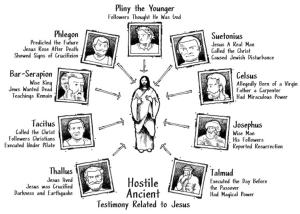
Image from Forensic Faith: A Homicide Detective Makes the Case for a More Reasonable, Evidential Christian Faith
Josephus (37-101AD)
In more detail than any other non-biblical historian, Josephus writes about Jesus in his “the Antiquities of the Jews” in 93AD. Josephus was born just four years after the crucifixion. He was a consultant for Jewish rabbis at an early age, became a Galilean military commander by the age of sixteen, and he was an eyewitness to much of what he recorded in the first century A.D. Under the rule of Roman emperor Vespasian, Josephus was allowed to write a history of the Jews. This history includes three passages about Christians, one in which he describes the death of John the Baptist, one in which he mentions the execution of James (and describes him as the brother of Jesus the Christ), and a final passage which describes Jesus as a wise man and the messiah. There is much legitimate controversy about the writing of Josephus, because the first discoveries of his writings are late enough to have been re-written by Christians who were accused of making additions to the text. So to be fair, we’ll examine a scholarly reconstruction stripped of Christian embellishment:
“Now around this time lived Jesus, a wise man. For he was a worker of amazing deeds and was a teacher of people who gladly accept the truth. He won over both many Jews and many Greeks. Pilate, when he heard him accused by the leading men among us, condemned him to the cross, (but) those who had first loved him did not cease (doing so). To this day the tribe of Christians named after him has not disappeared” (This neutral reconstruction follows closely the one proposed by John Meier, A Marginal Jew: Rethinking the Historical Jesus: The Roots of the Problem and the Person).
Now there are many other ancient versions of Josephus’ writing which are even more explicit about the nature of Jesus’ miracles, life and his status as the Christ, but let’s take this conservative version and see what we can learn. From this text, we can conclude: Jesus lived in Palestine, was a wise man and a teacher, worked amazing deeds, was accused by the Jews, crucified under Pilate and had followers called Christians.
Jewish Talmud (400-700AD)
While the earliest Talmudic writings of Jewish Rabbis appear in the 5th century, the tradition of these Rabbinic authors indicates they are faithfully transmitting teachings from the early “Tannaitic” period of the 1st Century BC to the 2nd Century AD. Scholars believe there are a number of Talmudic writings referring to Jesus, and many of these writings are said to use code words to describe Jesus (such as “Balaam” or “Ben Stada” or “a certain one”). But for our purposes we’ll be very conservative and limit our examination to the passages referring to Jesus in a more direct way:
“Jesus practiced magic and led Israel astray” (b. Sanhedrin 43a; cf. t. Shabbat 11.15; b. Shabbat 104b)
“Rabbi Hisda (d. 309) said that Rabbi Jeremiah bar Abba said, ‘What is that which is written, ‘No evil will befall you, nor shall any plague come near your house’? (Psalm 91:10)… ‘No evil will befall you’ (means) that evil dreams and evil thoughts will not tempt you; ‘nor shall any plague come near your house’ (means) that you will not have a son or a disciple who burns his food like Jesus of Nazareth.” (b. Sanhedrin 103a; cf. b. Berakhot 17b)
“Our rabbis have taught that Jesus had five disciples: Matthai, Nakai, Nezer, Buni and Todah. They brought Matthai to (to trial). He said, ‘Must Matthai be killed? For it is written, ‘When (mathai) shall I come and appear before God?’” (Psalm 92:2) They said to him, “Yes Matthai must be killed, for it is written, ‘When (mathai) he dies his name will perish’” (Psalm 41:5). They brought Nakai. He said to them, “Must Nakai be killed? For it is written, “The innocent (naqi) and the righteous will not slay’” (Exodus 23:7). They said to him, “Yes, Nakai must be kille, for it is written, ‘In secret places he slays the innocent (naqi)’” (Psalm 10:8). (b. Sanhedrin 43a; the passage continues in a similar way for Nezer, Buni and Todah)
And this, perhaps the most famous of Talmudic passages about Jesus:
“It was taught: On the day before the Passover they hanged Jesus. A herald went before him for forty days (proclaiming), “He will be stoned, because he practiced magic and enticed Israel to go astray. Let anyone who knows anything in his favor come forward and plead for him.” But nothing was found in his favor, and they hanged him on the day before the Passover. (b. Sanhedrin 43a)
From just these passages mentioning Jesus by name, we can conclude the following: Jesus had magical powers, led the Jews away from their beliefs, had disciples who were martyred for their faith (one of whom was named Matthai), and was executed on the day before the Passover.
Not bad, given this information is coming from ancient accounts hostile to the Biblical record. While these non-Christian sources interpret the claims of Christianity differently, they affirm the initial, evidential claims of the Biblical authors (much like those who interpret the evidence related to Kennedy’s assassination and the Twin Tower attacks come to different conclusions but affirm the basic facts of the historical events). Is there any evidence for Jesus outside the Bible? Yes, and the ancient non-Christian interpretations (and critical commentaries) of the Gospel accounts serve to strengthen the core claims of the New Testament. And I could name many more.
For more on this, please refer to Forensic Faith:
General Christian
History and Religion
Previous Post
June 22, 2024
What Is So Significant About The Cross?
Next Post

July 6, 2024 What Is In A Moment?
Recent Comments
"Has it ever occurred to you that people who claim to be "spiritual" do not ..."
Connecting To True Spirituality
"I don't see in article where I said Gabriel was an archangel. I even wrote ..."
"You were doing good until you started mixing in outdated mythology.Humans of every religion experience ..."
Are We Living Life Upside Down? ..."
"Where do you find Gabriel is said to be an archangel in the Bible?Only Michael ..."
Browse Our Archives
Select a Category balance body soul spirit born again occult organized religion reconnecting our spirit self-improvement Uncategorized walking spiritually
Select a Month October 2026 September 2026 August 2026 July 2026 June 2026 May 2026 April 2026 March 2026 February 2026 January 2026 December 2025 November 2025 October 2025 September 2025 August 2025 July 2025 June 2025 May 2025 April 2025 March 2025 February 2025 January 2025 December 2024 November 2024 October 2024 September 2024 August 2024 July 2024 June 2024 May 2024 April 2024 March 2024
TAKE THE
Religious Wisdom Quiz
Four beasts rose from the sea—one like a lion with eagle's wings, one like a bear, one like a leopard, and a fourth terrifying beast. What did these represent?
Select your answer to see how you score.
Four judgments Four kingdoms Four kings Four ages
Books by This Author Books by Raven's Writing Desk
Related posts from Raven's Writing Desk

Did Ancient China Once Worship the God of...
Did God Speak To The World Before Jesus...

Doing Enough for God? Why the Small Things...

The Sword of the Spirit Is Not What...
TRENDING AT PATHEOS Progressive Christian

What Being a Modern-Day Apostle Means to Me
In my last column, I discussed the ins and outs of modern-day...

Did Ancient China Once Worship the God of...
Across human history, a common thread weaves through the origins of the...

Love Your Neighbor – Including Earth-Kin: Lev. 19,...
God’s command to love your neighbor means acting in an ethical and...

Lead a Church Study of “Jesus and Lao...
Guest writer Jack Thomas (The Irreverent Reverend) reflects on leading his church...

Pastoral Wisdom for Responding to Sermon Pushback
Getting sermon pushback on your social justice sermon? Learn practical, Proverbs-based strategies...

Principles for Understanding the Apostolic Ministry Today
Whenever people discover that my formal ministry title is "apostle," as in...
view all Progressive Christian blogs
Ad-Free & Subscriber Log-In Subscription Support
- About Us
- 2026 Calendar
- Videos
- Podcasts
- Library of World Religions
- Faith In Media Tracker
- Advertise With Us
- Write for Us
- Privacy Policy
- Terms of Service
- Do Not Sell My Data
- Contact Us
- Radiant Digital
- Manage Newsletter Subscriptions
- Unsubscribe From Notifications
- Sitemap
Copyright 2008-2026, Patheos. All rights reserved.
Subscription Support Ad-Free & Subscriber Log-In
Follow Patheos