
BuddhistCatholicContemplativeEvangelicalGeneral ChristianHinduJewishLatter-day SaintMuslimNew VisionsProgressive Christian
Beliefs
- Buddhist
- Catholic
- Contemplative
- Evangelical
- General Christian
- Hindu
- Jewish
- Latter-day Saint
- More Voices
- Muslim
- New Visions
- Pagan
- Progressive Christian
Topics
- Religion News
- Food and Religion
- Sports and Religion
- Religious Art
- Religious Music and Entertainment
- Religious Events
- History and Religion
- Style and Religion
- Politics and Religion
- Women in Religion
- Recreation Outdoors and Religion
- Business Finance and Religion
- Careers Workplace and Religion
- Education and Religion
- Family Parenting and Religion
- Health Fitness and Religion
- Home and Religion
- Relationships and Religion
- Technology and Religion
- Travel and Religion
Columnists
- Buddhist Columnists
- Business Finance and Religion Columnists
- Careers Workplace and Religion Columnists
- Catholic Columnists
- Contemplative Columnists
- Education and Religion Columnists
- Evangelists Columnists
- Family Parenting and Religion Columnists
- General Christian Columnists
- Health Fitness and Religion Columnists
- Hindu Columnists
- History and Religion Columnists
- Home and Religion Columnists
- Jewish Columnists
- More Voices Columnists
- Latter Day Columnists
- Muslim Columnists
- New Visions Columnists
- Nonreligious Columnists
- Pagan Columnists
- Politics and Religion Columnists
- Progressive Columnists
- Recreation Outdoors and Religion Columnists
- Relationships and Religion Columnists
- Religion News Columnists
- Religious Art Columnists
- Religious Events Columnists
- Religious Music and Entertainment Columnists
- Sports and Religion Columnists
- Style and Religion Columnists
- Technology and Religion Columnists
- Travel and Religion Columnists
- Women in Religion Columnists
Resource Library
- 2026 Calendar
- Library of World Religions
- The 100 Most Holy Places on Earth
- Patheos Answers
- Podcasts
- Videos
- Faith Leaders Database
- Anglican Episcopalian
- Bahai
- Baptist
- Buddhism
- Christianity
- Confucianism
- Eastern Orthodoxy
- Hinduism
- Holiness and Pentecostal
- ISKCON
- Islam
- Judaism
- Lutheran
- Methodist
- The Church of Jesus Christ of Latter-day Saints
- New Age
- Paganism
- Presbytarian and Reformed
- Protestantism
- Religion Behind the Scenes
- Roman Catholic
- Scientology
- Shia Islam
- Sikhism
- Sufism
- Sunni Islam
- Taoism
- Zen
- See all religions
Research Tools
 Ad-Free & Subscriber Log-In Subscription Support
Ad-Free & Subscriber Log-In Subscription Support
Follow Patheos 

- Trending:
- Forgiveness
- |
- Marriage
- |
- Consciousness
- |
- Death Penalty
- |
- Election
- |
- Halloween

- Home
- Evangelical
- What Is the Value of Studying Systematic Theology?
What Is the Value of Studying Systematic Theology?
Last updated on: July 26, 2021 at 8:30 am by Randy Alcorn
What Is the Value of Studying Systematic Theology? 2021-06-30T11:25:09-08:00 Randy Alcorn
Patheos Explore the world's faith through different perspectives on religion and spirituality! Patheos has the views of the prevalent religions and spiritualities of the world.

A reader asked me, “What is the value of systematic theology? Isn’t there a risk of misinterpretation because of trying to process all of God’s Word through a system rather than letting it speak for itself?”
I think it’s impossible to teach theology without teaching worldview, and impossible to teach worldview without teaching theology, and in particular, systematic theology. A doctrine is a teaching that summarizes biblical truth. Hence the “view” in worldview amounts to a doctrinal lens, a belief system through which you see the world. It applies to everything from money to sex to abortion.
There is a theology of Heaven and work and nearly everything else. It’s “what God has to say about this subject in His Word.” It requires that we examine the whole counsel of God, the larger picture, lest we leave out something vital that is not recorded in Titus or Hebrews or Joshua or Proverbs (or whatever book may partially address a given issue). Ours shouldn’t be just a view based on a single passage or book of Scripture, but based on the whole counsel of God, which offers us checks and balances that we would not be aware of from a single book or chapter or paragraph of Scripture.
Isn’t it virtually impossible even to “share the gospel” without systematic theology? Even if you don’t choose to use a tract or gospel booklet, you must do what they do—select Bible portions and summarize their points in a way that is educated by, and true to, the whole of Scripture. “We have all sinned.” “God loves us.” “We need the price paid for our sins in order to be acceptable to God.” “Jesus went to the cross to pay for our sins.” “We must place our faith in Christ.”
The closest thing to doing this while restricting yourself to a single book of Scripture may be using Romans 1-11, but even then you will end up skipping from Romans 3:23 to 6:23 to 10:9,10 and summarizing your main points of creation, fall, sin, death, curse, Christ’s death, resurrection, and faith in the grace Christ offers us.
Along the way, to make the message more complete, you will probably import a number of passages from the Old Testament prophets, gospels, and other epistles. In other words, you will do systematic theology, pulling together Scripture to express an overall biblical teaching.
Of course, a systematic theology should never dictate our understanding of Scripture. But there is a chicken and egg aspect to this. The fact is that everyone brings assumptions and an interpretive grid to the text of Scripture. In fact, that’s their worldview. We all come to Scripture with a systematic theology—it’s just that often it’s wrong and full of holes and not biblically based.
We have a thirst for knowledge, and knowledge consists of seeing truths in relationship to each other. We do not just need the individual pearls of truths; we need the string that ties them together. Without the larger picture of God’s unfolding drama of redemption, and without systematic theology, pastors are constantly throwing out pearls to people, but they have no string to put them on and hold them together, and keep them in relation to each other. Because we left out the string, the pearls are jumbled and rolling around, and eventually get mixed up with things of lesser value, and many of them are lost in the confusion of competing worldviews that come from everything to Internet billboards to car commercials.
Consequently, I think it is impossible and unwise to simply study parts of God’s Word as individual entities without laboring to demonstrate their relationship to the larger whole (in other words, to systematize). Now we can over-systematize of course, and strip Scripture of paradox and mystery and wonder, but that is not inherent to systematic theology when it is done well. We should not throw out the baby with the bathwater.
I have heard people argue, “But God didn’t reveal Himself to us in a systematic theology. Therefore, it’s wrong to construct one.” But this is like saying, “God didn’t reveal mathematics or chemistry or physics, so it’s wrong to construct them as a science.” Not only is it not wrong, it is vital for progress and inevitable considering the way God created our minds. If these sciences hadn’t been constructed to organize observations and truths in relation to each other, people would be a lot more ignorant about the subject matters and society would not exist as we know it.
I’ll make a comparison with my favorite science, astronomy. In Scripture, God has revealed to us many truths in a history of redemption that involves many characters and stories. Likewise, the history of stars and planets and our observations of them involve many components. Astronomy is a way of gathering this vast realm of facts together so they can be learned and discussed, and theories can be explored and tested.
Rather than just learning isolated facts about the stars and planets, interesting though they be, these facts are studied and organized into a science called astronomy so that understanding can deepen and be better utilized and applied and discussed.
Isn’t that exactly what can happen with systematic theology? It’s what happened in my life, and I’ve seen it in the lives of many people.
Isolated facts about astronomy leave people initially excited but confused and ultimately disinterested because “it just doesn’t make sense.” The same is true of isolated Bible facts. God has made the human mind to want to organize information in a way that makes sense.
This is what astronomy and physics and psychology and sociology and systematic theology have in common. Of course, all are prone to overgeneralization and error, but the difference is that systematic theology begins with the Bible, which is true. So while the Bible didn’t come to us in systematic form, that doesn’t mean it is wrong to study its truths and try to organize them in relationship to each other, just like we do in every area in which we seek knowledge and understanding. And shouldn’t we labor all the harder to systematize with care and accuracy because of the inspired nature of what’s been entrusted to us?
I highly recommend not only Wayne Grudem’s large Systematic Theology, but also his abridged Bible Doctrine. I have recently been reading his expanded and updated systematic theology and have been thoroughly enjoying it. In the introduction Wayne explains which portions of the book are new, and some that have been revised, as well as how and why. I do believe the revised and updated work is well worth purchasing even for those who have and have read the original version.
Finally, here is a helpful article from Wayne about how and why to study systematic theology.
Photo by Jonas Denil on Unsplash


Browse Our Archives
Select a Category About Me Animals Books Books and Resources Christ Christian Life Christians Past and Present Church Creation Culture and Worldview Doctrine and Theology Eternal Perspective Ministries Fun Grace and Truth Grief Happiness Heaven Marriage and Family Missions Money and Giving Persecuted Church Politics Prayer Prolife Salvation Sexual Purity Sovereignty and Free Will Suffering and Evil Uncategorized Writing
Select a Month October 2026 September 2026 August 2026 July 2026 June 2026 May 2026 April 2026 March 2026 February 2026 January 2026 December 2025 November 2025 October 2025 September 2025 August 2025 July 2025 June 2025 May 2025 April 2025 March 2025 February 2025 January 2025 December 2024 November 2024 October 2024 September 2024 August 2024 July 2024 June 2024 May 2024 April 2024 March 2024 February 2024 January 2024 December 2023 November 2023 October 2023 September 2023 August 2023 July 2023 June 2023 May 2023 April 2023 March 2023 February 2023 January 2023 December 2022 November 2022 October 2022 September 2022 August 2022 July 2022 June 2022 May 2022 April 2022 March 2022 February 2022 January 2022 December 2021 November 2021 October 2021 September 2021 August 2021 July 2021 June 2021 May 2021 April 2021 March 2021 February 2021 January 2021 December 2020 November 2020 October 2020 September 2020 August 2020 July 2020 June 2020 May 2020 April 2020 March 2020 February 2020 January 2020 December 2019 November 2019 October 2019 September 2019 August 2019 July 2019 June 2019 May 2019 April 2019 March 2019 February 2019 January 2019 December 2018 October 2018 September 2018 August 2018 July 2018 June 2018 May 2018 April 2018 March 2018 February 2018 January 2018 December 2017 November 2017 October 2017 September 2017 August 2017 July 2017 June 2017 May 2017 April 2017 March 2017 February 2017 January 2017 December 2016 November 2016 October 2016 September 2016 August 2016 July 2016 June 2016 May 2016 April 2016 March 2016 February 2016 January 2016
Follow Us!
TAKE THE
Religious Wisdom Quiz
Who said, "The love of money is the root of all evil"?
Select your answer to see how you score.
Job Paul Solomon Jesus
Books by This Author Books by Randy Alcorn
Related posts from Eternal Perspectives, with Randy Alcorn

Does Scripture Tell Us That Animals Worship God?
Eternal Perspectives, with Randy Alcorn

Eight Myths about Heaven That Many Believe
Eternal Perspectives, with Randy Alcorn
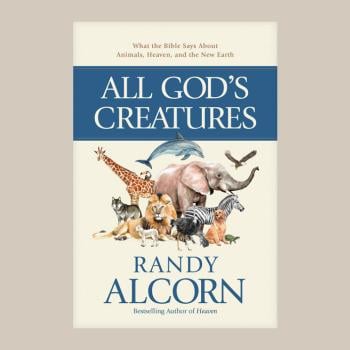
My New Book All God’s Creatures, Coming This...
Eternal Perspectives, with Randy Alcorn

It’s Possible to Find Happiness in Jesus Every...
Eternal Perspectives, with Randy Alcorn
TRENDING AT PATHEOS Evangelical

Pope Leo Celebrates Mass for Nurses & Docs...
I don't have any idea how he did it, but Pope Leo...

The Sermon on the Mount, Part I: Matthew...
The Sermon on the Mount, Part I (Matthew 4:12-5:12) St. Matthew moves...

What's up from Crossway: Reviewing some of their latest A few weeks...

Janie Learns the Way of the Cross: A...
Teaching children about Jesus' Passion can be challenging. Many parents and educators...

Looking For Good Catholic Writing - October 2026
He alone extends the heavens, and he walks upon the waves of...

In "Irreplaceable," our book on vocation and technology, Trevor Sutton and I...
view all Evangelical blogs
Ad-Free & Subscriber Log-In Subscription Support
- About Us
- 2026 Calendar
- Videos
- Podcasts
- Library of World Religions
- Faith In Media Tracker
- Advertise With Us
- Write for Us
- Privacy Policy
- Terms of Service
- Do Not Sell My Data
- Contact Us
- Radiant Digital
- Manage Newsletter Subscriptions
- Unsubscribe From Notifications
- Sitemap
Copyright 2008-2026, Patheos. All rights reserved.
Subscription Support Ad-Free & Subscriber Log-In
Follow Patheos