
BuddhistCatholicContemplativeEvangelicalGeneral ChristianHinduJewishLatter-day SaintMuslimNew VisionsProgressive Christian
Beliefs
- Buddhist
- Catholic
- Contemplative
- Evangelical
- General Christian
- Hindu
- Jewish
- Latter-day Saint
- More Voices
- Muslim
- New Visions
- Pagan
- Progressive Christian
Topics
- Religion News
- Food and Religion
- Sports and Religion
- Religious Art
- Religious Music and Entertainment
- Religious Events
- History and Religion
- Style and Religion
- Politics and Religion
- Women in Religion
- Recreation Outdoors and Religion
- Business Finance and Religion
- Careers Workplace and Religion
- Education and Religion
- Family Parenting and Religion
- Health Fitness and Religion
- Home and Religion
- Relationships and Religion
- Technology and Religion
- Travel and Religion
Columnists
- Buddhist Columnists
- Business Finance and Religion Columnists
- Careers Workplace and Religion Columnists
- Catholic Columnists
- Contemplative Columnists
- Education and Religion Columnists
- Evangelists Columnists
- Family Parenting and Religion Columnists
- General Christian Columnists
- Health Fitness and Religion Columnists
- Hindu Columnists
- History and Religion Columnists
- Home and Religion Columnists
- Jewish Columnists
- More Voices Columnists
- Latter Day Columnists
- Muslim Columnists
- New Visions Columnists
- Nonreligious Columnists
- Pagan Columnists
- Politics and Religion Columnists
- Progressive Columnists
- Recreation Outdoors and Religion Columnists
- Relationships and Religion Columnists
- Religion News Columnists
- Religious Art Columnists
- Religious Events Columnists
- Religious Music and Entertainment Columnists
- Sports and Religion Columnists
- Style and Religion Columnists
- Technology and Religion Columnists
- Travel and Religion Columnists
- Women in Religion Columnists
Resource Library
- 2026 Calendar
- Library of World Religions
- The 100 Most Holy Places on Earth
- Patheos Answers
- Podcasts
- Videos
- Faith Leaders Database
- Anglican Episcopalian
- Bahai
- Baptist
- Buddhism
- Christianity
- Confucianism
- Eastern Orthodoxy
- Hinduism
- Holiness and Pentecostal
- ISKCON
- Islam
- Judaism
- Lutheran
- Methodist
- The Church of Jesus Christ of Latter-day Saints
- New Age
- Paganism
- Presbytarian and Reformed
- Protestantism
- Religion Behind the Scenes
- Roman Catholic
- Scientology
- Shia Islam
- Sikhism
- Sufism
- Sunni Islam
- Taoism
- Zen
- See all religions
Research Tools
 Ad-Free & Subscriber Log-In Subscription Support
Ad-Free & Subscriber Log-In Subscription Support
Follow Patheos 

- Trending:
- Forgiveness
- |
- Marriage
- |
- Consciousness
- |
- Death Penalty
- |
- Election
- |
- Halloween

- Home
- Evangelical
- Goodness in a World of Evil: Philip Hallie and the Story of Le Chambon
Goodness in a World of Evil: Philip Hallie and the Story of Le Chambon
Last updated on: June 4, 2018 at 8:30 am by Randy Alcorn
Goodness in a World of Evil: Philip Hallie and the Story of Le Chambon 2018-06-04T05:30:16-08:00 Randy Alcorn
Patheos Explore the world's faith through different perspectives on religion and spirituality! Patheos has the views of the prevalent religions and spiritualities of the world.

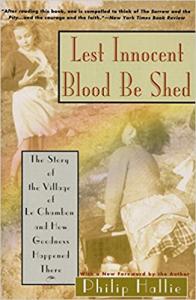 Philip Hallie’s marvelous book Lest Innocent Blood Be Shed tells the true story of Le Chambon, a French town where Pastor André Trocmé’s church, under the Nazi occupation, provided Jews with food, shelter, protection, and means of escape. Despite the disapproval of many, Trocmé and his church persevered in doing what they believed was right. As a result, “Le Chambon became the safest place for Jews in Europe.” [1] Over a period of about four years, the church rescued nearly twenty-five hundred Jews.
The Holocaust’s cruelty obsessed Hallie. He said he’d become “bitterly angry” and “over the years [of studying the Holocaust] I had dug myself into Hell.” Hallie speaks of a life-changing day when he discovered the stories of Christians in Le Chambon rescuing Jews, at peril of their own imprisonment and death. As he read, it surprised him to break into tears in what he called “an expression of moral praise.” Hallie later described the love of the church at Le Chambon:
It was this strenuous, this extraordinary obligation that… Trocmé expressed to the people in the big gray church. The love they preached was not simply adoration; nor was it simply a love of moral purity, of keeping one’s hands clean of evil. It was not a love of private ecstasy or a private retreat from evil. It was an active, dangerous love that brought help to those who needed it most. [2]
The day Hallie read of those flawed but loving Christians, he caught a view of God in the goodness they had done. He went home and spent a busy evening with family, then found himself in bed, weeping again over what happened in Le Chambon. Hallie wrote,
When I lay on my back in bed with my eyes closed, I saw more clearly than ever the images that had made me weep. I saw the two clumsy khaki-colored buses of the Vichy French police pull into the village square. I saw the police captain facing the pastor of the village and warning him that if he did not give up the names of the Jews they had been sheltering in the village, he and his fellow pastor, as well as the families who had been caring for the Jews, would be arrested. I saw the pastor refuse to give up these people who had been strangers in his village, even at the risk of his own destruction.
Then I saw the only Jew the police could find, sitting in an otherwise empty bus. I saw a thirteen-year-old boy, the son of the pastor, pass a piece of his precious chocolate through the window to the prisoner, while twenty gendarmes who were guarding the lone prisoner watched. And then I saw the villagers passing their little gifts through the window until there were gifts all around him—most of them food in those hungry days during the German occupation of France.
Lying there in bed, I began to weep again. I thought, Why run away from what is excellent simply because it goes through you like a spear? Lying there, I knew… a certain region of my mind contained an awareness of men and women in bloody white coats [committing unspeakable atrocities to] six- or seven- or eight-year-old Jewish children…. All of this I knew. But why not know joy?… Why must life be for me that vision of… children [hideously brutalized]? Something had happened, had happened for years in that mountain village. Why should I be afraid of it?
To the dismay of my wife, I left the bed unable to say a word, dressed, crossed the dark campus on a starless night, and read again those few pages on the village of Le Chambon-sur-Lignon. And to my surprise, again the spear, again the tears, again the frantic, painful pleasure that spills into the mind when a deep, deep need is being satisfied, or when a deep wound is starting to heal. [3]
Philosophy professor Eleonore Stump tells of coming to know Jesus through studying the problem of evil and suffering. Reflecting on her own experience (and Hallie’s), Stump writes,
So, in an odd sort of way, the mirror of evil can also lead us to God. A loathing focus on the evils of our world and ourselves prepares us to be the more startled by the taste of true goodness when we find it and the more determined to follow that taste until we see where it leads. And where it leads is to the truest goodness…to the sort of goodness of which the Chambonnais’s goodness is only a tepid aftertaste. The mirror of evil becomes translucent, and we can see through it to the goodness of God…. So you can come to Christ contemplating evil in a world of goodness, or contemplating goodness in a world of evil. [4]
One mother—her three children saved by the people of Le Chambon—said, “The Holocaust was storm, lightning, thunder, wind, rain, yes. And Le Chambon was the rainbow.” [5]
The history of the human race cannot be reduced to the Holocaust. There was and is considerable goodness in the world outside the Holocaust. Yet even inside it, in places like Le Chambon, a costly and beautiful goodness lives.
Excerpted from If God Is Good: Faith in the Midst of Suffering and Evil.
Read more about Le Chambon from the United States Holocaust Memorial Museum.
[1] Philip Paul Hallie, Lest Innocent Blood Be Shed (New York: HarperCollins, 1994), 4.
[2] Hallie, Lest Innocent Blood Be Shed, 129.
[3] Hallie, Lest Innocent Blood Be Shed, 110–11.
[4] Eleonore Stump, “The Mirror of Evil,” in God and the Philosophers, ed. Thomas V. Morris (New York: Oxford University Press, 1994), 235
[5] Os Guinness, Unspeakable (San Francisco: HarperCollins, 2005), 227.


Browse Our Archives
Select a Category About Me Animals Books Books and Resources Christ Christian Life Christians Past and Present Church Creation Culture and Worldview Doctrine and Theology Eternal Perspective Ministries Fun Grace and Truth Grief Happiness Heaven Marriage and Family Missions Money and Giving Persecuted Church Politics Prayer Prolife Salvation Sexual Purity Sovereignty and Free Will Suffering and Evil Uncategorized Writing
Select a Month October 2026 September 2026 August 2026 July 2026 June 2026 May 2026 April 2026 March 2026 February 2026 January 2026 December 2025 November 2025 October 2025 September 2025 August 2025 July 2025 June 2025 May 2025 April 2025 March 2025 February 2025 January 2025 December 2024 November 2024 October 2024 September 2024 August 2024 July 2024 June 2024 May 2024 April 2024 March 2024 February 2024 January 2024 December 2023 November 2023 October 2023 September 2023 August 2023 July 2023 June 2023 May 2023 April 2023 March 2023 February 2023 January 2023 December 2022 November 2022 October 2022 September 2022 August 2022 July 2022 June 2022 May 2022 April 2022 March 2022 February 2022 January 2022 December 2021 November 2021 October 2021 September 2021 August 2021 July 2021 June 2021 May 2021 April 2021 March 2021 February 2021 January 2021 December 2020 November 2020 October 2020 September 2020 August 2020 July 2020 June 2020 May 2020 April 2020 March 2020 February 2020 January 2020 December 2019 November 2019 October 2019 September 2019 August 2019 July 2019 June 2019 May 2019 April 2019 March 2019 February 2019 January 2019 December 2018 October 2018 September 2018 August 2018 July 2018 June 2018 May 2018 April 2018 March 2018 February 2018 January 2018 December 2017 November 2017 October 2017 September 2017 August 2017 July 2017 June 2017 May 2017 April 2017 March 2017 February 2017 January 2017 December 2016 November 2016 October 2016 September 2016 August 2016 July 2016 June 2016 May 2016 April 2016 March 2016 February 2016 January 2016
Follow Us!
TAKE THE
Religious Wisdom Quiz
Which animal did Jesus ride into Jerusalem on, fulfilling prophecy?
Select your answer to see how you score.
Ox Camel Horse Donkey
Books by This Author Books by Randy Alcorn
Related posts from Eternal Perspectives, with Randy Alcorn

4 Right Responses to Times of Suffering
Eternal Perspectives, with Randy Alcorn

We Can Trust God to Work for Our...
Eternal Perspectives, with Randy Alcorn

How Can We Trust God through Trials We...
Eternal Perspectives, with Randy Alcorn

Find Your Identity in God, Not Your Suffering
Eternal Perspectives, with Randy Alcorn
TRENDING AT PATHEOS Evangelical

When Halloween Unmasks Married Hearts
Written by Dr. David K. Ewen from Eternal Truth Bible College Behind...

Aristotle. He’s been called the father of logic, the father of the...

Methodist Central Hall and Westminster Abbey
Situated on the same square is Methodist Central Hall and Westminster Abbey. ...

57th Dove Awards Honor Dolly Parton, Crown New...
On gospel music’s biggest night, the 57th annual GMA Dove Awards honored...

The First Eucharistic Controversy: Christ’s Real Presence
For Catholics, the Eucharist is the source and summit of the Christian...

What a Stop Sign Can Teach Us About...
How to Make a Decision When You Can't Hear God Main point:...
view all Evangelical blogs
Ad-Free & Subscriber Log-In Subscription Support
- About Us
- 2026 Calendar
- Videos
- Podcasts
- Library of World Religions
- Faith In Media Tracker
- Advertise With Us
- Write for Us
- Privacy Policy
- Terms of Service
- Do Not Sell My Data
- Contact Us
- Radiant Digital
- Manage Newsletter Subscriptions
- Unsubscribe From Notifications
- Sitemap
Copyright 2008-2026, Patheos. All rights reserved.
Subscription Support Ad-Free & Subscriber Log-In
Follow Patheos