
BuddhistCatholicContemplativeEvangelicalGeneral ChristianHinduJewishLatter-day SaintMuslimNew VisionsProgressive Christian
Beliefs
- Buddhist
- Catholic
- Contemplative
- Evangelical
- General Christian
- Hindu
- Jewish
- Latter-day Saint
- More Voices
- Muslim
- New Visions
- Pagan
- Progressive Christian
Topics
- Religion News
- Food and Religion
- Sports and Religion
- Religious Art
- Religious Music and Entertainment
- Religious Events
- History and Religion
- Style and Religion
- Politics and Religion
- Women in Religion
- Recreation Outdoors and Religion
- Business Finance and Religion
- Careers Workplace and Religion
- Education and Religion
- Family Parenting and Religion
- Health Fitness and Religion
- Home and Religion
- Relationships and Religion
- Technology and Religion
- Travel and Religion
Columnists
- Buddhist Columnists
- Business Finance and Religion Columnists
- Careers Workplace and Religion Columnists
- Catholic Columnists
- Contemplative Columnists
- Education and Religion Columnists
- Evangelists Columnists
- Family Parenting and Religion Columnists
- General Christian Columnists
- Health Fitness and Religion Columnists
- Hindu Columnists
- History and Religion Columnists
- Home and Religion Columnists
- Jewish Columnists
- More Voices Columnists
- Latter Day Columnists
- Muslim Columnists
- New Visions Columnists
- Nonreligious Columnists
- Pagan Columnists
- Politics and Religion Columnists
- Progressive Columnists
- Recreation Outdoors and Religion Columnists
- Relationships and Religion Columnists
- Religion News Columnists
- Religious Art Columnists
- Religious Events Columnists
- Religious Music and Entertainment Columnists
- Sports and Religion Columnists
- Style and Religion Columnists
- Technology and Religion Columnists
- Travel and Religion Columnists
- Women in Religion Columnists
Resource Library
- 2026 Calendar
- Library of World Religions
- The 100 Most Holy Places on Earth
- Patheos Answers
- Podcasts
- Videos
- Faith Leaders Database
- Anglican Episcopalian
- Bahai
- Baptist
- Buddhism
- Christianity
- Confucianism
- Eastern Orthodoxy
- Hinduism
- Holiness and Pentecostal
- ISKCON
- Islam
- Judaism
- Lutheran
- Methodist
- The Church of Jesus Christ of Latter-day Saints
- New Age
- Paganism
- Presbytarian and Reformed
- Protestantism
- Religion Behind the Scenes
- Roman Catholic
- Scientology
- Shia Islam
- Sikhism
- Sufism
- Sunni Islam
- Taoism
- Zen
- See all religions
Research Tools
 Ad-Free & Subscriber Log-In Subscription Support
Ad-Free & Subscriber Log-In Subscription Support
Follow Patheos 

- Trending:
- Forgiveness
- |
- Marriage
- |
- Consciousness
- |
- Death Penalty
- |
- Election
- |
- Halloween

- Home
- Evangelical
- Happiness in Jesus Is a Righteous, God-Honoring Desire
Happiness in Jesus Is a Righteous, God-Honoring Desire
Last updated on: June 22, 2017 at 8:30 am by Randy Alcorn
Happiness in Jesus Is a Righteous, God-Honoring Desire 2017-06-21T09:55:36-08:00 Randy Alcorn
Patheos Explore the world's faith through different perspectives on religion and spirituality! Patheos has the views of the prevalent religions and spiritualities of the world.

This interview on happiness and the Christian life, and specifically related to my devotional 60 Days of Happiness, originally appeared on Lifeletter Café.
What is the most important thing you are hoping to accomplish in 60 Days of Happiness?
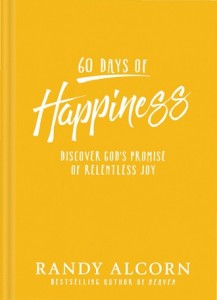 My hope is that readers will experience some paradigm shifts that will forever change their view of happiness and what God thinks of it. It may also change their perspective on God’s nature, causing them to see Him in a way that floods them with gladness and increases their fondness toward our Creator. “In your presence there is fullness of joy; at your right hand are pleasures forevermore” (Psalm 16:11). Much of the battle for joy hinges on whether we believe God is happy and wants us to be too.
As they contemplate God’s happiness, I believe readers of 60 Days of Happinesswill end up not only loving Him more but liking Him better. At least, that’s what happened to me as I studied Scripture and meditated on this subject for more than three years.
Religion so often has brought with it a culture of heaviness and “reverence”—what do you say to those who have a hard time making room for happiness?
I think we have a hard time seeing the place of happiness in the Christian life because we fail to understand that God is happy and that He created us to find delight and satisfaction in Him. Philosopher and theologian Cornelius Van Til (1895–1987) stated, “We may say, in all reverence, that God himself is happy.”
Some readers may be thinking, But does the Bible really say God is happy? The answer is yes—it does! Many times Scripture states that God experiences delight and pleasure. Other times when it affirms God’s happiness, readers of English Bibles don’t understand what the original language was communicating.
The apostle Paul wrote of “the gospel of the glory of the blessed [makarios] God with which I have been entrusted” (1 Timothy 1:11). Later in the same book, he refers to God as “he who is the blessed [makarios] and only Sovereign, the King of kings and Lord of lords” (6:15). In 1611, when King James translators chose the word blessed in verses like these, it meant “happy”! In fact, the 1828 edition of Noah Webster’s dictionary still defined blessed as, “Made happy or prosperous; extolled; pronounced happy. . . . Happy . . . enjoying spiritual happiness and the favor of God; enjoying heavenly felicity.”
Only when we understand that Scripture teaches God is happy can we believe that God wants us to be happy and that happiness has a legitimate place in our worship and reverence for Christ. Scripture makes this statement about imitating Jesus: “Whoever says he abides in him ought to walk in the same way in which he walked” (1 John 2:6). If Jesus walked around mostly miserable, we should be miserable too. If He was happy, we should be happy.
How did happiness get dismissed by the “joy theologians” as something only on the surface or something tied to circumstances?
There’s a long rich, history of equating joy with happiness in Christ. For example, Jonathan Edwards cited John 15:11 (“that [Jesus’] joy might remain in you,” KJV) to prove this point: “The happiness Christ gives to his people, is a participation of his own happiness.”
Charles Spurgeon said, “May you so come, and then may your Christian life be fraught with happiness, and overflowing with joy.” Spurgeon’s views of happiness and joy, evident in hundreds of his sermons, are completely contrary to the artificial wall the contemporary church has erected between the two.
In stark contrast to believers prior to the twentieth century, many modern Christians have portrayed happiness as, at best, inferior to joy and, at worst, evil. Oswald Chambers (1874–1917), whom I greatly respect, is one of the earliest Bible teachers to have spoken against happiness. Chambers wrote, “Happiness is no standard for men and women because happiness depends on my being determinedly ignorant of God and His demands.”
After extensive research, I’m convinced that no biblical or historical basis exists to define happiness as inherently sinful. Unfortunately, because Bible teachers such as Chambers saw people trying to find happiness in sin, they concluded that pursuing happiness was sinful.
Because this concept of joy vs. happiness has been repeated and preached so often throughout the last century, many Christians believe there’s a huge difference between them. Now it’s common to hear people make claims like this: “Joy is in the Bible, but happiness isn’t.”
The problem with statements like these is that they simply aren’t true. Even in the King James Version, which Chambers used, happy is found a total of twenty-nine times. For example, Jesus told His disciples, “If ye know these things, happy are ye if ye do them” (John 13:17). The apostle Paul wrote these words to Christians: “Happy is he that condemneth not himself in that thing which he alloweth” (Romans 14:22).
When did you uncover happiness as a core ingredient in your faith in Christ?
When I first read the Bible as an unchurched teenager, it was new, intriguing, and utterly disorienting. Because I had no reference points when I read Scripture, it wasn’t just Leviticus that confused me. But when I reached the Gospels, something changed. I was fascinated by Jesus. Everything about Him had the ring of truth, and soon I came to believe He was real. Then, by a miracle of grace, He transformed me—and the single most noticeable difference was my newfound happiness.
In the over forty-five years since, like everyone else, I’ve experienced suffering and heartaches in my life. Still, every day I find happiness in the One who reached out to me with His grace decades ago—and continues to do so whenever I call out to Him.
Yet as a young Christian, because I often heard warnings against happiness, I became wary of it. These proclamations were common enough that it seemed they must be right. But they made me uneasy, because I had celebrated my newfound happiness in Christ. Now I was being told that happiness was at least suspect and apparently even unspiritual, and shouldn’t be part of a serious Christian life.
To me, this was counterintuitive. Of course, we shouldn’t turn to sin for happiness—but happiness was something I gained when I came to Christ, not something I gave up! If it was God who made me happy to be forgiven and gave me the joy of a right relationship with Him and the privilege of walking with Him and serving Him, was God really against my happiness?
Years later, I’ve found that many believers are still operating under that assumption that happiness is inherently sinful and has no part in the Christian life. That’s one of the main reasons I studied what God’s word has to say about our happiness and His, and wrote my comprehensive book Happiness, as well as the devotional 60 Days of Happiness and small book God’s Promise of Happiness.
I’m remembering this lyric from my childhood days in church: “Trust and obey, for there’s no other way, to be happy in Jesus, but to trust and obey.” Is this supported by your thesis that happiness and holiness go hand in hand?
In the church I attended, an old Swedish Covenant congregation, we often sang that chorus, too. Though it has been many years since I sat in that church, the refrain still runs through my mind, and it’s worth repeating:
Trust and obey, for there’s no other way
To be happy in Jesus, but to trust and obey.
Some might consider that message simplistic, but I found it to be completely true. When I trusted Jesus, I was happy; when I didn’t, I wasn’t. When I obeyed Jesus—when I chose the path of holiness—I was happy. When I didn’t, I wasn’t.
I can confirm that those words are just as true now as they were then. In fact, they’ve proven true every day of my life since.
Note that the words aren’t an appeal to trust and obey because God demands our obedience (though He has every right to). Rather, the motive for trusting and obeying is being happy in Jesus.
When that hymn was written, happiness in Jesus was regarded as a righteous desire. That’s how we should regard it today. It’s not in opposition to our sanctification; it goes hand in hand with true, humble, Christ-honoring holiness.
How do you answer those who charge that “happiness” in the life of a Christ-follower is not the destination or end-goal?
I would agree that happiness, in and of itself, isn’t our ultimate goal.
At one point in my life, I wanted Jesus plus happiness. But this, I’m convinced, is wrong. What I first experienced as a young Christian was exactly right—happiness in Jesus. Jesus plus happiness separates the two, and when this occurs, happiness ascends the throne instead of Jesus. But happiness in Jesus recognizes that Jesus is bigger than happiness. This keeps happiness in its place. It doesn’t become an idol; instead, it’s seen for what it is—a natural and beautiful by-product of knowing and loving God.
If gambling, alcohol, television, video games, golf or fantasy football has become an idol to us—as nearly anything can—we’d be wise to give it up. But we can’t give up our desire for happiness. Instead, we need to turn it to its proper object—God—putting Him first by seeking our greatest happiness in Him.
Some might still say, “Our sole purpose in life is to glorify God, not to seek happiness.” But as John Piper puts it, “God is most glorified in us when we are most satisfied in Him.” In other words, to be happy in God is to glorify God.
The Westminster Shorter Catechism was written in 1646 by a group of English, Irish, and Scottish Reformed theologians. It begins with the question, “What is the chief end of man?” and offers the reply, “Man’s chief end is to glorify God and to enjoy Him forever.” For theologians to come up with “glorify God” is no surprise. But to enjoy him forever?
Think about this. Why didn’t they add “obey God forever” or “fear God forever”?
The composers of the catechism weren’t firing off an e-mail in which they chose words on the fly. They were writing a painstakingly deliberate statement of belief and practice that generations to come would memorize and seek to live by. Each word was judiciously selected.
Those seventeenth-century theologians and pastors stated that we exist not only to glorify God but also to find pleasure and happiness in Him. This doesn’t fit the stereotype of stodgy religious Scotsmen from nearly four hundred years ago.
Remarkably, the English Parliament officially endorsed this confession not long after it was written. What did theologians and even members of Parliament realize that has somehow been obscured in the centuries that followed?
And what does it mean to enjoy God? The Puritans knew. Thomas Watson said, “What is enjoying God for ever but to be put in a state of happiness? . . . God is the summum bonum, the chief good; therefore the enjoyment of him is the highest felicity.”
The catechism writers understood that God created people not only to glorify Him but also to be happy in Him—to be in a personal relationship with Him that’s deep, satisfying, and everlasting. As Psalm 68:3 says, “But may the righteous be glad and rejoice before God; may they be happy and joyful” (NIV).
What is one of your favorite stories or segments from 60 Days of Happiness?
In day 27, “Who or what is our primary source of happiness?” I share that one of the keys to enjoying life is connecting the dots between our happiness and God as its provider. He’s the one whose overflowing reservoir of happiness has spilled over into His creation.
As I wrote that entry for the book, I was looking up from my computer at a photo I took underwater. It reminded me of the sheer delight of my unforgettable ninety-minute encounter with a wonderful monk seal I named Molly.
Whenever I look at Molly’s photo, my heart fills with joyful memories and longing for the New Earth’s joy and the days that await us. That anticipation gives me a harvest of happiness today. Of course, many people who don’t know God love to snorkel and dive. They’re truly moved by the enchanting beauty of the reef.
But an immense part of my happiness as I snorkel is knowing God, the primary, who made all these secondary wonders. I sense His presence with me—both when I’m out in His ocean and as I sit in my home remembering His nearness, both then and now. This is a shared experience between my God and me, and even as I type, the memories of countless hours spent in the water together with Him, enjoying His beautiful underwater kingdom, bring joyful tears to my eyes. The beautiful coral reef and its wondrous creatures don’t draw me away from God—they draw me to Him.
Photo: Unsplash
Previous Post

June 19, 2017
Joni Eareckson Tada’s Advice for When You Don’t Wake Up Feeling Happy

Browse Our Archives
Select a Category About Me Animals Books Books and Resources Christ Christian Life Christians Past and Present Church Creation Culture and Worldview Doctrine and Theology Eternal Perspective Ministries Fun Grace and Truth Grief Happiness Heaven Marriage and Family Missions Money and Giving Persecuted Church Politics Prayer Prolife Salvation Sexual Purity Sovereignty and Free Will Suffering and Evil Uncategorized Writing
Select a Month October 2026 September 2026 August 2026 July 2026 June 2026 May 2026 April 2026 March 2026 February 2026 January 2026 December 2025 November 2025 October 2025 September 2025 August 2025 July 2025 June 2025 May 2025 April 2025 March 2025 February 2025 January 2025 December 2024 November 2024 October 2024 September 2024 August 2024 July 2024 June 2024 May 2024 April 2024 March 2024 February 2024 January 2024 December 2023 November 2023 October 2023 September 2023 August 2023 July 2023 June 2023 May 2023 April 2023 March 2023 February 2023 January 2023 December 2022 November 2022 October 2022 September 2022 August 2022 July 2022 June 2022 May 2022 April 2022 March 2022 February 2022 January 2022 December 2021 November 2021 October 2021 September 2021 August 2021 July 2021 June 2021 May 2021 April 2021 March 2021 February 2021 January 2021 December 2020 November 2020 October 2020 September 2020 August 2020 July 2020 June 2020 May 2020 April 2020 March 2020 February 2020 January 2020 December 2019 November 2019 October 2019 September 2019 August 2019 July 2019 June 2019 May 2019 April 2019 March 2019 February 2019 January 2019 December 2018 October 2018 September 2018 August 2018 July 2018 June 2018 May 2018 April 2018 March 2018 February 2018 January 2018 December 2017 November 2017 October 2017 September 2017 August 2017 July 2017 June 2017 May 2017 April 2017 March 2017 February 2017 January 2017 December 2016 November 2016 October 2016 September 2016 August 2016 July 2016 June 2016 May 2016 April 2016 March 2016 February 2016 January 2016
Follow Us!
TAKE THE
Religious Wisdom Quiz
Which northern king made golden calves for worship at Bethel and Dan?
Select your answer to see how you score.
Jehu Jeroboam Ahab Omri
Books by This Author Books by Randy Alcorn
Related posts from Eternal Perspectives, with Randy Alcorn

If Christians Shouldn’t Be Happy, Who Should Be?
Eternal Perspectives, with Randy Alcorn

True Happiness Is Only Found in the Last...
Eternal Perspectives, with Randy Alcorn

Attempting to Separate Holiness and Happiness Distorts Both
Eternal Perspectives, with Randy Alcorn

The Longing of God’s People for Heaven on...
Eternal Perspectives, with Randy Alcorn
TRENDING AT PATHEOS Evangelical

Methodist Central Hall and Westminster Abbey
Situated on the same square is Methodist Central Hall and Westminster Abbey. ...

57th Dove Awards Honor Dolly Parton, Crown New...
On gospel music’s biggest night, the 57th annual GMA Dove Awards honored...

The First Eucharistic Controversy: Christ’s Real Presence
For Catholics, the Eucharist is the source and summit of the Christian...

What a Stop Sign Can Teach Us About...
How to Make a Decision When You Can't Hear God Main point:...

Archdiocese Hosts Military Marriage Retreat in Germany
RASTATT, Germany — The transient military lifestyle, with its frequent deployments and...

Nearly every morning, I make the drive to Detroit with my high-school-age...
view all Evangelical blogs
Ad-Free & Subscriber Log-In Subscription Support
- About Us
- 2026 Calendar
- Videos
- Podcasts
- Library of World Religions
- Faith In Media Tracker
- Advertise With Us
- Write for Us
- Privacy Policy
- Terms of Service
- Do Not Sell My Data
- Contact Us
- Radiant Digital
- Manage Newsletter Subscriptions
- Unsubscribe From Notifications
- Sitemap
Copyright 2008-2026, Patheos. All rights reserved.
Subscription Support Ad-Free & Subscriber Log-In
Follow Patheos