
BuddhistCatholicContemplativeEvangelicalGeneral ChristianHinduJewishLatter-day SaintMuslimNew VisionsProgressive Christian
Beliefs
- Buddhist
- Catholic
- Contemplative
- Evangelical
- General Christian
- Hindu
- Jewish
- Latter-day Saint
- More Voices
- Muslim
- New Visions
- Pagan
- Progressive Christian
Topics
- Religion News
- Food and Religion
- Sports and Religion
- Religious Art
- Religious Music and Entertainment
- Religious Events
- History and Religion
- Style and Religion
- Politics and Religion
- Women in Religion
- Recreation Outdoors and Religion
- Business Finance and Religion
- Careers Workplace and Religion
- Education and Religion
- Family Parenting and Religion
- Health Fitness and Religion
- Home and Religion
- Relationships and Religion
- Technology and Religion
- Travel and Religion
Columnists
- Buddhist Columnists
- Business Finance and Religion Columnists
- Careers Workplace and Religion Columnists
- Catholic Columnists
- Contemplative Columnists
- Education and Religion Columnists
- Evangelists Columnists
- Family Parenting and Religion Columnists
- General Christian Columnists
- Health Fitness and Religion Columnists
- Hindu Columnists
- History and Religion Columnists
- Home and Religion Columnists
- Jewish Columnists
- More Voices Columnists
- Latter Day Columnists
- Muslim Columnists
- New Visions Columnists
- Nonreligious Columnists
- Pagan Columnists
- Politics and Religion Columnists
- Progressive Columnists
- Recreation Outdoors and Religion Columnists
- Relationships and Religion Columnists
- Religion News Columnists
- Religious Art Columnists
- Religious Events Columnists
- Religious Music and Entertainment Columnists
- Sports and Religion Columnists
- Style and Religion Columnists
- Technology and Religion Columnists
- Travel and Religion Columnists
- Women in Religion Columnists
Resource Library
- 2026 Calendar
- Library of World Religions
- The 100 Most Holy Places on Earth
- Patheos Answers
- Podcasts
- Videos
- Faith Leaders Database
- Anglican Episcopalian
- Bahai
- Baptist
- Buddhism
- Christianity
- Confucianism
- Eastern Orthodoxy
- Hinduism
- Holiness and Pentecostal
- ISKCON
- Islam
- Judaism
- Lutheran
- Methodist
- The Church of Jesus Christ of Latter-day Saints
- New Age
- Paganism
- Presbytarian and Reformed
- Protestantism
- Religion Behind the Scenes
- Roman Catholic
- Scientology
- Shia Islam
- Sikhism
- Sufism
- Sunni Islam
- Taoism
- Zen
- See all religions
Research Tools
 Ad-Free & Subscriber Log-In Subscription Support
Ad-Free & Subscriber Log-In Subscription Support
Follow Patheos 

- Trending:
- Forgiveness
- |
- Marriage
- |
- Consciousness
- |
- Death Penalty
- |
- Election
- |
- Halloween
 Radical Christian Millennial
- Home
- Progressive Christian
- Towards A Non-Apocalyptic Jesus
Towards A Non-Apocalyptic Jesus
Last updated on: July 22, 2016 at 3:16 am by Christian Chiakulas
Towards A Non-Apocalyptic Jesus 2016-07-22T03:16:18-04:00 Christian Chiakulas
Patheos Explore the world's faith through different perspectives on religion and spirituality! Patheos has the views of the prevalent religions and spiritualities of the world.
We start by collecting the earliest and best-attested Kingdom sayings throughout the gospels; I have used those identified by John Dominic Crossan in his book “Jesus: The Life of A Mediterranean Jewish Peasant.” These are the sayings most likely to be authentic words of Jesus because, as Crossan puts it, they are the ones “where at least two independent sources claim the Kingdom expression” (Crossan 459). I have only included these sayings from what Crossan identifies as the first (earliest) stratum of material, which ends with Mark (or possible the Didache, see below) and includes the hypothetical Q document as well as the Gospel of Thomas.
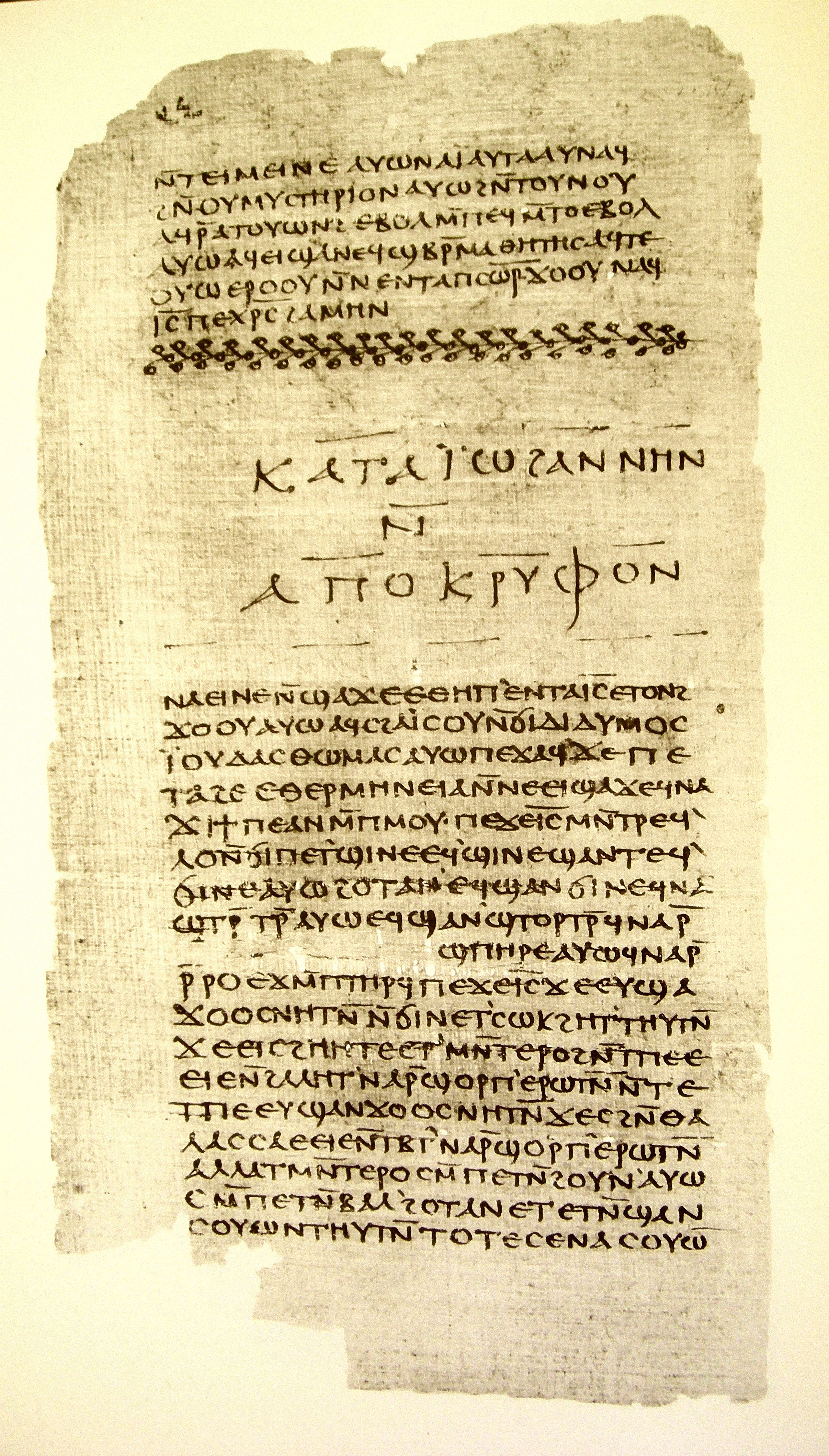
Beginning of the Gospel of Thomas, found at Nag Hammadi in 1945
These sayings are, by name/general summary: Kingdom and Children, The Mustard Seed, Blessed the Poor, When and Where, Two as One, The Lord’s Prayer, Greater Than John, The Planted Weeds, The Pearl, The Leaven, and The Treasure.
These sayings can be divided into four categories regarding their eschatological implications: ambiguous, neutral, apocalyptic, and anti-apocalyptic (favoring a “realized eschatology”), plus a special fifth category that deserves special attention. By my judgment:
Kingdom and Children and Blessed the Poor are neutral;
Only The Treasure is ambiguous (this is one of Jesus’s most confusing parables, and the disparate versions in Matthew and Thomas don’t help);
Lord’s Prayer and The Planted Weeds are unambiguously apocalyptic;
Mustard Seed, Two as One, Greater than John, The Pearl, and The Leaven are anti-apocalyptic;
And finally When and Where is apocalyptic in some forms, anti-apocalyptic in others. This requires careful explanation and hinges on the term “Son of Man.”
Before we get to that, let us deal with the other two explicitly apocalyptic sayings, Lord’s Prayer and The Planted Weeds.
The Lord’s Prayer comes to us in three versions; one in Matthew, one in Luke, and a third in the Didache that is extremely similar to Matthew.
If we accept the two-source answer to the Synoptic Problem, which I along with most scholars generally do, it seems clear that Luke’s shorter version of the prayer, which lacks any apocalyptic connotations whatsoever, is earliest. Generally, shorter forms of sayings are earlier; writers are much more likely to add than subtract. Matthew, as I’ve noted, is by far the most apocalyptic of the Synoptic gospels, and it makes sense for him to have added a plea for the Kingdom to hurry up when he was adapting from Q. The inverse theory, that Luke used Matthew as a source, claims that Luke took the second petition away because Luke had an anti-apocalyptic bias. This may sound convincing unless you know that A.) Matthew had already intensified the apocalypticism of Mark, and B.) Luke preserves other apocalyptic sayings intact.
(Quick aside: this would suggest that the Didache is dependent on Matthew, or vice-versa, a minority but very plausible opinion. I’m fine with that).
So I take the apocalyptic reference in the Lord’s Prayer as a probable interpolation, and certainly as not going back to the historical Jesus. The Planted Weeds, found in Thomas 57 and Matthew 13:24-30, speaks of weeds being separated from the good wheat and burned at the time of harvest. It is an interesting addition to Thomas, which is generally anti-apocalyptic. In any case, Matthew shows his hand a few passages later, when he literally has Jesus interpret this parable to his disciples: “The one who sows is the Son of Man; the field is the world, and the good seed are the children of the kingdom; the weeds are the children of the evil one, and the enemy who sowed them is the devil; the harvest is the end of the age, and the reapers are angels” (Matthew 13:37-39).
This should remind you of Augustine’s and Origen’s absolutely absurd allegorical interpretation of the Good Samaritan, in which literally every element of that story is a stand-in for something else (the inn, for example, is the Church). This way of reading parables has been criticized by everyone from John Calvin to CH Dodd (who, by the way, coined the term “realized eschatology”). The idea that Jesus himself would interpret his own parable (which defeats the purpose of a parable) in such a heavy-handed way is, quite frankly, absurd, and so Matthew’s usage if not the saying itself must fall under heavy suspicion.
Previous Post
July 17, 2016
Genesis - The Hope of the Exiled (And Some Funny Stuff, Too)
Next Post
July 24, 2016 Exodus - Israel Deals With Its Separation Anxiety
Browse Our Archives
Select a Category Activism Bible Communism Communism and Socialism Faith Historical Jesus History Justice Millennials Personal Politics The Kingdom of God Uncategorized
Select a Month December 2017 November 2017 October 2017 September 2017 August 2017 June 2017 May 2017 April 2017 March 2017 December 2016 October 2016 September 2016 August 2016 July 2016
Follow Us!
TAKE THE
Religious Wisdom Quiz
What happened to the golden calf?
Select your answer to see how you score.
Hidden Taken to Canaan Burned, ground to powder Set up for worship
Related posts from Radical Christian Millennial
Here's Why Productivity Doesn't Raise Wages Anymore

Polyamory and the Kingdom of God

What the Hell is Ta-Nehisi Coates Talking About?

TRENDING AT PATHEOS Progressive Christian

Why Christians Have a Sacred Duty to Vote:...
The Bible offers strong support for the sacred duty to vote. Here...

What Being a Modern-Day Apostle Means to Me
In my last column, I discussed the ins and outs of modern-day...

Did Ancient China Once Worship the God of...
Across human history, a common thread weaves through the origins of the...

Love Your Neighbor – Including Earth-Kin: Lev. 19,...
God’s command to love your neighbor means acting in an ethical and...

Lead a Church Study of “Jesus and Lao...
Guest writer Jack Thomas (The Irreverent Reverend) reflects on leading his church...

Principles for Understanding the Apostolic Ministry Today
Whenever people discover that my formal ministry title is "apostle," as in...
view all Progressive Christian blogs
Ad-Free & Subscriber Log-In Subscription Support
- About Us
- 2026 Calendar
- Videos
- Podcasts
- Library of World Religions
- Faith In Media Tracker
- Advertise With Us
- Write for Us
- Privacy Policy
- Terms of Service
- Do Not Sell My Data
- Contact Us
- Radiant Digital
- Manage Newsletter Subscriptions
- Unsubscribe From Notifications
- Sitemap
Copyright 2008-2026, Patheos. All rights reserved.
Subscription Support Ad-Free & Subscriber Log-In
Follow Patheos