
BuddhistCatholicContemplativeEvangelicalGeneral ChristianHinduJewishLatter-day SaintMuslimNew VisionsProgressive Christian
Beliefs
- Buddhist
- Catholic
- Contemplative
- Evangelical
- General Christian
- Hindu
- Jewish
- Latter-day Saint
- More Voices
- Muslim
- New Visions
- Pagan
- Progressive Christian
Topics
- Religion News
- Food and Religion
- Sports and Religion
- Religious Art
- Religious Music and Entertainment
- Religious Events
- History and Religion
- Style and Religion
- Politics and Religion
- Women in Religion
- Recreation Outdoors and Religion
- Business Finance and Religion
- Careers Workplace and Religion
- Education and Religion
- Family Parenting and Religion
- Health Fitness and Religion
- Home and Religion
- Relationships and Religion
- Technology and Religion
- Travel and Religion
Columnists
- Buddhist Columnists
- Business Finance and Religion Columnists
- Careers Workplace and Religion Columnists
- Catholic Columnists
- Contemplative Columnists
- Education and Religion Columnists
- Evangelists Columnists
- Family Parenting and Religion Columnists
- General Christian Columnists
- Health Fitness and Religion Columnists
- Hindu Columnists
- History and Religion Columnists
- Home and Religion Columnists
- Jewish Columnists
- More Voices Columnists
- Latter Day Columnists
- Muslim Columnists
- New Visions Columnists
- Nonreligious Columnists
- Pagan Columnists
- Politics and Religion Columnists
- Progressive Columnists
- Recreation Outdoors and Religion Columnists
- Relationships and Religion Columnists
- Religion News Columnists
- Religious Art Columnists
- Religious Events Columnists
- Religious Music and Entertainment Columnists
- Sports and Religion Columnists
- Style and Religion Columnists
- Technology and Religion Columnists
- Travel and Religion Columnists
- Women in Religion Columnists
Resource Library
- 2026 Calendar
- Library of World Religions
- The 100 Most Holy Places on Earth
- Patheos Answers
- Podcasts
- Videos
- Faith Leaders Database
- Anglican Episcopalian
- Bahai
- Baptist
- Buddhism
- Christianity
- Confucianism
- Eastern Orthodoxy
- Hinduism
- Holiness and Pentecostal
- ISKCON
- Islam
- Judaism
- Lutheran
- Methodist
- The Church of Jesus Christ of Latter-day Saints
- New Age
- Paganism
- Presbytarian and Reformed
- Protestantism
- Religion Behind the Scenes
- Roman Catholic
- Scientology
- Shia Islam
- Sikhism
- Sufism
- Sunni Islam
- Taoism
- Zen
- See all religions
Research Tools
 Ad-Free & Subscriber Log-In Subscription Support
Ad-Free & Subscriber Log-In Subscription Support
Follow Patheos 

- Trending:
- Forgiveness
- |
- Marriage
- |
- Consciousness
- |
- Death Penalty
- |
- Election
- |
- Halloween
 Radical Christian Millennial
- Home
- Progressive Christian
- Genesis – The Hope of the Exiled (And Some Funny Stuff, Too)
Genesis – The Hope of the Exiled (And Some Funny Stuff, Too)
Last updated on: July 24, 2016 at 12:16 am by Christian Chiakulas
Genesis – The Hope of the Exiled (And Some Funny Stuff, Too) 2016-07-24T00:16:11-04:00 Christian Chiakulas
Patheos Explore the world's faith through different perspectives on religion and spirituality! Patheos has the views of the prevalent religions and spiritualities of the world.
As a part of my quest to read the Bible all the way through – and blog the results – over the past few days I sat down and read Genesis from In the Beginning to Joseph’s burial in Egypt. Then I busted open my Introduction to the Bible textbook and read what it had to say. Then I read Genesis again the next day.
Aside from the fact that my head is now filled with so many ancient Near-Eastern proper nouns I might short-circuit (I especially love the ones that start with “beer” like “Beer-sheba”), what struck me immediately on my first reading is just how much Genesis reflects an Exilic worldview.
Now, I obviously had been familiar with Genesis before this undertaking; its stories are among the most famous in the entire Christian Bible, and its location means that a lot of people who start reading the Bible with grand notions in their heads can get through it pretty easily before giving up. I can honestly say that none of the contents truly surprised me.
I also was familiar with the “Documentary hypothesis” before doing this. John Dominic Crossan touched on it in his last book, How to Read the Bible and Still Be A Christian, and since then I’ve read up on it in a few other sources. It posits in its most common form that Genesis is the work of two distinct sources called the Yahwist and Priestly sources (J and P).
Now, the Yahwist source, which makes up the majority of Genesis, is generally thought to have been composed during the Monarchy, making it the earliest of the Torah’s sources. A compelling minority position, which I find more convincing, dates J to sometime during the Babylonian exile of the 6th century BCE.
Even without any knowledge of the exile and its indescribable influence on Judaic thought, you are struck by how many people in these stories are exiled in some way. Adam and Eve from Eden, Cain from his family, Hagar and Ishmael from Abraham, Jacob from Isaac, Joseph from Jacob…it’s almost as if the composer(s) of these stories were dealing with some separation anxiety of some sort.
Beyond that, the parallels in the “primordial history” of Genesis 1-12 to the creation myths of ancient Mesopotamia have been long noted. The great flood, Cain and Abel, the cunning serpent, and many other motifs and narratives come in modified form from ancient Mesopotamian legends such as the Epic of Gligamesh and the Enuma Elish, both dated to the 2nd millennium BCE. Kugler and Hartin state “the neo-Babylonian Empire responsible for the Judean Exile was unique in its desire to cultivate among its citizens the ancient myths of Mesopotamia” (55).
(Kugler and Hartin also cite as evidence that 11:31 mentions then-Abram being called from “Ur of the Chaldeans” which would be a glaring anachronism before the 7th or 6th centuries BCE; however they don’t consider the possibility of Priestly redaction of a Yahwist passage, so this piece of evidence is tenuous at best).
In any case, the constant emphasis on exile coupled with God’s faithfulness and enduring love for the descendants of Abraham seem so painfully obviously about the Babylonian Captivity I wonder if this reading will color my thoughts on the rest of the Torah going forward. The stories of humankind consistently failing to live up to God’s expectations and continuing only through God’s mercy (such as the mark of Cain) just don’t seem to fit into the court of a king like David.
So while of course some of these stories originate much earlier than the Exile, the current written form seems to me (at this point) a clear example of Exilic or even post-Exilic theology and etiology with the aim of nurturing hope and faith on the parts of the displaced Jews. The theme of God’s steadfast love and faith for Abraham’s family, even in the face of their failures and deceits (of which there are many), as well as the “tests” he puts them through (the Binding of Isaac is the most famous) seems to me a counterpoint to the very Deuteronomic idea that the Captivity was in some way a punishment for lack of faith.
Going forward I will be paying extremely close attention to the relationship between the Yahwist material and the Deuteronomic material, as well as looking for more evidence about J’s origin (monarchy or exile?)
Finally, I want to remark on something that is in no way profound (at least, not that I can think of) but that I found pretty hilarious both times I read.
Poor King Abimelech of Gerar, man. First Abraham and Sarah go into his lands, and he’s like, “Wow, this Sarah chick is gorgeous.”
And Abraham’s all like, “Oh, she’s my sister.”
So Abimelech, like any red-blooded Gerarian male, is all over that. Thankfully, God warns him in a dream that Sarah is really Abraham’s wife, so he returns her (just like you return a book to the library!) to her husband, hilariously calling him out as he does so:
“What have you done to us? How have I sinned against you, that you have brought such great guilt on me and my kingdom? You have done things to me that ought not to be done.” (20:10)
Abraham’s reply is just delightful. “I did it because I thought, There is no fear of God at all in this place, and they will kill me because of my wife.”
Translation: “I figured you guys were all a bunch of scumbags, even though I literally just got here.”
Then: “Oh, and it’s okay, because she totally is my sister as well as my wife. So technically I didn’t lie.”
Abimelech is so embarrassed he gives Abraham sheep and oxen and slaves and permission to settle anywhere in his lands. Abraham walks away now wealthy, presumably like this:
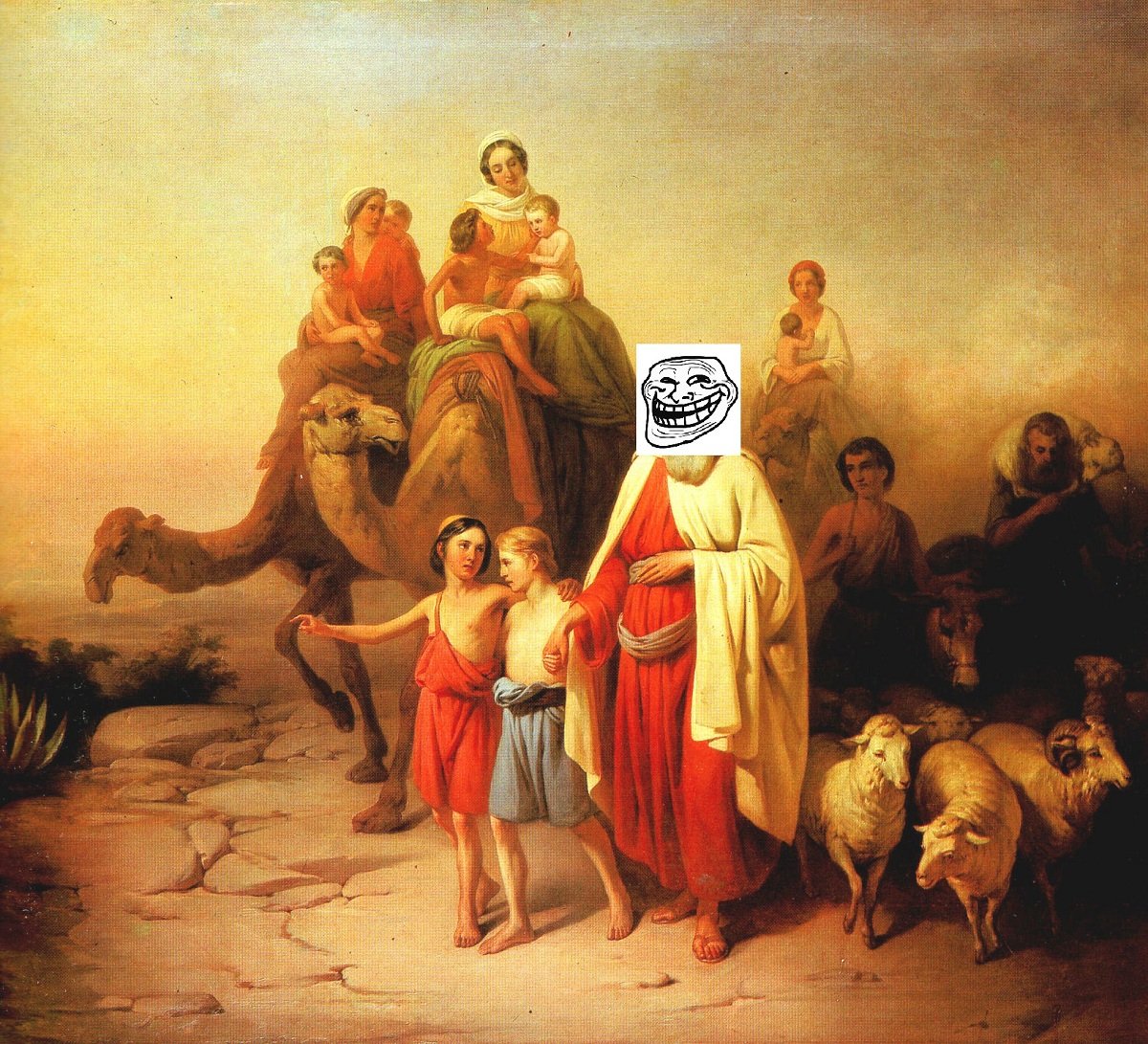
Behold my mad MS Paint skills.
But wait, because that’s not even the funny part. Many years later, Abraham’s son Isaac is in Gerar with his wife Rebekah, and what does the little shit do? He literally pulls the exact same stunt on Abimelech.
Can you imagine the look on Abimelech’s face when he realized that not only did he fall for the same absurd stunt twice, but that the second time was by the son of the guy who did it the first time? This poor guy never did anything to insult the God of Israel, and yet they terrorized him.
Isaac gives some kind of lame excuse about being afraid that Rebekah is so beautiful that people will murder him so they can take her for themselves (this makes Isaac the inventor of the humble-brag), but this is clearly absurd because this is literally the same king that made a covenant with Isaac’s father.
So in addition to being the chosen progenitor of God’s chosen people, Abraham was also likely the world’s first troll, a skill which he passed down to his children and grandchildren (Joseph trolled his brothers for years, not that they didn’t have it coming).
Now, again, I knew all of these stories before, but reading them all in one sitting like this allowed me to find the humor in them. It’s little things like this that keep me interested in the Bible, and I’m sure there will be more to come.
Next week! Moses and the Exodus: Did any of it really happen? And does that even matter? Tune in to hear my take on it.
Previous Post

July 13, 2016
Sunday: Let's Read the Bible With Fresh Eyes Together
Next Post

July 22, 2016 Towards A Non-Apocalyptic Jesus
Browse Our Archives
Select a Category Activism Bible Communism Communism and Socialism Faith Historical Jesus History Justice Millennials Personal Politics The Kingdom of God Uncategorized
Select a Month December 2017 November 2017 October 2017 September 2017 August 2017 June 2017 May 2017 April 2017 March 2017 December 2016 October 2016 September 2016 August 2016 July 2016
Follow Us!
TAKE THE
Religious Wisdom Quiz
In Jude, what did the Lord do to the people he saved from Egypt who did not believe?
Select your answer to see how you score.
Punished them Destroyed them Let them wander forty years Cast them into the wilderness
Related posts from Radical Christian Millennial

Here's Why Productivity Doesn't Raise Wages Anymore

While We're Outing Sexual Abusers, Let's Address Louis...

Polyamory and the Kingdom of God

What the Hell is Ta-Nehisi Coates Talking About?
TRENDING AT PATHEOS Progressive Christian

What Being a Modern-Day Apostle Means to Me
In my last column, I discussed the ins and outs of modern-day...

Did Ancient China Once Worship the God of...
Across human history, a common thread weaves through the origins of the...

Love Your Neighbor – Including Earth-Kin: Lev. 19,...
God’s command to love your neighbor means acting in an ethical and...

Lead a Church Study of “Jesus and Lao...
Guest writer Jack Thomas (The Irreverent Reverend) reflects on leading his church...

Pastoral Wisdom for Responding to Sermon Pushback
Getting sermon pushback on your social justice sermon? Learn practical, Proverbs-based strategies...

Principles for Understanding the Apostolic Ministry Today
Whenever people discover that my formal ministry title is "apostle," as in...
view all Progressive Christian blogs
Ad-Free & Subscriber Log-In Subscription Support
- About Us
- 2026 Calendar
- Videos
- Podcasts
- Library of World Religions
- Faith In Media Tracker
- Advertise With Us
- Write for Us
- Privacy Policy
- Terms of Service
- Do Not Sell My Data
- Contact Us
- Radiant Digital
- Manage Newsletter Subscriptions
- Unsubscribe From Notifications
- Sitemap
Copyright 2008-2026, Patheos. All rights reserved.
Subscription Support Ad-Free & Subscriber Log-In
Follow Patheos