
BuddhistCatholicContemplativeEvangelicalGeneral ChristianHinduJewishLatter-day SaintMuslimNew VisionsProgressive Christian
Beliefs
- Buddhist
- Catholic
- Contemplative
- Evangelical
- General Christian
- Hindu
- Jewish
- Latter-day Saint
- More Voices
- Muslim
- New Visions
- Pagan
- Progressive Christian
Topics
- Religion News
- Food and Religion
- Sports and Religion
- Religious Art
- Religious Music and Entertainment
- Religious Events
- History and Religion
- Style and Religion
- Politics and Religion
- Women in Religion
- Recreation Outdoors and Religion
- Business Finance and Religion
- Careers Workplace and Religion
- Education and Religion
- Family Parenting and Religion
- Health Fitness and Religion
- Home and Religion
- Relationships and Religion
- Technology and Religion
- Travel and Religion
Columnists
- Buddhist Columnists
- Business Finance and Religion Columnists
- Careers Workplace and Religion Columnists
- Catholic Columnists
- Contemplative Columnists
- Education and Religion Columnists
- Evangelists Columnists
- Family Parenting and Religion Columnists
- General Christian Columnists
- Health Fitness and Religion Columnists
- Hindu Columnists
- History and Religion Columnists
- Home and Religion Columnists
- Jewish Columnists
- More Voices Columnists
- Latter Day Columnists
- Muslim Columnists
- New Visions Columnists
- Nonreligious Columnists
- Pagan Columnists
- Politics and Religion Columnists
- Progressive Columnists
- Recreation Outdoors and Religion Columnists
- Relationships and Religion Columnists
- Religion News Columnists
- Religious Art Columnists
- Religious Events Columnists
- Religious Music and Entertainment Columnists
- Sports and Religion Columnists
- Style and Religion Columnists
- Technology and Religion Columnists
- Travel and Religion Columnists
- Women in Religion Columnists
Resource Library
- 2026 Calendar
- Library of World Religions
- The 100 Most Holy Places on Earth
- Patheos Answers
- Podcasts
- Videos
- Faith Leaders Database
- Anglican Episcopalian
- Bahai
- Baptist
- Buddhism
- Christianity
- Confucianism
- Eastern Orthodoxy
- Hinduism
- Holiness and Pentecostal
- ISKCON
- Islam
- Judaism
- Lutheran
- Methodist
- The Church of Jesus Christ of Latter-day Saints
- New Age
- Paganism
- Presbytarian and Reformed
- Protestantism
- Religion Behind the Scenes
- Roman Catholic
- Scientology
- Shia Islam
- Sikhism
- Sufism
- Sunni Islam
- Taoism
- Zen
- See all religions
Research Tools
 Ad-Free & Subscriber Log-In Subscription Support
Ad-Free & Subscriber Log-In Subscription Support
Follow Patheos 

- Trending:
- Forgiveness
- |
- Marriage
- |
- Consciousness
- |
- Death Penalty
- |
- Election
- |
- Halloween
 Quranalyze It
-
Categories
-
Meet The Author
-
- Home
- Muslim
- Non-Believers and the Qur’an: An Atheist Examines a Stupid Meme | Kile Jones
Non-Believers and the Qur’an: An Atheist Examines a Stupid Meme | Kile Jones
Last updated on: April 17, 2015 at 9:50 am by Ro Waseem
Non-Believers and the Qur’an: An Atheist Examines a Stupid Meme | Kile Jones 2015-04-17T09:50:41+05:00 Ro Waseem
Patheos Explore the world's faith through different perspectives on religion and spirituality! Patheos has the views of the prevalent religions and spiritualities of the world.
GUEST POST BY KILE JONES
As an avid practitioner of social media, I have come to accept the sharing of overly simplistic, naïve, and hateful memes as commonplace. The digital marketplace is not minus the vitriol of the real world. But as a former student of religious studies, and an atheist interested in working with religious persons, there are times when I have to stand up and say, “enough is enough!”
Recently I came across a meme comparing the Qur’an with hate speech. Apparently, according to this meme, the Qur’an says hateful things about “non-believers” 50 or so times. Including calling us “pigs,” “liars,” and “losers,” to name a few of the cacophony of slanders.
Many of these passages are cited more than once, so I won’t bother going over the same verses twice.
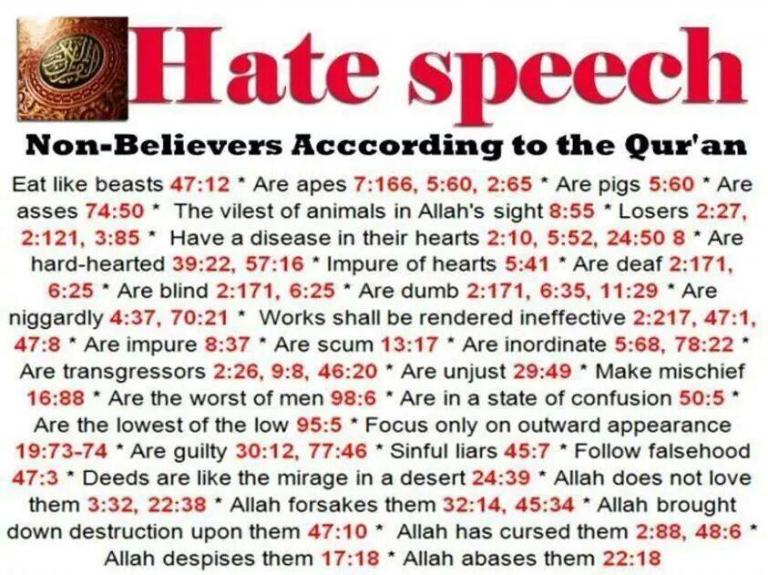
So I decided to look up these verses and see for myself whether this meme should be taken to show the Qur’an as hostile to non-believers.
1) We “eat like beasts.”
- 47:12:“Indeed, Allah will admit those who have believed and done righteous deeds to gardens beneath which rivers flow, but those who disbelieve enjoy themselves and eat as grazing livestock eat, and the Fire will be a residence for them.”
O.k. so those who disbelieve “enjoy themselves and eat as graving livestock eat.” Maybe I am being too nice, but I don’t see this verse saying, “You non-believers, you eat like beasts!” The verse appears to be juxtaposing the righteous—who have done righteous deeds—and not just any non-believers, but those who focus on carnal and fleshly pleasures. These non-believers are pictured as roaming around, illogically sucking up a hedonic fix. They are as dumb as livestock, because they only focus on “enjoying themselves.”
Many of us atheists, say the same things to the orgiastic-frenzied followers of Dionysus. They are set aside again two verses later, so notice what kind of non-believer is spoken of: “So is he who is on clear evidence from his Lord like him to whom the evil of his work has been made attractive and they follow their [own] desires?” [emphasis mine].
2) We “are apes.”
- 7:166: “So when they were insolent about that which they had been forbidden, We said to them, “Be apes, despised.”
Us non-believers call them “common ancestors,” but calling someone an ape can be quite the insult. But we have to ask who “they” are? Are “they” non-believers in general? Nope. If you read Surah 7 you will realize that it is describing the story of Adam, all the way down to Moses and Noah. Verses 61-64 speak specifically about Noah and the deluge. In verse 163, you will find the people who are called “apes”—a group of people who disobeyed the Sabbath, not non-believers in general. Once again, context matters.
In Surah 5, you will see that Muslims were taking in ridicule for their prayers (57-58) amongst the various “People of the Book” (“′Ahl al-Kitāb,” usually thought of as early Jewish and Christian sects). Apparently the rabbis and religious scholars of the time were not forbidding certain speech and action (63), and they are being rebuked. Once again, this is not directed to all non-believers, but to religious persons. These verses call out Sabbath-breakers and those who worship false gods (“Taghut”), not your everyday non-believer. It is the same with Surah 2. Notice how verse 65 mentions “those who transgressed among you concerning the sabbath.”
3) We are “the vilest of animals in Allah’s sight.”
- 8:55: “Indeed, the worst of living creatures in the sight of Allah are those who have disbelieved, and they will not [ever] believe.”
So who are these people? They have “disbelieved,” that’s for sure. They appear to be connected to the people described in the next verse “whom you made a treaty but then they break their pledge every time.” The verse before speaks of them as well: “[Theirs is] like the custom of the people of Pharaoh and of those before them.” The verses following 55 indicate that these are people who are breaking peace treaties with Muslims. If we strictly isolate “disbelievers,” and universalize Allah’s approach to them, then yes, this verse is problematic. But, once again, if this verse is about a specific kind of non-believer, then we must be careful not to generalize to all non-believers.
4) We are “losers.”
- 2:27: “Who break the covenant of Allah after contracting it and sever that which Allah has ordered to be joined and cause corruption on earth. It is those who are the losers.”
- 3:85: “And whoever desires other than Islam as religion – never will it be accepted from him, and he, in the Hereafter, will be among the losers.”
Far from the worst of insults, “loser” can still be quite offensive. So you break a contract, don’t believe in the Qur’an, and desire a different religion, and you lose. It would be strange to think of these verses as something other than basic religious doctrine—namely, there are tenets in Islam as there are in any other religion, tenets that prescribe one way of thinking and acting and condemn other ways of thinking and acting.
It would be foolish to think of this like that high-school friend who would say, “what a loser!” This is meant to convey a loss of cosmic proportions, not to name-call. All of the verses following 3:85 are about the eternal states of believers and non-believers, and yes, it looks like non-believers will be punished in the afterlife. And to be honest, you can easily find more grueling depictions of torment in certain forms of Buddhism, or Christianity for that matter.
5) We “have a disease in our hearts.”
- 2:10: “In their hearts is disease, so Allah has increased their disease; and for them is a painful punishment because they [habitually] used to lie.”
- 5:52: “So you see those in whose hearts is disease hastening into [association with] them, saying, “We are afraid a misfortune may strike us.” But perhaps Allah will bring conquest or a decision from Him, and they will become, over what they have been concealing within themselves, regretful.”
- 24:50: “Is there disease in their hearts? Or have they doubted? Or do they fear that Allah will be unjust to them, or His Messenger? Rather, it is they who are the wrongdoers.”
In chapter 2, who is the Qur’an speaking of? Who are “they?” Well non-believers, I’m sure it’s not you. That is, unless you are “some who say, “We believe in Allah and the Last Day,” but they are not believers” (2:9). I doubt you do. Similarly, Surah 5 is more about the Jews and Christians of the time, than about those we think of as “non-believers.” 5:51 specifically mentions Jews and Christians, and 5:59 shows that this message is directed towards the “People of the Book.” This is more of a debate amongst Jews, Christians, and Muslims in 7th century Arabia than a diatribe against modern-day non-believers. That’s my opinion at least.
In Surah 24 the claim of disease is the same as Surah 2 or 5: it is directed at people who say they believe in Allah. Notice a few verses before: “But the hypocrites say, “We have believed in Allah and in the Messenger, and we obey”; then a party of them turns away after that. And those are not believers” (24:47).
Now, let’s just say, for sake of argument, that these verses are referring to people like me. I’m not quite sure how the Qur’an saying I have a disease in my heart is hate-speech. If this were the case, countless other texts would be hate-speech. So would anything calling believers “idiots,” “blind,” or “evil.”
6) We are “hard-hearted.”
- 39:22: “So is one whose breast Allah has expanded to [accept] Islam and he is upon a light from his Lord [like one whose heart rejects it]? Then woe to those whose hearts are hardened against the remembrance of Allah. Those are in manifest error.”
Technically speaking, this verse is not saying non-believers have hard-hearts, it’s saying “woe to those whose hearts are hardened against the remembrance of Allah.” Once again, how is this hate-speech? Would it be hate-speech for a non-believer to say a Muslim is “stuck in his ways” or “unable to see the truth?” I don’t think so.
7) We are “impure of heart.”
- 5:41: “O Messenger, let them not grieve you who hasten into disbelief of those who say, “We believe” with their mouths, but their hearts believe not, and from among the Jews. [They are] avid listeners to falsehood, listening to another people who have not come to you. They distort words beyond their [proper] usages, saying “If you are given this, take it; but if you are not given it, then beware.” But he for whom Allah intends fitnah – never will you possess [power to do] for him a thing against Allah. Those are the ones for whom Allah does not intend to purify their hearts. For them in this world is disgrace, and for them in the Hereafter is a great punishment.”
I’m not sure how the meme-maker saw this as saying non-believers were “impure of heart.” It is speaking to those who say they believe with their mouth “but their hearts believe not.” This does not sound like a non-believer to me. Also notice how this verse says, “Allah does not intend to purify their hearts.” If you are seeing some anti-Semitism in this verse, be careful to note the word “among.”
8) We are “deaf.”
- 2:171: “The example of those who disbelieve is like that of one who shouts at what hears nothing but calls and cries cattle or sheep – deaf, dumb and blind, so they do not understand.”
Verse 170 talks about those who reject this new message of Muhammad, and stick to what their fathers believed. And then the example of those who disbelieve being like cattle is given. I am not afraid to say that I find this comparison offensive—but I certainly don’t consider it hate-speech. Similarly, I can’t help but think of the people these verses are directed at and what Catholics refer to as its sitz im leben.
9) We are “blind.”
- 6:25: “And among them are those who listen to you, but We have placed over their hearts coverings, lest they understand it, and in their ears deafness. And if they should see every sign, they will not believe in it. Even when they come to you arguing with you, those who disbelieve say, “This is not but legends of the former peoples.”
I understand the sentiment expresses here. Sometimes I look at people and think, “they’ll never change.” And in this sense, I see the Qur’an communicating this struggle. Saying someone is “blind and deaf” to the truth has been going on since time immemorial, and it would be strange of me to consider this something shockingly novel. Us non-believers use that kind of language all the time.
10) We are “dumb.”
- 11:29: “And O my people, I ask not of you for it any wealth. My reward is not but from Allah. And I am not one to drive away those who have believed. Indeed, they will meet their Lord, but I see that you are a people behaving ignorantly.”
I guess the person who created the meme meant to equate those “behaving ignorantly” with those who are “dumb.” You will also notice that Muhammad is talking to people who think he may be using his provisions incorrectly, or unduly elevating himself to a God-like status.
11) We are “niggardly.”
- 4:37: “Who are stingy and enjoin upon [other] people stinginess and conceal what Allah has given them of His bounty – and We have prepared for the disbelievers a humiliating punishment.”
- 70:21: “And when good touches him, withholding [of it].”
First of all, who the hell uses the word “niggardly”? So non-believers are said to be stingy and miserly, right? In Surah 4 the word “disbeliever” is used—but once again it’s a certain kind of non-believer. If you read the verses surrounding verse 37, you will quickly notice that these non-believers show off their money and riches.
70:21 follows a list describing “mankind,” (who are “anxious” and “impatient”) not just non-believers. But verse 22 may imply that these people are those who are not praying—i.e. non-believers. All around, I see this Surah as more of a message on how to responsibly utilize your wealth than decrying the greedy mentality of all non-believers.
12) Our “works shall be rendered ineffective.”
- 2:217: “They ask you about the sacred month – about fighting therein. Say, “Fighting therein is great [sin], but averting [people] from the way of Allah and disbelief in Him and [preventing access to] al-Masjid al-Haram and the expulsion of its people therefrom are greater [evil] in the sight of Allah. And fitnah is greater than killing.” And they will continue to fight you until they turn you back from your religion if they are able. And whoever of you reverts from his religion [to disbelief] and dies while he is a disbeliever – for those, their deeds have become worthless in this world and the Hereafter, and those are the companions of the Fire, they will abide therein eternally.”
- 47:1: “Those who disbelieve and avert [people] from the way of Allah – He will waste their deeds.”
- 47:8: “But those who disbelieve – for them is misery, and He will waste their deeds.”
The area around 2:217 spends quite a bit of time discussing issues relating to warfare—such as holidays from war, provisions, contacts and oaths, and the ethical ways to fight. Notice how the people this verse is directed to not only fight against them, but they try and make them turn their backs on their religion. It makes much more sense to view Qur’anic passages in historical context. It alleviates much of the burden of trying to shift the blame from all members of group x, to the particular people it has in mind.
Surah 47 provides glimpses of who these non-believers are: they “disliked what Allah revealed” (9), “travelled through the land” (10), and were driven out from Makkah (13). Sure, if you wish to interpret this passage as a metaphor for how future non-believers are considered, fine. But don’t act like these verses are not context-dependent.
13) We are “impure.”
- 8:37: “[This is] so that Allah may distinguish the wicked from the good and place the wicked some of them upon others and heap them all together and put them into Hell. It is those who are the losers.”
More precisely, depending on translation, we are “wicked.” A few verses earlier you can see who these passages are speaking to, namely, those who were fighting against Muhammad. “And [remember, O Muhammad], when those who disbelieved plotted against you to restrain you or kill you or evict you [from Makkah]. But they plan, and Allah plans. And Allah is the best of planners” (30). Remember how important it is to find out the identity of “those.”
14) We are “scum.”
- 13:17: “He sends down from the sky, rain, and valleys flow according to their capacity, and the torrent carries a rising foam. And from that [ore] which they heat in the fire, desiring adornments and utensils, is a foam like it. Thus Allah presents [the example of] truth and falsehood. As for the foam, it vanishes, [being] cast off; but as for that which benefits the people, it remains on the earth. Thus does Allah present examples.”
Foam. Yes, foam. This passage could be a metaphor for non-believers, especially since they are juxtaposed with believers in the next verse, but even if so, I fail to see how controversial this is. What do you expect from the Qur’an? That there is no difference between someone who believes in Allah and someone who does not? I could think of a lot worse things than “foam” to call those I disagree with.
15) We are “inordinate.”
- 5:68: “Say, “O People of the Scripture, you are [standing] on nothing until you uphold [the law of] the Torah, the Gospel, and what has been revealed to you from your Lord.” And that which has been revealed to you from your Lord will surely increase many of them in transgression and disbelief. So do not grieve over the disbelieving people.”
Someone please tell me how this verse shows non-believers to be excessive or unrestrained. This should be a lesson to all of us on proof-texting.
16) We are “transgressors.”
- 9:8: “How [can there be a treaty] while, if they gain dominance over you, they do not observe concerning you any pact of kinship or covenant of protection? They satisfy you with their mouths, but their hearts refuse [compliance], and most of them are defiantly disobedient.”
I wish I didn’t have so little to say here. Read the verses before verse 8 and you will realize that polytheists are the ones being talked about. These verses are all about how to handle polytheists during wartime. And listen to how sickening verse 6 is: “And if any one of the polytheists seeks your protection, then grant him protection so that he may hear the words of Allah. Then deliver him to his place of safety. That is because they are a people who do not know.”
17) We are “unjust.”
- 29:49: “Rather, the Qur’an is distinct verses [preserved] within the breasts of those who have been given knowledge. And none reject Our verses except the wrongdoers.”
Unjust, wrongdoer, gotcha. Let’s remember who this is addressed to. These “wrongdoers” were around at that time and are mentioned in the following verse: “they say, “Why are not signs sent down to him from his Lord?”
18) We “make mischief.”
- 16:88: “Those who disbelieved and averted [others] from the way of Allah – We will increase them in punishment over [their] punishment for what corruption they were causing.”
Notice how everything is in past-tense. It’s not saying “all future people who disbelieve”—rather, specifically looking at verse 86, this passage is speaking to the polytheists of the time.
19) We “are the worst of men.”
- 98:6: “Indeed, they who disbelieved among the People of the Scripture and the polytheists will be in the fire of Hell, abiding eternally therein. Those are the worst of creatures.”
Remember, the “People of the Book” (′Ahl al-Kitāb) and polytheists are not non-believers in the way we understand them. Also, notice how these groups disbelieved at a certain time. Their disbelief was punctiliar—i.e. at a historical place in time.
20) We “are in a state of confusion.”
- 50:5: “But they denied the truth when it came to them, so they are in a confused condition.”
Does anyone else notice how low the bar has been placed for “hate speech?” Confused? Really? Given the context of the Surah, I can see this being addressed to all people, even future ones. It goes through an argument from design and a history of what Christians call “natural revelation.” The mountains, the rain, the starry skies—these all speak of Allah. But once again, being called “confused” is a far cry from hate speech. I am thoroughly offended.
21) We “are the lowest of the low.”
- 95:5: “Then We return him to the lowest of the low.”
This short Surah is primarily about reward and judgment in the afterlife. Verse 6 says, “those who believe and do righteous deeds, for they will have a reward uninterrupted.” So yes, at the time of judgment, non-believers may be “the lowest of the low.” But this certainly doesn’t indicate that, while living, we are “the lowest of the low.”
22) We “focus only on outward appearance.”
- 19:73-74: “And when Our verses are recited to them as clear evidences, those who disbelieve say to those who believe, “Which of [our] two parties is best in position and best in association?” And how many a generation have We destroyed before them who were better in possessions and [outward] appearance?”
Here it is indicated that Allah destroyed many generations who were wealthy and privileged. These verses in no way indicate that all non-believers “focus only on outward appearance.” Of course, their were some who did back then, and some who still do, but certainly these passages don’t make the claim of the meme-maker.
23) We are “sinful liars.”
- 45:7: “Woe to every sinful liar.”
The sinful liars “Who hears the verses of Allah recited to him, then persists arrogantly as if he had not heard them. So give him tidings of a painful punishment” (45:8). Here is a passage I find very problematic. Bare in mind that this “sinful liar” may also be someone who “ridicules” the Qur’an (see verse 9), but either way, both understandings bother me. Similarly, to Muslims, Allah is saying these things, not people. Does this verse mean Muslims should go around calling non-believers “sinful liars?” And if calling someone a “sinful liar” is hate speech, than innumerable people and groups have been doing this since time immemorial. If you’re really looking for condemnation, read Romans.
24) “Allah does not love them.”
- 3:32: “Say, “Obey Allah and the Messenger.” But if they turn away – then indeed, Allah does not like the disbelievers.”
I don’t understand how Allah not loving non-believers is hate speech. If I said, “I don’t love you” would you consider it hate speech? The Sahih International translation that I have been quoting uses the word “like” instead of “love.” Many other translations use “love.” Either way, not liking or loving someone is nothing like hate speech. Also, I don’t like treacherous and ungrateful people as well.
In conclusion, it’s fair to say that proof-texting the Qur’an via meme is unwise. It ignores the textual and historical context in which these passages consist. Calling these passages “hate speech” towards non-believers is entirely unfounded. It’s a rhetorical ploy designed to rally non-believers against Muslims. Let’s also not forget the passages that are left out of the meme.
109:6, for instance, says, “For you is your religion, and for me is my religion.” This is a far cry from hate-speech.
—
*This was a guest post by Kile Jones. The views expressed by the writer and the reader comments do not necessarily reflect the views of Quranalyze It.
Kile Jones is an atheist involved in inter-faith dialogue who works towards building bridges between non-believers and religious persons. He is also the founder of “Interview an Atheist at Church Day” and Claremont Journal of Religion. His twitter is @KileBJones
—
Enjoyed this piece?
1. Please SHARE it to promote our voice.
2. SUBSCRIBE to our blog (No spamming – promise!).
3. LIKE our Facebook page for more!


Browse Our Archives
Select a Category Interviews Meet The Author Quran Short Blogs Uncategorized
Select a Month April 2016 March 2016 December 2015 November 2015 August 2015 June 2015 May 2015 April 2015 March 2015 January 2015 December 2014 November 2014 July 2014 June 2014 May 2014 April 2014 March 2014 February 2014 January 2014 December 2013 May 2013
Follow Us!
TAKE THE
Religious Wisdom Quiz
How many chapters are in the book of Hebrews?
Select your answer to see how you score.
16 10 13 15
Related posts from Quranalyze It

ISIS Has Something to do With Islam, And...

LGBT Muslims: We Must Stop Alienating Them

Does ISIS Represent "True Islam"? Mehdi Hasan Delivers...
A Short Summary of Al-Anaam (Chapter 6) |...
TRENDING AT PATHEOS Muslim

25 Years Later: How Much Has Changed for...
As we approach the 25th anniversary of September 11th, I’ve found myself...

Podcast: Third Spaces & The Rise of Yemeni...
In the latest episode of The Artistic Foodies Podcast, hosts Abbas...

HalalFest Picks: Best 60 Halal Spots for Super...
Back in 2016, I came up with a list of 29...

Unity Is America’s Strength — Division Is Its...
by Hidayatullah Ahsan When Valentina Gomez, a Republican candidate for Congress in...

Zohran Mamdani and New York’s Fight Against Islamophobia
This past June, against all odds, Zohran Mamdani won the Democratic primary...

What the Fourth of July Means to a...
As we mark another Fourth of July, millions of Americans will celebrate...
view all Muslim blogs
Ad-Free & Subscriber Log-In Subscription Support
- About Us
- 2026 Calendar
- Videos
- Podcasts
- Library of World Religions
- Faith In Media Tracker
- Advertise With Us
- Write for Us
- Privacy Policy
- Terms of Service
- Do Not Sell My Data
- Contact Us
- Radiant Digital
- Manage Newsletter Subscriptions
- Unsubscribe From Notifications
- Sitemap
Copyright 2008-2026, Patheos. All rights reserved.
Subscription Support Ad-Free & Subscriber Log-In
Follow Patheos