
BuddhistCatholicContemplativeEvangelicalGeneral ChristianHinduJewishLatter-day SaintMuslimNew VisionsProgressive Christian
Beliefs
- Buddhist
- Catholic
- Contemplative
- Evangelical
- General Christian
- Hindu
- Jewish
- Latter-day Saint
- More Voices
- Muslim
- New Visions
- Pagan
- Progressive Christian
Topics
- Religion News
- Food and Religion
- Sports and Religion
- Religious Art
- Religious Music and Entertainment
- Religious Events
- History and Religion
- Style and Religion
- Politics and Religion
- Women in Religion
- Recreation Outdoors and Religion
- Business Finance and Religion
- Careers Workplace and Religion
- Education and Religion
- Family Parenting and Religion
- Health Fitness and Religion
- Home and Religion
- Relationships and Religion
- Technology and Religion
- Travel and Religion
Columnists
- Buddhist Columnists
- Business Finance and Religion Columnists
- Careers Workplace and Religion Columnists
- Catholic Columnists
- Contemplative Columnists
- Education and Religion Columnists
- Evangelists Columnists
- Family Parenting and Religion Columnists
- General Christian Columnists
- Health Fitness and Religion Columnists
- Hindu Columnists
- History and Religion Columnists
- Home and Religion Columnists
- Jewish Columnists
- More Voices Columnists
- Latter Day Columnists
- Muslim Columnists
- New Visions Columnists
- Nonreligious Columnists
- Pagan Columnists
- Politics and Religion Columnists
- Progressive Columnists
- Recreation Outdoors and Religion Columnists
- Relationships and Religion Columnists
- Religion News Columnists
- Religious Art Columnists
- Religious Events Columnists
- Religious Music and Entertainment Columnists
- Sports and Religion Columnists
- Style and Religion Columnists
- Technology and Religion Columnists
- Travel and Religion Columnists
- Women in Religion Columnists
Resource Library
- 2026 Calendar
- Library of World Religions
- The 100 Most Holy Places on Earth
- Patheos Answers
- Podcasts
- Videos
- Faith Leaders Database
- Anglican Episcopalian
- Bahai
- Baptist
- Buddhism
- Christianity
- Confucianism
- Eastern Orthodoxy
- Hinduism
- Holiness and Pentecostal
- ISKCON
- Islam
- Judaism
- Lutheran
- Methodist
- The Church of Jesus Christ of Latter-day Saints
- New Age
- Paganism
- Presbytarian and Reformed
- Protestantism
- Religion Behind the Scenes
- Roman Catholic
- Scientology
- Shia Islam
- Sikhism
- Sufism
- Sunni Islam
- Taoism
- Zen
- See all religions
Research Tools
 Ad-Free & Subscriber Log-In Subscription Support
Ad-Free & Subscriber Log-In Subscription Support
Follow Patheos 

- Trending:
- Forgiveness
- |
- Marriage
- |
- Consciousness
- |
- Death Penalty
- |
- Election
- |
- Halloween
 Quranalyze It
-
Categories
-
Meet The Author
-
- Home
- Muslim
- Music: Forbidden in Islam?
Music: Forbidden in Islam?
Last updated on: April 17, 2015 at 9:57 am by Ro Waseem
Music: Forbidden in Islam? 2015-04-17T09:57:38+05:00 Ro Waseem
Patheos Explore the world's faith through different perspectives on religion and spirituality! Patheos has the views of the prevalent religions and spiritualities of the world.
The topic of music is one that is much discussed among Muslims, especially the youth. The web is full of humongous articles outlining the tiniest details of which instruments are allowed (if any), and the forums are full of questions regarding music. At a time when we should be focusing on matters like education, justice, and human rights; we’re still stuck at an almost laughable issue: Whether it is permissible for a Muslim to listen to music or not? But let’s not digress; and get to the heart of the matter.
In traditional Islamic thought, it is widely believed that music is forbidden in Islam as it is considered a mere waste of time that may have negative effects on the listener, and thus deter people from practicing Islam. The Hadith contain contradictory rulings on the subject of music, with some allowing it and others forbidding it. Hence, both the proponents and opponents of music justify their position by quoting Hadith that support their viewpoint.
To judge whether a thing is forbidden in Islam from a contradictory secondary source would not be a very wise choice. Let us then explore this topic from the Quran, as it acts as a Furqan (Criterion) over any other secondary source.
But before we do that, I feel it is vital for the reader to understand that things are neither positive, nor negative; they’re neutral in nature. It is how you use it that deems it beneficial or detrimental. A knife, for example, is a neutral object. Just because a knife could be used to harm another being does not mean that we should ban it and forego its positive uses.
With that being said, the same idea applies to music. Music that encourages positivity is a very useful means to uplift your mood, and motivate you. It is nourishment for the soul and counts among the many blessings of God to us humans. However, music that promotes negativity such as promiscuousness and lewdness should simply be avoided, just as you would avoid any other detrimental thing. After all, the whole point of Islam is to make responsible decisions in life. Is it not?
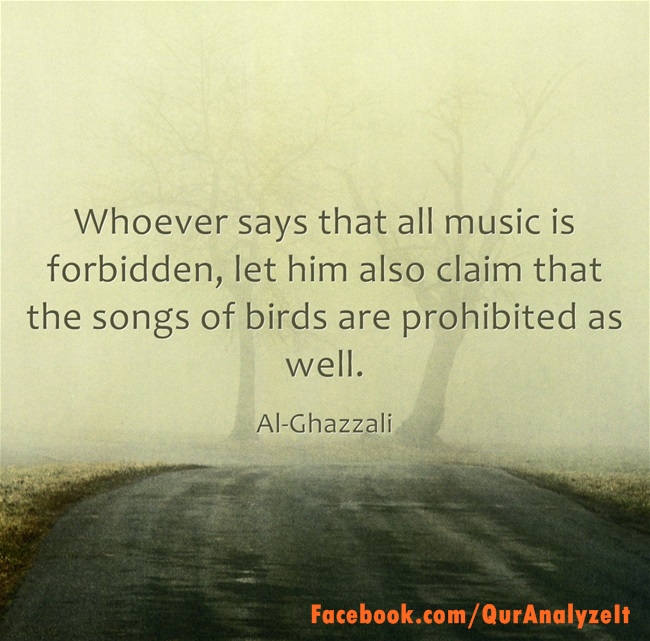
Coming to the Quran, it does not specifically refer to music in its discourse. What that means is that this is an unimportant subject, for which you get to make the judgment call based on reason and experience. However, although the majority of conventional scholars on Islam quote two verses to justify the prohibition on music, a careful reading of the Quran serves to dismiss this. Let us then analyze these two verses:
“Tempt and allure them with your voice such of them as you can. You may prompt them into armed conflicts, have a share in their resources and children, and give them (false) promises. And whatever Satan promises them is but meant to delude the mind.” Quran, 17:64
I find that the reasoning that goes behind prohibiting music is very simplistic indeed; for it demonizes music, as a whole, based on some songs that encourage immorality. Not staying true to the Quran holistically, traditional scholars would have you believe that the voice of Shaitan used to tempt, and allure you refers to music. Again, what about the music that promotes justice, equality, and peace? The argument falls flat on the face.
As a matter of fact, this “voice” is clearly defined in the last chapter of the Quran:
“(I seek refuge) From the evil of the sneaking whisperer who whispers (evil) in the hearts of people.” Quran, 114:4-5
The Shaitan deludes you in only one way: evil inclinations and suggestions that suddenly prompt up within yourself, acting counter to your nature. This is how it misleads us, and gives us “false promises of hope.”
Among the people, there are those who uphold baseless narratives (Lahwal Hadith), and thus divert others from the path of God without knowledge, and take it in vain. These have incurred a shameful retribution. Quran, 31:6
However you define and interpret “Hadith”, the purpose it plays is that it diverts people from the path of God – this is the defining phrase. This actually cements my point that good music, which in no way diverts you from godly virtues, is perfectly suitable and does not fall into the category of “baseless Hadith”.
A piece of advice:
And do not utter falsehoods by letting your tongues determine [at your own discretion], “This is lawful and that is forbidden”, thus attributing your own lying inventions to God: for, behold, they who attribute their own lying inventions to God will never prosper. Quran, 16:116
Conclusion
Forbidding things that are not explicitly referred to in the Quran is an act that is severely condemned by God as it leads to the misuse of religion to enslave people in the name of Islam by the “holy men.” It is revealing to observe that the scholars who forbid music in the name of Islam suddenly deem singing and *some* instruments to be permissible when it comes to religious songs, songs that overly praise Prophet Mohammad (which is risky business). Eh, double standards? Where is the consistency in approach that one would expect from a scholar?
It becomes highly problematic when additional laws and regulations are added on top of the word of God, as this leads to the complication of Islam and thus deters Muslims from practicing it. It’s not like the masses have adhered to this supposed commandment of God to not indulge in music, rather what it may do is that it may give a Muslim, who enjoys music, the impression of not being a “good Muslim”. Once you’ve established this, you have no incentive left to guard yourself from the things that are actually forbidden in the Quran, and may end up right in the midst of them.
Oh, the painful irony of it all.
*If you liked this post, please help us spread the word by sharing it on your social networks!
Please subscribe to our blog by clicking the “follow” button (Top right – PC) and (Bottom – Cell phone/Tablet).
And please like Our Facebook Page: http://www.facebook.com/quranalyzeit
Previous Post

March 28, 2014
Kassim Ahmad: The Hero We Don’t Deserve!
Next Post

April 26, 2014 The 4 Major Factors That Fuel Religious Fundamentalism | Ro Waseem
Browse Our Archives
Select a Category Interviews Meet The Author Quran Short Blogs Uncategorized
Select a Month April 2016 March 2016 December 2015 November 2015 August 2015 June 2015 May 2015 April 2015 March 2015 January 2015 December 2014 November 2014 July 2014 June 2014 May 2014 April 2014 March 2014 February 2014 January 2014 December 2013 May 2013
Follow Us!
TAKE THE
Religious Wisdom Quiz
What proportion of lepers healed by Jesus returned to thank Him?
Select your answer to see how you score.
All ten One out of ten None Five
Related posts from Quranalyze It

ISIS Has Something to do With Islam, And...

LGBT Muslims: We Must Stop Alienating Them

Does ISIS Represent "True Islam"? Mehdi Hasan Delivers...
A Short Summary of Al-Anaam (Chapter 6) |...
TRENDING AT PATHEOS Muslim

25 Years Later: How Much Has Changed for...
As we approach the 25th anniversary of September 11th, I’ve found myself...

Podcast: Third Spaces & The Rise of Yemeni...
In the latest episode of The Artistic Foodies Podcast, hosts Abbas...

HalalFest Picks: Best 60 Halal Spots for Super...
Back in 2016, I came up with a list of 29...

Unity Is America’s Strength — Division Is Its...
by Hidayatullah Ahsan When Valentina Gomez, a Republican candidate for Congress in...

Zohran Mamdani and New York’s Fight Against Islamophobia
This past June, against all odds, Zohran Mamdani won the Democratic primary...

What the Fourth of July Means to a...
As we mark another Fourth of July, millions of Americans will celebrate...
view all Muslim blogs
Ad-Free & Subscriber Log-In Subscription Support
- About Us
- 2026 Calendar
- Videos
- Podcasts
- Library of World Religions
- Faith In Media Tracker
- Advertise With Us
- Write for Us
- Privacy Policy
- Terms of Service
- Do Not Sell My Data
- Contact Us
- Radiant Digital
- Manage Newsletter Subscriptions
- Unsubscribe From Notifications
- Sitemap
Copyright 2008-2026, Patheos. All rights reserved.
Subscription Support Ad-Free & Subscriber Log-In
Follow Patheos