
BuddhistCatholicContemplativeEvangelicalGeneral ChristianHinduJewishLatter-day SaintMuslimNew VisionsProgressive Christian
Beliefs
- Buddhist
- Catholic
- Contemplative
- Evangelical
- General Christian
- Hindu
- Jewish
- Latter-day Saint
- More Voices
- Muslim
- New Visions
- Pagan
- Progressive Christian
Topics
- Religion News
- Food and Religion
- Sports and Religion
- Religious Art
- Religious Music and Entertainment
- Religious Events
- History and Religion
- Style and Religion
- Politics and Religion
- Women in Religion
- Recreation Outdoors and Religion
- Business Finance and Religion
- Careers Workplace and Religion
- Education and Religion
- Family Parenting and Religion
- Health Fitness and Religion
- Home and Religion
- Relationships and Religion
- Technology and Religion
- Travel and Religion
Columnists
- Buddhist Columnists
- Business Finance and Religion Columnists
- Careers Workplace and Religion Columnists
- Catholic Columnists
- Contemplative Columnists
- Education and Religion Columnists
- Evangelists Columnists
- Family Parenting and Religion Columnists
- General Christian Columnists
- Health Fitness and Religion Columnists
- Hindu Columnists
- History and Religion Columnists
- Home and Religion Columnists
- Jewish Columnists
- More Voices Columnists
- Latter Day Columnists
- Muslim Columnists
- New Visions Columnists
- Nonreligious Columnists
- Pagan Columnists
- Politics and Religion Columnists
- Progressive Columnists
- Recreation Outdoors and Religion Columnists
- Relationships and Religion Columnists
- Religion News Columnists
- Religious Art Columnists
- Religious Events Columnists
- Religious Music and Entertainment Columnists
- Sports and Religion Columnists
- Style and Religion Columnists
- Technology and Religion Columnists
- Travel and Religion Columnists
- Women in Religion Columnists
Resource Library
- 2026 Calendar
- Library of World Religions
- The 100 Most Holy Places on Earth
- Patheos Answers
- Podcasts
- Videos
- Faith Leaders Database
- Anglican Episcopalian
- Bahai
- Baptist
- Buddhism
- Christianity
- Confucianism
- Eastern Orthodoxy
- Hinduism
- Holiness and Pentecostal
- ISKCON
- Islam
- Judaism
- Lutheran
- Methodist
- The Church of Jesus Christ of Latter-day Saints
- New Age
- Paganism
- Presbytarian and Reformed
- Protestantism
- Religion Behind the Scenes
- Roman Catholic
- Scientology
- Shia Islam
- Sikhism
- Sufism
- Sunni Islam
- Taoism
- Zen
- See all religions
Research Tools
 Ad-Free & Subscriber Log-In Subscription Support
Ad-Free & Subscriber Log-In Subscription Support
Follow Patheos 

- Trending:
- Forgiveness
- |
- Marriage
- |
- Consciousness
- |
- Death Penalty
- |
- Election
- |
- Halloween
 Quranalyze It
-
Categories
-
Meet The Author
-
- Home
- Muslim
- “Salih”: One Of The Least Understood Attributes Of A Muslim
“Salih”: One Of The Least Understood Attributes Of A Muslim
Last updated on: February 21, 2014 at 2:50 pm by Ro Waseem
“Salih”: One Of The Least Understood Attributes Of A Muslim 2014-02-21T14:50:47+05:00 Ro Waseem
Patheos Explore the world's faith through different perspectives on religion and spirituality! Patheos has the views of the prevalent religions and spiritualities of the world.
You open up a traditional translation of the Quran, and you will find that it would usually translate characteristics of believers such as “Saliheen” (For ex. 2:62) and “Muttaqeen” (For ex. 2:2) as “Righteous people”. My problem with “righteous” is that it is too bland – too generic. Righteousness is a broad term. What aspect of righteousness, I would ask?
Just as God has several attributes, each attribute revealing a specific characteristic; similarly there are also numerous attributes of a Muslim. These diverse attributes are provided in the Quran to act as a checklist for those who seek to live by the Quran as a moral code on life. For ex: Muttaqeen, Mohsineen, Musalleen, Mufliheen, Musliheen etc.
For this post, I’d like to focus on the attribute of being a “Salih”.
A concordance of the word Salih reveals that it means to reform/amend. This attribute is of such vital importance, that it is used 100+ times in the Quran! “Those who believed (aamanu) and do acts of reformation (amallan Salihan)” is a very repetitive phrase in the Quran. As I said, brushing it off as “righteous” robs itself off the defining characteristic that God wants us to develop and fails to do justice to these words, linguistically.
As an exercise, try substituting righteousness in place of Sa-la-ha in the following verses. It just doesn’t fit:
So We responded to him, and We gave to him Yahya, and amended (Aslahna) for him his wife. Indeed, they used to hasten to good deeds and supplicate Us in hope and fear, and they were to Us humbly submissive. Quran 21:90
If one sees gross injustice or bias on the part of a testator, and takes corrective action (Aslaha) to restore justice to the will, he commits no sin. GOD is Forgiver, Most Merciful. Quran 2:182
Therefore, Saliheen are the reformers who set things right. Reformation is a vital part of faith as faith should never be static. This is because anything that doesn’t grow is dead. If I have the same outlook on the world 10 years from now, I have failed to utilize the time to help me grow as a person. Muslims are encouraged to continually make reforms in their beliefs, whenever better information presents itself. That alone should make us more humble and compassionate towards each other, as the “I know it all” mindset gets suppressed.
In a broader sense, Saliheen also strive for reform in their community. Musa and Ibrahim (Salutes and respect to them) are prime examples of this. We have come to the point where we believe Islam to be a set of rituals only. All the while, the core message of the Quran which is all about activism and reformation gets ignored and sidetracked.
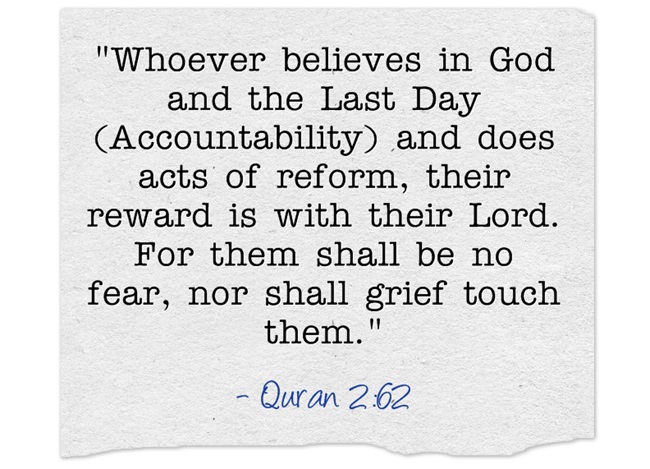
God likes reformers, not zealots.
I leave you with one of my favorite verses:
Surely, those who believe and do acts of reformation, the Almighty will shower them with love and affection. Quran 19:96
*Concordance of Salih as used in the Quran: http://corpus.quran.com/qurandictionary.jsp?q=SlH#(2:62:14)
Previous Post

February 14, 2014
Blasphemy And Apostasy Laws: Islam or Hislam?

Browse Our Archives
Select a Category Interviews Meet The Author Quran Short Blogs Uncategorized
Select a Month April 2016 March 2016 December 2015 November 2015 August 2015 June 2015 May 2015 April 2015 March 2015 January 2015 December 2014 November 2014 July 2014 June 2014 May 2014 April 2014 March 2014 February 2014 January 2014 December 2013 May 2013
Follow Us!
TAKE THE
Religious Wisdom Quiz
Which was the day that God ended His creation and rested?
Select your answer to see how you score.
On the 5th day He never rested On the 7th day On the 6th day
Related posts from Quranalyze It

ISIS Has Something to do With Islam, And...

LGBT Muslims: We Must Stop Alienating Them

Does ISIS Represent "True Islam"? Mehdi Hasan Delivers...
A Short Summary of Al-Anaam (Chapter 6) |...
TRENDING AT PATHEOS Muslim

25 Years Later: How Much Has Changed for...
As we approach the 25th anniversary of September 11th, I’ve found myself...

Podcast: Third Spaces & The Rise of Yemeni...
In the latest episode of The Artistic Foodies Podcast, hosts Abbas...

HalalFest Picks: Best 60 Halal Spots for Super...
Back in 2016, I came up with a list of 29...

Unity Is America’s Strength — Division Is Its...
by Hidayatullah Ahsan When Valentina Gomez, a Republican candidate for Congress in...

Zohran Mamdani and New York’s Fight Against Islamophobia
This past June, against all odds, Zohran Mamdani won the Democratic primary...

What the Fourth of July Means to a...
As we mark another Fourth of July, millions of Americans will celebrate...
view all Muslim blogs
Ad-Free & Subscriber Log-In Subscription Support
- About Us
- 2026 Calendar
- Videos
- Podcasts
- Library of World Religions
- Faith In Media Tracker
- Advertise With Us
- Write for Us
- Privacy Policy
- Terms of Service
- Do Not Sell My Data
- Contact Us
- Radiant Digital
- Manage Newsletter Subscriptions
- Unsubscribe From Notifications
- Sitemap
Copyright 2008-2026, Patheos. All rights reserved.
Subscription Support Ad-Free & Subscriber Log-In
Follow Patheos