
BuddhistCatholicContemplativeEvangelicalGeneral ChristianHinduJewishLatter-day SaintMuslimNew VisionsProgressive Christian
Beliefs
- Buddhist
- Catholic
- Contemplative
- Evangelical
- General Christian
- Hindu
- Jewish
- Latter-day Saint
- More Voices
- Muslim
- New Visions
- Pagan
- Progressive Christian
Topics
- Religion News
- Food and Religion
- Sports and Religion
- Religious Art
- Religious Music and Entertainment
- Religious Events
- History and Religion
- Style and Religion
- Politics and Religion
- Women in Religion
- Recreation Outdoors and Religion
- Business Finance and Religion
- Careers Workplace and Religion
- Education and Religion
- Family Parenting and Religion
- Health Fitness and Religion
- Home and Religion
- Relationships and Religion
- Technology and Religion
- Travel and Religion
Columnists
- Buddhist Columnists
- Business Finance and Religion Columnists
- Careers Workplace and Religion Columnists
- Catholic Columnists
- Contemplative Columnists
- Education and Religion Columnists
- Evangelists Columnists
- Family Parenting and Religion Columnists
- General Christian Columnists
- Health Fitness and Religion Columnists
- Hindu Columnists
- History and Religion Columnists
- Home and Religion Columnists
- Jewish Columnists
- More Voices Columnists
- Latter Day Columnists
- Muslim Columnists
- New Visions Columnists
- Nonreligious Columnists
- Pagan Columnists
- Politics and Religion Columnists
- Progressive Columnists
- Recreation Outdoors and Religion Columnists
- Relationships and Religion Columnists
- Religion News Columnists
- Religious Art Columnists
- Religious Events Columnists
- Religious Music and Entertainment Columnists
- Sports and Religion Columnists
- Style and Religion Columnists
- Technology and Religion Columnists
- Travel and Religion Columnists
- Women in Religion Columnists
Resource Library
- 2026 Calendar
- Library of World Religions
- The 100 Most Holy Places on Earth
- Patheos Answers
- Podcasts
- Videos
- Faith Leaders Database
- Anglican Episcopalian
- Bahai
- Baptist
- Buddhism
- Christianity
- Confucianism
- Eastern Orthodoxy
- Hinduism
- Holiness and Pentecostal
- ISKCON
- Islam
- Judaism
- Lutheran
- Methodist
- The Church of Jesus Christ of Latter-day Saints
- New Age
- Paganism
- Presbytarian and Reformed
- Protestantism
- Religion Behind the Scenes
- Roman Catholic
- Scientology
- Shia Islam
- Sikhism
- Sufism
- Sunni Islam
- Taoism
- Zen
- See all religions
Research Tools
 Ad-Free & Subscriber Log-In Subscription Support
Ad-Free & Subscriber Log-In Subscription Support
Follow Patheos 

- Trending:
- Forgiveness
- |
- Marriage
- |
- Consciousness
- |
- Death Penalty
- |
- Election
- |
- Halloween
 Quis ut Deus?
- Home
- Progressive Christian
- History and Religion
- Religious-Based Shaming Against Suicide Victims
Religious-Based Shaming Against Suicide Victims
Last updated on: September 18, 2022 at 10:35 pm by Connor Brennan
Religious-Based Shaming Against Suicide Victims 2022-09-18T22:35:49-05:00 Connor Brennan
Patheos Explore the world's faith through different perspectives on religion and spirituality! Patheos has the views of the prevalent religions and spiritualities of the world.

Image by Connor Brennan
Content/Trigger Warning: Discussion of Suicide/Suicide Attempts
September is Suicide Awareness Month. Christianity has often done a shoddy job of approaching this sensitive topic. Some Christian groups and speakers choose to shame suicide victims and refuse to discuss God’s mercy in regard to this tragedy.
Historical Christian Views on Suicide
It’s been uncomfortable for me, this process of digging into the old views of certain Christian authorities against suicide. “What a mess” isn’t quite sufficient.
I’ve been reading this article by Religion Online about how certain speakers, such as Thomas Aquinas, viewed suicide. The author of this article shared a quote from Aquinas himself asserting that suicide is the one sin that a person can’t seek repentance for.
Well, that’s horrifying!
Aquinas might as well have argued that suicide is an unforgivable sin. It doesn’t help at all that, as the author also shared, Dante placed suicide victims in the 7th circle of Hell in Dante’s Inferno.
Relevant Magazine wrote an article about the severe misconceptions Christians continue to purport, even with the readily available research that discounts these claims. They remind their readers that while suicide is never God’s will, under no circumstances does it automatically consign somebody to Hell.
I appreciate that they also point out that the majority of mentions of suicide in the Bible center around wicked men or individuals who wanted to escape capture by their enemies. To my knowledge, there’s no instance in the Bible where a person committed suicide because of mental anguish, a far more common cause.
Learn Religions wrote a similar article on this matter. They remind us that suicide isn’t unforgivable, especially when it isn’t the unpardonable sin (Fairchild, 2020). Suicide isn’t the same as rejecting God, or (as detailed in Matthew 12:31-32), “blasphemy against the Holy Spirit.
Merciless “Christian” Attitudes Against Suicide Victims
I found this blog post from my fellow Patheos writer Sheri Faye Rosendahl, where she writes about the memory of a beloved friend she lost to suicide. Her friend was only 21 and was mercilessly shamed after getting an abortion. She knew that she wouldn’t have been able to support a child, and afterward, Christian people in her life accused her of being a murderer.
The pain and anguish drove her to take her life. At her funeral, a church woman had the nerve to state that the true tragedy wasn’t how much anguish this young woman had been in but rather that she’d “chosen” to be eternally separated from God.
Way to ignore these important words from Romans:
“For I am convinced that neither death nor life, neither angels nor demons, neither the present nor the future, nor any powers, neither height nor depth, nor anything else in all creation, will be able to separate us from the love of God that is in Christ Jesus our Lord.” (Romans 8:38-39)
Shame is cruel, and as Sheri wrote in her post, it’s capable of taking lives. It’s beyond despicable that her friend received such pitiless words after her death from “Christians” who continued to look down on her without any compassion.
Russell Moore on Shaming Suicide Victims
I found this clip from The Gospel Coalition‘s YouTube channel featuring Russell Moore, a compassionate Christian speaker:
I appreciate this tidbit:
“And so we’re not saved on the basis of the last thing that we do being something that is acceptable to God. We’re saved by the grace and mercy of God.
And that’s something that’s especially important when we’re thinking of issues of suicide, where, often, almost always, those who are committing suicide are in a place of deep, deep anguish and distress, various sorts of mental illness or mental plagues or sense of hopelessness that’s coming upon them.
And so we ought to view that with compassion. And so the response that we ought to have when someone we love commits suicide is not to blame people, not to blame that person, not to be angry at that person. Nor is it to wonder, ‘Does this mean that this person is outside of the reach of God’s grace?'”
–Russell Moore, “Russell Moore on Whether Christians Who Commit Suicide Go to Heaven”
Cautious Answers
Moore mentions in this video that he’s cautious about how he answers this, out of the possibility that the person asking the question is suicidal themselves. He expressed concern that his answer could unwittingly encourage somebody to go through with it.
That fear seems to have influenced the former Catholic decree against giving suicide victims a proper church burial. This article from Catholic Answers states that before knowledge about mental illness became common, the Church feared that giving suicide victims a church burial would somehow give suicide a stamp of moral approval.
I’m not a fan of this explanation, especially since my old high school had a similar attitude towards a girl who took her life many years ago. Compared to other students who’d tragically passed away from accidents, this girl received a disproportionate response from the administration. If I remember correctly, they were worried about encouraging other students to consider suicide.
While I do understand the desire to prevent more suicide from happening, I still believe they made a mistake. Outside of her school friends, this poor girl barely received any acknowledgment from the rest of the school. In fact, when somebody made a memorial poster for her and pinned it in the entrance hallway, somebody had the nerve to deface it with a message along the lines of, “Go to Hell.”
Brushing this tragedy under the rug won’t prevent more suicides from happening. The summer after she passed away, my fellow graduating classmate Will likewise took his life. We mourn both him and Paige to this day, years later.
Boy, do I feel cynical remembering all of this.
Avoiding Toxic Christian “Positivity” Towards Mental Illness
I’ve discovered the Christian site Sojo (short for Sojourners), where candid writers discuss topics such as how the Church mishandles mental illness. One of their authors wrote a powerful piece about her history of struggling with depression while surrounded by invalidating Christians.
Her fellow Christians believed that instead of medication, Christians should instead resort to increased amounts of daily prayer and memorizing Bible verses to combat depression. They also believed that anybody who didn’t lean on these techniques has inadequate faith or trust in God.
The author also mentions in her piece that she heard other Christians blame her depression on “the Enemy”, Satan.
Don’t. Please, don’t ever blame depression on the Devil. I say that as a Christian who has spent years grappling with both depression and disturbing “spiritual warfare” experiences.
When a person of faith who’s struggling with mental illness is told that Satan is to blame, it sends the wrong message. It tells them that no matter how hard they fight, they’re waging a losing war with endless battles. On top of this, it might also make them believe that God has seemingly abandoned them to their suffering.
One of my favorite verses to hold onto (that objectively helps me instead of diminishing my depression) is this one from the Book of Psalms:
“The LORD is near to the brokenhearted and saves the crushed in spirit.” (Psalm 34:18)
No, This Isn’t Our “Cross to Bear”
As well-meaning as other Christians try to be about how they approach mental illness, some responses to those suffering should be avoided at all costs. One of these is telling a person struggling with mental illness that their illness is their “cross to bear”.
When I read the aforementioned article from Sojo, I also found a reader article published on their site by a young man who’s a suicide survivor. I highly recommend reading what he wrote; it’s very direct and to the point.
God doesn’t give us mental illness as a “cross to bear”. As the author wrote, our illnesses are simply one part of ourselves that, unfortunately, are liable to stay with us. The true “cross” we have to contend with is the oppressive forces in our lives that either dismiss our suffering or tell us to “grin and bear it”.
Christians who choose to either ignore or invalidate someone’s anguish fail to follow God’s example. The story of God and His prophet Elijah shows that instead of berating us for “not trusting Him more”, He urges us to be honest with Him about what’s weighing on our hearts. That, and God also told Elijah not to forsake resting and eating well, is something I need reminding during my own rough patches.
Kate Marsh’s Story in “Life is Strange”
I did a blog post studying Kate Marsh, an important character from the Life is Strange video game, looking into what drove her to her attempted suicide. If the player investigates Kate’s room during the scene where she asks them for guidance, they find out that her family has near-disowned her based on horrendous assumptions about her circumstances.
Kate’s mother and aunt accuse her of both being a harlot and of risking Hell for her actions. They wrote these horrible things to her after Kate (after being drugged) was caught on videotape doing out-of-character things at a student party. Instead of asking Kate what happened, her mother and aunt make disgusting assumptions and choose to both shame and condemn her.
On the contrary, Kate also receives a tenderhearted postcard from her father. In this postcard, Richard Marsh quotes this verse:
“The light shines in the darkness, and the darkness has not overcome it.” (John 1:5)
After quoting this verse, Richard tells Kate that she’s his “brightest light against the dark”. Instead of joining his wife and sister in mercilessly condemning Kate, Richard gently reminds his daughter of how much she means to him.
His words of love can end up saving Kate’s life in the scene where the player seeks to stop her from committing suicide. If the player read his postcard beforehand, they can choose to mention Richard as another person who cares about Kate. Hearing Max (the main character) remind her of how much her father loves her leads to Kate taking Max’s hand and stepping away from death.
Max can also remind Kate of her favorite Bible verse:
“Come to Me, all you who are weary and burdened, and I will give you rest.” (Matthew 11:28)
God never shames us for our suffering. Kate’s father exemplifies how He approaches us in dark times, reminding us of how much we mean to Him.
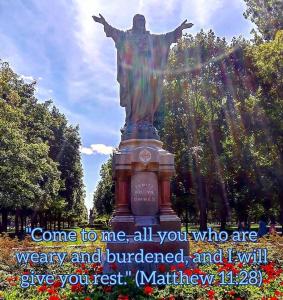
Image by Connor Brennan
God’s Mercy For Suicide Victims
Even in my Progressive church, we never deeply discussed the ramifications of suicide. Because of this, I had to turn to the web for guidance in the aftermath of losing my classmate Will to this tragedy.
I can’t remember exactly what I found back then, but it stoked my fear that Will was forever lost. Protestant sources on the matter didn’t help me find peace about his soul’s final destination.
During my last Fall semester at college, I discovered St. Faustina and her encounters with Jesus. Jesus asked her to share with the world the depths of His Mercy, to combat the despair that often prevents us from approaching Him.
Reading her talks with Jesus finally put my heart at ease about Will. I’d refused to believe that God had dismissively chosen to condemn Will eternally after he’d suffered such anguish. What St. Faustina shared confirmed that God’s Mercy is far bigger than any of us can comprehend in our lifetimes.
Delving Into Divine Mercy
I found this video from Ascension Presents featuring Fr. Chris Alar, who shares his grief over losing his grandmother to suicide and his own blissful discovery of St. Faustina’s meetings with Jesus:
(Content/Trigger Warning: Discussion of suicide and a moment of graphic description [@ 8:37 mark])
“…St. Faustina said, in paragraph 1486 of the diary, that Jesus comes to the soul 3 times at the moment of death, and gives the chance to repent.”
–Fr. Chris Alar, “God’s Mercy and Suicide”
I broke down in tears hearing this. I’ve read a portion of St. Faustina’s Diary, but I haven’t gotten far enough to read this quote. How beautiful this is, and how relieving it is as well.
Christians sometimes make the terrible mistake of boxing in God’s mercy per their own standards and perceptions. God wills for all to be saved, and under no circumstances does He desire to see a soul become lost.
Suicide is a tragedy, and even years later, it’s completely normal to still grieve for the ones we lose to it. At this point in time, it’s been nearly 10 years since Will died, and I still break down crying over him.
I know now that he found his peace, and while I still miss him, I know that I’ll see him again.
Also, here’s the Divine Mercy Chaplet if you’re interested!
Finding the Light
Not knowing what the future holds is crippling, especially if you struggle with depression, which utterly compounds this uncertainty.
I’ve been on a sporadic binge of rewatching the Lord of the Rings films, and one of my new favorite scenes is this one from The Return of the King. After Elrond told Arwen that there was nothing good in her future, “only death”, Arwen sees a vision that says otherwise:
Even though Elrond believes that the joyful portion of his daughter’s future isn’t certain, Arwen reminds him that to give up entirely would mean a lifetime of regret.
In the darkest times, it’s incredibly difficult to see or perceive what lies on the other side of our suffering. And when somebody not struggling alongside us has the gall to cheapen it all with phrases like, “Just keep smiling,” the dismissal echoes in the dark. No matter how well-intended words like these are, they do nothing to help those of us who feel helpless to escape our situation.
Not to mention, constantly smiling like a robot is beyond unrealistic. And we weren’t created to be robots.
Through my research for this blog post, I’ve discovered (thanks to this article by APA Divisions) that even President Lincoln and Beethoven struggled with depression (Minahan, 2016). If a famed leader and one of the world’s most famous musicians, respectively, suffered from depression, then we should tolerate no shame when we struggle with it ourselves.
As Céline Dion reminds us in her song “Ashes”, somehow, beauty can be found even in the darkest times, no matter how deep the darkness:
You are not alone. If you or somebody you know needs immediate assistance, please don’t hesitate to use the National Suicide Prevention Line’s new 988 number (they no longer use the old 10-digit number; this new 3-digit number has seen a 45% increase in call volume).
Citations
- Fairchild, Mary. (2020, August 28). What Does the Bible Say About Suicide? Retrieved from https://www.learnreligions.com/suicide-and-the-bible-701953
- Minahan, J. A. (2016, October). Suicide and shame. The General Psychologist. https://www.apadivisions.org/division-1/publications/newsletters/general/2016/10/suicide-shame
Featured Image by Connor Brennan
Hello, and thank you for supporting my work here on Patheos! If you’d like to support me further, please feel free to “Buy Me A Coffee” here:
https://www.buymeacoffee.com/connorb943C
History and Religion
Previous Post

August 30, 2022
Jesus Mourns His Lost Sheep
Next Post

October 5, 2022 Remembering Saint Faustina on Her Feast Day (Oct. 5th)
Browse Our Archives
Select a Category afterlife dreams LGBTQIA Media Analysis Personal politics Religion spirituality Uncategorized
Select a Month December 2022 November 2022 October 2022 September 2022 August 2022 July 2022 June 2022 May 2022 April 2022 March 2022 February 2022 January 2022 August 2021 July 2021 June 2021 May 2021 April 2021 January 2021 November 2020 October 2020 September 2020 July 2020 February 2020 November 2019 October 2019 September 2019 July 2019 June 2019 April 2019 July 2018 May 2018 February 2018 December 2017 November 2017 August 2017 July 2017 February 2017
Follow Us!
TAKE THE
Religious Wisdom Quiz
True or False: Ruth was from Moab and chose to stay with her mother-in-law Naomi.
Select your answer to see how you score.
FALSE TRUE
Related posts from Quis ut Deus?

Remembering Saint Faustina on Her Feast Day (Oct....



Good and Bad Friends: Exploring Biblical Takes on...
TRENDING AT PATHEOS Progressive Christian

Why Christians Have a Sacred Duty to Vote:...
The Bible offers strong support for the sacred duty to vote. Here...

What Being a Modern-Day Apostle Means to Me
In my last column, I discussed the ins and outs of modern-day...

Did Ancient China Once Worship the God of...
Across human history, a common thread weaves through the origins of the...

Love Your Neighbor – Including Earth-Kin: Lev. 19,...
God’s command to love your neighbor means acting in an ethical and...

Lead a Church Study of “Jesus and Lao...
Guest writer Jack Thomas (The Irreverent Reverend) reflects on leading his church...

Principles for Understanding the Apostolic Ministry Today
Whenever people discover that my formal ministry title is "apostle," as in...
view all Progressive Christian blogs
Ad-Free & Subscriber Log-In Subscription Support
- About Us
- 2026 Calendar
- Videos
- Podcasts
- Library of World Religions
- Faith In Media Tracker
- Advertise With Us
- Write for Us
- Privacy Policy
- Terms of Service
- Do Not Sell My Data
- Contact Us
- Radiant Digital
- Manage Newsletter Subscriptions
- Unsubscribe From Notifications
- Sitemap
Copyright 2008-2026, Patheos. All rights reserved.
Subscription Support Ad-Free & Subscriber Log-In
Follow Patheos