
BuddhistCatholicContemplativeEvangelicalGeneral ChristianHinduJewishLatter-day SaintMuslimNew VisionsProgressive Christian
Beliefs
- Buddhist
- Catholic
- Contemplative
- Evangelical
- General Christian
- Hindu
- Jewish
- Latter-day Saint
- More Voices
- Muslim
- New Visions
- Pagan
- Progressive Christian
Topics
- Religion News
- Food and Religion
- Sports and Religion
- Religious Art
- Religious Music and Entertainment
- Religious Events
- History and Religion
- Style and Religion
- Politics and Religion
- Women in Religion
- Recreation Outdoors and Religion
- Business Finance and Religion
- Careers Workplace and Religion
- Education and Religion
- Family Parenting and Religion
- Health Fitness and Religion
- Home and Religion
- Relationships and Religion
- Technology and Religion
- Travel and Religion
Columnists
- Buddhist Columnists
- Business Finance and Religion Columnists
- Careers Workplace and Religion Columnists
- Catholic Columnists
- Contemplative Columnists
- Education and Religion Columnists
- Evangelists Columnists
- Family Parenting and Religion Columnists
- General Christian Columnists
- Health Fitness and Religion Columnists
- Hindu Columnists
- History and Religion Columnists
- Home and Religion Columnists
- Jewish Columnists
- More Voices Columnists
- Latter Day Columnists
- Muslim Columnists
- New Visions Columnists
- Nonreligious Columnists
- Pagan Columnists
- Politics and Religion Columnists
- Progressive Columnists
- Recreation Outdoors and Religion Columnists
- Relationships and Religion Columnists
- Religion News Columnists
- Religious Art Columnists
- Religious Events Columnists
- Religious Music and Entertainment Columnists
- Sports and Religion Columnists
- Style and Religion Columnists
- Technology and Religion Columnists
- Travel and Religion Columnists
- Women in Religion Columnists
Resource Library
- 2026 Calendar
- Library of World Religions
- The 100 Most Holy Places on Earth
- Patheos Answers
- Podcasts
- Videos
- Faith Leaders Database
- Anglican Episcopalian
- Bahai
- Baptist
- Buddhism
- Christianity
- Confucianism
- Eastern Orthodoxy
- Hinduism
- Holiness and Pentecostal
- ISKCON
- Islam
- Judaism
- Lutheran
- Methodist
- The Church of Jesus Christ of Latter-day Saints
- New Age
- Paganism
- Presbytarian and Reformed
- Protestantism
- Religion Behind the Scenes
- Roman Catholic
- Scientology
- Shia Islam
- Sikhism
- Sufism
- Sunni Islam
- Taoism
- Zen
- See all religions
Research Tools
 Ad-Free & Subscriber Log-In Subscription Support
Ad-Free & Subscriber Log-In Subscription Support
Follow Patheos 

- Trending:
- Forgiveness
- |
- Marriage
- |
- Consciousness
- |
- Death Penalty
- |
- Election
- |
- Halloween
 Quaker Pagan Reflections
- Home
- Pagan
- Confronting Racism, Yankee Pagan Style
Confronting Racism, Yankee Pagan Style
Last updated on: March 9, 2015 at 8:43 am by Cat Chapin-Bishop
Confronting Racism, Yankee Pagan Style 2015-03-09T08:43:03-04:00 Cat Chapin-Bishop
Patheos Explore the world's faith through different perspectives on religion and spirituality! Patheos has the views of the prevalent religions and spiritualities of the world.
I am a Yankee. Right down to my Pagan soul.
My understanding of what it means to be a Pagan is to try to live in right relationship with the gods, the land, and the people, including the ancestors. My gods are those that are comfortable in New England’s woods and hills. My land is this rocky landscape of New England. And my people and my ancestors–on Mom’s side, at least–are New Englanders: sea captains and dairy farmers, teachers and laborers. Whatever granite is in this place or in my ancestors lives on in me and in my Pagan practice.
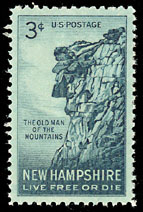
Old Man of the Mountain stamp
And that granite is why I am so driven to speak out against racism.
To help me explain what I mean, I’m going to go ahead and borrow an ancestor: my friend Kirk White‘s father.
A Yankee like a Rock
Kirk’s ancestors, like mine, were among the first Englishmen to arrive in North America. Like mine, this landscape was where they found their home. And like me, my friend Kirk and his family before him has loved New England–Vermont in his case, Maine and Massachusetts in mine.
Now, Kirk grew up on the farm his family had owned for over a hundred years. Farming in New England, though, has never been an easy way to earn a living, and, like other families before and since, Kirk’s family found other ways to pay their bills. So when Kirk was growing up, his dad Ron was a contractor.
During the real estate boom of the 1970s, Ron got hired by a big developer to build houses for vacationers in Vermont. There was a lot of money changing hands.
Now, standard practice in construction, then and probably now, says that the people under you get paid when you get paid. So the construction workers get paid when the contractor gets paid, and the contractor gets paid when the developer gets paid. But sometimes, there are delays. And on this job, there were lots of delays.
People have to eat. Ron had a crew under him, filled with workers who needed to eat, and who couldn’t wait until next month or next year to do that. So Ron took out loans, and did what he had to do so that all the people working under him got paid. Because he knew what it was like, to need to feed your kids today on money you won’t have until tomorrow, and he wasn’t going to make people deal with that.
Then it turned out that that particular developer wasn’t going to pay anybody; his deals had gone sour. He declared bankruptcy, and Ron and his crew were way too far down on the food chain to ever get a share.
Ron had paid his workers. They were fine. But Ron’s debts were all in his own name, and he had no way to pay them. Worse: that was the year his house burned down. One of Ron’s sons died. His wife had a heart attack. It was just that kind of year.
The sensible thing to do would have been to follow the developer into bankruptcy, but Ron couldn’t make himself do that. He felt himself honor-bound to repay all those loans, all that money. No court would have held him to it–but his own integrity did. So he busted a gut doing every kind of work he could lay hands on. His wife went back to work, despite her heart. They couldn’t rebuild the house, so they moved into a trailer… and Kirk grew up in something very near poverty.
Ron scrimped and saved and drove himself for years and years… and in the end, he paid it all back. Every last dime.
Well, almost.
In the end, it was Kirk himself who paid that last $40,000, when he took possession of the farm–and the integrity–that came down in the family to him.
When I began working on this essay, I called him on the phone. I’d only heard the story once, though obviously it had left me with a strong impression. Then, after some basic fact-checking, I asked Kirk the question that had been on my mind. I asked if, growing up, he’d ever resented it–making do with so little when, if his Dad had been a little less unyielding, he might have had so much more.
“To be honest,” he said, “I never thought of it until just now, when you asked.”
He paused, thinking. “It always just seemed to me that it was the right thing to do–the honorable thing. I guess I just… admired him for it.”
And that, to me, is integrity. Integrity like bedrock, like the land itself.
When I say that “I’m a Yankee,” what I mean is, I consider myself to be walking in the footsteps of men and women like Ron White. Granite integrity may be hard to live up to, but like Kirk, that’s the kind of person I aspire to be.
That is what I’m proud of. But–and if you are a black or brown reader of this blog, you’re probably here way ahead of me–I don’t get to hold onto the pride of my heritage unless I’m willing to own the shame.
Receiving Stolen Goods
Our Yankee forebears were not innocent of the stain of racism. Neither, for that matter, am I.
I’m not just talking about slavery–though all the New England states had slavery; they just ended it a little sooner than other parts of the country. (Should we make a virtue out of having ended the theft of lives sooner–through a gradual emancipation–than other parts of the country? “We Stole a Little Less Than Some White People!” what a ringing endorsement of our integrity!)

Rugged Coastline near Pemaquid Point. Jacklee, 2015.

I do not stand apart from these injustices. My ancestors profited from a system that marginalized and robbed people of color. Those sea captains I’m so proud to claim in my family tree? The New England shipping industry was built on the Triangular Slave Trade. Whether my direct ancestors ever participated is almost beside the point: the industry was created by it. Likewise Maine farmers owed their prosperity, in part, to supplying that same industry, before as well as after the abolition of the slave trade.
It would be one thing if the injustice had stopped when the Age of Sail had ended. Then I could at least hold my father’s side of the family innocent bystanders to the crimes of racism! But it’s not so.
Did you know, for instance, that Maine wouldn’t allow Native Americans to vote until 1953? And not only was the land I love so much stolen from its original owners, but Indian children, growing up in Maine, were stolen from their families in order to “kill the Indian” in them right up through the 1990s.
Then there are the ways that, during my lifetime and my parents’ lifetimes, my prosperity, as a white woman, was assured in part by denying people of color equal access to government help. From the benefits of the GI Bill to FHA loans, my government colluded with banks, realtors, and colleges to be sure that my (white) ancestors would prosper through programs deliberately designed to discourage access by people of color.
I never asked for this. My parents never asked for this. Nevertheless, the fact remains: my family’s prosperity was paid for in part by the marginalization of people of color, in New England and elsewhere.
Honoring my Ancestors; Honoring my Debts
Here’s what I conclude from all this: I owe a debt. If you are a white American, until and unless we stop getting preferential treatment in hiring, education, housing, and law enforcement, you owe a debt. Whether our specific ancestors ever intended to cheat anyone really is not the question–at least, not to me.
Ron didn’t set out to steal from anyone, after all. He didn’t sit back and say, “That was so long ago,” or “It wasn’t my fault,” or “It’s not my problem.” Knowing he had a debt, he worked until he managed to pay it back.
If I am to claim that bedrock as my own, can I do less? As Ta-Nehisi Coates has observed,
One cannot escape the question by hand-waving at the past, disavowing the acts of one’s ancestors, nor by citing a recent date of ancestral immigration. The last slaveholder has been dead for a very long time. The last soldier to endure Valley Forge has been dead much longer. To proudly claim the veteran and disown the slaveholder is patriotism à la carte.
What will honoring this debt entail? Will it involve reparations, a financial recognition of hardships imposed? Perhaps. At the very least, it will involve breaking the silence, listening to an honoring the experiences of people of color, and confronting the complicity of white Americans.
Racism exists. It hasn’t gone away, and in fact, it’s still killing people, still destroying lives.
I am a white American. I didn’t ask to have anyone cheated out of anything. I never signed up for it; I never wanted it. But I am also a Pagan and I honor my ancestors. Here is the lesson I choose to take from them: It doesn’t matter if it’s “not our fault.” Before there can be Reconciliation, there must be Truth.
We need to be like Ron. Pay our debts.
Speak the truth, work like hell, and pay that goddamn debt.
Previous Post

February 20, 2015
Real Anti-racism Will Involve Mistakes
Next Post

April 11, 2015 On Prayer: An Online Shrine to the Victims of Racism
Browse Our Archives
Select a Category Cat's posts Peter's posts Uncategorized
Select a Month March 2017 February 2017 November 2016 July 2016 June 2016 May 2016 April 2016 February 2016 January 2016 December 2015 November 2015 October 2015 September 2015 August 2015 July 2015 June 2015 April 2015 March 2015 February 2015 January 2015 December 2014 November 2014 October 2014 September 2014 August 2014 July 2014 June 2014 May 2014 April 2014 March 2014 January 2014 December 2013 November 2013 October 2013 September 2013 July 2013 June 2013 March 2013 February 2013 December 2012 November 2012 August 2012 July 2012 June 2012 April 2012 February 2012 January 2012 November 2011 October 2011 September 2011 August 2011 July 2011 June 2011 May 2011 April 2011 March 2011 February 2011 January 2011 December 2010 November 2010 October 2010 September 2010 August 2010 July 2010 June 2010 May 2010 April 2010 March 2010 February 2010 January 2010 December 2009 November 2009 October 2009 September 2009 August 2009 July 2009 June 2009 May 2009 April 2009 March 2009 February 2009 January 2009 December 2008 November 2008 October 2008 September 2008 August 2008 July 2008 June 2008 May 2008 April 2008 March 2008 February 2008 January 2008 December 2007 November 2007 October 2007 September 2007 August 2007 July 2007 June 2007 May 2007 April 2007 March 2007 February 2007 January 2007 December 2006 October 2006 September 2006 August 2006 July 2006 June 2006 May 2006 April 2006 March 2006 July 2000
Follow Us!
TAKE THE
Religious Wisdom Quiz
Who said, "I can do all things through Christ who strengthens me"?
Select your answer to see how you score.
Peter James Paul John
Related posts from Quaker Pagan Reflections

Goodbye to Patheos Pagan Channel


Peter on Mysticism and Facebook in a Time...
TRENDING AT PATHEOS Pagan

I was recently chatting with someone on Instagram. She asked me what...

While there are many people who share their results, the end of...

On July 23, I saw Christopher Nolan's The Odyssey which is Homer’s...

As I write this two big events have just finished up. One...

Restoring the Watershed of Divine Love
Perhaps cooperation is not something we manufacture through legislation, ideology, or moral...

Many UUs don’t pray because of bad experiences in a previous religion,...
view all Pagan blogs
Ad-Free & Subscriber Log-In Subscription Support
- About Us
- 2026 Calendar
- Videos
- Podcasts
- Library of World Religions
- Faith In Media Tracker
- Advertise With Us
- Write for Us
- Privacy Policy
- Terms of Service
- Do Not Sell My Data
- Contact Us
- Radiant Digital
- Manage Newsletter Subscriptions
- Unsubscribe From Notifications
- Sitemap
Copyright 2008-2026, Patheos. All rights reserved.
Subscription Support Ad-Free & Subscriber Log-In
Follow Patheos