
BuddhistCatholicContemplativeEvangelicalGeneral ChristianHinduJewishLatter-day SaintMuslimNew VisionsProgressive Christian
Beliefs
- Buddhist
- Catholic
- Contemplative
- Evangelical
- General Christian
- Hindu
- Jewish
- Latter-day Saint
- More Voices
- Muslim
- New Visions
- Pagan
- Progressive Christian
Topics
- Religion News
- Food and Religion
- Sports and Religion
- Religious Art
- Religious Music and Entertainment
- Religious Events
- History and Religion
- Style and Religion
- Politics and Religion
- Women in Religion
- Recreation Outdoors and Religion
- Business Finance and Religion
- Careers Workplace and Religion
- Education and Religion
- Family Parenting and Religion
- Health Fitness and Religion
- Home and Religion
- Relationships and Religion
- Technology and Religion
- Travel and Religion
Columnists
- Buddhist Columnists
- Business Finance and Religion Columnists
- Careers Workplace and Religion Columnists
- Catholic Columnists
- Contemplative Columnists
- Education and Religion Columnists
- Evangelists Columnists
- Family Parenting and Religion Columnists
- General Christian Columnists
- Health Fitness and Religion Columnists
- Hindu Columnists
- History and Religion Columnists
- Home and Religion Columnists
- Jewish Columnists
- More Voices Columnists
- Latter Day Columnists
- Muslim Columnists
- New Visions Columnists
- Nonreligious Columnists
- Pagan Columnists
- Politics and Religion Columnists
- Progressive Columnists
- Recreation Outdoors and Religion Columnists
- Relationships and Religion Columnists
- Religion News Columnists
- Religious Art Columnists
- Religious Events Columnists
- Religious Music and Entertainment Columnists
- Sports and Religion Columnists
- Style and Religion Columnists
- Technology and Religion Columnists
- Travel and Religion Columnists
- Women in Religion Columnists
Resource Library
- 2026 Calendar
- Library of World Religions
- The 100 Most Holy Places on Earth
- Patheos Answers
- Podcasts
- Videos
- Faith Leaders Database
- Anglican Episcopalian
- Bahai
- Baptist
- Buddhism
- Christianity
- Confucianism
- Eastern Orthodoxy
- Hinduism
- Holiness and Pentecostal
- ISKCON
- Islam
- Judaism
- Lutheran
- Methodist
- The Church of Jesus Christ of Latter-day Saints
- New Age
- Paganism
- Presbytarian and Reformed
- Protestantism
- Religion Behind the Scenes
- Roman Catholic
- Scientology
- Shia Islam
- Sikhism
- Sufism
- Sunni Islam
- Taoism
- Zen
- See all religions
Research Tools
 Ad-Free & Subscriber Log-In Subscription Support
Ad-Free & Subscriber Log-In Subscription Support
Follow Patheos 

- Trending:
- Forgiveness
- |
- Marriage
- |
- Consciousness
- |
- Death Penalty
- |
- Election
- |
- Halloween
 Quaker Pagan Reflections
- Home
- Pagan
- Pipes Lined with Fairy Gold
Pipes Lined with Fairy Gold
Last updated on: March 11, 2014 at 12:16 pm by Cat Chapin-Bishop
Pipes Lined with Fairy Gold 2014-03-11T12:16:00-04:00 Cat Chapin-Bishop
Patheos Explore the world's faith through different perspectives on religion and spirituality! Patheos has the views of the prevalent religions and spiritualities of the world.
I wonder, sometimes, how much of my spiritual life is owing to the physical arrangement of books in the Wilbraham Public Library when I was small.
I learned to read early; I can’t remember a time when I didn’t know how to read. And in the beginning, I’m sure read what every young child reads: picture books picked out by my parents.

But my memories of books begin in the Wilbraham Public Library–not the spacious brick and glass building they have now, but the late Victorian building that was torn down before I started school. Built in 1875, it looked like a castle to my childhood eyes… which is almost all I remember about it, except for a glass display case for a teddy bears’ dollhouse, and the fact that there was one particular little nook in the children’s room that was just the right size and shape for my small body to feel cozy and enfolded.
And that small nook was where the fairy tale books lived.
It’s only now, as an adult, that it comes to me how odd it was that a child who had not yet entered elementary school was curled up week after week with books by Andrew Lang: The Blue Fairy Book, The Yellow Fairy Book, The Red Fairy Book, The Brown Fairy Book… those books were my best friends. Of course I loved Beatrix Potter’s wonderful books, too (is anything more wonderful to a small child’s hands than books sized just at the right scale for them?) but it was the Fairy Books, with their quaint Edwardian diction and detailed line drawings that really spoke to me.
Or perhaps it was simply that the books were shelved at the right height, in the right sort of comfortable
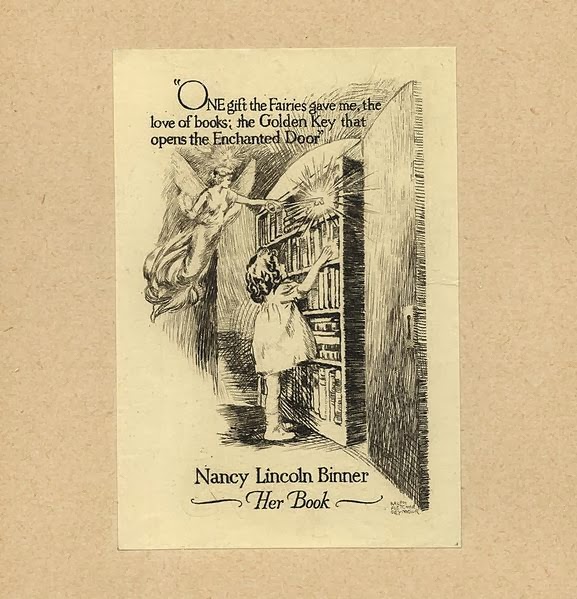 Ralph Fletcher Seymour, Bookplate

reading nook. Who knows? Even a bright child who reads early does not completely understand the reasons for the things she does, let alone understand mysteries like card catalogs and Dewey Decimal. But those were my books, and that was my place.
And then… they closed down my wonderful castle of a library.
After a year of book mobile books, the library reopened in a dazzlingly modern, enormous new building… and, uninitiated as I was in the ways of Dewey Decimal, I searched not for the folk tale section where my old friends would have been, but for the nicest reading nook, and so I discovered fiction.
As I write these words, I’m aware of the controversy that has raged this year over which Pagans are or are not “actual polytheists,” worshipping “real gods.” The identification of an actual problem–the obliviousness too many Wiccans, Druids, and other well-established Pagan groups sometimes have about other forms of Paganism–has been muddled up together with a range of grievances and grudges. In the midst of this muddle, a few angry voices have been raised to condemn Wicca for being syncretistic and “Romanticized“–having roots in the late flowering of the Romantic movement that popularized a host of idealistic notions of what pre-Christian Europe might have been.
I’m here to plead guilty to that last charge.
I’ll go farther. I suspect that I am Wiccan in part because it is syncretistic, and because it does have roots, in part, in the Victorian and Romantic projections of what a pagan past might have been… based, in part, on fairy tales, folk tales, and the speculations of people like the Brothers Grimm.
I didn’t know it at the time, but when I was six years old and wolfing down as many fairy tales as I could, I was filling my mental and emotional attic with a certain kind of cultural furniture. My dreaming mind is stuffed full of glass mountains no mortal can climb, fish that can speak and grant wishes, and assorted fairies, witches, goblins and dwarves who bring challenges to the hero of the tale–voices from an Otherworld, possessed of a tricky wisdom.
It is no surprise that, with a subconscious filled with the stories of my Western culture’s longings and with a syncretistic vision of a past that never–quite–was, it would be the figure of the Witch that would beckon to me when I found my own mystical bent. I graduated from Lang to Frazer’s Golden Bough and W.Y. Evans-Wentz’s The Fairy Faith in Celtic Countries, and eventually found my way to Margot Adler’s Drawing Down the Moon and Leland’s Aradia. I’m sure her descriptions of modern-day Witches had resonance for me in part because of the borrowings of those earlier authors.
Did they distort what they borrowed? They did. Did their projections of a shining Celtic Twilight, lost in the mists of time, serve to hide the very real abuses of an Imperialist age, as American myths of the “noble savage” hid the racism and oppression we acted out on American Indians? I rather think they did. Which is a sad and bitter thing to own, when I look with my historical eyes, and I do understand those who reject the syncretism of my ancestors–my Victorian and Edwardian ancestors, whose ideas formed the matrix from which modern Wicca flowered– because of it.
I am a product of that culture. I feel compelled to own its excesses as well as its beauties as my own, for better and for worse.
Moreover, I didn’t first encounter my culture as a historian, reading with the mind of an adult. I first encountered these repackaged myths and stories, not as a little Imperialist, but as a five year old girl, with an unformed mind and a heart already longing for Mystery. This is the soil from which I grew.
Mystery comes to us in the shapes we’re ready to see. My mind was not formed for the historically correct, precise scholarship of today’s Reconstructionist Paganism. My mind was formed by the stories of my culture, here and now, the glorious and the ignominy of who my Western people have been. Conquerers, apologists, poor scholars, perhaps. But Lang opened my mind to Frazer, who opened my mind to Evans-Wentz, who opened my mind to Yeats… and to Wicca and the whole modern Western occultist strain of mysticism.
(Thank goodness I was born before the era of the Disney home video. How on earth do children furnish their minds out of Disney home videos?)
The culture that I grew out of, the mental and emotional compost of everything that the developed world was 100 years ago, is a soil uniquely appropriate to me, a modern American woman. This is the collection of symbols that formed the language that my gods now use to speak to me–gods, land spirits, spirits of the natural world, and all the other Shining Ones around us in the world.
I am not saying that the gods are archetypes, or figures of my unconscious. I don’t believe that. However, I do believe that the gods can speak to me through archetypes, through dreams and visions that were formed by my unconscious… as Wicca was formed by those same symbols, that same layer of cultural sediment.
I am not saying that those who choose a more scholarly path are doing something wrong. I can’t really speak for anyone’s spiritual experiences but my own, and I’m not trying to do so.
But I do see it as legitimate, to eat and drink spiritual food grown in the same cultural soil that grew me–as legitimate as it is to eat the tomato that grew in my backyard this summer, despite the fact that tomatoes are not native to my New England soil. The tomatoes that are growing here now? They’re native, now, for me, in a way no older, purer food could be.
Quakers have a saying, with regards to vocal ministry, the practice of giving voice to the promptings of Spirit felt within a Quaker meeting: “The water always tastes of the pipes.” Meaning, even inspired ministry, faithfully transmitted, is going to use the vocabulary, the knowledge, the basic understandings of the minister. Even while we communicate something outside ourselves, we lend it a flavor of ourselves.
In the case of Wicca, this is one of the attractions of the path. The gods probably are not as I understand them, through the distorting lens of Victorian spiritual projections, with all that added cultural baggage.
But since the gods are probably not understandable to human minds at all, that does not seem nearly as much a liability to me as it is an asset, the power those symbols have deep in my earliest life. The gods–whoever, whatever they are–seem perfectly able to use those symbols to speak to me down deep, underneath my notional self, down where my roots are.
For me, the water tastes of pipes lined with fairy gold. And that… is just right.
Previous Post

January 25, 2014
Bears Eat My Lettuce
Next Post

March 22, 2014 Judy Harrow (1945--2014)
Browse Our Archives
Select a Category Cat's posts Peter's posts Uncategorized
Select a Month March 2017 February 2017 November 2016 July 2016 June 2016 May 2016 April 2016 February 2016 January 2016 December 2015 November 2015 October 2015 September 2015 August 2015 July 2015 June 2015 April 2015 March 2015 February 2015 January 2015 December 2014 November 2014 October 2014 September 2014 August 2014 July 2014 June 2014 May 2014 April 2014 March 2014 January 2014 December 2013 November 2013 October 2013 September 2013 July 2013 June 2013 March 2013 February 2013 December 2012 November 2012 August 2012 July 2012 June 2012 April 2012 February 2012 January 2012 November 2011 October 2011 September 2011 August 2011 July 2011 June 2011 May 2011 April 2011 March 2011 February 2011 January 2011 December 2010 November 2010 October 2010 September 2010 August 2010 July 2010 June 2010 May 2010 April 2010 March 2010 February 2010 January 2010 December 2009 November 2009 October 2009 September 2009 August 2009 July 2009 June 2009 May 2009 April 2009 March 2009 February 2009 January 2009 December 2008 November 2008 October 2008 September 2008 August 2008 July 2008 June 2008 May 2008 April 2008 March 2008 February 2008 January 2008 December 2007 November 2007 October 2007 September 2007 August 2007 July 2007 June 2007 May 2007 April 2007 March 2007 February 2007 January 2007 December 2006 October 2006 September 2006 August 2006 July 2006 June 2006 May 2006 April 2006 March 2006 July 2000
Follow Us!
TAKE THE
Religious Wisdom Quiz
Who did Jesus raise from the dead after four days?
Select your answer to see how you score.
Himself Jairus’ daughter Lazarus Widow's son
Related posts from Quaker Pagan Reflections



Goodbye to Patheos Pagan Channel

TRENDING AT PATHEOS Pagan

I was recently chatting with someone on Instagram. She asked me what...

While there are many people who share their results, the end of...

On July 23, I saw Christopher Nolan's The Odyssey which is Homer’s...

As I write this two big events have just finished up. One...

Restoring the Watershed of Divine Love
Perhaps cooperation is not something we manufacture through legislation, ideology, or moral...

Many UUs don’t pray because of bad experiences in a previous religion,...
view all Pagan blogs
Ad-Free & Subscriber Log-In Subscription Support
- About Us
- 2026 Calendar
- Videos
- Podcasts
- Library of World Religions
- Faith In Media Tracker
- Advertise With Us
- Write for Us
- Privacy Policy
- Terms of Service
- Do Not Sell My Data
- Contact Us
- Radiant Digital
- Manage Newsletter Subscriptions
- Unsubscribe From Notifications
- Sitemap
Copyright 2008-2026, Patheos. All rights reserved.
Subscription Support Ad-Free & Subscriber Log-In
Follow Patheos