
BuddhistCatholicContemplativeEvangelicalGeneral ChristianHinduJewishLatter-day SaintMuslimNew VisionsProgressive Christian
Beliefs
- Buddhist
- Catholic
- Contemplative
- Evangelical
- General Christian
- Hindu
- Jewish
- Latter-day Saint
- More Voices
- Muslim
- New Visions
- Pagan
- Progressive Christian
Topics
- Religion News
- Food and Religion
- Sports and Religion
- Religious Art
- Religious Music and Entertainment
- Religious Events
- History and Religion
- Style and Religion
- Politics and Religion
- Women in Religion
- Recreation Outdoors and Religion
- Business Finance and Religion
- Careers Workplace and Religion
- Education and Religion
- Family Parenting and Religion
- Health Fitness and Religion
- Home and Religion
- Relationships and Religion
- Technology and Religion
- Travel and Religion
Columnists
- Buddhist Columnists
- Business Finance and Religion Columnists
- Careers Workplace and Religion Columnists
- Catholic Columnists
- Contemplative Columnists
- Education and Religion Columnists
- Evangelists Columnists
- Family Parenting and Religion Columnists
- General Christian Columnists
- Health Fitness and Religion Columnists
- Hindu Columnists
- History and Religion Columnists
- Home and Religion Columnists
- Jewish Columnists
- More Voices Columnists
- Latter Day Columnists
- Muslim Columnists
- New Visions Columnists
- Nonreligious Columnists
- Pagan Columnists
- Politics and Religion Columnists
- Progressive Columnists
- Recreation Outdoors and Religion Columnists
- Relationships and Religion Columnists
- Religion News Columnists
- Religious Art Columnists
- Religious Events Columnists
- Religious Music and Entertainment Columnists
- Sports and Religion Columnists
- Style and Religion Columnists
- Technology and Religion Columnists
- Travel and Religion Columnists
- Women in Religion Columnists
Resource Library
- 2026 Calendar
- Library of World Religions
- The 100 Most Holy Places on Earth
- Patheos Answers
- Podcasts
- Videos
- Faith Leaders Database
- Anglican Episcopalian
- Bahai
- Baptist
- Buddhism
- Christianity
- Confucianism
- Eastern Orthodoxy
- Hinduism
- Holiness and Pentecostal
- ISKCON
- Islam
- Judaism
- Lutheran
- Methodist
- The Church of Jesus Christ of Latter-day Saints
- New Age
- Paganism
- Presbytarian and Reformed
- Protestantism
- Religion Behind the Scenes
- Roman Catholic
- Scientology
- Shia Islam
- Sikhism
- Sufism
- Sunni Islam
- Taoism
- Zen
- See all religions
Research Tools
 Ad-Free & Subscriber Log-In Subscription Support
Ad-Free & Subscriber Log-In Subscription Support
Follow Patheos 

- Trending:
- Forgiveness
- |
- Marriage
- |
- Consciousness
- |
- Death Penalty
- |
- Election
- |
- Halloween
 Quaker Pagan Reflections
- Home
- Pagan
- An Open Letter to My Christian Quaker Friends: Part 1 of 2
An Open Letter to My Christian Quaker Friends: Part 1 of 2
Last updated on: July 15, 2013 at 7:35 pm by Cat Chapin-Bishop
An Open Letter to My Christian Quaker Friends: Part 1 of 2 2013-07-15T19:35:00-04:00 Cat Chapin-Bishop
Patheos Explore the world's faith through different perspectives on religion and spirituality! Patheos has the views of the prevalent religions and spiritualities of the world.
First, I want to say thank you for making me welcome among you. You might not have, so I’m grateful–because I need to be here. I didn’t become a Quaker to prove a point, and I didn’t become a Pagan because I love controversy. Our shared culture often treats anyone who is not a Christian as a threat or a flake, and it has been a joy and a delight to be heard first, judged second (or even not at all).
The back story, for those of you who don’t already know it: I became a Quaker, not because my clever monkey brain thought it was a fun idea, but because the Peace Testimony reached out one day and grabbed me by the scruff of the neck, and tossed me into Quaker meeting. Once there, I discovered that Quaker process, and, most of all That Spirit That Gathers Us had become central to my life. I fell in love with That Spirit.
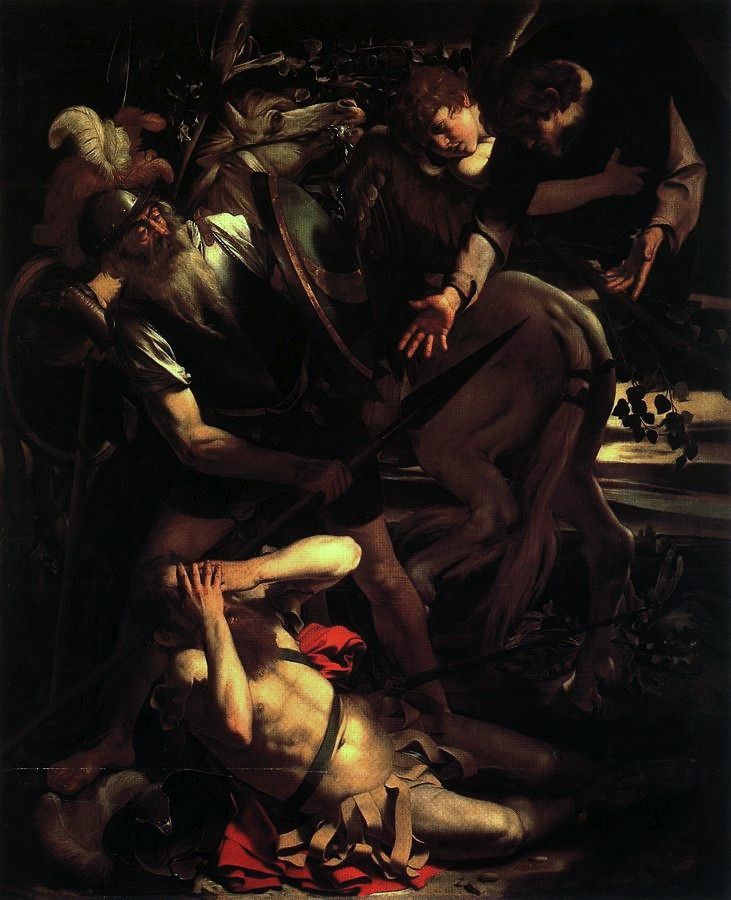 La Conversion de Saint Paul (Odescalchi)

I became a member of the Religious Society of Friends the way an alcoholic becomes a member of AA. It wasn’t exactly a choice. I was called, I was led, I had a Saul on the Road to Damascus moment, and from that time to this, I’ve needed to live a big piece of my life among Quakers, because Quakers are listening to Something I need to hear. It’s not that I was a bad person before becoming a Friend… But being a good one has become much easier, and I find myself continuing to grow in ways that are hard to explain if you haven’t experienced them. There is new real estate opening up in my heart: new sources of compassion and patience and hope, and I keep finding new ways to put that to use out in the world.
Plus, as I believe I have mentioned, I’m madly in love with That Spirit.
I’m grateful for the transformations happening within me in very much the same way I’m grateful for having been a mother: a whole part of my being would have been denied me if I hadn’t had my child. I can’t even imagine who I would be without either of those experiences, and that I have been given a chance to have this spiritual birth is remarkable… because of who else I am besides a Quaker.
It hasn’t always been easy for my Christian Friends, because the same spiritual integrity that made me show up and keep showing up for Quaker meetings–because I was called, and I knew it–has also kept me loyal to and part of the Pagan community that formed for me a soul capable of hearing a spiritual call in the first place. That Spirit has been with me for a long, long time; I didn’t first encounter It among Friends. Furthermore, other spirits, of a different but still strong and good, have been with me for many years before I began attending Quaker meeting. I love them, too.
My Saul on the Road moment not only did not include Jesus–at least, That Spirit never used that name with me–but it did not come with any sense of separation from what I had been before. I was then and I am still a modern Pagan, a Wiccan, a worshiper of the Old Gods of forest and field. And if being a Quaker seems as central to my being as having raised a child, respecting and embracing the gods of my Paganism seems as much a part of me as loving my husband or the family that raised me.
The thing about love is, it tends to last. I love both my spiritual families, and I have no plans to leave anyone behind. And that is a challenging thing, from a traditional, Christian, Quaker point of view.
I know that there are those, Pagan as well as Quaker, who see my insistence on straddling the divide between those two labels as a reflection of a “cafeteria religion,” in which I pick and choose only my favorite bits of religion to practice. I understand the fear, in a world in which the values of Friends and the values of Pagans (let’s call them Peace and Balance, as shorthand) are under constant attack by a consumer society. Who wants to see their religion turned into yet another consumer product? Who wouldn’t be wary of the possibility of that happening? I get it.
And then there’s Jesus himself. Regardless of my sincerity or my integrity, my understanding of myself as a Friend-but-not-a-Christian is problematic to a lot of Quakers. For though many liberal Quakers turn out to be ambivalent about the figure of Jesus, plenty of Quakers feel certain that it is Jesus that gives the entire Religious Society of Friends in all its branches its strength.
The church is called the Body of Christ for a reason, the logic goes, and if Jesus isn’t the head of that Body, what is the point? “Christ has come to teach his people himself,” George Fox proclaimed. Surely, then, Quakers who question the significance of Jesus are removing the Society of Friends from what it means to be a Quaker. Take Jesus out of the experience of the Religious Society of Friends, and what is left? Do we become the Secular Society of Friends? What, the question becomes, are liberal Friends listening to in all that silence?
Christian Friends can feel hard beset, given the diversity of our meetings. Lots of us are not clear to name what we are listening for “Jesus,” and, what’s more, some of us actually don’t seem to be listening to much outside of our own busy monkey thoughts. I can say we are listening to Something, and that I’m pretty sure the Something is what you’re calling Jesus (though I don’t) but even I have to admit–some of us in the Religions Society of Friends seem to be mostly listening to our own egos.
Did that never happen, though, in the days before there were non-Christian Friends?
There’s more, however. Some non-Christian Friends reject Quaker mysticism altogether, denying that the direct spiritual encounter is with anything but the individual conscience. Other non-Christian Friends reject any and all ministry couched in Christian or Biblical language.
I’ve heard Christian Friends speak of being silenced or scolded in their meetings for using language that others found “too Christian.” This can happen around vocal ministry, or around any personal statement that uses explicitly Christian language; those of us who feel alienated from the figure of Jesus or the language of the Bible can behave as though these communications are acts of aggression against us, instead of the faithfulness to Truth those words most often represent to the Friends who are speaking.
Taken altogether, it can be hard to be a Christian within the liberal branch of the Religious Society of Friends.
It seems worth telling you, yes, I see that. It’s not your imagination. Uneasiness around Christianity is epidemic among Friends, and it often gets focused as criticism of Christ-centered Friends in our midst.
Though I came into this religious body expecting there to be tension around my presence from Christians, I have come to see that I’m not alone in being viewed with unease. Ironically or not, that is one of the things I have in common with Christ-centered Friends.
And yes, some among us non-Christians have experienced intolerance and abuse in the name of Jesus, or bear scars from Christianist, dominionist persecution out in the world. There’s a whole lot of intolerance out there, masquerading in what my Christ-centered Quaker friends experience as a religion of compassion and love.
The victims of that intolerance do deserve tenderness and care. There are many immigrants in the Religious Society of Friends, and some of those immigrants are refugees from religious war zones. Accepting that with tenderness and love is one of the challenges that faces all the branches of the Religious Society of Friends; it’s just particularly obvious within many liberal meetings.
I see that this can be constraining and difficult at times. I hate to add another burden to what is already a challenge to our meetings’ hospitality.
However, I agree with those who say that Christian Friends must be particularly careful when they speak of Jesus, or when they speak from the Bible.
This might seem harsh. Weren’t Christians here as Quakers first? Hasn’t the Religious Society of Friends long been understood to be “primitive Christianity revived?” Why, then, should Christian Quakers take special pains around non-Christian Friends and religious refugees in what is, essentially, their spiritual home territory?
The answer is this: the territory of Spirit does not belong to any of us humans, regardless of what labels we use to describe our relationship with it, and the care to be taken is not–most emphatically not–a care to be inoffensive, to non-Christians or anybody else. Bland niceness is not the goal.
Yes, Christian Friends need to be tender and faithful when they speak what is on their hearts–but the care is to be faithful to The Spirit That Gathers Us. It is most certainly not a duty to speak to a lowest common denominator with non-Christian Friends, spiritual refugees or no.
What is required is is to stay low to the Truth, not to hide it or apologize for it. Here’s what I would ask: Do not share one syllable more of your Scriptures than the “Spirit that gave them forth” is speaking in you–but equally, do not share one syllable less.
When speaking from Spirit, use whatever language That Spirit lends you–and if that involves quoting from the Bible, speaking of your experiences of Christ, or sharing any other words that may be uncomfortable, for me or for you, do it! Do not be “nice” to anyone: be bold! But do not speak beyond what is given you to say: be low. Only be faithful in your speaking.
It’s not enough to speak your truth, as you experienced it once, years ago. You must speak from love, in the present moment, and from Spirit, also in the present moment.
Well, but what about me? What about me, and other non-Christians among Friends? What are we required to do, to give to this relationship?
It is our duty to be faithful, too: bold and low, just like you.
Luckily, it turns out that Spirit is a magnificent translator. To those of us who are also staying low and open, also being courageous and present, She will grant the ability to listen in tongues. (This I know experimentally. I have lived this one many times… and “I love to listen where the words come from.” Trust the Spirit That Sent You.)
And we are equally called upon, we non-Christian Friends, to be faithful. Even if we share no names for the Spirit that draws us all into fellowship in this body, many of us do share the experience of being gathered by it. It is our job to be faithful to it, with or without matching vocabulary, and to speak out without apology when we are given words to speak.
You may hear words on my lips that you are uncomfortable with.
You may hear words on my lips that contradict your beliefs.
You may hear words on my lips that make no sense to you at all.
As I am obligated to stay low and faithful in my listening to you, you are equally obligated to stay low and faithful listening to me.
Some of you–most of you–understand this very deeply. For that especially, I am grateful. You did not only let me through the door–you sat at the table with me, and we have shared that particular spiritual communion.
Is there more? What else do I need from you?
I will tell you in the second half of this letter.
* * *
NOTE: Since I penned these words, Ashley W., at A Passionate and Determined Quest for Adequacy has written her own post, on the surprising kinship between Quakers of very different apparent theologies. Ashley cited this post as a partial inspiration for her thoughts, and I was quite excited by that, as I think she understood my point of view very well.
Another, very different response has been posted to my open letter at Quaker Quaker, by blogger Jim Wilson. I wouldn’t want it thought that I was ignoring his words, when he put such care into crafting a response. However, I am not a member of that community, as it is a quite explicitly Christ-centered Quaker community. As a non-member, I cannot respond to his blog post.
Luckily, Joanna Hoyt was able to post. As Quakers are fond of saying, “That Friend speaks my mind.” Thank you, Joanna, for putting it into words for me.
A further response to Jim Wilson’s post at Quaker Quaker has been posted by Susanne at Susanne’s Quaker Musings.
Finally, this discussion is also being carried at Quaker Universalist Conversations.
Previous Post

July 9, 2013
The Gospel of The Princess Bride
Next Post

July 22, 2013 An Open Letter to my Quaker Christian Friends: Part 2 of 2
Browse Our Archives
Select a Category Cat's posts Peter's posts Uncategorized
Select a Month March 2017 February 2017 November 2016 July 2016 June 2016 May 2016 April 2016 February 2016 January 2016 December 2015 November 2015 October 2015 September 2015 August 2015 July 2015 June 2015 April 2015 March 2015 February 2015 January 2015 December 2014 November 2014 October 2014 September 2014 August 2014 July 2014 June 2014 May 2014 April 2014 March 2014 January 2014 December 2013 November 2013 October 2013 September 2013 July 2013 June 2013 March 2013 February 2013 December 2012 November 2012 August 2012 July 2012 June 2012 April 2012 February 2012 January 2012 November 2011 October 2011 September 2011 August 2011 July 2011 June 2011 May 2011 April 2011 March 2011 February 2011 January 2011 December 2010 November 2010 October 2010 September 2010 August 2010 July 2010 June 2010 May 2010 April 2010 March 2010 February 2010 January 2010 December 2009 November 2009 October 2009 September 2009 August 2009 July 2009 June 2009 May 2009 April 2009 March 2009 February 2009 January 2009 December 2008 November 2008 October 2008 September 2008 August 2008 July 2008 June 2008 May 2008 April 2008 March 2008 February 2008 January 2008 December 2007 November 2007 October 2007 September 2007 August 2007 July 2007 June 2007 May 2007 April 2007 March 2007 February 2007 January 2007 December 2006 October 2006 September 2006 August 2006 July 2006 June 2006 May 2006 April 2006 March 2006 July 2000
Follow Us!
TAKE THE
Religious Wisdom Quiz
What is the ecumenical council where Roman Catholicism addressed modernization in the 1960s?
Select your answer to see how you score.
Ephesus Council of Nicaea Vatican II Trent
Related posts from Quaker Pagan Reflections

Goodbye to Patheos Pagan Channel


Peter on Mysticism and Facebook in a Time...

TRENDING AT PATHEOS Pagan

I was recently chatting with someone on Instagram. She asked me what...

While there are many people who share their results, the end of...

On July 23, I saw Christopher Nolan's The Odyssey which is Homer’s...

As I write this two big events have just finished up. One...

Restoring the Watershed of Divine Love
Perhaps cooperation is not something we manufacture through legislation, ideology, or moral...

Many UUs don’t pray because of bad experiences in a previous religion,...
view all Pagan blogs
Ad-Free & Subscriber Log-In Subscription Support
- About Us
- 2026 Calendar
- Videos
- Podcasts
- Library of World Religions
- Faith In Media Tracker
- Advertise With Us
- Write for Us
- Privacy Policy
- Terms of Service
- Do Not Sell My Data
- Contact Us
- Radiant Digital
- Manage Newsletter Subscriptions
- Unsubscribe From Notifications
- Sitemap
Copyright 2008-2026, Patheos. All rights reserved.
Subscription Support Ad-Free & Subscriber Log-In
Follow Patheos