
BuddhistCatholicContemplativeEvangelicalGeneral ChristianHinduJewishLatter-day SaintMuslimNew VisionsProgressive Christian
Beliefs
- Buddhist
- Catholic
- Contemplative
- Evangelical
- General Christian
- Hindu
- Jewish
- Latter-day Saint
- More Voices
- Muslim
- New Visions
- Pagan
- Progressive Christian
Topics
- Religion News
- Food and Religion
- Sports and Religion
- Religious Art
- Religious Music and Entertainment
- Religious Events
- History and Religion
- Style and Religion
- Politics and Religion
- Women in Religion
- Recreation Outdoors and Religion
- Business Finance and Religion
- Careers Workplace and Religion
- Education and Religion
- Family Parenting and Religion
- Health Fitness and Religion
- Home and Religion
- Relationships and Religion
- Technology and Religion
- Travel and Religion
Columnists
- Buddhist Columnists
- Business Finance and Religion Columnists
- Careers Workplace and Religion Columnists
- Catholic Columnists
- Contemplative Columnists
- Education and Religion Columnists
- Evangelists Columnists
- Family Parenting and Religion Columnists
- General Christian Columnists
- Health Fitness and Religion Columnists
- Hindu Columnists
- History and Religion Columnists
- Home and Religion Columnists
- Jewish Columnists
- More Voices Columnists
- Latter Day Columnists
- Muslim Columnists
- New Visions Columnists
- Nonreligious Columnists
- Pagan Columnists
- Politics and Religion Columnists
- Progressive Columnists
- Recreation Outdoors and Religion Columnists
- Relationships and Religion Columnists
- Religion News Columnists
- Religious Art Columnists
- Religious Events Columnists
- Religious Music and Entertainment Columnists
- Sports and Religion Columnists
- Style and Religion Columnists
- Technology and Religion Columnists
- Travel and Religion Columnists
- Women in Religion Columnists
Resource Library
- 2026 Calendar
- Library of World Religions
- The 100 Most Holy Places on Earth
- Patheos Answers
- Podcasts
- Videos
- Faith Leaders Database
- Anglican Episcopalian
- Bahai
- Baptist
- Buddhism
- Christianity
- Confucianism
- Eastern Orthodoxy
- Hinduism
- Holiness and Pentecostal
- ISKCON
- Islam
- Judaism
- Lutheran
- Methodist
- The Church of Jesus Christ of Latter-day Saints
- New Age
- Paganism
- Presbytarian and Reformed
- Protestantism
- Religion Behind the Scenes
- Roman Catholic
- Scientology
- Shia Islam
- Sikhism
- Sufism
- Sunni Islam
- Taoism
- Zen
- See all religions
Research Tools
 Ad-Free & Subscriber Log-In Subscription Support
Ad-Free & Subscriber Log-In Subscription Support
Follow Patheos 

- Trending:
- Forgiveness
- |
- Marriage
- |
- Consciousness
- |
- Death Penalty
- |
- Election
- |
- Halloween
 Quaker Pagan Reflections
- Home
- Pagan
- On Sacred Land: In Wilderness (Part 2 of 3)
On Sacred Land: In Wilderness (Part 2 of 3)
Last updated on: February 21, 2013 at 3:51 pm by Cat Chapin-Bishop
On Sacred Land: In Wilderness (Part 2 of 3) 2013-02-21T15:51:00-04:00 Cat Chapin-Bishop
Patheos Explore the world's faith through different perspectives on religion and spirituality! Patheos has the views of the prevalent religions and spiritualities of the world.
“Nature is not mute. It is man who is deaf.” – Terence Mckenna
If we accept that land is alive, and has spirit and the ability to communicate to us how (and whether) it wants to relate to us, how do we find out what that is?
I’ve said that I respect Andras’s family’s patience in learning to hear from their land before diving in to constructing sacred sites on it, and it’s something that I think Peter and I share. But what is it that we’re “hearing,” and how are we best to listen for it?
This is where Andras’s ideas and mine diverge–in theory, if not in practice.
I’m tempted to go into detail here, explaining some examples of what happens when Pagans don’t listen to the land, but instead arbitrarily impose their preconceived notions about what kinds of shrines they “get” to construct on land once they own it.
Unfortunately, if I give specific examples, those who have been to those sites or were the ones to build them will probably recognize the examples enough to be insulted–but probably not enough to change how they relate to the land. So many of us are partially or completely tone-deaf when it comes to spiritual listening, and it’s hard to know what to do about that. I’m sure this is part of the reason so many people who do past life work turn out to have been Cleopatra in a past life, and why so many more people have eagles and wolves for spirit guides than have turkey buzzards, chipmunks, or mice.
We are all Very Important People… to ourselves. And it can be hard for any spiritual voice to get through the sound of our own subjectivism. (This is as true among Quakers as among Pagans, of course, though the results of mistaking our own wishes for God’s voice are less colorful and less useful as comic relief.)
Andras spoke about this briefly at his talk. “People come to me, and they say, ‘Rocks speak to me!’ And I say, ‘That’s very nice. What language are they speaking in? English? How amazing–a rock that is tens of thousands of years old, and it speaks perfect English!'”
I take his point… as well as taking in the reason he was raising it: it is hard to learn how to listen to what the land itself may have to say when we come to the land with so many expectations we can nimbly project onto every object we see.
Andras’s suggestion for cutting through the fog of our self-deception, though, is different from mine.
At Glenshire Farm, where the Arthens live, there are plenty of human structures: homes, outbuildings, and so on. There are gardens. There is open land, and there is forest. There are sacred sites where humans interact with whatever spiritual presence connects with us through those gateways… and there is “wilderness.”
The scare quotes above are not to mock Andras’s use of the term wilderness for the wooded portions of his land, but to mark a particular interpretation and meaning of that word. For while it would be hopelessly naive to believe that any woods in New England (or possibly, any landscape anywhere in the world) is wilderness in the sense of being untouched by human beings, the way Andras uses the word is meaningful. What he means by wilderness are places where the land is left “to itself,” to be shaped by whatever its own resources (spiritual or biological) might be, rather than to be shaped by humans.
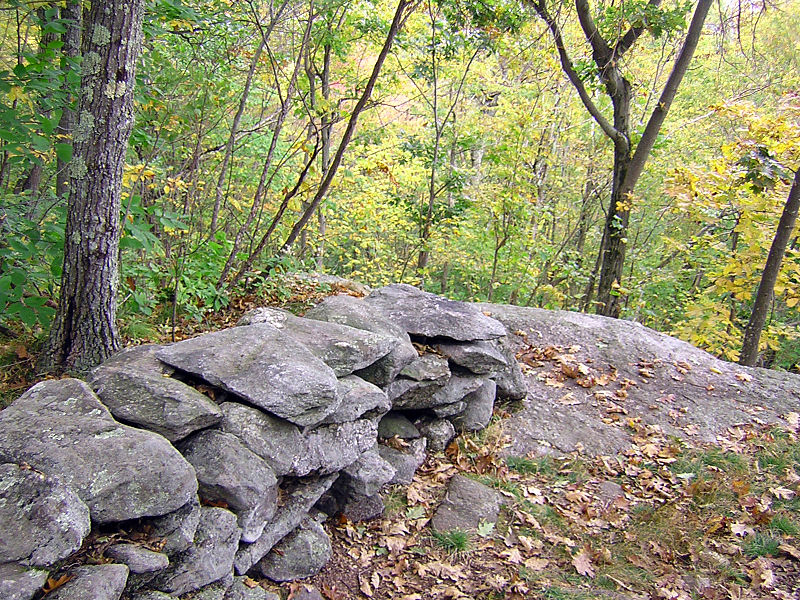 Rob Larsen, 2004. Stone Wall.

While the forests of New England have been shaped by human activity for thousands of years, so that there is a sense in which no land here is purely wilderness, that’s not to say that it’s meaningless to allow the land to grow and change, spiritually as well as ecologically, to its own forms. I agree that this is a spiritual good.
However, Andras goes further. It is in wilderness, he says, that we learn to hear the spirits of the land. And whether human intrusions happened a year ago or thirty years ago, the more seemingly secluded land is from the sights or sounds of human activity, the more like wilderness it becomes, as a spiritual matter–and the more effective that land is, as a teacher.
I disagree for a number of reasons.
First of all, this definition of wilderness becomes human-centered as soon as we take apparent isolation from humans to be a mark of its presence. For while the sounds of traffic and airplanes overhead may be disruptive to my meditations out in the woods, other things, from acid rain to invasive species, may be far more disruptive to the spirits and species of a particular area. It’s not how wild a place seems to me that matters, surely, but how whole and healthy its ecosystem is, and how well-suited to that landscape.
So I’m a little suspicious, to begin with, of a prescription to shake human projections loose from our interactions with wild places that begins by putting human experience at the center of what we mean by wild.
More importantly, I disagree with this approach experientially. It just doesn’t jive with my own encounters with the spirits of land and place.
Maybe this is as good a place as any to confess that, while I don’t hear rocks talking to me… I have heard trees.
So to speak. And no, they don’t use words, that I’ve ever heard–not in English or any other language. And I was as surprised as anyone, when it began to happen to me.
It started like this.
I was living in a tiny apartment downtown in a small Vermont village, only a few short blocks from the my daughter’s daycare. We walked almost everywhere–one of the advantages of village life. But for all that, and all the sometimes-quaintness of a small town in Vermont, you must not picture my living in a Thomas Kincaid print. My walk took me past junked cars as well as rose bushes. There were mountains in the distance, but I crossed railroad tracks, bypassed rusted oil drums, and walked on well-worn asphalt sidewalks much of my way through. It was not bucolic, and by no stretch of the imagination was it anyone’s definition of wilderness.
I had just dropped my daughter off for the morning, and was on my way back to begin work. It was a warm day in early summer, with birds singing, a few lazy cyclists riding by, but mostly just the satisfaction that comes from walking quietly under a sunny sky. I was on a side street, well away from the main road, when I walked under a spreading maple tree with a thick trunk that had buckled the sidewalk underfoot.
And just as I walked past I felt… something. Something soft.
It was much more like the touch of a friendly cat, twining between the legs of a human it likes, than it was like language. It was not literally a touch–I felt it inwardly and not on my skin.
But it startled me. I had not been looking for anything unusual that morning. I was not thinking about the tree; I was not even thinking particularly spiritual thoughts. But still… there it was.
Like a hand on my shoulder: something alive seemed to be saying hello. So I stood still for a moment or two, my arms spread a bit away from my body. And I tried, as best I could, to say hello back.
I don’t know how successful I was, but I do know that, from that point on, I took that route whenever I could, and made a point of “listening” for my tree. And sometimes, it seemed to greet me. And sometimes, it did not.
Likewise, in the years since, I’ve tried to “listen” for other trees. Some seem to greet me, to recognize me, and some do not. Some seem inert. Some seem closed for business, and uninterested in mankind–or at least in me. Some seem downright hostile. (Come to think of it, that’s a lot like cats, isn’t it?)
But every now and then, there will be a “friendly” seeming one, and I will pause for a while, and… try, at least, to return the communication.
I’ve never succeeded in communicating with a very young tree. Larger trees seem “louder” to me, perhaps? I haven’t entirely worked it out. I have, however, connected with trees of any number of species, and in all sorts of locations, from sidewalks to parks, old woodlots to college campuses.
I wouldn’t say that the tree’s location makes no difference–I have the feeling that the row of magnificent old oaks by Northampton’s Forbes Library, standing beside a bustling main artery, have no patience with our species at all. But “wilderness” does not seem to be part of the equation that allows me to have that fleeting sense of connection with a tree.
What’s more, wilderness–in the sense Andras means it, or any other–does not seem to be part of the equation that allows me to have a different, subtler sense of connection with the spirits of particular places. Quite the opposite, in fact.
I grew up in the woods, far from the sound of cars and humans. What’s more, as a young woman, I loved climbing mountains. I have spent time where land is truly wild, where roads are miles distant and never plowed, in landscapes of rock, dwarfed pine, and lichen. The tops of tall mountains are like desert islands, awash in an ocean of air.
And some of what I think Andras was trying to convey is true. Projecting human wishes and ideals onto such a landscape is transparently folly when you are up there. It is wonderful to discover that for yourself, in your body and not just in thought. I remember my youthful joy (and the small shiver of fear) as I picked my way along the Knife Edge Trail on Mt. Katahdin for the first time. There’s a steep drop-off on both sides, and in places, the trail is narrower than seems safe. What’s more, the trail is over loose, wobbly boulders. While crossing them, they shift under your weight as you cross.
It turns out, when they made mountains, they left out the handrails. There are places where you can feel the lack.
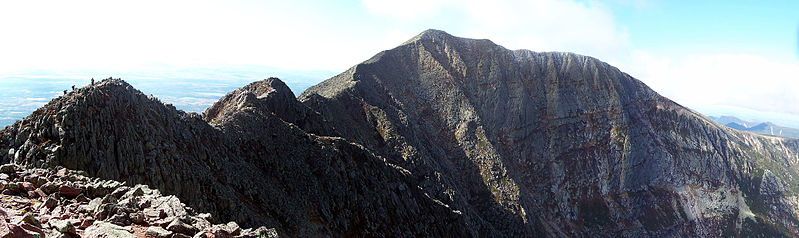 Greg Neault, 2008. Baxter Peak and the Knife Edge Trail.

Now, the Knife Edge is not actually very dangerous; the trail is traveled by hardy children and elders, and no special mountaineering skills are needed to use it. But my joy and my fear weren’t about the danger of it–my emotions were rooted in the pure, bare alienness of that landscape. It wasn’t a fear of falling that made me catch my breath.
It was how clear it was that there was nothing in the mountain that cared one way or another if I did.
The mountain did not hate me. It was not hostile. It simply found me as unimportant as did the birds and clouds overhead.
Wilderness may be a good place to lose a sense of being the center of the universe. But wilderness, generally speaking, has nothing to say to man. We are irrelevant to it.
To the extent that I have encountered wilderness in this world, I have found it to be completely indifferent to me. I love it, I value it, I long to preserve it and protect it. But never on any day have I felt that it had any interest in “speaking” to me in any personal sense at all.
Wilderness, then, is the last place I would send someone who was trying to learn to connect to the spirits of the land.
Part 1: On Sacred Land; Listening to Spirit
Previous Post

February 11, 2013
On Sacred Land: Listening to Spirit (Part 1 of 3)
Next Post
March 19, 2013 Peter's Spiritual Journey, Part III: Who Am I?
Browse Our Archives
Select a Category Cat's posts Peter's posts Uncategorized
Select a Month March 2017 February 2017 November 2016 July 2016 June 2016 May 2016 April 2016 February 2016 January 2016 December 2015 November 2015 October 2015 September 2015 August 2015 July 2015 June 2015 April 2015 March 2015 February 2015 January 2015 December 2014 November 2014 October 2014 September 2014 August 2014 July 2014 June 2014 May 2014 April 2014 March 2014 January 2014 December 2013 November 2013 October 2013 September 2013 July 2013 June 2013 March 2013 February 2013 December 2012 November 2012 August 2012 July 2012 June 2012 April 2012 February 2012 January 2012 November 2011 October 2011 September 2011 August 2011 July 2011 June 2011 May 2011 April 2011 March 2011 February 2011 January 2011 December 2010 November 2010 October 2010 September 2010 August 2010 July 2010 June 2010 May 2010 April 2010 March 2010 February 2010 January 2010 December 2009 November 2009 October 2009 September 2009 August 2009 July 2009 June 2009 May 2009 April 2009 March 2009 February 2009 January 2009 December 2008 November 2008 October 2008 September 2008 August 2008 July 2008 June 2008 May 2008 April 2008 March 2008 February 2008 January 2008 December 2007 November 2007 October 2007 September 2007 August 2007 July 2007 June 2007 May 2007 April 2007 March 2007 February 2007 January 2007 December 2006 October 2006 September 2006 August 2006 July 2006 June 2006 May 2006 April 2006 March 2006 July 2000
Follow Us!
TAKE THE
Religious Wisdom Quiz
Who did Jesus raise from the dead after four days?
Select your answer to see how you score.
Himself Jairus’ daughter Lazarus Widow's son
Related posts from Quaker Pagan Reflections

Goodbye to Patheos Pagan Channel


Peter on Mysticism and Facebook in a Time...

TRENDING AT PATHEOS Pagan

I was recently chatting with someone on Instagram. She asked me what...

While there are many people who share their results, the end of...

On July 23, I saw Christopher Nolan's The Odyssey which is Homer’s...

As I write this two big events have just finished up. One...

Restoring the Watershed of Divine Love
Perhaps cooperation is not something we manufacture through legislation, ideology, or moral...

Many UUs don’t pray because of bad experiences in a previous religion,...
view all Pagan blogs
Ad-Free & Subscriber Log-In Subscription Support
- About Us
- 2026 Calendar
- Videos
- Podcasts
- Library of World Religions
- Faith In Media Tracker
- Advertise With Us
- Write for Us
- Privacy Policy
- Terms of Service
- Do Not Sell My Data
- Contact Us
- Radiant Digital
- Manage Newsletter Subscriptions
- Unsubscribe From Notifications
- Sitemap
Copyright 2008-2026, Patheos. All rights reserved.
Subscription Support Ad-Free & Subscriber Log-In
Follow Patheos