
BuddhistCatholicContemplativeEvangelicalGeneral ChristianHinduJewishLatter-day SaintMuslimNew VisionsProgressive Christian
Beliefs
- Buddhist
- Catholic
- Contemplative
- Evangelical
- General Christian
- Hindu
- Jewish
- Latter-day Saint
- More Voices
- Muslim
- New Visions
- Pagan
- Progressive Christian
Topics
- Religion News
- Food and Religion
- Sports and Religion
- Religious Art
- Religious Music and Entertainment
- Religious Events
- History and Religion
- Style and Religion
- Politics and Religion
- Women in Religion
- Recreation Outdoors and Religion
- Business Finance and Religion
- Careers Workplace and Religion
- Education and Religion
- Family Parenting and Religion
- Health Fitness and Religion
- Home and Religion
- Relationships and Religion
- Technology and Religion
- Travel and Religion
Columnists
- Buddhist Columnists
- Business Finance and Religion Columnists
- Careers Workplace and Religion Columnists
- Catholic Columnists
- Contemplative Columnists
- Education and Religion Columnists
- Evangelists Columnists
- Family Parenting and Religion Columnists
- General Christian Columnists
- Health Fitness and Religion Columnists
- Hindu Columnists
- History and Religion Columnists
- Home and Religion Columnists
- Jewish Columnists
- More Voices Columnists
- Latter Day Columnists
- Muslim Columnists
- New Visions Columnists
- Nonreligious Columnists
- Pagan Columnists
- Politics and Religion Columnists
- Progressive Columnists
- Recreation Outdoors and Religion Columnists
- Relationships and Religion Columnists
- Religion News Columnists
- Religious Art Columnists
- Religious Events Columnists
- Religious Music and Entertainment Columnists
- Sports and Religion Columnists
- Style and Religion Columnists
- Technology and Religion Columnists
- Travel and Religion Columnists
- Women in Religion Columnists
Resource Library
- 2026 Calendar
- Library of World Religions
- The 100 Most Holy Places on Earth
- Patheos Answers
- Podcasts
- Videos
- Faith Leaders Database
- Anglican Episcopalian
- Bahai
- Baptist
- Buddhism
- Christianity
- Confucianism
- Eastern Orthodoxy
- Hinduism
- Holiness and Pentecostal
- ISKCON
- Islam
- Judaism
- Lutheran
- Methodist
- The Church of Jesus Christ of Latter-day Saints
- New Age
- Paganism
- Presbytarian and Reformed
- Protestantism
- Religion Behind the Scenes
- Roman Catholic
- Scientology
- Shia Islam
- Sikhism
- Sufism
- Sunni Islam
- Taoism
- Zen
- See all religions
Research Tools
 Ad-Free & Subscriber Log-In Subscription Support
Ad-Free & Subscriber Log-In Subscription Support
Follow Patheos 

- Trending:
- Forgiveness
- |
- Marriage
- |
- Consciousness
- |
- Death Penalty
- |
- Election
- |
- Halloween
 Quaker Pagan Reflections
- Home
- Pagan
- Neighbors
Neighbors
Last updated on: July 5, 2012 at 11:21 am by Cat Chapin-Bishop
Neighbors 2012-07-05T11:21:00-04:00 Cat Chapin-Bishop
Patheos Explore the world's faith through different perspectives on religion and spirituality! Patheos has the views of the prevalent religions and spiritualities of the world.
When we die, where do we go? Does more of us remain in the grave, or where we have lived?
My husband Peter and I have lived in this down-at-heels farmhouse for three summers now. It is an odd house, in an odd sort of a neighborhood; I have hundreds of acres of woods, much of it owned by various public groups, in my backyard, a suburban neighborhood of close-built ranch houses across the street, and a neighbor in such another house not a stone’s throw from my kitchen window.
 Despite the fact that deer and bears and hawks and owls are all regular visitors to my yard, despite my flourishing garden and apple trees, I do not live in anything like isolation. And there is no place on my property that is truly private from my neighbors or from the street.
I’ll admit, my dream of a house in the woods was of a house off by itself in the woods–maybe not one where I could never glimpse the smoke from my neighbors’ chimneys, but definitely one where I would never have to see my neighbor unless I sought them out. I wanted privacy and solitude in a natural setting, and I did not get that when we found this house.
Instead, I got Pat and Joyce, a couple in their early 60’s, whose chemically-enhanced lawn was the pride of their existence, and whose lawn ornaments, ride-on mower, and drifts of cigarette smoke were far from the pastoral fantasy I’d wished for.
From the first time we visited our house, they were there: Pat nearly always with a beer in his hand, and Joyce with a cigarette most often firmly clenched between her lips, as she dug up a weed or transplanted an annual. Pat was quiet and reserved, but Joyce’s whiskey-rough voice was raised again and again with greetings, advice, questions, advice, advice, and more advice. She had advice on how we fenced the part of the yard for our dogs, on the overgrown state of the perennial beds we inherited from the owner a decade ago–a particular friend of hers–on how we cared for our dogs, took out our trash, hung out our laundry. (It was Pat who once advised Joyce, in Peter’s hearing, to wait to be asked for that advice, and to let us do what we wanted in our own yard.)
I didn’t think I was going to like her at all.
I was wrong.
While I continued to find the drifts of cigarette smoke annoying–and in fact could not breathe the few times I was inside their house, where the lingering smoke triggered my allergies and made me wheeze–and never lost my sense that my gardening was never going to live up to Joyce’s standards, her company especially grew on me over time. She was upfront–OK, meddlesome. But also generous. It was typical that she not only offered advice on setting up our dog fence, but actually came over on a hot summer’s day and insisted on helping us to set it up, offering us supplies left over from projects of her own and her energy and enthusiasm on a day when we were mostly wilted from the heat and effort of moving.
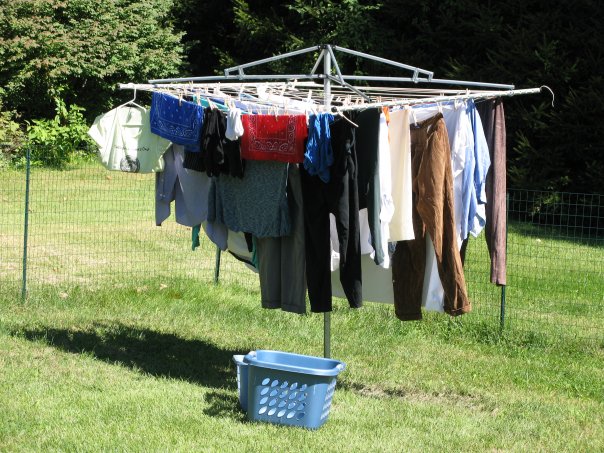
When we set up the clothesline in the back yard, she was dismissive. “If you really want to save money, tell Peter to take your trash to the dump yourself and cancel that pickup!” she told me. (An impossibility in a teacher’s busy life, in our experience. But no criticism stings a Yankee like a criticism of our thrift–either implying we have too much of it, or not enough!) I swallowed a retort and continued to hang out the clothes… which meant being outside, in the sun and air, watching the birds hang in the sky overhead, but which also meant being outside as Joyce puttered in her garden.
We got to calling out news to each other over the hedge. She came into the yard to admire the dogs (and to advise us on proper walks schedules, especially for our lab mix, who she adored). I asked her to help me identify weeds from unknown perennials in the border between our yards… she brought me a clump of celery the size of my thigh, carrots from her garden… Somehow, we passed from a strained politeness (my mother’s voice in my inner ear: “Be nice!”) to something like warmth. I don’t remember any boundary markers between wariness and friendship. Suddenly, there we were.
When Peter built my raised beds for me, there she was, with advice we were actually asking for. And when we didn’t take all of it, she shrugged her shoulders, and gave us more that we could use.
She warned us that the arborist was not going to be able to save our hemlock from the wooly adelgids that are plaguing it. (She was right, though it is not dead yet.) She gave us fresh tomatoes; I gave her elderberry jelly. She let me harvest black raspberries from her back yard and dill from her garden; I gave her pickles. She told us stories about her friend Eddie, the master gardener who created our garden beds, and we told her stories about our daughter, soon to be married, and her soon-to-be-husband, Nate.
This past fall, when a freak October blizzard left us without power for almost a week, Peter took a snow rake to her roof, and she let us use her gas grill for making our coffee.
We were neighbors. And we were friends.
She delighted in our successes with our raised beds, showed me how to dig and divide perennials, and let us come over and cuddle and coo over their new dog, Sydney, when they brought home a rescued Bichon to keep Pat company.
For Pat was increasingly ill. On disability for years for a blood disorder, he began to have repeated hospitalizations for hemorrhaging, sometimes in his brain. He’d lost fingers to his disease before, but now he was losing mental acuity as well.
And Joyce was diagnosed with breast cancer. When she went in for surgery, she gave Peter (who could breathe the air in their house) detailed instructions on Pat’s medication schedule, and asked him to check in on her husband each day. She was afraid for him, and she was afraid for herself.
I don’t know how religion entered our conversations. I think I may have simply needed to let Joyce know that she was not alone; I told her, during one of our conversations in the back yard that I was “holding her in prayer.”
Well. Holding her in the Light. “Prayer” is such a loaded expression, meaning so many things to so many people. And it implies, in most minds, a Christianity I don’t possess.
The phrase I chose was cowardly, perhaps. But to have said, “I’m doing spells for your health and for Pat’s,” while also true, would have been more about me and my needs than about her needs and Pat’s. I couldn’t do it; why lay more questions, potential conflicts and misunderstandings, long-winded explanations, on a woman who had more than enough on her mind? So I said “prayer,” and let her assume what she felt comfortable assuming.
I fear she thought me to be something I am not. Peter, too. But I couldn’t really make myself care about that.
Joyce lost her hair. We praised her wig. Pat came home. We asked after his health. Joyce’s hair returned, she began landscaping the very back edge of her property, we saw one another more and less and more as the seasons passed.
And then Pat died, and on a rainy day this spring, we attended his memorial at a funeral home downtown.
There was an open casket, and many formally dressed strangers… and Joyce. And I hugged her–for, though Joyce was not a huggy person, she and I had passed that point in friendship some years ago. And I felt how small she was in my arms, and how fragile. Though she was not a thin or a slight woman, she felt birdlike when I held her.
“It’s so lonely without him,” she said to me as we faced the coffin where Pat lay, a Red Sox cap beside him. He lay so still on the pale satin lining, and there was no life left in or near him anywhere–no sense that this had ever been a person, other than that outward husk. “How am I ever going to go on?”
We made plans to dine together.
She broke them; Joyce was not ready to be with anyone yet.
Weekends and five workdays passed–the five days of compassionate leave that our society affords for the death of a life partner–and she returned to work. And died there, that very first day back. Went into her office, shut the door, and had a heart attack. She was gone by the time a coworker found her there, lying on the floor.
My neighbors, Pat and Joyce, died within two weeks of one another. Relatives came, cleaned out the house, ran a tag sale, and put the house up on the market. The sun still shines, her grass still grows–and is mown, on a ride-on mower, by a friend in the neighborhood who does it for the memory of her–but there is no plot of dill, or tomatoes, or celery or carrots growing in her yard this year. It is empty and barren, even as all those flowers she planted all the many years of her life in that house continue to bloom and bloom and bloom.
Somehow, I cannot wrap my head around the strangeness of it all: of death and what happens to us when we die. And so I pause at my kitchen window, dumbfounded by the lawn ornaments, dumbfounded by the flowers, the greenery, the grass next door, just beyond the hedge.
When I hang my laundry, I pause, waiting for Joyce’s voice to greet me. When I return home, I stand in the driveway, looking for her. And every glimpse across my yard reminds me that she is gone, and she is never coming back.
I remember that I didn’t think I was going to like her. I remember that I used to brace myself, with my mother’s lessons in politeness, whenever I heard her voice.

And I think of how many people in each of our lives are like that to us. How many times do we turn away from a neighbor, because their lawn ornaments are too bright and slightly tacky, or because they clench a cigarette between their lips in concentration as they work in the garden, because they give us too much advice, or don’t hold exactly the same values that we do?
It is one thing, that we turn away from those among us who do real harm in the world. But if we are honest, how much more often do we refuse to see the humanness in ordinary men and women who might, like my neighbor Joyce, become friends if we would only allow ourselves to see them properly–unique, whole, and beautiful, and here for so short a time?
We forget; I forget. One neighbor is not enough to break me of a lifetime’s habit of cynicism. But I am intending, at least, to remember, which is something. And I have Joyce’s flowers to remind me–Joyce’s flowers, and the care she gave to mine.
Previous Post

June 30, 2012
Pagan Values: Hospitality (And the Affordable Care Act)
Next Post
July 7, 2012 The Lincoln's Dog Test
Browse Our Archives
Select a Category Cat's posts Peter's posts Uncategorized
Select a Month March 2017 February 2017 November 2016 July 2016 June 2016 May 2016 April 2016 February 2016 January 2016 December 2015 November 2015 October 2015 September 2015 August 2015 July 2015 June 2015 April 2015 March 2015 February 2015 January 2015 December 2014 November 2014 October 2014 September 2014 August 2014 July 2014 June 2014 May 2014 April 2014 March 2014 January 2014 December 2013 November 2013 October 2013 September 2013 July 2013 June 2013 March 2013 February 2013 December 2012 November 2012 August 2012 July 2012 June 2012 April 2012 February 2012 January 2012 November 2011 October 2011 September 2011 August 2011 July 2011 June 2011 May 2011 April 2011 March 2011 February 2011 January 2011 December 2010 November 2010 October 2010 September 2010 August 2010 July 2010 June 2010 May 2010 April 2010 March 2010 February 2010 January 2010 December 2009 November 2009 October 2009 September 2009 August 2009 July 2009 June 2009 May 2009 April 2009 March 2009 February 2009 January 2009 December 2008 November 2008 October 2008 September 2008 August 2008 July 2008 June 2008 May 2008 April 2008 March 2008 February 2008 January 2008 December 2007 November 2007 October 2007 September 2007 August 2007 July 2007 June 2007 May 2007 April 2007 March 2007 February 2007 January 2007 December 2006 October 2006 September 2006 August 2006 July 2006 June 2006 May 2006 April 2006 March 2006 July 2000
Follow Us!
TAKE THE
Religious Wisdom Quiz
Who was Paul's mentor mentioned in his letters to Timothy?
Select your answer to see how you score.
Lois Phoebe Onesimus Silas
Related posts from Quaker Pagan Reflections

Goodbye to Patheos Pagan Channel


Peter on Mysticism and Facebook in a Time...

TRENDING AT PATHEOS Pagan

I was recently chatting with someone on Instagram. She asked me what...

While there are many people who share their results, the end of...

On July 23, I saw Christopher Nolan's The Odyssey which is Homer’s...

As I write this two big events have just finished up. One...

Restoring the Watershed of Divine Love
Perhaps cooperation is not something we manufacture through legislation, ideology, or moral...

Many UUs don’t pray because of bad experiences in a previous religion,...
view all Pagan blogs
Ad-Free & Subscriber Log-In Subscription Support
- About Us
- 2026 Calendar
- Videos
- Podcasts
- Library of World Religions
- Faith In Media Tracker
- Advertise With Us
- Write for Us
- Privacy Policy
- Terms of Service
- Do Not Sell My Data
- Contact Us
- Radiant Digital
- Manage Newsletter Subscriptions
- Unsubscribe From Notifications
- Sitemap
Copyright 2008-2026, Patheos. All rights reserved.
Subscription Support Ad-Free & Subscriber Log-In
Follow Patheos