
BuddhistCatholicContemplativeEvangelicalGeneral ChristianHinduJewishLatter-day SaintMuslimNew VisionsProgressive Christian
Beliefs
- Buddhist
- Catholic
- Contemplative
- Evangelical
- General Christian
- Hindu
- Jewish
- Latter-day Saint
- More Voices
- Muslim
- New Visions
- Pagan
- Progressive Christian
Topics
- Religion News
- Food and Religion
- Sports and Religion
- Religious Art
- Religious Music and Entertainment
- Religious Events
- History and Religion
- Style and Religion
- Politics and Religion
- Women in Religion
- Recreation Outdoors and Religion
- Business Finance and Religion
- Careers Workplace and Religion
- Education and Religion
- Family Parenting and Religion
- Health Fitness and Religion
- Home and Religion
- Relationships and Religion
- Technology and Religion
- Travel and Religion
Columnists
- Buddhist Columnists
- Business Finance and Religion Columnists
- Careers Workplace and Religion Columnists
- Catholic Columnists
- Contemplative Columnists
- Education and Religion Columnists
- Evangelists Columnists
- Family Parenting and Religion Columnists
- General Christian Columnists
- Health Fitness and Religion Columnists
- Hindu Columnists
- History and Religion Columnists
- Home and Religion Columnists
- Jewish Columnists
- More Voices Columnists
- Latter Day Columnists
- Muslim Columnists
- New Visions Columnists
- Nonreligious Columnists
- Pagan Columnists
- Politics and Religion Columnists
- Progressive Columnists
- Recreation Outdoors and Religion Columnists
- Relationships and Religion Columnists
- Religion News Columnists
- Religious Art Columnists
- Religious Events Columnists
- Religious Music and Entertainment Columnists
- Sports and Religion Columnists
- Style and Religion Columnists
- Technology and Religion Columnists
- Travel and Religion Columnists
- Women in Religion Columnists
Resource Library
- 2026 Calendar
- Library of World Religions
- The 100 Most Holy Places on Earth
- Patheos Answers
- Podcasts
- Videos
- Faith Leaders Database
- Anglican Episcopalian
- Bahai
- Baptist
- Buddhism
- Christianity
- Confucianism
- Eastern Orthodoxy
- Hinduism
- Holiness and Pentecostal
- ISKCON
- Islam
- Judaism
- Lutheran
- Methodist
- The Church of Jesus Christ of Latter-day Saints
- New Age
- Paganism
- Presbytarian and Reformed
- Protestantism
- Religion Behind the Scenes
- Roman Catholic
- Scientology
- Shia Islam
- Sikhism
- Sufism
- Sunni Islam
- Taoism
- Zen
- See all religions
Research Tools
 Ad-Free & Subscriber Log-In Subscription Support
Ad-Free & Subscriber Log-In Subscription Support
Follow Patheos 

- Trending:
- Forgiveness
- |
- Marriage
- |
- Consciousness
- |
- Death Penalty
- |
- Election
- |
- Halloween
 Quaker Pagan Reflections
- Home
- Pagan
- The Learning Curve
The Learning Curve
Last updated on: December 24, 2010 at 3:01 am by Cat Chapin-Bishop
The Learning Curve 2010-12-24T03:01:00-04:00 Cat Chapin-Bishop
Patheos Explore the world's faith through different perspectives on religion and spirituality! Patheos has the views of the prevalent religions and spiritualities of the world.
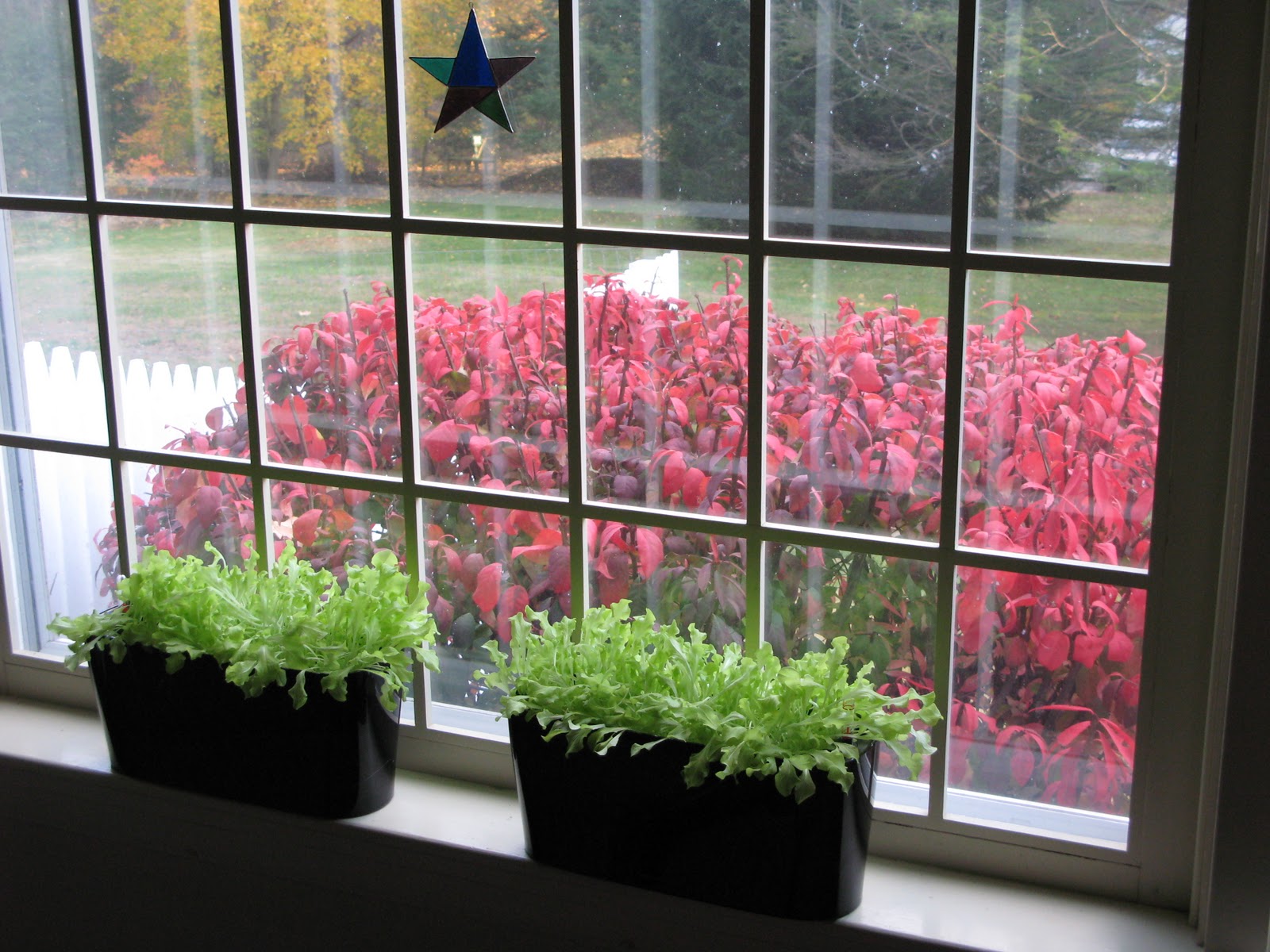 Our salad garden in October
Tally of new plastic waste since our last report: 11 oz.
So, a few weeks ago, I posted very optimistically about the possibility of subsisting through the winter on salads from greens I grew myself, on my windowsill. And a glance at this picture will explain why.
With our excellent southern exposure and a couple of self-watering planters, I had big dreams for green leafies.
Now, I’m a little wary of any “earth-friendly” project that begins by buying new stuff–especially, as these planters were, new plastic stuff. But I love salads, and I really did not want to go back to plastic-wrapped salads hauled over distances, so I went online and ordered these. (I know myself; if it were my job to make it rain anywhere on the planet, that locale would quickly become a desert.)
In this picture, the planters look very promising, don’t they? I planted the lettuce quite close together, as I have done on occasion in the past outdoors, when I’ve put in “ornamental” borders of leaf lettuce around flower gardens. But the lettuce was spindly and never grew much larger than this.
Whether this is the fault of the potting soil, the indoor lighting, or the density of the seedlings I did not know. So I replanted the next time more thinly, in clusters.
Which barely germinated. I had foolishly altered two of the conditions of the experiment, and reseeded with some organic lettuce seeds that had been included for free in another order we’d made. Perhaps because they were old and likely to annoy paying customers by not germinating.
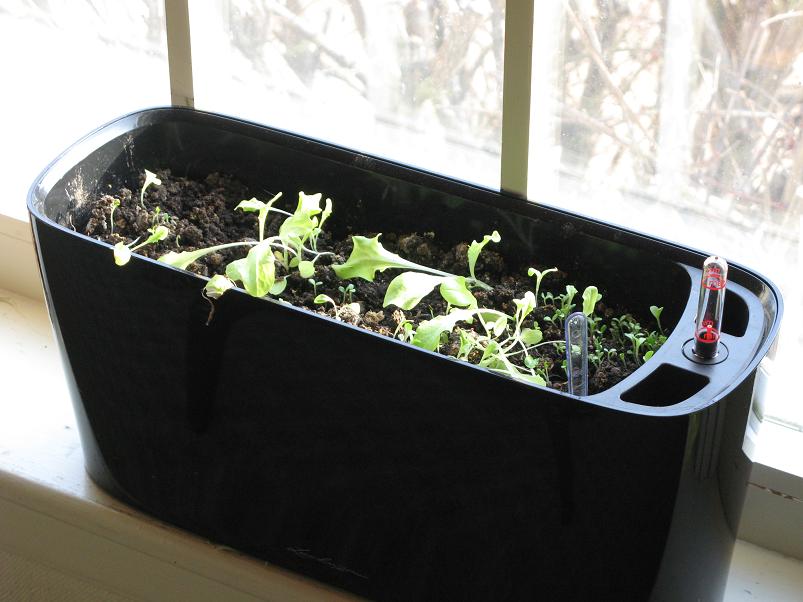 I have since reseeded the second planter as well, with the original bargain-basement seeds I got at the end of the season from a big box store. Those seeds are not doing especially well, either. Not more vigorous than the original batch, for sure. There is just not very much lettuce growing on our windowsill.
They are simply too small to keep up with our demand. The lettuce I originally planted grew slowly at best, and provided us with only about four salads before I’d completely exhausted both beds. I need at least another three planters to match the number of salads we would probably want to eat in the amount of time it takes for lettuce to germinate and grow to maturity, and that’s a lot of money–and plastic–to invest.
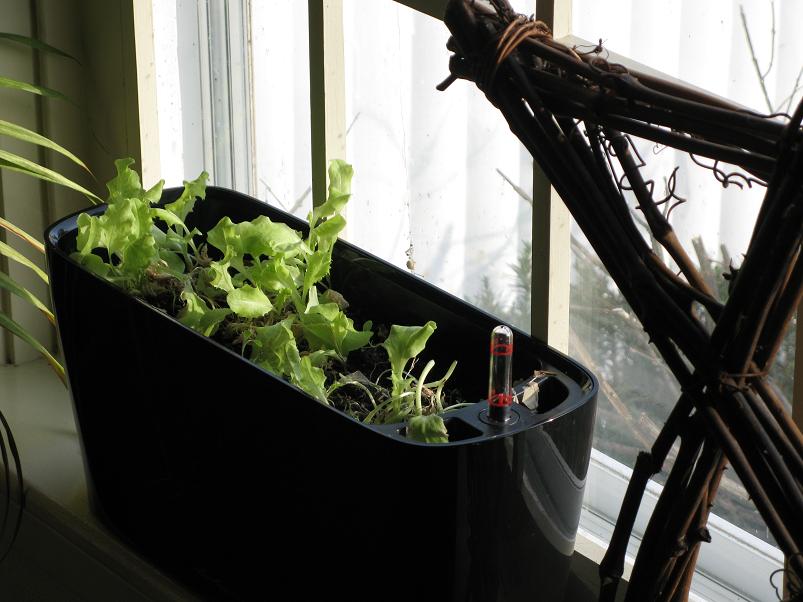
If I trusted myself to keep up with a watering schedule, I could plant them in almost anything, I suppose. But, well, I know myself. I don’t think that experiment would have a particularly happy outcome, either.
The alfalfa sprouts are doing very well. And I normally have at least three quart jars at some stage of production; I’ll probably experiment soon with growing sprouts in old nylon stockings or in cotton bags–which may or may not work, but I’m willing to find out.
However, I don’t think the lettuce crop makes sense. If I can, I should probably simply rely on winter keeping vegetables–my own and the local coop’s–and save the bins for some winter windowsill herbs.
I admit, I’m disappointed.
But it’s a valuable reminder. I think we can learn to live quite comfortably and gracefully without many of the modern conveniences our grandmothers lived without. But, as our grandmothers did, we will have some learning to do in order to get there. Everything about living in a less consumerist way takes a knowledge base, from knowing how little soap is needed to wash the laundry, to how to bake bread or save winter food.
We’re experimenting. A couple of weeks ago, we bought a winter farm share in a local CSA, and brought home about 100 pounds of food, some including winter vegetables I’ve never tried to cook before, like turnips and rutabagas. And then there are the questions. How do I preserve 30 pounds of fresh carrots or potatoes? What’s the best way for me to keep ten pounds of beets edible over the next few months? What should I do to keep all the fresh potatoes and butternut squash?
Peter built us a lovely bin for the potatoes, for the space between our heated front hall and our unheated garage. We’ve stowed the carrots between layers of damp sawdust, but we’re still seeking the part of the house where we can find the right temperature–our basement is much too warm, what with the furnace and hot water heater down there.
So perhaps the lovely potato bin will be a failure–or a very limited success, as was the windowsill lettuce. Perhaps we will come up with ideas that will make it work next year, if it doesn’t work this year.
The point is, while I am committed to living in a lower-impact way in terms of the food I eat (and avoiding food waste–one often overlooked way to reduce our emissions footprint!) I can’t ever guarantee any experiment’s success at the outset. There is a learning curve for everything, and in order to make change for the better, I have to accept that sometimes I’m going to fail. Hopefully on the way to some satisfying success.
And if it’s as satisfying as the boiled carrots with ginger and maple syrup I served for dinner this week, that will be a pretty nice reward.
Even if we do have to forgo the salad.
var fctb_tool=null; function FCTB_Init_873738507f13fb43839f78b22956b9d8(t) { fctb_tool=t; start(fctb_tool); }
var fctb_tool=null; function FCTB_Init_655a2a34ecc87f4baa0417cd44e4a13d(t) { fctb_tool=t; start(fctb_tool); }
var fctb_tool=null; function FCTB_Init_3bb50dda743a314189e08f4b7340131d(t) { fctb_tool=t; start(fctb_tool); }
Previous Post

December 5, 2010
Peter on the Minute of Sending Forth
Next Post
January 1, 2011 Chestnut House: Our 1 lb, 3 oz. Holiday for Six
Browse Our Archives
Select a Category Cat's posts Peter's posts Uncategorized
Select a Month March 2017 February 2017 November 2016 July 2016 June 2016 May 2016 April 2016 February 2016 January 2016 December 2015 November 2015 October 2015 September 2015 August 2015 July 2015 June 2015 April 2015 March 2015 February 2015 January 2015 December 2014 November 2014 October 2014 September 2014 August 2014 July 2014 June 2014 May 2014 April 2014 March 2014 January 2014 December 2013 November 2013 October 2013 September 2013 July 2013 June 2013 March 2013 February 2013 December 2012 November 2012 August 2012 July 2012 June 2012 April 2012 February 2012 January 2012 November 2011 October 2011 September 2011 August 2011 July 2011 June 2011 May 2011 April 2011 March 2011 February 2011 January 2011 December 2010 November 2010 October 2010 September 2010 August 2010 July 2010 June 2010 May 2010 April 2010 March 2010 February 2010 January 2010 December 2009 November 2009 October 2009 September 2009 August 2009 July 2009 June 2009 May 2009 April 2009 March 2009 February 2009 January 2009 December 2008 November 2008 October 2008 September 2008 August 2008 July 2008 June 2008 May 2008 April 2008 March 2008 February 2008 January 2008 December 2007 November 2007 October 2007 September 2007 August 2007 July 2007 June 2007 May 2007 April 2007 March 2007 February 2007 January 2007 December 2006 October 2006 September 2006 August 2006 July 2006 June 2006 May 2006 April 2006 March 2006 July 2000
Follow Us!
TAKE THE
Religious Wisdom Quiz
How many years from Abraham to Jesus?
Select your answer to see how you score.
1000 years 1500 years 2500 years 2000 years
Related posts from Quaker Pagan Reflections

Goodbye to Patheos Pagan Channel


Peter on Mysticism and Facebook in a Time...

TRENDING AT PATHEOS Pagan

I was recently chatting with someone on Instagram. She asked me what...

While there are many people who share their results, the end of...

On July 23, I saw Christopher Nolan's The Odyssey which is Homer’s...

As I write this two big events have just finished up. One...

Restoring the Watershed of Divine Love
Perhaps cooperation is not something we manufacture through legislation, ideology, or moral...

Many UUs don’t pray because of bad experiences in a previous religion,...
view all Pagan blogs
Ad-Free & Subscriber Log-In Subscription Support
- About Us
- 2026 Calendar
- Videos
- Podcasts
- Library of World Religions
- Faith In Media Tracker
- Advertise With Us
- Write for Us
- Privacy Policy
- Terms of Service
- Do Not Sell My Data
- Contact Us
- Radiant Digital
- Manage Newsletter Subscriptions
- Unsubscribe From Notifications
- Sitemap
Copyright 2008-2026, Patheos. All rights reserved.
Subscription Support Ad-Free & Subscriber Log-In
Follow Patheos