
BuddhistCatholicContemplativeEvangelicalGeneral ChristianHinduJewishLatter-day SaintMuslimNew VisionsProgressive Christian
Beliefs
- Buddhist
- Catholic
- Contemplative
- Evangelical
- General Christian
- Hindu
- Jewish
- Latter-day Saint
- More Voices
- Muslim
- New Visions
- Pagan
- Progressive Christian
Topics
- Religion News
- Food and Religion
- Sports and Religion
- Religious Art
- Religious Music and Entertainment
- Religious Events
- History and Religion
- Style and Religion
- Politics and Religion
- Women in Religion
- Recreation Outdoors and Religion
- Business Finance and Religion
- Careers Workplace and Religion
- Education and Religion
- Family Parenting and Religion
- Health Fitness and Religion
- Home and Religion
- Relationships and Religion
- Technology and Religion
- Travel and Religion
Columnists
- Buddhist Columnists
- Business Finance and Religion Columnists
- Careers Workplace and Religion Columnists
- Catholic Columnists
- Contemplative Columnists
- Education and Religion Columnists
- Evangelists Columnists
- Family Parenting and Religion Columnists
- General Christian Columnists
- Health Fitness and Religion Columnists
- Hindu Columnists
- History and Religion Columnists
- Home and Religion Columnists
- Jewish Columnists
- More Voices Columnists
- Latter Day Columnists
- Muslim Columnists
- New Visions Columnists
- Nonreligious Columnists
- Pagan Columnists
- Politics and Religion Columnists
- Progressive Columnists
- Recreation Outdoors and Religion Columnists
- Relationships and Religion Columnists
- Religion News Columnists
- Religious Art Columnists
- Religious Events Columnists
- Religious Music and Entertainment Columnists
- Sports and Religion Columnists
- Style and Religion Columnists
- Technology and Religion Columnists
- Travel and Religion Columnists
- Women in Religion Columnists
Resource Library
- 2026 Calendar
- Library of World Religions
- The 100 Most Holy Places on Earth
- Patheos Answers
- Podcasts
- Videos
- Faith Leaders Database
- Anglican Episcopalian
- Bahai
- Baptist
- Buddhism
- Christianity
- Confucianism
- Eastern Orthodoxy
- Hinduism
- Holiness and Pentecostal
- ISKCON
- Islam
- Judaism
- Lutheran
- Methodist
- The Church of Jesus Christ of Latter-day Saints
- New Age
- Paganism
- Presbytarian and Reformed
- Protestantism
- Religion Behind the Scenes
- Roman Catholic
- Scientology
- Shia Islam
- Sikhism
- Sufism
- Sunni Islam
- Taoism
- Zen
- See all religions
Research Tools
 Ad-Free & Subscriber Log-In Subscription Support
Ad-Free & Subscriber Log-In Subscription Support
Follow Patheos 

- Trending:
- Forgiveness
- |
- Marriage
- |
- Consciousness
- |
- Death Penalty
- |
- Election
- |
- Halloween
 Quaker Pagan Reflections
- Home
- Pagan
- Pagan Values: Community.
Pagan Values: Community.
Last updated on: June 12, 2010 at 11:30 am by Cat Chapin-Bishop
Pagan Values: Community. 2010-06-12T11:30:00-04:00 Cat Chapin-Bishop
Patheos Explore the world's faith through different perspectives on religion and spirituality! Patheos has the views of the prevalent religions and spiritualities of the world.
It’s one of my favorite memories.
On the last day of the small Pagan gathering, perhaps a dozen of us had hiked down the hill, piled into our cars, and made our way to the neighborhood pancake house. Sweaty and grimy, smelling of woodsmoke and insect repellent, clad in hiking boots and sneakers, shorts and blue jeans, we had taken one long table in the middle of the restaurant.
The restaurant itself is a celebration of all things down-to-earth and Vermont. I’ve seen farmers enjoying a plate of eggs still wearing their barn boots–and been grateful to the ones considerate enough to hose them off first–as well as hunters stoking up either before or after a morning of deer hunting, families with babies in high chairs, and, of course, in leaf season, the occasional tourist.
There’s nothing occult or New Age about the Sugar House. It’s just there, as it has been for decades, with it’s fluorescent lights, tiled floor, and picnic style benches and tables: a local fixture, and the home of the best pancakes and maple syrup in Central Vermont.
Over pancakes and eggs and coffee and orange juice, then, our group of old friends had laughed and joked, told stories of our kids, our families, and our daily lives. We’d caught up on the lives of community members who were not there this year–who had gone back to school, who was getting married or moving across country, divorcing or building a new house–in one last, loving effusion of our sense of ourselves as Tribe, before we would return to atomized lives among our non-Pagan friends and neighbors.
It was, as every year, a wonderful meal.
But my memory comes from a moment at the end of the meal, when a stranger from another table approached us, and hesitantly asked, “Excuse me. I don’t mean to be rude–I couldn’t help overhearing a little. Are you all… Pagans?”
We said we were, and she smiled, and nodded, and went back to her own table.
Understand, none of us were wearing anything remotely like flowing robes. I don’t even think there were any tie-dyed shirts in evidence; any pentacles or other occult jewelry were either small or tucked into the flannel shirts and tees we were wearing.
Nor had our conversation been overtly esoteric. To the best of my recollection, we weren’t speaking of gods or goddesses, ritual drumming techniques or magickal tools. Instead, our conversation had focused on daily life: our kids, our plans, our small triumphs and disappointments.
But somehow, seeing how we interacted, this woman whom none of us even knew had figured out that there was something different about us from the usual crowd at the Sugar House. Somehow, she had figured out that we were Pagans.
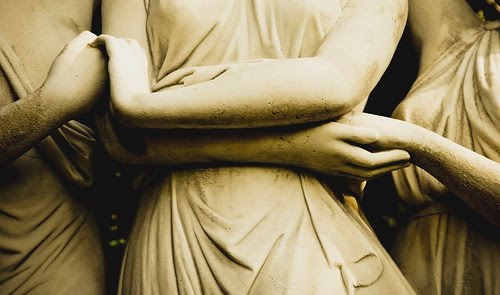 It is my belief that her clue was how we loved each other, how we belonged to one another.
We related to each other with the freedom and trust and happiness that comes of being in your deepest self with a group of others, not once only, but over and over again, over the course of decades. We belonged to each other in a way that is rare today, in our society of nuclear families and individualistic consumers. Perhaps only communities of monks or nuns have a similar experience–but an experience largely cloistered from the world, and, in any case, rooted in a religion far less world-embracing than Paganism.
The key to understanding us was our connectedness. Wiccans and Druids, shamans and Hellenes and Kabbalists, we had stood together in the firelight and joined together in love of the Old Gods; students and retirees, athletic and disabled, rural and urban, we had shared the cycles of our lives over many years.
The years that have passed have changed that community. Some of the faces that were at that table have been taken from us by death. Bitter quarrels have divided us, and time has only partially reconciled us. Formerly healthy adults have become disabled, children have become adults, and some of us have moved far, far away, never to return.
But the sense of connection remains. My own daughter I remember rocketing through the woods with a mini-tribe of younger Pagans, when she was only eight years old. “Mom!” she called out to me, one day as she dashed past. “Mom! Mom! We’re playing we’re like it was in the old days–like we’re a Pagan village!”
“Playing” indeed–but it was no game. It was real. I was there.
My daughter no longer considers herself to be a Pagan. Does that invalidate the time she spent in the “Pagan village” as a child? I think not. She is still close to many of the adults from that spiritual community, still discusses her spiritual life (which is alive and flourishing, albeit in a different form from my own) with not only me, but with many of those adults who knew her as that joyful wild child.
How common is it for our children, once grown, to remain close friends with their parents’ closest friends?
I hope it is common indeed, at least within the Pagan world. For, with my own daughter grown, my heart has room in it for my friends’ children. One of the joys of middle age, for me, is the sense of continuity and connection I have with my friends’ children as I watch them grow. This is true whether they remain Pagan–as some have–or not–as some have not.
This is, I think, because the connections we have with one another, whether within generations or spanning them, are much less about what we believe–a creed or common ideology–as about who we are.
We Pagans are a people in relationship with one another: a relationship deepened by our lived experiences of the Old Gods, but both wider and deeper than any single set of religious doctrines. We are rooted, in the final analysis, in Life–in shared Life: in community.
There has been a lot of talk, in recent weeks, about how Paganism is not really a community, how even the concept of “Paganism” as a single anything, as an identity, is meaningless.
As someone who has drunk deep from the well of a diverse and tradition-spanning Pagan community, I beg to differ. At our best, we grow and deepen in our love for one another, love that unites rather than divides by ideology; love that is shared with the earth; love that lasts even through pain and aging.
I’ve tasted this water. To my community, to my family, I say: do not settle for less.
If you build it, we will come.
Photo credit: Valerie Everett, under a Creative Commons Attribution license. This post is part of the 2010 Pagan Values blogging event.
Previous Post

June 10, 2010
Local Food and Mysteries Solved
Next Post
June 13, 2010 Week 2 Plastic Tally: 6 oz, Divide by Two
Browse Our Archives
Select a Category Cat's posts Peter's posts Uncategorized
Select a Month March 2017 February 2017 November 2016 July 2016 June 2016 May 2016 April 2016 February 2016 January 2016 December 2015 November 2015 October 2015 September 2015 August 2015 July 2015 June 2015 April 2015 March 2015 February 2015 January 2015 December 2014 November 2014 October 2014 September 2014 August 2014 July 2014 June 2014 May 2014 April 2014 March 2014 January 2014 December 2013 November 2013 October 2013 September 2013 July 2013 June 2013 March 2013 February 2013 December 2012 November 2012 August 2012 July 2012 June 2012 April 2012 February 2012 January 2012 November 2011 October 2011 September 2011 August 2011 July 2011 June 2011 May 2011 April 2011 March 2011 February 2011 January 2011 December 2010 November 2010 October 2010 September 2010 August 2010 July 2010 June 2010 May 2010 April 2010 March 2010 February 2010 January 2010 December 2009 November 2009 October 2009 September 2009 August 2009 July 2009 June 2009 May 2009 April 2009 March 2009 February 2009 January 2009 December 2008 November 2008 October 2008 September 2008 August 2008 July 2008 June 2008 May 2008 April 2008 March 2008 February 2008 January 2008 December 2007 November 2007 October 2007 September 2007 August 2007 July 2007 June 2007 May 2007 April 2007 March 2007 February 2007 January 2007 December 2006 October 2006 September 2006 August 2006 July 2006 June 2006 May 2006 April 2006 March 2006 July 2000
Follow Us!
TAKE THE
Religious Wisdom Quiz
True or False: Romans teaches that we are justified by works of the law.
Select your answer to see how you score.
FALSE TRUE
Related posts from Quaker Pagan Reflections

Goodbye to Patheos Pagan Channel


Peter on Mysticism and Facebook in a Time...

TRENDING AT PATHEOS Pagan

I was recently chatting with someone on Instagram. She asked me what...

While there are many people who share their results, the end of...

On July 23, I saw Christopher Nolan's The Odyssey which is Homer’s...

As I write this two big events have just finished up. One...

Restoring the Watershed of Divine Love
Perhaps cooperation is not something we manufacture through legislation, ideology, or moral...

Many UUs don’t pray because of bad experiences in a previous religion,...
view all Pagan blogs
Ad-Free & Subscriber Log-In Subscription Support
- About Us
- 2026 Calendar
- Videos
- Podcasts
- Library of World Religions
- Faith In Media Tracker
- Advertise With Us
- Write for Us
- Privacy Policy
- Terms of Service
- Do Not Sell My Data
- Contact Us
- Radiant Digital
- Manage Newsletter Subscriptions
- Unsubscribe From Notifications
- Sitemap
Copyright 2008-2026, Patheos. All rights reserved.
Subscription Support Ad-Free & Subscriber Log-In
Follow Patheos