
BuddhistCatholicContemplativeEvangelicalGeneral ChristianHinduJewishLatter-day SaintMuslimNew VisionsProgressive Christian
Beliefs
- Buddhist
- Catholic
- Contemplative
- Evangelical
- General Christian
- Hindu
- Jewish
- Latter-day Saint
- More Voices
- Muslim
- New Visions
- Pagan
- Progressive Christian
Topics
- Religion News
- Food and Religion
- Sports and Religion
- Religious Art
- Religious Music and Entertainment
- Religious Events
- History and Religion
- Style and Religion
- Politics and Religion
- Women in Religion
- Recreation Outdoors and Religion
- Business Finance and Religion
- Careers Workplace and Religion
- Education and Religion
- Family Parenting and Religion
- Health Fitness and Religion
- Home and Religion
- Relationships and Religion
- Technology and Religion
- Travel and Religion
Columnists
- Buddhist Columnists
- Business Finance and Religion Columnists
- Careers Workplace and Religion Columnists
- Catholic Columnists
- Contemplative Columnists
- Education and Religion Columnists
- Evangelists Columnists
- Family Parenting and Religion Columnists
- General Christian Columnists
- Health Fitness and Religion Columnists
- Hindu Columnists
- History and Religion Columnists
- Home and Religion Columnists
- Jewish Columnists
- More Voices Columnists
- Latter Day Columnists
- Muslim Columnists
- New Visions Columnists
- Nonreligious Columnists
- Pagan Columnists
- Politics and Religion Columnists
- Progressive Columnists
- Recreation Outdoors and Religion Columnists
- Relationships and Religion Columnists
- Religion News Columnists
- Religious Art Columnists
- Religious Events Columnists
- Religious Music and Entertainment Columnists
- Sports and Religion Columnists
- Style and Religion Columnists
- Technology and Religion Columnists
- Travel and Religion Columnists
- Women in Religion Columnists
Resource Library
- 2026 Calendar
- Library of World Religions
- The 100 Most Holy Places on Earth
- Patheos Answers
- Podcasts
- Videos
- Faith Leaders Database
- Anglican Episcopalian
- Bahai
- Baptist
- Buddhism
- Christianity
- Confucianism
- Eastern Orthodoxy
- Hinduism
- Holiness and Pentecostal
- ISKCON
- Islam
- Judaism
- Lutheran
- Methodist
- The Church of Jesus Christ of Latter-day Saints
- New Age
- Paganism
- Presbytarian and Reformed
- Protestantism
- Religion Behind the Scenes
- Roman Catholic
- Scientology
- Shia Islam
- Sikhism
- Sufism
- Sunni Islam
- Taoism
- Zen
- See all religions
Research Tools
 Ad-Free & Subscriber Log-In Subscription Support
Ad-Free & Subscriber Log-In Subscription Support
Follow Patheos 

- Trending:
- Forgiveness
- |
- Marriage
- |
- Consciousness
- |
- Death Penalty
- |
- Election
- |
- Halloween
 Quaker Pagan Reflections
- Home
- Pagan
- What’s Wrong With Recycling? The Trouble With Plastic
What’s Wrong With Recycling? The Trouble With Plastic
Last updated on: December 14, 2008 at 5:14 pm by Cat Chapin-Bishop
What’s Wrong With Recycling? The Trouble With Plastic 2008-12-14T17:14:00-04:00 Cat Chapin-Bishop
Patheos Explore the world's faith through different perspectives on religion and spirituality! Patheos has the views of the prevalent religions and spiritualities of the world.
- This post is the first in a series. The sequel to this post is What to Do About Plastic: Watermelon Pickles and String Too Short to Save.
I am increasingly troubled by the ubiquitous presence of something I used to take for granted: plastic.
I’m typing these words on a plastic keyboard, and watching them appear on a computer monitor that is largely made of plastic. At my left are a series of plastic notebooks I use to hold information on my work for my monthly meeting, and on my right a stack of DVDs I bought to show my classes in school. Plastic, plastic everywhere…
So, what’s the problem? Plastic can be recycled, right?
Well, sometimes yes, and sometimes no… and actually, even when the answer is apparently yes, it’s really no.
Here’s what I mean: most of us who care two pins for the planet are by now familiar with the recycling symbol, with a number in the middle of an ouroboros of arrows. Setting aside for the moment the problem of plastic without the little symbol (not recyclable by any definition) and whatever plastics are not recyclable in your area, the chief difficulty is this: that little ouroboros is a symbol of eternity, of the snake that can eat its tail forever. And that implied promise is kept on materials like aluminum, steel, and glass, that essentially can be recycled forever. It is not the case for paper, but whatever paper is unrecoverable after repeated recyclings can, at least, be digested by microorganisms and return to feed the soil from which it came.
Plastic is never recyclable in this way. At best, plastic downcycles–it is reduced to a less and less useful form, until it reaches, in the end, an unrecoverable, unrecyclable end point… which is, unlike the grey cardboard box or the brown paper bag, as indigestible to the microorganisms that maintain our ecology as is plutonium.
And it may, ultimately, be as toxic.
This is not good news.
So what happens to the plastic that is not recycled, or which reaches the nadir of its recoverability, whether as a discarded bit of polar-fleece or as a bit of composite deck lumber? It does reenter the ecosystem, sometimes as windblown bits of plastic bag that whisk along the roadways until they are caught in a high tree; are tattered by the wind and sun until they are stripped from the tree; are ultimately caught up in streams or stormdrains or rivers, and are swept into the oceans, where they can wind up in places like this:

Or like this:
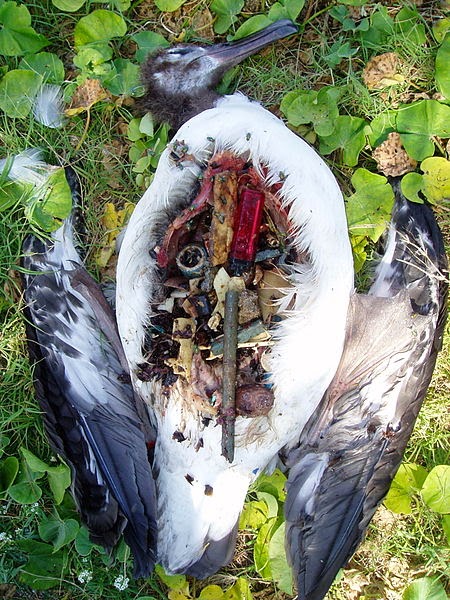


Right.
Sorry to depress everybody with dead animal pictures. Somehow, it’s hard for us to take things like the environment seriously unless we have something with eyes and a brain to empathize with, isn’t it?
I’ve been unable to confirm the claims I’ve found online that “nearly every seabird on the planet has plastic waste” in its gullet–but it is clear that dead birds, fish, and sea turtles all too often prove to have ingested plastic waste. Kilograms of it, in the case of large animals. Enough to cause death through starvation, intestinal blockage or puncture, and so on, in all too many cases.
But here’s the really bad news. That bit about the sea turtles and the birds? That’s the good news, environmentally speaking. Because, yeah, we are seeing species dying off at a rate unprecedented in human history and maybe even in geological history, but, at least in theory, species that become extinct can be supplanted by new species that evolve. And there is certainly one hell of a selection pressure in operation here, to select for turtles, birds, whales, and dolphins that know the difference between a floating bit of plastic and their next meal. So, while we may lose some beloved aquatic species, there may, someday, be more to replace them.
If we haven’t poisoned that entire ecosystem, of course.
Which is where the bad news really kicks in, because the dead sea turtles are the least of our problems with plastic. Plastic, you see, is really terrifying stuff: as far as we know, it will take geologic time to break down chemically: 500,000 to a million years. But it breaks down physically, into smaller and smaller bits, in a relatively short time–subject it to sun, water, weather, and it becomes tiny little particles.
This is not good news, even if it sounds like it is. To quote from one discussion of the often repeated (but little-supported) claim that plastic bags will degrade in “only” 500 years or so:
While polymers do indeed photodegrade, that doesn’t remove it from the environment. The big pieces simply become smaller. This is mostly a minor irritant on land (where microscopic polymers will just become another inorganic component of soil), but poses serious risks to marine life, who can’t distinguish indigestible polymer particles from food.
Thus marine organisms starve to death with guts full of styrofoam and PVC. This is bad enough when the creatures eating themselves to death are cuddly critters like sea turtles or pelicans, but as polymers degrade into microscopic bits the effect moves down the food chain, such that these particles are now replacing plankton. You can knock off the top of the food pyramid (turtles and pelicans) with little effect, but let’s think really hard about what happens when you kick out the base.
All of which leaves aside the aesthetic issue of areas of ocean the size of continents that consist almost entirely of rafts of plastic garbage.
Those, by the way, look like this:

But it’s not how they look that’s the truly horrifying thing. It’s how they act:
A study by the Japanese geochemist Hideshige Takada and his colleagues at Tokyo University in 2001 found that plastic polymers act like a sponge for resilient poisons such as DDT and polychlorinated biphenyls. Takada’s team found non-water-soluble toxic chemicals can be found in plastic in levels as high as a million times their concentration in water.
In other words, we are starving out, poisoning, and crowding out the base of the ocean’s food chain. Plastics are appearing in portions of our oceans at high enough densities to “smother marine life,” and take the place of the plankton that feed all the other life forms of the sea–and which, taken as a whole, produce half our planet’s oxygen.
Worried yet?
I am… an that’s without taking into account the fact that, while too stable to break down naturally or fully by any biological process, plastics are also too unstable not to leach out vast quantities of toxic components used to stabilize, tint, or change various properties of plastics for short term use. So readily do plastics release poisons into the environment, in fact, that we are coming to understand that even in the short lifespan of a disposable plastic water bottle, it may well be leaching carcinogenic compounds into the liquids we consume. In fact, ironically enough, plastics break down so easily that museum curators, wanting to preserve some of the many pop-culture artifacts made from plastic in this century, find it exceedingly challenging to do so.
The problem…is that many of these components aren’t chemically bound to the polymer chains. Thus, over time and under certain conditions, the additives can ooze out of the plastic. Studies suggest that many of these substances–including pthalates, flame retardants, and bisphenol A–leach from consumer products and cause significant health problems for humans.
Loss of these additives doesn’t help the plastic, either.
I guess that’s a concern when you’re trying to preserve a forty-year-old Barbie doll. But, overall, I’d have to say its far more of a concern when you’re considering thousands upon thousands of tons of this material, in the soil and in the oceans, creating biological deserts possibly for millenia to come.
Oh, yes–and did I mention that highly toxic processes involved in their production, as well?
 We can’t be having with this, people…
So what’s to be done? Well. Let’s talk. More tomorrow.
For more information, please see:
A Comparison of Plastic and Plankton in the North Pacific Plastic Gyre.
Marine Birds and Plastic Pollution.
Plastic Ocean.
Polymers are Forever.
Previous Post

December 5, 2008
The Dark
Browse Our Archives
Select a Category Cat's posts Peter's posts Uncategorized
Select a Month March 2017 February 2017 November 2016 July 2016 June 2016 May 2016 April 2016 February 2016 January 2016 December 2015 November 2015 October 2015 September 2015 August 2015 July 2015 June 2015 April 2015 March 2015 February 2015 January 2015 December 2014 November 2014 October 2014 September 2014 August 2014 July 2014 June 2014 May 2014 April 2014 March 2014 January 2014 December 2013 November 2013 October 2013 September 2013 July 2013 June 2013 March 2013 February 2013 December 2012 November 2012 August 2012 July 2012 June 2012 April 2012 February 2012 January 2012 November 2011 October 2011 September 2011 August 2011 July 2011 June 2011 May 2011 April 2011 March 2011 February 2011 January 2011 December 2010 November 2010 October 2010 September 2010 August 2010 July 2010 June 2010 May 2010 April 2010 March 2010 February 2010 January 2010 December 2009 November 2009 October 2009 September 2009 August 2009 July 2009 June 2009 May 2009 April 2009 March 2009 February 2009 January 2009 December 2008 November 2008 October 2008 September 2008 August 2008 July 2008 June 2008 May 2008 April 2008 March 2008 February 2008 January 2008 December 2007 November 2007 October 2007 September 2007 August 2007 July 2007 June 2007 May 2007 April 2007 March 2007 February 2007 January 2007 December 2006 October 2006 September 2006 August 2006 July 2006 June 2006 May 2006 April 2006 March 2006 July 2000
Follow Us!
TAKE THE
Religious Wisdom Quiz
What does Paul say is the greatest of faith, hope, and love?
Select your answer to see how you score.
Faith Strength Hope Love
Related posts from Quaker Pagan Reflections

Goodbye to Patheos Pagan Channel


Peter on Mysticism and Facebook in a Time...

TRENDING AT PATHEOS Pagan

I was recently chatting with someone on Instagram. She asked me what...

While there are many people who share their results, the end of...

On July 23, I saw Christopher Nolan's The Odyssey which is Homer’s...

As I write this two big events have just finished up. One...

Restoring the Watershed of Divine Love
Perhaps cooperation is not something we manufacture through legislation, ideology, or moral...

Many UUs don’t pray because of bad experiences in a previous religion,...
view all Pagan blogs
Ad-Free & Subscriber Log-In Subscription Support
- About Us
- 2026 Calendar
- Videos
- Podcasts
- Library of World Religions
- Faith In Media Tracker
- Advertise With Us
- Write for Us
- Privacy Policy
- Terms of Service
- Do Not Sell My Data
- Contact Us
- Radiant Digital
- Manage Newsletter Subscriptions
- Unsubscribe From Notifications
- Sitemap
Copyright 2008-2026, Patheos. All rights reserved.
Subscription Support Ad-Free & Subscriber Log-In
Follow Patheos