
BuddhistCatholicContemplativeEvangelicalGeneral ChristianHinduJewishLatter-day SaintMuslimNew VisionsProgressive Christian
Beliefs
- Buddhist
- Catholic
- Contemplative
- Evangelical
- General Christian
- Hindu
- Jewish
- Latter-day Saint
- More Voices
- Muslim
- New Visions
- Pagan
- Progressive Christian
Topics
- Religion News
- Food and Religion
- Sports and Religion
- Religious Art
- Religious Music and Entertainment
- Religious Events
- History and Religion
- Style and Religion
- Politics and Religion
- Women in Religion
- Recreation Outdoors and Religion
- Business Finance and Religion
- Careers Workplace and Religion
- Education and Religion
- Family Parenting and Religion
- Health Fitness and Religion
- Home and Religion
- Relationships and Religion
- Technology and Religion
- Travel and Religion
Columnists
- Buddhist Columnists
- Business Finance and Religion Columnists
- Careers Workplace and Religion Columnists
- Catholic Columnists
- Contemplative Columnists
- Education and Religion Columnists
- Evangelists Columnists
- Family Parenting and Religion Columnists
- General Christian Columnists
- Health Fitness and Religion Columnists
- Hindu Columnists
- History and Religion Columnists
- Home and Religion Columnists
- Jewish Columnists
- More Voices Columnists
- Latter Day Columnists
- Muslim Columnists
- New Visions Columnists
- Nonreligious Columnists
- Pagan Columnists
- Politics and Religion Columnists
- Progressive Columnists
- Recreation Outdoors and Religion Columnists
- Relationships and Religion Columnists
- Religion News Columnists
- Religious Art Columnists
- Religious Events Columnists
- Religious Music and Entertainment Columnists
- Sports and Religion Columnists
- Style and Religion Columnists
- Technology and Religion Columnists
- Travel and Religion Columnists
- Women in Religion Columnists
Resource Library
- 2026 Calendar
- Library of World Religions
- The 100 Most Holy Places on Earth
- Patheos Answers
- Podcasts
- Videos
- Faith Leaders Database
- Anglican Episcopalian
- Bahai
- Baptist
- Buddhism
- Christianity
- Confucianism
- Eastern Orthodoxy
- Hinduism
- Holiness and Pentecostal
- ISKCON
- Islam
- Judaism
- Lutheran
- Methodist
- The Church of Jesus Christ of Latter-day Saints
- New Age
- Paganism
- Presbytarian and Reformed
- Protestantism
- Religion Behind the Scenes
- Roman Catholic
- Scientology
- Shia Islam
- Sikhism
- Sufism
- Sunni Islam
- Taoism
- Zen
- See all religions
Research Tools
 Ad-Free & Subscriber Log-In Subscription Support
Ad-Free & Subscriber Log-In Subscription Support
Follow Patheos 

- Trending:
- Forgiveness
- |
- Marriage
- |
- Consciousness
- |
- Death Penalty
- |
- Election
- |
- Halloween
 Pursued by Truth
- Home
- Catholic
- What Was Jesus Doing in the Basement?
What Was Jesus Doing in the Basement?
Last updated on: February 27, 2016 at 7:00 am by Guest Contributor
What Was Jesus Doing in the Basement? 2016-02-26T15:42:28-04:00 Guest Contributor
Patheos Explore the world's faith through different perspectives on religion and spirituality! Patheos has the views of the prevalent religions and spiritualities of the world.
By Sr. Anne Flanagan
Sister Julia came to my office the other day with a real find: “Sister Anne, I found your Jesus in the basement!”
No, the Blessed Sacrament had not transported itself from the chapel. But I still went down to the basement of the “Promised Land” building to bring my Jesus back upstairs.
There he was, mounted on smooth wood, an art print long faded by the sunlight: the Christ of Sinai. The icon had been a gift to our community from the nearby Transfiguration Monastery and had hung on the wall outside of chapel long enough to turn its coloring to shades of blue and yellow (at which point it must have been relocated to the basement). It’s not that I hadn’t seen the image in years: I have a life-sized print of it in my room and holy card versions in every prayerbook I use on a regular basis. There are three copies in my Liturgy of the Hours alone! I even have an 8 x 11 version I take with me on trips. (All those years of passing by the icon on my way to chapel must have “imprinted” on me.)
There’s an interesting quality to this image that I didn’t really notice until it was pointed out to me. The face of Jesus, so majestic, is really made of two slightly unmatched halves, each of which communicates a different emotional quality. In fact, I have noticed that what I see when I look at the icon depends very much on my state of soul! When I am interiorly out of sorts, that arched eyebrow seems to heighten as if to invite me to consider what may be coming between me and the Lord.
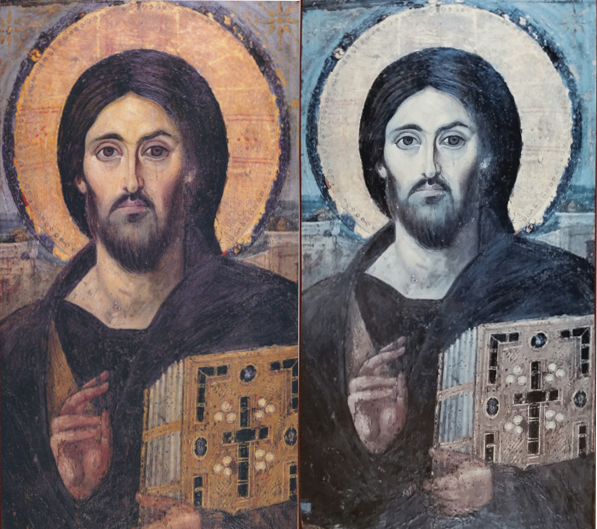
The oldest known icon of Christ Pantocrator, (Saint Catherine’s Monastery).
On Right: “My” Jesus: The icon that hung outside of chapel (now in my office).
On Left: This image gives you a better sense of the full beauty of the icon.
There are many remarkable features hidden in this icon. First of all its style: while there are certainly aspects that we might associate with Eastern icons, there is a kind of physicality to the painting that is not at all typical. It seems a cross between a portrait and an icon.
Then there is that dual quality to the face: On the left (as we see it), there is a serene, almost two-dimensional face; on the right, the features are irregular: the eyebrow is arched, the nostril prominent, the cheek featuring shadowing that implies a set jaw. Some interpretations of this duality see the right side of the face as reflecting Christ’s suffering during his Passion, with a broken nose and contusions over his eye, while the left side seems to image the Risen Christ. Another approach sees the strongly three-dimensional right side as communicating Christ’s human nature, and the unworldly two-dimensional left as a portrayal of his divine nature.
But then there is the book, sealed shut. Is that the “book of life” (see Rev. 3:5)? That could make this an image of Christ on Judgment Day. He is both the tender shepherd who tells the sheep on his right (our left) “Come, you whom my Father has blessed: inherit the Kingdom prepared for you from the foundations of the earth!” But to the “goats” on his left (our right), “the King” will say, “Depart from me…for I was hungry and you gave me no food, thirsty and you gave me no drink” (Mt 25: 31-46).
Scholars believe that this image was probably painted in Constantinople sometime around the year 600, and may have even been commissioned by an emperor. (Constantinople was the capitol of the Byzantine Empire.) In a move that saved it from the ravages of the iconoclasts (“icon-breakers”), the image seems to have been transferred early on to St Catherine’s Monastery on Mount Sinai in faraway Egypt, where it is venerated to this day. No one knows who “wrote” this incredible icon, but it was clearly a person who put his (or her?) magnificent talent at the service of the Holy Spirit.
When we place ourselves at the service of God, whatever we do, no matter how insignificant it seems, can echo through the centuries as grace for others.
 Sister Anne Flanagan, a Daughter of St Paul, a native of New Orleans, is author of Five Keys to Understanding Pope Francis. She has also recorded over two dozen albums as a soprano in the Daughters of St Paul choir. Follow her on Twitter @nunblogger. She blogs at Nun Blog.
This post first appeared in the Daughters of St. Paul My Discover Hope weekly email; if you would like to subscribe to our sisters weekly email, you can do so here.
Stay in touch! Like Pursued by Truth on Facebook:
Pursued by Truth
Previous Post

February 24, 2016
Guess Who Is Turning 100 Years Old?
Next Post

March 2, 2016 5 Solutions for Election Season Despair, Anger, and Worry
Browse Our Archives
Select a Category Advent Art Atheism Book Reviews Christmas Church Issues Discernment Easter Ecumenism Entertainment Environment Eucharist Evangelization Family Freebies Guest Post Holy Spirit Inspire Me Interreligious Dialogue Jesus Lectio Divina Lent Life Issues Liturgical Season Mary Media MISC Movie Reviews Pauline Pope Francis Prayer Prayer Intention Religious Life Saints Sanctity Scripture Social Justice Social Teaching St. Paul Theology of the Body Uncategorized US News Vocations World News Writing Year of Mercy
Select a Month September 2016 June 2016 May 2016 April 2016 March 2016 February 2016 January 2016 December 2015 November 2015 October 2015 September 2015 August 2015 July 2015 June 2015 May 2015 April 2015 March 2015 February 2015 January 2015 December 2014 November 2014 October 2014 September 2014 August 2014 July 2014 June 2014 May 2014 April 2014 March 2014 February 2014 January 2014 December 2013 November 2013 October 2013 September 2013 July 2013 June 2013 May 2013 April 2013 March 2013 February 2013 January 2013 December 2012 November 2012 October 2012 September 2012 August 2012 July 2012 June 2012 May 2012 April 2012 March 2012 February 2012 January 2012 December 2011 November 2011 October 2011 September 2011 August 2011 July 2011 June 2011 April 2011 March 2011 February 2011 January 2011 December 2010 November 2010 October 2010 September 2010 August 2010
Follow Us!
TAKE THE
Religious Wisdom Quiz
What happened to Jesus 40 days after His resurrection?
Select your answer to see how you score.
He performed one last miracle He visited the temple He went back into hiding He ascended into heaven
Related posts from Pursued by Truth

WATCH: Sr. Maria Kim's Vocation Story
How God Hauled Me Kicking and Screaming Into...
3 Moments When the Holy Spirit Worked in...
Archbishop of Damascus: 4 Greatest Challenges to Christians...
TRENDING AT PATHEOS Catholic

Rejecting Doom: Christian Hope And Human Action
Christianity is a religion of hope. We are to have hope and...

It’s What Comes From Within Which Matters
One of the most difficult things for us to understand is why...

Why I Choose the Eucharist Over the Sermon
Choose the Eucharist, Not the Sermon What are we supposed to get...

5 Design Elements Found in Spiritually Rooted Homes
Putting Spirituality Into Home Decor Our homes are more than our living...

Credo: A Story of God Told with the...
About 10 years ago, I began to imagine a personal "Credo" that...

The Anatomy of Divine Revelation in Catholic Thought
The claim that God has made Himself known to human beings is...
view all Catholic blogs
Ad-Free & Subscriber Log-In Subscription Support
- About Us
- 2026 Calendar
- Videos
- Podcasts
- Library of World Religions
- Faith In Media Tracker
- Advertise With Us
- Write for Us
- Privacy Policy
- Terms of Service
- Do Not Sell My Data
- Contact Us
- Radiant Digital
- Manage Newsletter Subscriptions
- Unsubscribe From Notifications
- Sitemap
Copyright 2008-2026, Patheos. All rights reserved.
Subscription Support Ad-Free & Subscriber Log-In
Follow Patheos