
BuddhistCatholicContemplativeEvangelicalGeneral ChristianHinduJewishLatter-day SaintMuslimNew VisionsProgressive Christian
Beliefs
- Buddhist
- Catholic
- Contemplative
- Evangelical
- General Christian
- Hindu
- Jewish
- Latter-day Saint
- More Voices
- Muslim
- New Visions
- Pagan
- Progressive Christian
Topics
- Religion News
- Food and Religion
- Sports and Religion
- Religious Art
- Religious Music and Entertainment
- Religious Events
- History and Religion
- Style and Religion
- Politics and Religion
- Women in Religion
- Recreation Outdoors and Religion
- Business Finance and Religion
- Careers Workplace and Religion
- Education and Religion
- Family Parenting and Religion
- Health Fitness and Religion
- Home and Religion
- Relationships and Religion
- Technology and Religion
- Travel and Religion
Columnists
- Buddhist Columnists
- Business Finance and Religion Columnists
- Careers Workplace and Religion Columnists
- Catholic Columnists
- Contemplative Columnists
- Education and Religion Columnists
- Evangelists Columnists
- Family Parenting and Religion Columnists
- General Christian Columnists
- Health Fitness and Religion Columnists
- Hindu Columnists
- History and Religion Columnists
- Home and Religion Columnists
- Jewish Columnists
- More Voices Columnists
- Latter Day Columnists
- Muslim Columnists
- New Visions Columnists
- Nonreligious Columnists
- Pagan Columnists
- Politics and Religion Columnists
- Progressive Columnists
- Recreation Outdoors and Religion Columnists
- Relationships and Religion Columnists
- Religion News Columnists
- Religious Art Columnists
- Religious Events Columnists
- Religious Music and Entertainment Columnists
- Sports and Religion Columnists
- Style and Religion Columnists
- Technology and Religion Columnists
- Travel and Religion Columnists
- Women in Religion Columnists
Resource Library
- 2026 Calendar
- Library of World Religions
- The 100 Most Holy Places on Earth
- Patheos Answers
- Podcasts
- Videos
- Faith Leaders Database
- Anglican Episcopalian
- Bahai
- Baptist
- Buddhism
- Christianity
- Confucianism
- Eastern Orthodoxy
- Hinduism
- Holiness and Pentecostal
- ISKCON
- Islam
- Judaism
- Lutheran
- Methodist
- The Church of Jesus Christ of Latter-day Saints
- New Age
- Paganism
- Presbytarian and Reformed
- Protestantism
- Religion Behind the Scenes
- Roman Catholic
- Scientology
- Shia Islam
- Sikhism
- Sufism
- Sunni Islam
- Taoism
- Zen
- See all religions
Research Tools
 Ad-Free & Subscriber Log-In Subscription Support
Ad-Free & Subscriber Log-In Subscription Support
Follow Patheos 

- Trending:
- Forgiveness
- |
- Marriage
- |
- Consciousness
- |
- Death Penalty
- |
- Election
- |
- Halloween
 Pursued by Truth
- Home
- Catholic
- What Is the Year of Mercy? Resources and Details…
What Is the Year of Mercy? Resources and Details…
Last updated on: December 8, 2015 at 9:37 am by Guest Contributor
What Is the Year of Mercy? Resources and Details… 2015-12-08T09:37:28-04:00 Guest Contributor
Patheos Explore the world's faith through different perspectives on religion and spirituality! Patheos has the views of the prevalent religions and spiritualities of the world.
By Kathryn Hermes, FSP
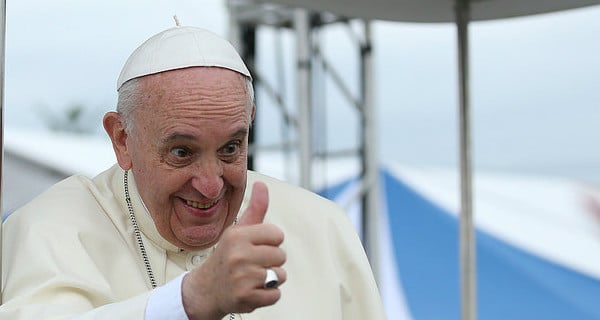
Photo credit: KOREA.NET – Official page of the Republic of Korea / Foter / CC BY-SA
If there is one word that has characterized the pontificate of Pope Francis, it is the word mercy.
As St. John Paul II before him—who called for a recourse to mercy “in this difficult, critical phase of the history of the Church and of the world” (Dives in Misericordia, 15)—Pope Francis has looked out onto today’s world situation and called for a revolution in tenderness.
We see Francis modeling this revolution in his actions, in his gaze, in his words…all of which have captured the imagination of Catholics and non-Catholics alike.
When people ask me for prayers, I hear all kinds of situations in which people are longing for mercy: the restoration of family relationships, court cases involving sons and daughters; situations at work that are unfair; the longing to be heard by another. We long for mercy.
Mercy can be a hard word to swallow. We all want mercy shown to ourselves when we mess up or even sin, but have you ever noticed how mercy isn’t the first thing that comes to our mind when others sin against us, or cause us problems, or get in our way? We talk about mercy, but at the same time set up incredible hurdles to be overcome for someone to show they “deserve” that mercy. This creates the terrible situations of hardness, isolation, and sorrow in our world. Maybe you have felt them yourself?
At the first Angelus message after his election, Francis already gave a us a hint about how mercy is really what we all need: “Feeling mercy, that this word changes everything. This is the best thing we can feel: it changes the world. A little mercy makes the world less cold and more just.”
And in an Angelus message two years later: “There is so much need of mercy today, and it is important that the lay faithful live it and bring it into different social environments. Go forth! We are living in the age of mercy, this is the age of mercy.”
And in his 2015 Lenten Message: “How greatly I desire that all those places where the Church is present, especially our parishes and our communities, may become islands of mercy in the midst of the sea of indifference!”
EXTRAORDINARY YEAR OF MERCY
After last Easter , Pope Francis declared an Extraordinary Jubilee of Mercy beginning on the Feast of the Immaculate Conception December 8 of 2015 and extending to the Feast of Christ the King 2016. Extraordinary Jubilees are great events in the life of the Church. The custom of calling extraordinary Jubilees dates back to the XVI century. The last extraordinary Holy Years, which were celebrated during the previous century, were those in 1933, proclaimed by Pius XI to celebrate XIX hundred years of Redemption and in 1983, proclaimed by John Paul II on the occasion of the 1950 years of Redemption.
The Face of Mercy: Buy the Document or Read Online
WHY A YEAR OF MERCY?
In the formal announcement for the Jubilee of Mercy, Pope Francis stated:
Many question in their hearts: why a Jubilee of Mercy today? Simply because the Church, in this time of great historical change, is called to offer more evident signs of God’s presence and closeness. This is not the time to be distracted; on the contrary, we need to be vigilant and to reawaken in ourselves the capacity to see what is essential. This is a time for the Church to rediscover the meaning of the mission entrusted to her by the Lord on the day of Easter: to be a sign and an instrument of the Father’s mercy (cf. Jn 20:21-23). For this reason, the Holy Year must keep alive the desire to know how to welcome the numerous signs of the tenderness which God offers to the whole world and, above all, to those who suffer, who are alone and abandoned, without hope of being pardoned or feeling the Father’s love. A Holy Year to experience strongly within ourselves the joy of having been found by Jesus, the Good Shepherd who has come in search of us because we were lost. A Jubilee to receive the warmth of his love when he bears us upon his shoulders and brings us back to the Father’s house. A year in which to be touched by the Lord Jesus and to be transformed by his mercy, so that we may become witnesses to mercy. Here, then, is the reason for the Jubilee: because this is the time for mercy. It is the favorable time to heal wounds, a time not to be weary of meeting all those who are waiting to see and to touch with their hands the signs of the closeness of God, a time to offer everyone the way of forgiveness and reconciliation.
WHAT DO WE DO IN A EXTRAORDINARY JUBILEE?
So what do we do in an Extraordinary Jubilee of Mercy? What’s going to happen? How can I access this mercy for myself? How can I experience the Church’s indulgence, and how can I be a part of this revolution of tenderness?
First of all, the Pontifical Council for the Promotion of New Evangelization is charged with the worldwide organization of everything that will happen.
But you can begin by reading and reflecting on the very beautiful short document called a Bull of Indiction titled The Face of Mercy in which Pope Francis shares with the whole Church his vision of Christ’s mercy in the world today. The document also reveals some of the ways in which this mercy will be shared in a special way throughout the Holy Year with as many as possible:
- Holy Doors will be declared as places of pilgrimage to obtain mercy: “May pilgrimage be an impetus to conversion: by crossing the threshold of the Holy Door, we will find the strength to embrace God’s mercy and dedicate ourselves to being merciful with others as the Father has been with us” (14). Dioceses will have an opportunity to open a Holy Door, The Door of Mercy.
- Mercy for the poor: “We look forward to the experience of opening our hearts to those living on the outermost fringes of society” (15).
- Living the works of mercy: “It is my burning desire that, during this Jubilee, the Christian people may reflect on the corporal and spiritual works of mercy.” (15).
- An intense celebration of Lent in the parishes in 2016 (17).
- Missionaries of Mercy sent by the Pope throughout the world: “During Lent of this Holy Year, I intend to send out Missionaries of Mercy. They will be a sign of the Church’s maternal solicitude for the People of God, enabling them to enter the profound richness of this mystery so fundamental to the faith. There will be priests to whom I will grant the authority to pardon even those sins reserved to the Holy See, so that the breadth of their mandate as confessors will be even clearer” (18)
- Special indulgences for the Jubilee: “A Jubilee also entails the granting of indulgences. This practice will acquire an even more important meaning in the Holy Year of Mercy” (22)
- Encounter with Judaism and Islam: “I trust that this Jubilee year celebrating the mercy of God will foster an encounter with [Judaism and Islam] and with other noble religious traditions; may it open us to even more fervent dialogue so that we might know and understand one another better; may it eliminate every form of closed-mindedness and disrespect, and drive out every form of violence and discrimination” (23)
PRAYER FOR THE YEAR OF MERCY
© Pontifical Council for the Promotion of New Evangelization
Lord Jesus Christ,
you have taught us to be merciful like the heavenly Father,
and have told us that whoever sees you sees Him.
Show us your face and we will be saved.
Your loving gaze freed Zacchaeus and Matthew from being enslaved by money;
the adulteress and Magdalene from seeking happiness only in created things;
made Peter weep after his betrayal,
and assured Paradise to the repentant thief.
Let us hear, as if addressed to each one of us, the words that you spoke to the Samaritan woman:
“If you knew the gift of God!”
You are the visible face of the invisible Father,
of the God who manifests his power above all by forgiveness and mercy:
let the Church be your visible face in the world, its Lord risen and glorified.
You willed that your ministers would also be clothed in weakness
in order that they may feel compassion for those in ignorance and error:
let everyone who approaches them feel sought after, loved, and forgiven by God.
Send your Spirit and consecrate every one of us with its anointing,
so that the Jubilee of Mercy may be a year of grace from the Lord,
and your Church, with renewed enthusiasm, may bring good news to the poor,
proclaim liberty to captives and the oppressed,
and restore sight to the blind.
We ask this through the intercession of Mary, Mother of Mercy,
you who live and reign with the Father and the Holy Spirit for ever and ever.
Amen.
 The study of spirituality has been a life-long pursuit of Kathryn J. Hermes, F.S.P. She has an M.T.S. from Weston Jesuit Center for Theological Studies and an advanced certificate in Scripture. She is the author of Surviving Depression—A Catholic Approach (now in ten languages), Making Peace with Yourself—15 Steps for Spiritual Healing, Beginning Contemplative Prayer, St. Joseph—Help for Life’s Emergencies, Holding on to Hope, among others. Hermes is a Daughter of St. Paul. She currently directs Digital Publishing for the publishing house of the Daughters of St. Paul. She is a spiritual director, offers presentations on spirituality and depression, and leads retreats.
This post first appeared in the Daughters of St. Paul Pauline Books and Media blog and My Discover Hope weekly email; if you would like to subscribe to our sisters weekly email, you can do so here.
Previous Post

December 2, 2015
Diamonds From Jesus
Next Post
December 9, 2015 Father Roderick Explains #YearofMercy in 60 Seconds WITH LEGOS
Browse Our Archives
Select a Category Advent Art Atheism Book Reviews Christmas Church Issues Discernment Easter Ecumenism Entertainment Environment Eucharist Evangelization Family Freebies Guest Post Holy Spirit Inspire Me Interreligious Dialogue Jesus Lectio Divina Lent Life Issues Liturgical Season Mary Media MISC Movie Reviews Pauline Pope Francis Prayer Prayer Intention Religious Life Saints Sanctity Scripture Social Justice Social Teaching St. Paul Theology of the Body Uncategorized US News Vocations World News Writing Year of Mercy
Select a Month September 2016 June 2016 May 2016 April 2016 March 2016 February 2016 January 2016 December 2015 November 2015 October 2015 September 2015 August 2015 July 2015 June 2015 May 2015 April 2015 March 2015 February 2015 January 2015 December 2014 November 2014 October 2014 September 2014 August 2014 July 2014 June 2014 May 2014 April 2014 March 2014 February 2014 January 2014 December 2013 November 2013 October 2013 September 2013 July 2013 June 2013 May 2013 April 2013 March 2013 February 2013 January 2013 December 2012 November 2012 October 2012 September 2012 August 2012 July 2012 June 2012 May 2012 April 2012 March 2012 February 2012 January 2012 December 2011 November 2011 October 2011 September 2011 August 2011 July 2011 June 2011 April 2011 March 2011 February 2011 January 2011 December 2010 November 2010 October 2010 September 2010 August 2010
Follow Us!
TAKE THE
Religious Wisdom Quiz
What is the main Christian group in Ethiopia called?
Select your answer to see how you score.
Assemblies of God Pentecostal Ethiopian Orthodox Tewahedo Church Baptist
Related posts from Pursued by Truth

NEW Syrian Archbishop's Letter: Will We Become the...
How God Hauled Me Kicking and Screaming Into...
3 Moments When the Holy Spirit Worked in...

How to Read Amoris Laetitia without Assumptions, Cynicism,...
TRENDING AT PATHEOS Catholic

Creation, Preservation, and Teleology in Catholic Theology
As I write this, it is very early Monday morning. Like millions...

The Parable Of The Sower And The Word...
One of Christ’s most famous parables is that of the sower who...

Rejecting Doom: Christian Hope And Human Action
Christianity is a religion of hope. We are to have hope and...

Why I Choose the Eucharist Over the Sermon
Choose the Eucharist, Not the Sermon What are we supposed to get...

5 Design Elements Found in Spiritually Rooted Homes
Putting Spirituality Into Home Decor Our homes are more than our living...

Credo: A Story of God Told with the...
About 10 years ago, I began to imagine a personal "Credo" that...
view all Catholic blogs
Ad-Free & Subscriber Log-In Subscription Support
- About Us
- 2026 Calendar
- Videos
- Podcasts
- Library of World Religions
- Faith In Media Tracker
- Advertise With Us
- Write for Us
- Privacy Policy
- Terms of Service
- Do Not Sell My Data
- Contact Us
- Radiant Digital
- Manage Newsletter Subscriptions
- Unsubscribe From Notifications
- Sitemap
Copyright 2008-2026, Patheos. All rights reserved.
Subscription Support Ad-Free & Subscriber Log-In
Follow Patheos