
BuddhistCatholicContemplativeEvangelicalGeneral ChristianHinduJewishLatter-day SaintMuslimNew VisionsProgressive Christian
Beliefs
- Buddhist
- Catholic
- Contemplative
- Evangelical
- General Christian
- Hindu
- Jewish
- Latter-day Saint
- More Voices
- Muslim
- New Visions
- Pagan
- Progressive Christian
Topics
- Religion News
- Food and Religion
- Sports and Religion
- Religious Art
- Religious Music and Entertainment
- Religious Events
- History and Religion
- Style and Religion
- Politics and Religion
- Women in Religion
- Recreation Outdoors and Religion
- Business Finance and Religion
- Careers Workplace and Religion
- Education and Religion
- Family Parenting and Religion
- Health Fitness and Religion
- Home and Religion
- Relationships and Religion
- Technology and Religion
- Travel and Religion
Columnists
- Buddhist Columnists
- Business Finance and Religion Columnists
- Careers Workplace and Religion Columnists
- Catholic Columnists
- Contemplative Columnists
- Education and Religion Columnists
- Evangelists Columnists
- Family Parenting and Religion Columnists
- General Christian Columnists
- Health Fitness and Religion Columnists
- Hindu Columnists
- History and Religion Columnists
- Home and Religion Columnists
- Jewish Columnists
- More Voices Columnists
- Latter Day Columnists
- Muslim Columnists
- New Visions Columnists
- Nonreligious Columnists
- Pagan Columnists
- Politics and Religion Columnists
- Progressive Columnists
- Recreation Outdoors and Religion Columnists
- Relationships and Religion Columnists
- Religion News Columnists
- Religious Art Columnists
- Religious Events Columnists
- Religious Music and Entertainment Columnists
- Sports and Religion Columnists
- Style and Religion Columnists
- Technology and Religion Columnists
- Travel and Religion Columnists
- Women in Religion Columnists
Resource Library
- 2026 Calendar
- Library of World Religions
- The 100 Most Holy Places on Earth
- Patheos Answers
- Podcasts
- Videos
- Faith Leaders Database
- Anglican Episcopalian
- Bahai
- Baptist
- Buddhism
- Christianity
- Confucianism
- Eastern Orthodoxy
- Hinduism
- Holiness and Pentecostal
- ISKCON
- Islam
- Judaism
- Lutheran
- Methodist
- The Church of Jesus Christ of Latter-day Saints
- New Age
- Paganism
- Presbytarian and Reformed
- Protestantism
- Religion Behind the Scenes
- Roman Catholic
- Scientology
- Shia Islam
- Sikhism
- Sufism
- Sunni Islam
- Taoism
- Zen
- See all religions
Research Tools
 Ad-Free & Subscriber Log-In Subscription Support
Ad-Free & Subscriber Log-In Subscription Support
Follow Patheos 

- Trending:
- Forgiveness
- |
- Marriage
- |
- Consciousness
- |
- Death Penalty
- |
- Election
- |
- Halloween
 Pursued by Truth
- Home
- Catholic
- Should I Force My Teenager to Go to Mass?
Should I Force My Teenager to Go to Mass?
Last updated on: December 15, 2015 at 10:25 am by Sr. Theresa Aletheia Noble
Should I Force My Teenager to Go to Mass? 2015-12-15T10:25:46-04:00 Sr. Theresa Aletheia Noble
Patheos Explore the world's faith through different perspectives on religion and spirituality! Patheos has the views of the prevalent religions and spiritualities of the world.

Photo credit: 1000 paper clips via Foter.com / CC BY-ND
I was recently on Kim Tisor’s podcast show “Our Catholic Way.”
Kim is a delightful host who interviews Catholic converts and is a convert herself. I had a lot of fun discussing my conversion story in relation to my book The Prodigal You Love: Inviting Loved Ones Back to the Church.
In the interview, Kim does a great job of weaving practical questions in with the story of my conversion.
A question that came up is one that is asked of me quite often, “Should I force my teenager to go to Mass?”
There are differing opinions on this question. I am not a psychologist and I am not a parent of teenagers. But based on my experience as a rebellious teen who fell away from the Church when I was fourteen, I feel pretty strongly that parents of teens should make it clear to their children that Mass, just like family dinner or any other family activity, is non-negotiable.
Boundaries are very important for kids. They can be difficult to enforce, especially during the teenage years, and parents should choose wisely “which mountains to die on” so to speak, but Mass attendance is one boundary that I think is very important.
My parents “forced” me to go to Mass. I was an atheist. I was a very rebellious kid, but I did not push back a whole lot on this issue because I just knew it was what we did as a family. It was not up for discussion. I often was annoyed during Mass, but my Mom tells me, and I remember, that there were times when I would perk up and tune into what was going on or what the priest was saying. Those potential moments of openness are precious and important.
In my book I devote an entire chapter to “Respecting Free Will.” I believe this is key in inviting our loved ones back to the Church. But when children are underage, it is a parent’s responsibility to set boundaries – and going to Mass as a family, in my opinion, is an acceptable boundary to set.
I know not every family setting is the same and we must always approach situations with respect for the individual and the circumstances involved. So, I am not proposing a hard and fast rule. The difference between a 13-year-old and a 17-year-old is immense. And there may be times when a parent may feel it best to give their teenagers a choice about going to Mass, and in the long run this might be helpful in terms of keeping them in the Church. But in most cases, when it is at all possible, I think it best to make it clear to children that Mass is simply something we do as a family.
Dr. Gregory Popcak, a fellow blogger on Patheos, wrote on this subject:
If you, as a parent take your child’s earthly nourishment seriously, why would you neglect your child’s spiritual nutrition? It needs to be understood in your household that Mass attendance is not optional.
He then goes on to make several important points about underlying issues that need to be addressed when a teenager refuses to go to Mass.
Father Z, a popular blogger and priest, also recently addressed this question similarly:
We “force” our children to do many things against their will. We force them to brush their teeth, eat their broccoli, clean their rooms, stand up straight, and be polite to Aunt Frieda when she visits. This does not seem universally to lead to lapsed dental care, abhorrence of broccoli, perpetually messy rooms, slouchers and rudeness when they hit adulthood.
Father Z then goes on to make the distinction between teenagers and adult children.
I agree that this distinction is really important.
Adulthood is the time when parents should back off and make it clear to their children that as adults they need to make decisions for themselves. When my parents did this, it gave me pause, even as an atheist. They were very clear that when I entered adulthood I was now making important decisions on my own. They hoped I would make the right one when it came to Mass, but they ceased using their parental authority on this issue. (Although they asked me if I would be willing to attend Mass when I was home as an example to my siblings, and I did so, out of respect for my parents).
Of course there are issues surrounding this, particularly in relation to receiving the Eucharist.
I address this question in the interview. But I do not think we should encourage our teenagers to miss Mass out of concerns surrounding the reception of the Eucharist. There are other ways to address that.
I cover quite a bit more than the issue of teenagers going to Mass in the interview with Kim but I wanted to give a little context to that topic in particular because I receive a lot of questions around it.
Hope you enjoy the interview!
http://wp.production.patheos.com/blogs/pursuedbytruth/files/2015/12/catholic-way-srtheresa.mp3
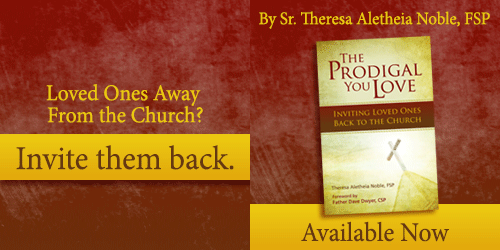
The Prodigal You Love: Inviting Loved Ones Back to the Church
Previous Post

December 12, 2015
12 Reasons Why Our Lady of Guadalupe is the BEST
Next Post

December 16, 2015 God Showed Me Mercy Anyway
Browse Our Archives
Select a Category Advent Art Atheism Book Reviews Christmas Church Issues Discernment Easter Ecumenism Entertainment Environment Eucharist Evangelization Family Freebies Guest Post Holy Spirit Inspire Me Interreligious Dialogue Jesus Lectio Divina Lent Life Issues Liturgical Season Mary Media MISC Movie Reviews Pauline Pope Francis Prayer Prayer Intention Religious Life Saints Sanctity Scripture Social Justice Social Teaching St. Paul Theology of the Body Uncategorized US News Vocations World News Writing Year of Mercy
Select a Month September 2016 June 2016 May 2016 April 2016 March 2016 February 2016 January 2016 December 2015 November 2015 October 2015 September 2015 August 2015 July 2015 June 2015 May 2015 April 2015 March 2015 February 2015 January 2015 December 2014 November 2014 October 2014 September 2014 August 2014 July 2014 June 2014 May 2014 April 2014 March 2014 February 2014 January 2014 December 2013 November 2013 October 2013 September 2013 July 2013 June 2013 May 2013 April 2013 March 2013 February 2013 January 2013 December 2012 November 2012 October 2012 September 2012 August 2012 July 2012 June 2012 May 2012 April 2012 March 2012 February 2012 January 2012 December 2011 November 2011 October 2011 September 2011 August 2011 July 2011 June 2011 April 2011 March 2011 February 2011 January 2011 December 2010 November 2010 October 2010 September 2010 August 2010
Follow Us!
TAKE THE
Religious Wisdom Quiz
What church leader is called "the Bishop of Rome"?
Select your answer to see how you score.
The Patriarch The General Superintendent The Archbishop of Canterbury The Pope
Related posts from Pursued by Truth

NEW Syrian Archbishop's Letter: Will We Become the...

The Prodigal You Love: Book Signing and Talk...

How to Read Amoris Laetitia without Assumptions, Cynicism,...

5 Ways to Keeping Your Kids Reading This...
TRENDING AT PATHEOS Catholic

Creation, Preservation, and Teleology in Catholic Theology
As I write this, it is very early Monday morning. Like millions...

The Parable Of The Sower And The Word...
One of Christ’s most famous parables is that of the sower who...

Rejecting Doom: Christian Hope And Human Action
Christianity is a religion of hope. We are to have hope and...

Why I Choose the Eucharist Over the Sermon
Choose the Eucharist, Not the Sermon What are we supposed to get...

5 Design Elements Found in Spiritually Rooted Homes
Putting Spirituality Into Home Decor Our homes are more than our living...

Credo: A Story of God Told with the...
About 10 years ago, I began to imagine a personal "Credo" that...
view all Catholic blogs
Ad-Free & Subscriber Log-In Subscription Support
- About Us
- 2026 Calendar
- Videos
- Podcasts
- Library of World Religions
- Faith In Media Tracker
- Advertise With Us
- Write for Us
- Privacy Policy
- Terms of Service
- Do Not Sell My Data
- Contact Us
- Radiant Digital
- Manage Newsletter Subscriptions
- Unsubscribe From Notifications
- Sitemap
Copyright 2008-2026, Patheos. All rights reserved.
Subscription Support Ad-Free & Subscriber Log-In
Follow Patheos