
BuddhistCatholicContemplativeEvangelicalGeneral ChristianHinduJewishLatter-day SaintMuslimNew VisionsProgressive Christian
Beliefs
- Buddhist
- Catholic
- Contemplative
- Evangelical
- General Christian
- Hindu
- Jewish
- Latter-day Saint
- More Voices
- Muslim
- New Visions
- Pagan
- Progressive Christian
Topics
- Religion News
- Food and Religion
- Sports and Religion
- Religious Art
- Religious Music and Entertainment
- Religious Events
- History and Religion
- Style and Religion
- Politics and Religion
- Women in Religion
- Recreation Outdoors and Religion
- Business Finance and Religion
- Careers Workplace and Religion
- Education and Religion
- Family Parenting and Religion
- Health Fitness and Religion
- Home and Religion
- Relationships and Religion
- Technology and Religion
- Travel and Religion
Columnists
- Buddhist Columnists
- Business Finance and Religion Columnists
- Careers Workplace and Religion Columnists
- Catholic Columnists
- Contemplative Columnists
- Education and Religion Columnists
- Evangelists Columnists
- Family Parenting and Religion Columnists
- General Christian Columnists
- Health Fitness and Religion Columnists
- Hindu Columnists
- History and Religion Columnists
- Home and Religion Columnists
- Jewish Columnists
- More Voices Columnists
- Latter Day Columnists
- Muslim Columnists
- New Visions Columnists
- Nonreligious Columnists
- Pagan Columnists
- Politics and Religion Columnists
- Progressive Columnists
- Recreation Outdoors and Religion Columnists
- Relationships and Religion Columnists
- Religion News Columnists
- Religious Art Columnists
- Religious Events Columnists
- Religious Music and Entertainment Columnists
- Sports and Religion Columnists
- Style and Religion Columnists
- Technology and Religion Columnists
- Travel and Religion Columnists
- Women in Religion Columnists
Resource Library
- 2026 Calendar
- Library of World Religions
- The 100 Most Holy Places on Earth
- Patheos Answers
- Podcasts
- Videos
- Faith Leaders Database
- Anglican Episcopalian
- Bahai
- Baptist
- Buddhism
- Christianity
- Confucianism
- Eastern Orthodoxy
- Hinduism
- Holiness and Pentecostal
- ISKCON
- Islam
- Judaism
- Lutheran
- Methodist
- The Church of Jesus Christ of Latter-day Saints
- New Age
- Paganism
- Presbytarian and Reformed
- Protestantism
- Religion Behind the Scenes
- Roman Catholic
- Scientology
- Shia Islam
- Sikhism
- Sufism
- Sunni Islam
- Taoism
- Zen
- See all religions
Research Tools
 Ad-Free & Subscriber Log-In Subscription Support
Ad-Free & Subscriber Log-In Subscription Support
Follow Patheos 

- Trending:
- Forgiveness
- |
- Marriage
- |
- Consciousness
- |
- Death Penalty
- |
- Election
- |
- Halloween
 Pursued by Truth
- Home
- Catholic
- 5 Tips: When Friends and Family Disagree on Gay Marriage
5 Tips: When Friends and Family Disagree on Gay Marriage
Last updated on: July 13, 2015 at 7:30 am by Sr. Theresa Aletheia Noble
5 Tips: When Friends and Family Disagree on Gay Marriage 2015-07-12T21:16:23-04:00 Sr. Theresa Aletheia Noble
Patheos Explore the world's faith through different perspectives on religion and spirituality! Patheos has the views of the prevalent religions and spiritualities of the world.
 I was an ardent gay rights and same-sex marriage supporter when I was an atheist.
I continued to be one after coming back to the Church, although I approached the issue with more caution, much more cognizant of my ability to completely miss the truth.
I gradually moved towards orthodoxy in many of my positions on other topics but this one was the last to go. It took a lot of time, study and prayer, but I eventually came to a place where I began to understand and accept where the Church is coming from on gay marriage and the issues surrounding it.
So instead of celebrating the Supreme Court decision on same-sex marriage as I would have in my former life, I instead feel quite a bit of unease.
I feel concern for Christians and people of other religions who oppose same-sex marriage. I wonder how this decision will affect religious freedom.
I am worried for future generations who will live in a society that does not recognize the natural and essential complementarity of men and women. And I am concerned about the rights of children who, if at all possible, should be able to know and love their natural parents.
I’ll also admit I don’t like people thinking I’m a hater, especially when I have devoted my life to being a lover.
But I am also concerned about how some Christians are reacting to this decision. Especially concerning to me is the suggestion from some that this is a delightful opportunity for people in the pews who have different views on this issue to leave.
Wow.
So the young people who have grown up in a culture in which they were lucky if their natural parents stayed together (and a living miracle if their parents did not use contraception) should just be expected to magically get this, buck up or get out?
And the Catholics who have endured many years of scandal as of late and are having difficulty trusting teachings on sex from a Church in which some people have enabled pedophiles should just get over it?
What about the people who genuinely love their faith, go to Mass every Sunday (or more), have compassionate hearts, are involved in works of mercy, but just can’t understand the Church’s teaching on this subject in the midst of a culture that ostracizes and labels people as haters if they don’t go along?
And the potential converts/reverts and all people in the midst of conversion (e.g. all of us!), should they just refrain from attending Mass until they have their ducks in a row and won’t feel offended when their priest preaches on same-sex marriage?
Who wants to say good riddance to these people?
Since I used to be one of them, I sure don’t.
(And I have to be honest, when I see others advocating for this, I think deep down inside it may be because we don’t want to do the work on ourselves that is required to remain in relationship with those with whom we disagree).
It is true that Catholics who are not in union with the Church on this issue are called to assent in faith and prayerfully investigate what the Church teaches. But I think it is also true that Catholics who are in union with the Church are tasked with being living invitations to investigation, not impediments.
As Christians in a society that is increasingly opposed to our worldview, I believe it is imperative that we stand strong in our support for traditional marriage. But, I think it is also important for us to avoid defensiveness and isolation from those who disagree with us.
This begins with our friends and family, especially those who are still in the pews, many of whom have showered our Facebook feeds with rainbows in the past weeks.
If you are like me and you want to stay in relationship with your friends and family who support same-sex marriage, here are some tips, drawn from my book The Prodigal You Love: Inviting Loved Ones Back to the Church, and from my own experience talking to friends and family who disagree with me on this issue.
1. Believe in the Good Intentions of the Other: I think the main reason this issue is difficult to talk about is the unfortunate way that it has been framed: To be against gay marriage is to be a bigot. (And on the other side, to be for gay marriage is to support the downfall of Western civilization as we know it).
I explain why it is possible to be against gay marriage and not be a bigot in my post “I Am a Christian Not a Bigot, Thanks“:
As Christians, we believe in the dignity and value of every single human person. This is at the foundation of our faith. But Christian opposition to gay marriage has nothing to do with gay people per se. In other words, our opposition to gay marriage is not inherently bigoted – sound like word play? It’s really not.
It may happen to be true that a Christian is also a bigot and therefore he believes marriage is between a man and a woman because he is bigoted. But this is like a person who hates golfers and therefore thinks they should be barred from the World Series. All people who believe golfers should be barred from the World Series do not, therefore, believe this because they hate golfers. This is a pretty clear logical distinction but it is unfortunately lost on the majority of people who support gay marriage.
Many Christians believe that acting on homosexual inclinations is a sin, which is not an automatically bigoted perspective. But even if you believe it is bigoted to think this, it is not logically related to the Christian view of marriage, (even though Christians and others conflate the two all the time).
It’s important that Christians understand this bad logic and that we can confidently defend our position on marriage, even if it is just to defend our right to hold this point of view and not even the view itself.
In the end, dialogue is impossible if one person is unable to recognize the good intentions of the other person.
And this goes both ways. If we expect a gay marriage supporter to respect where we are coming from, then we must respect where they are coming from, even if we disagree with their conclusions.
2. Love the Truth: If both people can agree that there is truth and that dialogue is one way to reach the truth, then you can have a fruitful conversation. But if one person believes that he or she already has a monopoly on truth, then the conversation is already over.
For orthodox Catholics, this can be a problem if we approach an issue with the belief that since the Church contains the Truth, we automatically have a ironclad understanding of the truth. I try not to approach any disagreement with this attitude. I believe I always have something to learn about the truth from another person. In fact, my recent conversations on this issue with people who disagree with me have helped me to understand this issue more clearly.
From The Prodigal You Love:
[W]e are always traveling in what I like to call “little t” truth territory. In other words, Jesus is the Truth. God is the complete, awe-inspiring Truth. As human beings we have reason, so we can know truth, but we will never fully know Truth (with a big T), at least not in this life. Jesus left us very clear teachings, and the Church continues to teach us with the guidance of the Holy Spirit. We may know these things to be true, but if we are humble, we can be sure that we do not completely understand every aspect of the faith and anything else that we believe to be true.
For example, we can know that a car is green. However, we may not understand how the photoreceptors in our eyes perceive that car to be green. And we also may or may not know that the perception of an object’s color is influenced by light and even by the color of the objects nearby. In other words, when we talk truth with those we love, it is always important to keep our limited perspective in mind. We may know what the Church teaches on a certain subject, but it is important to hear objections out.
We can approach these objections with humility, not with the idea that the Church may be wrong but that our understanding may be wrong or limited. When we are open to humbly discussing a person’s objections to Church teaching, it is possible to learn a lot, whether we agree with the person’s position or not.
In an age of relativism it is hard for some to believe that people still love the truth. But I believe that beneath the confusion and the lack of trust in today’s world, there is a thirst for truth and a knowledge, rooted in the deepest recesses of our human nature, that truth can be found.
3. Leave Your Defenses Behind: When a family member who supports gay marriage recently asked me what I thought about the Supreme Court ruling, I felt my heart rate go up immediately.
It’s not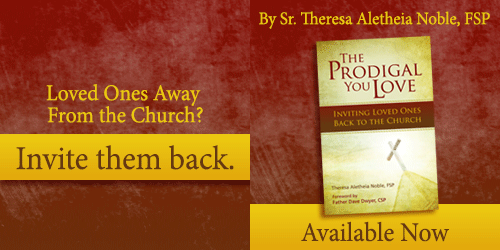 easy to talk about these things with people we love. In this particular case, I did not fear losing the relationship because I know I am loved, but I did fear fracturing our relationship further over this issue. I feared that I would be seen differently if I could not articulate myself well.
So, immediately when this question was asked, I asked God to help me say the right things. And throughout the conversation I reminded myself not to be defensive. I actually paused several times and in my head I said to myself, “Don’t be defensive, don’t be defensive. This is not about you.” It helped.
If we cannot talk about a topic without getting tripping over our ego and defenses, it is going to be hard to find common ground with others. Truth can only be found when we are willing to lay down our defenses and humbly search for it with others.
4. Follow God’s Will: I am embarrassed to say that I often do not take the time to ask God where he wants a discussion to go.
But asking God what he wants before launching into our own monologues is important.
Sometimes God wants us to just shut up. And other times he wants us to be brave and discuss our beliefs even if we don’t feel prepared. Either way, it makes sense to listen to God’s ideas before our own.
From The Prodigal You Love:
[E]ven if we can eloquently defend our faith, sometimes it is best to refrain from saying anything. It may feel embarrassing to remain silent if we are used to having our say, but a little humiliation is sometimes just what we need to grow in humility. There will be times when our loved ones need to share their feelings without judgment or disagreement on our part, and we may need to learn to listen silently and leave our perfectly reasoned, fabulous arguments unsaid. Or the reverse may be true. We may feel like cowering and running from an argument when God is asking us to humbly and courageously express our faith. In either case, humbly accepting God’s will is likely to bear more fruit than eloquent words or fearful silence.
5. Embrace the Sword but Don’t Swing It: Jesus told us that he did not come to bring peace but the sword (Mt 10:34). These words are comforting in times like this. But I don’t think Jesus is asking us to approach the culture with our swords raised. Instead he asks us to accept when the sword of truth causes unwanted fractures in our relationships.
As Christians, we are called to be open, inviting and respectful of others. But sometimes the truth causes division. I don’t think Christians are called to do the sword wielding and ostracizing, (unless a person’s behavior is really egregious). But if our friends and family do not understand where we are coming from, and if they even feel like they have to reject our love, we do need to accept the pain with serenity and grace (rather than changing our position).
It feels terrible to be misunderstood. Just ask Jesus (and our brothers and sisters who experience same-sex attraction for that matter). But the suffering we feel can always be offered up for others, especially for Christians in other countries who suffer much worse than misunderstanding.
– – –
These are some of my ideas. I hope they are helpful.
Please feel free to share in the combox different methods that you have successfully used to dialogue respectfully with others on this issue or other hot-button issues.
Previous Post

July 11, 2015
Sorry Folks...(and My Upcoming Iowa Trip!)
Next Post

July 14, 2015 FREE Podcast: How to Seek the Truth in Humility
Browse Our Archives
Select a Category Advent Art Atheism Book Reviews Christmas Church Issues Discernment Easter Ecumenism Entertainment Environment Eucharist Evangelization Family Freebies Guest Post Holy Spirit Inspire Me Interreligious Dialogue Jesus Lectio Divina Lent Life Issues Liturgical Season Mary Media MISC Movie Reviews Pauline Pope Francis Prayer Prayer Intention Religious Life Saints Sanctity Scripture Social Justice Social Teaching St. Paul Theology of the Body Uncategorized US News Vocations World News Writing Year of Mercy
Select a Month September 2016 June 2016 May 2016 April 2016 March 2016 February 2016 January 2016 December 2015 November 2015 October 2015 September 2015 August 2015 July 2015 June 2015 May 2015 April 2015 March 2015 February 2015 January 2015 December 2014 November 2014 October 2014 September 2014 August 2014 July 2014 June 2014 May 2014 April 2014 March 2014 February 2014 January 2014 December 2013 November 2013 October 2013 September 2013 July 2013 June 2013 May 2013 April 2013 March 2013 February 2013 January 2013 December 2012 November 2012 October 2012 September 2012 August 2012 July 2012 June 2012 May 2012 April 2012 March 2012 February 2012 January 2012 December 2011 November 2011 October 2011 September 2011 August 2011 July 2011 June 2011 April 2011 March 2011 February 2011 January 2011 December 2010 November 2010 October 2010 September 2010 August 2010
Follow Us!
TAKE THE
Religious Wisdom Quiz
What does Paul tell the Thessalonians to do without ceasing?
Select your answer to see how you score.
Give thanks Pray Rejoice Study the word
Related posts from Pursued by Truth

NEW Syrian Archbishop's Letter: Will We Become the...

WATCH: Sr. Maria Kim's Vocation Story

How to Read Amoris Laetitia without Assumptions, Cynicism,...

Archbishop of Damascus: 4 Greatest Challenges to Christians...
TRENDING AT PATHEOS Catholic

Creation, Preservation, and Teleology in Catholic Theology
As I write this, it is very early Monday morning. Like millions...

The Parable Of The Sower And The Word...
One of Christ’s most famous parables is that of the sower who...

Rejecting Doom: Christian Hope And Human Action
Christianity is a religion of hope. We are to have hope and...

Why I Choose the Eucharist Over the Sermon
Choose the Eucharist, Not the Sermon What are we supposed to get...

5 Design Elements Found in Spiritually Rooted Homes
Putting Spirituality Into Home Decor Our homes are more than our living...

Credo: A Story of God Told with the...
About 10 years ago, I began to imagine a personal "Credo" that...
view all Catholic blogs
Ad-Free & Subscriber Log-In Subscription Support
- About Us
- 2026 Calendar
- Videos
- Podcasts
- Library of World Religions
- Faith In Media Tracker
- Advertise With Us
- Write for Us
- Privacy Policy
- Terms of Service
- Do Not Sell My Data
- Contact Us
- Radiant Digital
- Manage Newsletter Subscriptions
- Unsubscribe From Notifications
- Sitemap
Copyright 2008-2026, Patheos. All rights reserved.
Subscription Support Ad-Free & Subscriber Log-In
Follow Patheos