
BuddhistCatholicContemplativeEvangelicalGeneral ChristianHinduJewishLatter-day SaintMuslimNew VisionsProgressive Christian
Beliefs
- Buddhist
- Catholic
- Contemplative
- Evangelical
- General Christian
- Hindu
- Jewish
- Latter-day Saint
- More Voices
- Muslim
- New Visions
- Pagan
- Progressive Christian
Topics
- Religion News
- Food and Religion
- Sports and Religion
- Religious Art
- Religious Music and Entertainment
- Religious Events
- History and Religion
- Style and Religion
- Politics and Religion
- Women in Religion
- Recreation Outdoors and Religion
- Business Finance and Religion
- Careers Workplace and Religion
- Education and Religion
- Family Parenting and Religion
- Health Fitness and Religion
- Home and Religion
- Relationships and Religion
- Technology and Religion
- Travel and Religion
Columnists
- Buddhist Columnists
- Business Finance and Religion Columnists
- Careers Workplace and Religion Columnists
- Catholic Columnists
- Contemplative Columnists
- Education and Religion Columnists
- Evangelists Columnists
- Family Parenting and Religion Columnists
- General Christian Columnists
- Health Fitness and Religion Columnists
- Hindu Columnists
- History and Religion Columnists
- Home and Religion Columnists
- Jewish Columnists
- More Voices Columnists
- Latter Day Columnists
- Muslim Columnists
- New Visions Columnists
- Nonreligious Columnists
- Pagan Columnists
- Politics and Religion Columnists
- Progressive Columnists
- Recreation Outdoors and Religion Columnists
- Relationships and Religion Columnists
- Religion News Columnists
- Religious Art Columnists
- Religious Events Columnists
- Religious Music and Entertainment Columnists
- Sports and Religion Columnists
- Style and Religion Columnists
- Technology and Religion Columnists
- Travel and Religion Columnists
- Women in Religion Columnists
Resource Library
- 2026 Calendar
- Library of World Religions
- The 100 Most Holy Places on Earth
- Patheos Answers
- Podcasts
- Videos
- Faith Leaders Database
- Anglican Episcopalian
- Bahai
- Baptist
- Buddhism
- Christianity
- Confucianism
- Eastern Orthodoxy
- Hinduism
- Holiness and Pentecostal
- ISKCON
- Islam
- Judaism
- Lutheran
- Methodist
- The Church of Jesus Christ of Latter-day Saints
- New Age
- Paganism
- Presbytarian and Reformed
- Protestantism
- Religion Behind the Scenes
- Roman Catholic
- Scientology
- Shia Islam
- Sikhism
- Sufism
- Sunni Islam
- Taoism
- Zen
- See all religions
Research Tools
 Ad-Free & Subscriber Log-In Subscription Support
Ad-Free & Subscriber Log-In Subscription Support
Follow Patheos 

- Trending:
- Forgiveness
- |
- Marriage
- |
- Consciousness
- |
- Death Penalty
- |
- Election
- |
- Halloween
 Pursued by Truth
- Home
- Catholic
- 2015 Graduates: Make Your Bed
2015 Graduates: Make Your Bed
Last updated on: May 27, 2015 at 7:49 am by Guest Contributor
2015 Graduates: Make Your Bed 2015-05-27T07:49:03-04:00 Guest Contributor
Patheos Explore the world's faith through different perspectives on religion and spirituality! Patheos has the views of the prevalent religions and spiritualities of the world.
Guest post by Father Anthony Gerber, a homily for the graduation Mass at St. Dominic High School
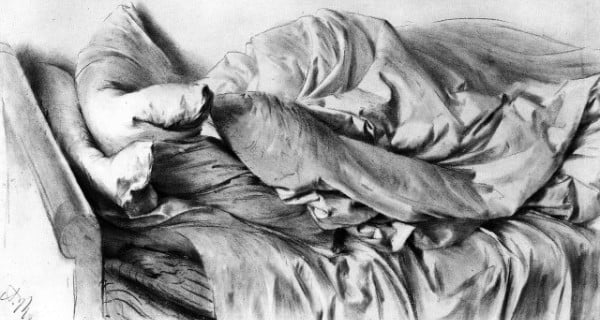
Unmade Bed by Adolph von Menzel (circa 1845)
There is a saying among some of the priests at the seminary. It is “Remove the scaffolding and the man will be revealed.” The priests would say this as the men would go home for summer break and leave the rule and rigors of seminary life; the men were totally off on their own to make decisions not based on obligation or because opportunities were served up on a platter for them. No, the men would go home and make decisions based on what they had or had not integrated from their learning (or lack thereof) in the seminary.
The scaffolding of the seminary life is removed and we’d see if the man looked more like Christ the Priest… or not.
The same happens to you now. For the vast majority of your life, you have been behind scaffolding, like a building under construction, obedient—or mostly so—to the expectations and obligations given to you. These have dictated your life to this moment. Getting out of bed, to name just one of numerous examples, was grounded not only by your alarm, but also by your mom or dad or the fear of being tardy and someone noticing. Now, few will. Something as mundane as getting up is up to you.
And so Jesus prays. On the night before he died, Jesus prays to the Father: “Father, I have consecrated them in the truth…. I have protected them, guarded them… I pray for them… keep them from the Evil One… I sent them out in to the world…”
Jesus is concerned about you. I’m concerned about you. Your parents are too. It’s not easy “out there.” We know what happens when we are left to our own designs. You know what happens, right? I mean… #Senioritis.
Let’s talk about that for a moment. How did senioritis go? Like crawling over a finish line. Quick poll: how many of you during the past semester at one point or another said: “I’m so done with this”? (Go ahead, raise your hand) … (*this can easily be turned into a “praise God” sign*)
Yes, praise God!
As a past high school teacher, I was always a little intrigued by senioritis: What caused it? Was it simply apathy? burnout? Was it the stress of doing school and college prep? Was it because things like Flannery O’Connor’s use of irony in her short story you studied in AP American Lit just didn’t seem to bear any weight on whether or not you were getting into whatever college and major you were already accepted into?
Senioritis, I have found, is a collection of all of these… and which ultimately boil down to one thing: what motivates you? What is your intention for doing what you do? What gets you up in the morning?
Senioritis happens because, frankly, we sometimes don’t know. And that’s actually the beauty of the second semester of senior year. During the second semester, all of the “baloney” motivators—and I say “baloney” because I can’t say the actual word (this is a PG rated liturgy)…. During the second semester, all of the “baloney” motivators are stripped away and we are faced with what seems like nothing: just deadlines, busywork, and study that really means nothing to my life.
But it was precisely in that moment that we all had a choice. We didn’t realize we had a choice, but we did. The choice was this: to love the subject you were studying not because you were obliged to, not because of grades, not because of impact on college, but to love it for its own sake. Senioritis is the symptom of a greater illness: namely, that we have yet to learn to love a thing selflessly—for it’s own sake.
I’m going to be honest with you, most people never learn this lesson. There are lots and lots of people in corporate America, politics, medicine, and even higher university education who do what they do not because they are or were motivated by love of the thing itself, but because they were moved there by a lifetime of decisions motivated by fear of negative consequences or other selfish reasons. When they reach their forties or fifties, they have a mid-life crisis: that’s senioritis for older people. (… did you notice? that was nervous laughter.)
They face the same question that you faced this past Spring and which you will again face this Autumn: What gets you out of bed in the morning?
The scaffolding is being removed. What will we see?
The Lord consecrated us in truth and prays for us that we might have a good reason for getting up each morning. He prays the reason might be love….
* *
When I was in the seminary, there was a brilliant professor there who spoke very high theology and who totally blew our minds. One year, he was reassigned and his parting words of advice were:
“Gentlemen, always make your bed.”
We laughed about this. I mean, of all the things you could leave us with, you say “always make your bed”? How mundane!
I mean, yeah, I grasped the intention: it was orderly, virtuous, contributed to cleanliness, blah blah blah….
But I tried it. …. (And it was invigorating!)
Actually, I noticed something odd about it: when I was stressed out or anxious or depressed, I never made my bed. When I was feeling good, I made my bed. I learned that something like this simple virtuous but mundane action had become a barometer for self-knowledge. And self-knowledge is very important—especially in college! I mean, to know when we aren’t being healthy, to know when we need to close the book and go outside, to know when we just simply need to go to bed….
I wish I knew about this in college. Because, really, making your bed will help you with other things we often struggle with in college.
So, for example, hung-over people never make their beds. Fact.
People who do things that they shouldn’t be doing with other people in their beds don’t wake up in the morning and say “Hey, let’s make the bed together,” … because that’s weird … and what are we, married? …. And maybe we should be married before we do things in bed, ‘k?
But there is more to it than that. At some point we all realize that we’re going to die. (#SorryNotSorry). But we are. I remember hearing once that going to bed and falling asleep pre-figures death (which is why we should always make an act of contrition before going to bed—we just never know; you might not have a tomorrow!). By the same token, awaking and rising out of bed to a new day pre-figures the resurrection and the dawn of eternal life.
So, when Jesus rose from the dead, the linens in which he was wrapped were neatly folded. These neatly folded linens were proof to the apostles that Jesus had indeed risen—the proof was because linens were expensive and if Jesus had been stolen by robbers, well then the robbers would have stolen them too (and certainly not folded them!).
Making one’s bed, and I know this sounds like a stretch—but making my bed would become a reminder of heaven and of always keeping my face turned toward God in hopefulness, to keep right perspective when I got mired in the muck, to keep priorities straight, and so serve as a reminder: even the smallest virtues can conquer the largest vices—especially when the little things are done for love.
This is ultimately the challenge before you. Everything has been served to you on a platter. Your school has served you religion. Your school has served you the opportunities for making friends. Your school served you the obligations that motivated you to study. Your parents served your personal needs—from feeding you to doing your laundry to picking you up, etc, etc, etc, ad infinitum et ad nauseam. And this was done because we love you. It was done because we know that it is more blessed to give than to receive. And you have received.
But now you will have to intentionally choose to give. Intentionally choose to love.
Friendships—they are going to take work. Keeping up with people back home—you’re going to have to carve out time in your schedule and intentionally choose to love. Religion? Same deal. The challenge of college is that you now have to intentionally choose. And all of the baloney motivators are stripped away.
You will ask yourself “is this worth it?” Is this friendship, this class, this going to Mass at 8pm on a Sunday when I have a final due tomorrow—is this worth it? And you will learn what motivates you. And that might frighten you because you might realize that the only thing that motivates you is the thing that might have motivated you your whole life so far: namely: fear… or, worse, you.
I challenge you, then. I’m not inviting, I’m not humbly requesting. I dare you, I challenge you: love. Give selflessly. Choose to study not because what you get from it, but because learning is beautiful. Choose to go to Mass not because of what you do or don’t get out of it, but because Jesus is lovely and challenging. Choose to make your bed, not because I said so, but because maybe there is something hidden and mysterious in the wild world of small virtues—something worth discovering, something lovely in itself.
Like you. We loved you for you. We gave to you not because of what we could get out of you, but because we loved you and still love you for you. For your own sake.
It says, “I have consecrated you in the truth” which is another way of saying that Jesus has totally given his life for you, the consecration happening by the shedding of his blood.
So too, us: we have consecrated you in everything we have given you….
It is now that you are sent. We will miss you. But you must go. Consecrate the world in love!
Go and do the same!
 Father Anthony Gerber is a priest in the Archdiocese of St. Louis, serving at St. Joseph’s in Cottleville.
He has been ordained since 2011.
He blogs at Uberrima Fides.
Previous Post

May 23, 2015
A Holy Biker Gang: 1,400 Mile Bike Ride for Vocations
Next Post

May 29, 2015 Sister Anne of the Touch of Death
Browse Our Archives
Select a Category Advent Art Atheism Book Reviews Christmas Church Issues Discernment Easter Ecumenism Entertainment Environment Eucharist Evangelization Family Freebies Guest Post Holy Spirit Inspire Me Interreligious Dialogue Jesus Lectio Divina Lent Life Issues Liturgical Season Mary Media MISC Movie Reviews Pauline Pope Francis Prayer Prayer Intention Religious Life Saints Sanctity Scripture Social Justice Social Teaching St. Paul Theology of the Body Uncategorized US News Vocations World News Writing Year of Mercy
Select a Month September 2016 June 2016 May 2016 April 2016 March 2016 February 2016 January 2016 December 2015 November 2015 October 2015 September 2015 August 2015 July 2015 June 2015 May 2015 April 2015 March 2015 February 2015 January 2015 December 2014 November 2014 October 2014 September 2014 August 2014 July 2014 June 2014 May 2014 April 2014 March 2014 February 2014 January 2014 December 2013 November 2013 October 2013 September 2013 July 2013 June 2013 May 2013 April 2013 March 2013 February 2013 January 2013 December 2012 November 2012 October 2012 September 2012 August 2012 July 2012 June 2012 May 2012 April 2012 March 2012 February 2012 January 2012 December 2011 November 2011 October 2011 September 2011 August 2011 July 2011 June 2011 April 2011 March 2011 February 2011 January 2011 December 2010 November 2010 October 2010 September 2010 August 2010
Follow Us!
TAKE THE
Religious Wisdom Quiz
Who did God ask to sacrifice his only son as a test?
Select your answer to see how you score.
Jacob Abraham Moses David
Related posts from Pursued by Truth

NEW Syrian Archbishop's Letter: Will We Become the...

How God Hauled Me Kicking and Screaming Into...
3 Moments When the Holy Spirit Worked in...

How to Read Amoris Laetitia without Assumptions, Cynicism,...
TRENDING AT PATHEOS Catholic

Rejecting Doom: Christian Hope And Human Action
Christianity is a religion of hope. We are to have hope and...

It’s What Comes From Within Which Matters
One of the most difficult things for us to understand is why...

Why I Choose the Eucharist Over the Sermon
Choose the Eucharist, Not the Sermon What are we supposed to get...

5 Design Elements Found in Spiritually Rooted Homes
Putting Spirituality Into Home Decor Our homes are more than our living...

Credo: A Story of God Told with the...
About 10 years ago, I began to imagine a personal "Credo" that...

The Anatomy of Divine Revelation in Catholic Thought
The claim that God has made Himself known to human beings is...
view all Catholic blogs
Ad-Free & Subscriber Log-In Subscription Support
- About Us
- 2026 Calendar
- Videos
- Podcasts
- Library of World Religions
- Faith In Media Tracker
- Advertise With Us
- Write for Us
- Privacy Policy
- Terms of Service
- Do Not Sell My Data
- Contact Us
- Radiant Digital
- Manage Newsletter Subscriptions
- Unsubscribe From Notifications
- Sitemap
Copyright 2008-2026, Patheos. All rights reserved.
Subscription Support Ad-Free & Subscriber Log-In
Follow Patheos