
BuddhistCatholicContemplativeEvangelicalGeneral ChristianHinduJewishLatter-day SaintMuslimNew VisionsProgressive Christian
Beliefs
- Buddhist
- Catholic
- Contemplative
- Evangelical
- General Christian
- Hindu
- Jewish
- Latter-day Saint
- More Voices
- Muslim
- New Visions
- Pagan
- Progressive Christian
Topics
- Religion News
- Food and Religion
- Sports and Religion
- Religious Art
- Religious Music and Entertainment
- Religious Events
- History and Religion
- Style and Religion
- Politics and Religion
- Women in Religion
- Recreation Outdoors and Religion
- Business Finance and Religion
- Careers Workplace and Religion
- Education and Religion
- Family Parenting and Religion
- Health Fitness and Religion
- Home and Religion
- Relationships and Religion
- Technology and Religion
- Travel and Religion
Columnists
- Buddhist Columnists
- Business Finance and Religion Columnists
- Careers Workplace and Religion Columnists
- Catholic Columnists
- Contemplative Columnists
- Education and Religion Columnists
- Evangelists Columnists
- Family Parenting and Religion Columnists
- General Christian Columnists
- Health Fitness and Religion Columnists
- Hindu Columnists
- History and Religion Columnists
- Home and Religion Columnists
- Jewish Columnists
- More Voices Columnists
- Latter Day Columnists
- Muslim Columnists
- New Visions Columnists
- Nonreligious Columnists
- Pagan Columnists
- Politics and Religion Columnists
- Progressive Columnists
- Recreation Outdoors and Religion Columnists
- Relationships and Religion Columnists
- Religion News Columnists
- Religious Art Columnists
- Religious Events Columnists
- Religious Music and Entertainment Columnists
- Sports and Religion Columnists
- Style and Religion Columnists
- Technology and Religion Columnists
- Travel and Religion Columnists
- Women in Religion Columnists
Resource Library
- 2026 Calendar
- Library of World Religions
- The 100 Most Holy Places on Earth
- Patheos Answers
- Podcasts
- Videos
- Faith Leaders Database
- Anglican Episcopalian
- Bahai
- Baptist
- Buddhism
- Christianity
- Confucianism
- Eastern Orthodoxy
- Hinduism
- Holiness and Pentecostal
- ISKCON
- Islam
- Judaism
- Lutheran
- Methodist
- The Church of Jesus Christ of Latter-day Saints
- New Age
- Paganism
- Presbytarian and Reformed
- Protestantism
- Religion Behind the Scenes
- Roman Catholic
- Scientology
- Shia Islam
- Sikhism
- Sufism
- Sunni Islam
- Taoism
- Zen
- See all religions
Research Tools
 Ad-Free & Subscriber Log-In Subscription Support
Ad-Free & Subscriber Log-In Subscription Support
Follow Patheos 

- Trending:
- Forgiveness
- |
- Marriage
- |
- Consciousness
- |
- Death Penalty
- |
- Election
- |
- Halloween
 Pursued by Truth
- Home
- Catholic
- Atheist in the Communion Line – A Follow-up Post
Atheist in the Communion Line – A Follow-up Post
Last updated on: October 25, 2014 at 6:23 am by Sr. Theresa Aletheia Noble
Atheist in the Communion Line – A Follow-up Post 2014-10-25T06:23:21-04:00 Sr. Theresa Aletheia Noble
Patheos Explore the world's faith through different perspectives on religion and spirituality! Patheos has the views of the prevalent religions and spiritualities of the world.
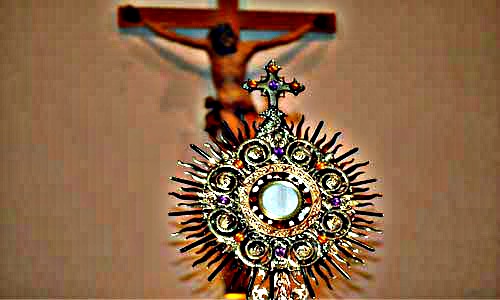 The grace of God often comes to a person in the midst of paradox and mystery.
This is perhaps the truth that many missed when they read part of my story of return to the Church. In short, I was an atheist, fallen-away Catholic involved in serious sin who stumbled into Mass one day and received the Eucharist. This moment was the start of my journey back to the Church and eventually into religious life.
Certainly, a reason to celebrate right?
Unfortunately, many reacted to my story of coming home by chastising me or by suggesting that it would have been better if only I had converted in another way, under more perfect circumstances. “If someone had met you at the door and told you not to receive, surely that would have been better,” some opined. However, many people also shared with me that their experience was similar to my own.
As many of you understood, I was simply sharing my journey. I was clear that I now know I should not have received the Eucharist under the circumstances I did. But at the same time, when I entered the church that day, I was an ignorant fool stumbling toward Christ for the first time in a long time and so I do not regret what happened that day.
I know this sounds dangerously close to relativism and many people were concerned about that in the combox.
But it is not.
This is the same principle Benedict XVI was referring to when he said, “There may be a basis in the case of some individuals, as perhaps when a male prostitute uses a condom, where this can be a first step in the direction of a moralization.”
For most people, (except for some spin-masters of the media), it is clear that Benedict XVI was not endorsing condoms or prostitution with this statement. He was simply referring to the idea of gradualism, an idea as old human nature – that humans move gradually toward the good and in the midst of sin and paradox.
In other words, humans who are moving toward God and not away often find themselves continuing to sin, but their actions, even if objectively disordered, can be a movement in the direction of the good. Thinking in this way is not relativism or an endorsement of sin.
Too compound the mystery, it is also possible that God still transmitted grace to me through the sacrament. This is something I feel happened, but I can never be sure of it until I get to heaven. But St. Thomas Aquinas does back me up on this possibility. Even in a state of serious sin, he says a person can receive grace if they approach the sacrament “devoutly and reverently” without consciousness of being in mortal sin and no attachment to sin (III, q. 79, a. 3).
I have no idea if I was in the unlikely state to which St. Thomas refers. I think this is why Jesus enjoins us not to judge one another (Lk 6:37). We are ill-equipped to judge even ourselves, let alone others. But I do believe God communicated grace to me that day. How precisely is another question, but God is the only one who knows the answer to that.
I am not endorsing the idea that people who commit serious sin should regularly receive the Eucharist.
That is a dangerous path I would not suggest people follow. But it is the path that I took, and one that many others have taken. And I truly believe that God, in his mercy, meets people like us in our ignorance while we are “still far away” (Lk 15:20).
All of us slowly make our way to God through the mire of sin, hypocrisy and contradiction: “For I do not do the good I want, but I do the evil I do not want” (Rm 7:19).
Grace, conversion and the spiritual life are full of mystery and paradox. Sometimes I think when we encounter these things, it makes sense to step back and take a deep breath, like we do at the foot of a majestic mountain and admire God’s handiwork, rather than set to work drawing lines and making judgments about what we will only know for sure when we meet God face to face.
I will close with a beautiful quote from Henri de Lubac that speaks to the discernment, but also the daring, needed in considering these situations, something I think Pope Francis understands well:
From the truest truth to the falsest falsehood, there is often only one step. It has often been noted, quite rightly. But from the noting of that fact to the condemning of certain truths, as being dangerously near falsehood, there is also one step, and that step as well is often taken, this time very wrongly. The fear of falling prey to error must never prevent us from getting to the full truth. To overstep the limit, to go beyond, would be to err through excessive daring; but there are also errors of timidity which consist precisely in stopping short, never daring to go any further than half-truths. Love of truth never goes without daring. And that is one of the reasons why truth is not loved.
Blessings to you all.
Previous Post

October 23, 2014
He Kissed Me on the Cheek...
Next Post
October 26, 2014 #MediaNuns Need Your Help to Spread the Gospel
Browse Our Archives
Select a Category Advent Art Atheism Book Reviews Christmas Church Issues Discernment Easter Ecumenism Entertainment Environment Eucharist Evangelization Family Freebies Guest Post Holy Spirit Inspire Me Interreligious Dialogue Jesus Lectio Divina Lent Life Issues Liturgical Season Mary Media MISC Movie Reviews Pauline Pope Francis Prayer Prayer Intention Religious Life Saints Sanctity Scripture Social Justice Social Teaching St. Paul Theology of the Body Uncategorized US News Vocations World News Writing Year of Mercy
Select a Month September 2016 June 2016 May 2016 April 2016 March 2016 February 2016 January 2016 December 2015 November 2015 October 2015 September 2015 August 2015 July 2015 June 2015 May 2015 April 2015 March 2015 February 2015 January 2015 December 2014 November 2014 October 2014 September 2014 August 2014 July 2014 June 2014 May 2014 April 2014 March 2014 February 2014 January 2014 December 2013 November 2013 October 2013 September 2013 July 2013 June 2013 May 2013 April 2013 March 2013 February 2013 January 2013 December 2012 November 2012 October 2012 September 2012 August 2012 July 2012 June 2012 May 2012 April 2012 March 2012 February 2012 January 2012 December 2011 November 2011 October 2011 September 2011 August 2011 July 2011 June 2011 April 2011 March 2011 February 2011 January 2011 December 2010 November 2010 October 2010 September 2010 August 2010
Follow Us!
TAKE THE
Religious Wisdom Quiz
Which Christian group primarily uses icons in worship?
Select your answer to see how you score.
Eastern Orthodox Baptist Anglican Quaker
Related posts from Pursued by Truth

NEW Syrian Archbishop's Letter: Will We Become the...
Death and Social Security Fraud: Celebrating Mother Teresa

WATCH: Sr. Maria Kim's Vocation Story
How God Hauled Me Kicking and Screaming Into...
TRENDING AT PATHEOS Catholic

Rejecting Doom: Christian Hope And Human Action
Christianity is a religion of hope. We are to have hope and...

It’s What Comes From Within Which Matters
One of the most difficult things for us to understand is why...

Why I Choose the Eucharist Over the Sermon
Choose the Eucharist, Not the Sermon What are we supposed to get...

5 Design Elements Found in Spiritually Rooted Homes
Putting Spirituality Into Home Decor Our homes are more than our living...

Credo: A Story of God Told with the...
About 10 years ago, I began to imagine a personal "Credo" that...

The Anatomy of Divine Revelation in Catholic Thought
The claim that God has made Himself known to human beings is...
view all Catholic blogs
Ad-Free & Subscriber Log-In Subscription Support
- About Us
- 2026 Calendar
- Videos
- Podcasts
- Library of World Religions
- Faith In Media Tracker
- Advertise With Us
- Write for Us
- Privacy Policy
- Terms of Service
- Do Not Sell My Data
- Contact Us
- Radiant Digital
- Manage Newsletter Subscriptions
- Unsubscribe From Notifications
- Sitemap
Copyright 2008-2026, Patheos. All rights reserved.
Subscription Support Ad-Free & Subscriber Log-In
Follow Patheos