
BuddhistCatholicContemplativeEvangelicalGeneral ChristianHinduJewishLatter-day SaintMuslimNew VisionsProgressive Christian
Beliefs
- Buddhist
- Catholic
- Contemplative
- Evangelical
- General Christian
- Hindu
- Jewish
- Latter-day Saint
- More Voices
- Muslim
- New Visions
- Pagan
- Progressive Christian
Topics
- Religion News
- Food and Religion
- Sports and Religion
- Religious Art
- Religious Music and Entertainment
- Religious Events
- History and Religion
- Style and Religion
- Politics and Religion
- Women in Religion
- Recreation Outdoors and Religion
- Business Finance and Religion
- Careers Workplace and Religion
- Education and Religion
- Family Parenting and Religion
- Health Fitness and Religion
- Home and Religion
- Relationships and Religion
- Technology and Religion
- Travel and Religion
Columnists
- Buddhist Columnists
- Business Finance and Religion Columnists
- Careers Workplace and Religion Columnists
- Catholic Columnists
- Contemplative Columnists
- Education and Religion Columnists
- Evangelists Columnists
- Family Parenting and Religion Columnists
- General Christian Columnists
- Health Fitness and Religion Columnists
- Hindu Columnists
- History and Religion Columnists
- Home and Religion Columnists
- Jewish Columnists
- More Voices Columnists
- Latter Day Columnists
- Muslim Columnists
- New Visions Columnists
- Nonreligious Columnists
- Pagan Columnists
- Politics and Religion Columnists
- Progressive Columnists
- Recreation Outdoors and Religion Columnists
- Relationships and Religion Columnists
- Religion News Columnists
- Religious Art Columnists
- Religious Events Columnists
- Religious Music and Entertainment Columnists
- Sports and Religion Columnists
- Style and Religion Columnists
- Technology and Religion Columnists
- Travel and Religion Columnists
- Women in Religion Columnists
Resource Library
- 2026 Calendar
- Library of World Religions
- The 100 Most Holy Places on Earth
- Patheos Answers
- Podcasts
- Videos
- Faith Leaders Database
- Anglican Episcopalian
- Bahai
- Baptist
- Buddhism
- Christianity
- Confucianism
- Eastern Orthodoxy
- Hinduism
- Holiness and Pentecostal
- ISKCON
- Islam
- Judaism
- Lutheran
- Methodist
- The Church of Jesus Christ of Latter-day Saints
- New Age
- Paganism
- Presbytarian and Reformed
- Protestantism
- Religion Behind the Scenes
- Roman Catholic
- Scientology
- Shia Islam
- Sikhism
- Sufism
- Sunni Islam
- Taoism
- Zen
- See all religions
Research Tools
 Ad-Free & Subscriber Log-In Subscription Support
Ad-Free & Subscriber Log-In Subscription Support
Follow Patheos 

- Trending:
- Forgiveness
- |
- Marriage
- |
- Consciousness
- |
- Death Penalty
- |
- Election
- |
- Halloween
 Pursued by Truth
- Home
- Catholic
- Led Zepplin Meets St. Therese (in an Elevator)
Led Zepplin Meets St. Therese (in an Elevator)
Last updated on: October 1, 2012 at 4:25 pm by Sr. Theresa Aletheia Noble
Led Zepplin Meets St. Therese (in an Elevator) 2012-10-01T16:25:00-04:00 Sr. Theresa Aletheia Noble
Patheos Explore the world's faith through different perspectives on religion and spirituality! Patheos has the views of the prevalent religions and spiritualities of the world.
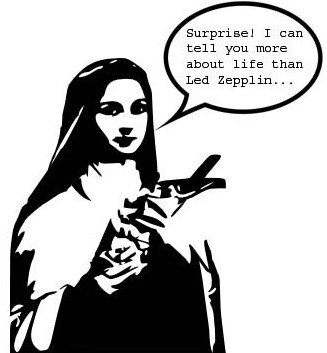
I spent the summer after 7th grade lounging around my neighborhood pool listening to a cassette tape of Led Zepplin’s greatest hits, reveling in my teenage angst.
My mother became rightly concerned about her daughter who just a couple years earlier would have chosen to serenely read Anne of Green Gables by the pool. Instead, I disdainfully discarded Anne and opted for Sylvia Plath’s The Bell Jar while listening to Stairway to Heavenover and over again.
Recently, I thought about those days as I read the passage from Genesis about Jacob’s Ladder (Genesis 28:10-19). In it, Jacob had a dream in which he saw a ladder and “God’s angels were going up and down on it.”
Traditionally, the ladder in Jacob’s dream has been said to symbolize many things. For Jews, it was often interpreted as symbolizing the prayers and sacrifices offered in Temple that served as a bridge between heaven and earth. Saint Irenaeus saw the ladder as a symbol of the Christian Church leading people to God. Many of the saints saw it as a symbol of the path of perfection. Others saw Jesus himself as the ladder; because Jesus is both fully God and fully man, his humanity serves as the connection between God and man.
However, I was surprised to see that my Bible translates “ladder” as “stairway.” I immediately consulted the footnote and discovered that the Hebrew word sulam, traditionally translated as “ladder,” is now thought to be more accurately translated as “stairway.” Many scholars believe that the staircase Jacob dreamed of was likely similar to the Babylonian ziggurats.
Whether the true translation is “staircase” or a “ladder,” the essential idea remains the same: It is through the life, death and resurrection of Jesus that we are able to climb the stairway to heaven.
In Led Zepplin’s song Stairway to Heaven, he sings about a woman who lives a superficial life focused on material things. The woman even thinks she can buy the stairway to heaven. The thing she does not realize is that the stairway is already free. Jesus is the stairway and he gives himself to us free of charge.
Unfortunately, neither the image of a stairway nor a ladder is appealing to me. I have a hard time climbing a few flights of stairs, let alone one that stretches to heaven. Even knowing that the stairway is Jesus, I still feel like the arduous journey is beyond my stair climbing skill set. Like a typical American, I find myself wondering if there are any more comfortable options – perhaps a heavenly escalator?
Then I remembered my dear patron saint who celebrates her feast day today. St. Therese, the delightful saint who, seeing the stairway of perfection, faints into the arms of Jesus and asks him to take her up in an elevator. She says:
In rich homes there are elevators that replace stairs to great advantage. I would also like to find an elevator to lift me up to Jesus, because I’m too little to climb the rough staircase of perfection. The elevator that must lift me up to heaven is Your arms, Jesus! For that I don’t need to become big. On the contrary, I have to stay little.
It’s no wonder this woman is a Doctor of the Church.
We spend our lives trying our hardest to puff ourselves up and pretend that we are bigger and better than we are. But the truth that we all know deep down inside is that we are little. There is always something in us that remains in touch with our smallness.
Rejoicing in our smallness is the beauty of the Little Way. St. Therese did not espouse some kind of backwards worm theology. She did not see our smallness and feel disdain or fear. Instead, recognizing her wretchedness, she feels joy. After all, our weakness gives us an excuse to leap into the arms of God and leave it all up to Him.
Don’t we all want this, deep down inside?
So, on this feast day of St. Therese, let’s ask for her intercession:
Forget stairways little T, we want the grace to accept a ticket on the heavenly elevator of God’s love.
Previous Post

September 26, 2012
Photography, Light & Divinization
Next Post
October 8, 2012 When Fish Fall Down a Waterfall, Do They Die?
Browse Our Archives
Select a Category Advent Art Atheism Book Reviews Christmas Church Issues Discernment Easter Ecumenism Entertainment Environment Eucharist Evangelization Family Freebies Guest Post Holy Spirit Inspire Me Interreligious Dialogue Jesus Lectio Divina Lent Life Issues Liturgical Season Mary Media MISC Movie Reviews Pauline Pope Francis Prayer Prayer Intention Religious Life Saints Sanctity Scripture Social Justice Social Teaching St. Paul Theology of the Body Uncategorized US News Vocations World News Writing Year of Mercy
Select a Month September 2016 June 2016 May 2016 April 2016 March 2016 February 2016 January 2016 December 2015 November 2015 October 2015 September 2015 August 2015 July 2015 June 2015 May 2015 April 2015 March 2015 February 2015 January 2015 December 2014 November 2014 October 2014 September 2014 August 2014 July 2014 June 2014 May 2014 April 2014 March 2014 February 2014 January 2014 December 2013 November 2013 October 2013 September 2013 July 2013 June 2013 May 2013 April 2013 March 2013 February 2013 January 2013 December 2012 November 2012 October 2012 September 2012 August 2012 July 2012 June 2012 May 2012 April 2012 March 2012 February 2012 January 2012 December 2011 November 2011 October 2011 September 2011 August 2011 July 2011 June 2011 April 2011 March 2011 February 2011 January 2011 December 2010 November 2010 October 2010 September 2010 August 2010
Follow Us!
TAKE THE
Religious Wisdom Quiz
What does God question Job about, showing His wisdom in creation?
Select your answer to see how you score.
Animals and nature Battles Kingdoms Religious rituals
Related posts from Pursued by Truth

NEW Syrian Archbishop's Letter: Will We Become the...

Death and Social Security Fraud: Celebrating Mother Teresa

WATCH: Sr. Maria Kim's Vocation Story

How God Hauled Me Kicking and Screaming Into...
TRENDING AT PATHEOS Catholic

Rejecting Doom: Christian Hope And Human Action
Christianity is a religion of hope. We are to have hope and...

It’s What Comes From Within Which Matters
One of the most difficult things for us to understand is why...

Why I Choose the Eucharist Over the Sermon
Choose the Eucharist, Not the Sermon What are we supposed to get...

5 Design Elements Found in Spiritually Rooted Homes
Putting Spirituality Into Home Decor Our homes are more than our living...

Credo: A Story of God Told with the...
About 10 years ago, I began to imagine a personal "Credo" that...

The Anatomy of Divine Revelation in Catholic Thought
The claim that God has made Himself known to human beings is...
view all Catholic blogs
Ad-Free & Subscriber Log-In Subscription Support
- About Us
- 2026 Calendar
- Videos
- Podcasts
- Library of World Religions
- Faith In Media Tracker
- Advertise With Us
- Write for Us
- Privacy Policy
- Terms of Service
- Do Not Sell My Data
- Contact Us
- Radiant Digital
- Manage Newsletter Subscriptions
- Unsubscribe From Notifications
- Sitemap
Copyright 2008-2026, Patheos. All rights reserved.
Subscription Support Ad-Free & Subscriber Log-In
Follow Patheos