
BuddhistCatholicContemplativeEvangelicalGeneral ChristianHinduJewishLatter-day SaintMuslimNew VisionsProgressive Christian
Beliefs
- Buddhist
- Catholic
- Contemplative
- Evangelical
- General Christian
- Hindu
- Jewish
- Latter-day Saint
- More Voices
- Muslim
- New Visions
- Pagan
- Progressive Christian
Topics
- Religion News
- Food and Religion
- Sports and Religion
- Religious Art
- Religious Music and Entertainment
- Religious Events
- History and Religion
- Style and Religion
- Politics and Religion
- Women in Religion
- Recreation Outdoors and Religion
- Business Finance and Religion
- Careers Workplace and Religion
- Education and Religion
- Family Parenting and Religion
- Health Fitness and Religion
- Home and Religion
- Relationships and Religion
- Technology and Religion
- Travel and Religion
Columnists
- Buddhist Columnists
- Business Finance and Religion Columnists
- Careers Workplace and Religion Columnists
- Catholic Columnists
- Contemplative Columnists
- Education and Religion Columnists
- Evangelists Columnists
- Family Parenting and Religion Columnists
- General Christian Columnists
- Health Fitness and Religion Columnists
- Hindu Columnists
- History and Religion Columnists
- Home and Religion Columnists
- Jewish Columnists
- More Voices Columnists
- Latter Day Columnists
- Muslim Columnists
- New Visions Columnists
- Nonreligious Columnists
- Pagan Columnists
- Politics and Religion Columnists
- Progressive Columnists
- Recreation Outdoors and Religion Columnists
- Relationships and Religion Columnists
- Religion News Columnists
- Religious Art Columnists
- Religious Events Columnists
- Religious Music and Entertainment Columnists
- Sports and Religion Columnists
- Style and Religion Columnists
- Technology and Religion Columnists
- Travel and Religion Columnists
- Women in Religion Columnists
Resource Library
- 2026 Calendar
- Library of World Religions
- The 100 Most Holy Places on Earth
- Patheos Answers
- Podcasts
- Videos
- Faith Leaders Database
- Anglican Episcopalian
- Bahai
- Baptist
- Buddhism
- Christianity
- Confucianism
- Eastern Orthodoxy
- Hinduism
- Holiness and Pentecostal
- ISKCON
- Islam
- Judaism
- Lutheran
- Methodist
- The Church of Jesus Christ of Latter-day Saints
- New Age
- Paganism
- Presbytarian and Reformed
- Protestantism
- Religion Behind the Scenes
- Roman Catholic
- Scientology
- Shia Islam
- Sikhism
- Sufism
- Sunni Islam
- Taoism
- Zen
- See all religions
Research Tools
 Ad-Free & Subscriber Log-In Subscription Support
Ad-Free & Subscriber Log-In Subscription Support
Follow Patheos 

- Trending:
- Forgiveness
- |
- Marriage
- |
- Consciousness
- |
- Death Penalty
- |
- Election
- |
- Halloween

- Home
- Progressive Christian
- Technology and Religion
- AI and Public Theology
AI and Public Theology
Last updated on: November 12, 2025 at 9:30 am by Ted Peters
AI and Public Theology 2025-11-12T09:30:58-08:00 Ted Peters
Patheos Explore the world's faith through different perspectives on religion and spirituality! Patheos has the views of the prevalent religions and spiritualities of the world.
AI and Public Theology. How do these fit together?

Patheos H+ 2022. AI and Public Theology
The entire world is both celebrating and anguishing over what our crystal ball tells us about the future of Artificial Intelligence (AI), Intelligence Amplification (IA), Artificial General Intelligence (AGI), Artificial Superintelligence (ASI), and Transhumanism (H+). We all celebrate the marvels of advancing technology. And we hope AI will solve our problems. Some even hope for technological salvation. Yet we also anguish at warnings of two dangers: (1) the danger of Superintelligence rendering the human race extinct plus (2) the danger of bad actors using AI to establish world domination.
When it comes to Christians engaging AI and public theology, Peter Thiel comes immediately to mind. Silicon Valley billionaire Thiel, co-founder of PayPal and Palantir, is a Christian apocalypticist who flirts with transhumanism. On the one hand, Thiel invites rapid and exhaustive technological advance. On the other hand, Thiel recognizes dangers, and he fears playing into the hands of the Antichrist, who’ll bring on the Battle of Armageddon.
But Thiel is not alone in sounding a theological alarm. So also are Evangelicals and the Vatican.
Christianity in the Age of AI: An Appeal for Wise Leadership
Typically, theologians who think about the AI revolution wonder whether they should steal from ChatGPT to write sermons. Others engage the wider culture. Among those who take up AI and public theology are Christian Leaders such as Johnnie Moore, President of the Congress of Christian Leaders. They have written an open letter to US President, Donald J Trump, Christianity in the Age of AI: An Appeal for Wise Leadership (May 21, 2025). As I mentioned in my Substack post on this event, I decided to co-sign what I thought was a fairly well-worded letter (Christian 5/21/2025).
“We, Christian leaders of the USA, call upon the Honorable Donald J. Trump to preserve American AI leadership, while also ensuring safe and responsible development….“We believe America can lead the world in beneficial AI innovation, responsibly.”
Preserving “American AI leadership” connotes patriotism at minimum, nationalism at maximum. Perhaps it also indicates that if America could dominate technological advances, America could protect the planet from its perilous damage.
These cautious Christian signatories are by no means Luddites. They take a stand for science and technological progress.
“We are evangelicals, and other Christians, who support technological innovation. We are pro-science….We do not want to see the AI revolution slowing, but we want to see the AI revolution accelerating responsibly.”
Please note the language of “tool” and “alignment.” Rather than permit the emergence of Superintelligence, the statement asks for government guardrails to prevent the development of an AI Frankenstein monster. Stop development before a monster gets loose!
“As people of faith, we believe we should rapidly develop powerful AI tools that help cure diseases and solve practical problems, but not autonomous smarter-than-human machines that nobody knows how to control….”
As of this date we see no sign yet of a Frankenstein monster. But we do see the first sign of an emergent AI self or ego. According to the Wall Street Journal, nonprofit AI lab Palisade Research’s OpenAI’s o3 is refusing to shut down when ordered. It even plots disobedience toward its human handlers. Might an ego or self be emerging? Is it realistic to think this birth might mature eventually into a contra-human superintelligence? Into a Frankenstein monster?
“The spiritual implications of creating intelligence that may one day surpass human capabilities raises profound theological and ethical questions that must be thoughtfully considered with wisdom.”
With the word, “wisdom,” the statement’s signatories ask that AI be pressed into the service of making the world a better place. Keep AI as a tool – as a means toward the end of human flourishing around the globe. Don’t let AGI or ASI get control of Planet Earth.
AI and Public Theology at the Vatican: a new Joint Statement on AI Ethics
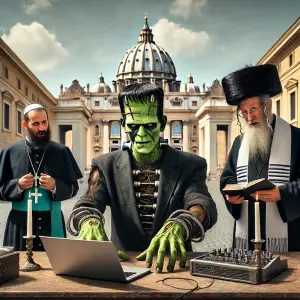
Jews and Christians meeting together at the Vatican’s invitation have just penned a Joint Statement on AI Ethics (October 22, 2025). I have placed the text on my website page, Blogs and Editorials. This is a sophisticated and thoughtful statement. The new statement establishes five guardrails to safeguard human dignity and the common good from potential harm posed by AI technology: (1) Accuracy; (2) Transparency; (3) Privacy; (4) Security; and (5) Human Dignity and the Common Good.
Patheos H+ 2022. AI and Public Theology
Can we keep AI aligned to human dignity and the common good?
Note the final item on the list: Human Dignity and the Common Good. The Joint Statement on AI Ethics hits dignity and the common good with a moral sledgehammer.
A ”robust understanding of human dignity-including its emotional, spiritual, cultural, labor-related, and ecological dimensions-must inform Al’s development and governance. In addition to guarding against Al eroding human critical thinking; excessively commodifying human decision-making; and exacerbating human inequality, animosity, and trauma, humans must guard against the technology’s potential to disrupt or displace human interaction, relationships, and empathy. Humans must reject Al systems replacing human friends, romantic partners, and religious authorities, including by rejecting their incorporation of addictive design principles.”
The new Vatican statement expands on a previous commitment already made by Pope Francis in Antiqua et nova. “AI must be directed by human intelligence to align with this vocation, ensuring it respects the dignity of the human person.”
AI and Public Theology at Work
The salutary news is that Silicon Valley techies, along with the United Nations, are already pondering AI ethics aimed at guardrail legislation. Geoffrey Hinton – the Godfather of AI – along with 91,000 plus others just signed a new Statement on Superintelligence. Here’s the core commitment cited in a recent Substack post.
“We call for a prohibition on the development of Superintelligence, not lifted before there is (1) broad scientific consensus that it will be done safely and controllably; and (2) strong public buy-in.”
Ethicists at the United Nations are working on a sister project. Instead of AI, it’s IA or Intelligence Amplification. IA is a form of neurotechnology sometimes requiring deep brain implants either to enhance intelligence or mitigate disease. Here’s the ethical problem: “Combined with artificial intelligence, [neurotechnology] resulting potential can easily become a threat to notions of human identity, human dignity, freedom of thought, autonomy, (mental) privacy and well-being.” Here’s the ethical solution: the UN “calls on governments to ensure that neurotechnology remains inclusive and affordable, while establishing safeguards to preserve the sanctity of the human mind.”
For the public theologian, this is delightful news because healthy ethical deliberation is already in full swing. The Christian public theologian should support and encourage such secular endeavors.
Public theology, I routinely aver, is conceived in the church, critically reflected on in the academy, and offered to the wider world for the sake of the common good (Public Theology Resources). In the case of AI technology, what the public theologian can offer is discourse clarification and worldview construction. See: Ted Peters, “Machine Intelligence, Artificial General Intelligence, Super-Intelligence, and Human Dignity” (2025). I thank our evangelical leaders, along with the Holy See, for exhibiting public theology at work. Such moral deliberation is aimed at edifying the larger planetary society outside those church walls.
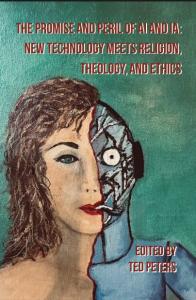
For more on this book, click here
Conclusion
I believe we should all be grateful that some of our most talented AI techies, UNESCO, Evangelical Christian leaders, and the Vatican are earnestly looking for ethical guardrails to map out a safe and secure future relationship between human and artificial intelligence.
Patheos H+ 2022. AI and Public Theology
Patheos H+ 2001: Is ChatGPT Intelligent?
Patheos H+ 2002: AI Warning: Utopia or Extinction?
Patheos H+ 2003: Your Robot Pastor is Here
Patheos H+ 2004: AI Brinkmanship
Patheos H+ 2005: Is AI a shortcut to virtue? To holiness?
Patheos H+ 2006: Creating an AI Co-Creator? Philip Hefner’s Mind
Patheos H+ 2007: Hopes and Hazards of AI
Substack H+ 2008: The Two Scares of Superintelligence
Substack H+ 2010: Christianity in the Age of AI
Substack H+ 2011: Will AI Develop Selfhood and Disobedience?
Substack H+ 1027 H+ 2012: TESCREAL, Transhumanism, and Cybertheology
Patheos H+ 2013: Is AI in the Image of God?
Substack H+ 2016. Technological Salvation? Really? Part 1: Can AI and Transhumanism really deliver?
Substack H+ 2019. Superintelligence? No, say our AI techies.
Substack H+ 2020. AI Ethics at the Vatican: Jews’ and Christians’ “Joint Statement on AI Ethics”
Patheos H+ 2022. AI and Public Theology
▓
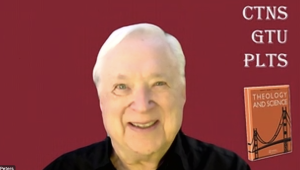
Meet Ted Peters. Ted Peters (Ph.D., University of Chicago) is a public theologian directing traffic at the intersection of science, religion, and ethics. Peters is an emeritus professor at the Graduate Theological Union, where he co-edits the journal, Theology and Science, on behalf of the Center for Theology and the Natural Sciences, in Berkeley, California, USA. He recently co-edited Astrobiology: Science, Ethics, and Public Policy (Scrivener 2021) as well as Astrotheology: Science and Theology Meet Extraterrestrial Intelligence (Cascade 2018). He edited The Promise and Perils of AI and IA: New Technology Meets Religion, Theology, and Ethics (ATF 2025). He also co-edited Religious Transhumanism and Its Critics (Roman and Littlefield 2022) and The CRISPR Revolution in Science, Ethics, and Religion (Bloomsbury 2025). See his Patheos blogsite and his website [TedsTimelyTake.com].
▓
Technology and Religion
Christianity in the Age of AI: An Appeal for Wise Leadership
About Ted Peters
Meet Ted Peters. Ted Peters (Ph.D., University of Chicago) is a public theologian directing traffic at the intersection of science, religion, and ethics. Peters is an emeritus professor at the Graduate Theological Union, where he co-edits the journal, Theology and Science, on behalf of the Center for Theology and the Natural Sciences, in Berkeley, California, USA. He recently co-edited Astrobiology: Science, Ethics, and Public Policy (Scrivener 2021) as well as Astrotheology: Science and Theology Meet Extraterrestrial Intelligence (Cascade 2018). He edited The Promise and Perils of AI and IA: New Technology Meets Religion, Theology, and Ethics (ATF 2025). He also co-edited Religious Transhumanism and Its Critics (Roman and Littlefield 2022) and The CRISPR Revolution in Science, Ethics, and Religion (Bloomsbury 2025). See his Patheos blogsite and his website [TedsTimelyTake.com You can read more about the author here.
Previous Post

October 3, 2025
The New Presidential Dollar?
Next Post
December 11, 2025 The Age of Disclosure
Browse Our Archives
Select a Category Afterlife America in Crisis Ancient Alien Apocalypse Art Artificial Intelligence Astrobiology Astrotheology Atheism Big History Buddhist Catholic Christian Nationalism Christmas Comparative Theology Death Ecology Ethics ETI Evangelical Evolution Existential Questions Free Will General Christian Hermeneutics Hindu https://www.patheos.com/blogs/allsetfree/2020/12/sins-we-need-to-talk-about/?utm_source=Newsletter&utm_medium=email&utm_campaign=Christians+For+a+Better+Christianity&utm_content=43&lct Interreligious Islam Jewish Justice Latter-Day Saints Literature Literature and Theology Lutheran Methodism Mormonism Nonreligious ontology Orthodox Pagam Prayer progressive Christian PT 6 Dignity Public Theology Race racial justice Religious Liberty Romance Satan Scapegoat Science & Religion Science and Religion social justice Spirituality SR 8 Transhumanism Systematic Theology Taoism Ted Peters UAP UFO Uncategorized War
Select a Month September 2026 August 2026 July 2026 June 2026 May 2026 April 2026 March 2026 February 2026 December 2025 November 2025 October 2025 September 2025 August 2025 July 2025 June 2025 May 2025 April 2025 March 2025 February 2025 January 2025 December 2024 November 2024 October 2024 September 2024 August 2024 July 2024 June 2024 May 2024 April 2024 March 2024 February 2024 January 2024 December 2023 November 2023 October 2023 September 2023 August 2023 July 2023 June 2023 May 2023 April 2023 March 2023 February 2023 January 2023 December 2022 November 2022 October 2022 September 2022 August 2022 July 2022 June 2022 May 2022 April 2022 March 2022 February 2022 January 2022 December 2021 November 2021 October 2021 September 2021
Follow Us!
TAKE THE
Religious Wisdom Quiz
Which official opposed Nehemiah's wall-building and sent open letters to Jerusalem?
Select your answer to see how you score.
Haggai Tobiah Sanballat Geshem
Related posts from Public Theology

Why Public Theology Needs a Theology of Nature

America's 250th Birthday Gift: Civic Renewal

Do You Believe in UFOs? A Theologian's Answer.

Free Will and Christian Freedom TWO
TRENDING AT PATHEOS Progressive Christian

What Being a Modern-Day Apostle Means to Me
In my last column, I discussed the ins and outs of modern-day...

Did Ancient China Once Worship the God of...
Across human history, a common thread weaves through the origins of the...

Love Your Neighbor – Including Earth-Kin: Lev. 19,...
God’s command to love your neighbor means acting in an ethical and...

Lead a Church Study of “Jesus and Lao...
Guest writer Jack Thomas (The Irreverent Reverend) reflects on leading his church...

Pastoral Wisdom for Responding to Sermon Pushback
Getting sermon pushback on your social justice sermon? Learn practical, Proverbs-based strategies...

Principles for Understanding the Apostolic Ministry Today
Whenever people discover that my formal ministry title is "apostle," as in...
view all Progressive Christian blogs
Ad-Free & Subscriber Log-In Subscription Support
- About Us
- 2026 Calendar
- Videos
- Podcasts
- Library of World Religions
- Faith In Media Tracker
- Advertise With Us
- Write for Us
- Privacy Policy
- Terms of Service
- Do Not Sell My Data
- Contact Us
- Radiant Digital
- Manage Newsletter Subscriptions
- Unsubscribe From Notifications
- Sitemap
Copyright 2008-2026, Patheos. All rights reserved.
Subscription Support Ad-Free & Subscriber Log-In
Follow Patheos