
BuddhistCatholicContemplativeEvangelicalGeneral ChristianHinduJewishLatter-day SaintMuslimNew VisionsProgressive Christian
Beliefs
- Buddhist
- Catholic
- Contemplative
- Evangelical
- General Christian
- Hindu
- Jewish
- Latter-day Saint
- More Voices
- Muslim
- New Visions
- Pagan
- Progressive Christian
Topics
- Religion News
- Food and Religion
- Sports and Religion
- Religious Art
- Religious Music and Entertainment
- Religious Events
- History and Religion
- Style and Religion
- Politics and Religion
- Women in Religion
- Recreation Outdoors and Religion
- Business Finance and Religion
- Careers Workplace and Religion
- Education and Religion
- Family Parenting and Religion
- Health Fitness and Religion
- Home and Religion
- Relationships and Religion
- Technology and Religion
- Travel and Religion
Columnists
- Buddhist Columnists
- Business Finance and Religion Columnists
- Careers Workplace and Religion Columnists
- Catholic Columnists
- Contemplative Columnists
- Education and Religion Columnists
- Evangelists Columnists
- Family Parenting and Religion Columnists
- General Christian Columnists
- Health Fitness and Religion Columnists
- Hindu Columnists
- History and Religion Columnists
- Home and Religion Columnists
- Jewish Columnists
- More Voices Columnists
- Latter Day Columnists
- Muslim Columnists
- New Visions Columnists
- Nonreligious Columnists
- Pagan Columnists
- Politics and Religion Columnists
- Progressive Columnists
- Recreation Outdoors and Religion Columnists
- Relationships and Religion Columnists
- Religion News Columnists
- Religious Art Columnists
- Religious Events Columnists
- Religious Music and Entertainment Columnists
- Sports and Religion Columnists
- Style and Religion Columnists
- Technology and Religion Columnists
- Travel and Religion Columnists
- Women in Religion Columnists
Resource Library
- 2026 Calendar
- Library of World Religions
- The 100 Most Holy Places on Earth
- Patheos Answers
- Podcasts
- Videos
- Faith Leaders Database
- Anglican Episcopalian
- Bahai
- Baptist
- Buddhism
- Christianity
- Confucianism
- Eastern Orthodoxy
- Hinduism
- Holiness and Pentecostal
- ISKCON
- Islam
- Judaism
- Lutheran
- Methodist
- The Church of Jesus Christ of Latter-day Saints
- New Age
- Paganism
- Presbytarian and Reformed
- Protestantism
- Religion Behind the Scenes
- Roman Catholic
- Scientology
- Shia Islam
- Sikhism
- Sufism
- Sunni Islam
- Taoism
- Zen
- See all religions
Research Tools
 Ad-Free & Subscriber Log-In Subscription Support
Ad-Free & Subscriber Log-In Subscription Support
Follow Patheos 

- Trending:
- Forgiveness
- |
- Marriage
- |
- Consciousness
- |
- Death Penalty
- |
- Election
- |
- Halloween

- Home
- Progressive Christian
- Technology and Religion
- K2-18b? New Space Neighbors?
K2-18b? New Space Neighbors?
Last updated on: April 22, 2025 at 8:14 am by Ted Peters
K2-18b? New Space Neighbors? 2025-04-22T08:14:42-07:00 Ted Peters
Patheos Explore the world's faith through different perspectives on religion and spirituality! Patheos has the views of the prevalent religions and spiritualities of the world.

Will we find new space neighbors on K2 18b? NASA photo.
Who lives on K2-18b? New Space Neighbors? Should our churches invite these new space neighbors to next Sunday evening’s covered dish potluck?
Are new space neighbors only 124 light years away from Earth?
Like our family dog sniffing in the new neighbor’s back yard, the olfactory sensors aboard NASA’s James Webb Space Telescope (JWST) have caught the scent of dimethyl sulfide in the atmosphere of an exoplanet. That exoplanet’s address is EPIC 201912552b. It is the second planet orbiting a red dwarf sun, K2-18. It’s only 124 lightyears down the street.
Originally detected by Kepler, JWST is now providing more details. James Webb astrobiologists calculate K2-18b at 2.6 times the radius of Earth with a 33 day orbit within that star’s habitable zone.
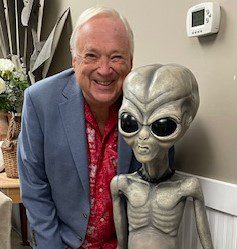
Ted Peters is the one on the left.
Might dimethyl sulfide (DMS; CH3SCH3) count as a biosignature indicating the presence of new space neighbors? Comprising one atom of sulfur bonded to two methyl groups, each of which contains one carbon atom and three hydrogen atoms, it’s a biosignature here on Earth. No doubt you’ve smelled this organosulfur once or twice. Dimethyl sulfide gives off that stinky odor reminding us of garlic or rotten eggs. This odor is emitted constantly by tiny plankton in our oceans. Can Webb’s spectroscopic nose accurately smell life on K2-18b?
Cambridge University’s Nikku Madhusudhan and colleagues believe K2-18b to be a hycean world—that is oceanic with a rich hydrogen atmosphere. Writing April 17, 2025, in Astrophysical Journal Letters, these scientists say this strongly suggests the “possibility of biological activity on K2-18b.”
New space neighbors? Not so fast! Scientific American commentator Meghan Bartels refers us to a 2024 study by Nathan Reed and colleagues on the “abiotic” production of organosulfur gases including dimethyl sulfide. “Although our results constrain the robustness of common organosulfur gases as biosignatures, the presence of these compounds may serve as an indicator of metabolic potential on exoplanets.” In short, dimethyl sulfide could be produced abiotically as well as biotically. This renders premature a judgment that JWST has proven the presence of life on K2-18b.
Astrobiology and Astrotheology
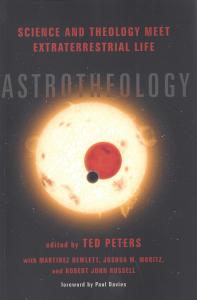
Like waving an ice cream cone in front of a four-year old’s widely opened eyes, astrobiologists constantly tantalize terrestrial imaginations with the prospect of extraterrestrial life. Giving free reign to our imaginations, we at the Center for Theology and the Natural Sciences in Berkeley have begun to develop a new discipline: Astrotheology.
“Astrotheology is that branch of theology which provides a critical analysis of the contemporary space sciences combined with an explication of classic doctrines such as creation and Christology for the purpose of constructing a comprehensive and meaningful understanding of our human situation within an astonishingly immense cosmos” (Peters, 2018, 11-12).
Currently, some of my colleagues – Carolina De La Fuente, Arvin Gouw, and Junghyung Kim — are working on a new anthology of articles written by experts in both astrobiology and astrotheology. I expect a publication date in early 2026.
Whiteheadian theologian Andrew M. Davis invites us to embrace an intergalactic religion. Rather than a set of dogmas, this religion is “an attitude or orientation toward the universe as allusive to the divine axianoetic reality behind it; that is, an ultimate reality of Mind and Value” (Davis 2022, 448).
We astrotheologians are getting ready. As soon as extraterrestrial neighbors pay us a call here on Earth, we will greet them with an invitation to join us for a potluck.
Conclusion
We in the churches should thank our scientist friends in astrobiology and related fields for providing us with new data and new learnings. The far horizon that beckons our imaginations is constantly receding and encompassing ever more possibilities. The magnificence of God’s creation only grows and grows.
Patheos SR 1200. K2-18b: New Space Neighbors?
Astrotheology’s contribution to public theology
Astrotheology as Public Theology
Do we have space neighbors in God’s kingdom?
Introducing astrotheology and astroethics
Does extraterrestrial life have intrinsic value?
Data from the PETERS ETI RELIGIOUS CRISIS Survey
Would confirmation of ETI cause a crisis for terrestrial religion? (Royal Society)
Would confirmation of ETI cause a crisis for terrestrial religion? (Patheos)
“After Contact” Interview with Nick Pope
▓
Ted Peters directs traffic at the intersection of science, religion, and ethics. Peters is an emeritus professor at the Graduate Theological Union, where he co-edits the journal, Theology and Science, with Robert John Russell on behalf of the Center for Theology and the Natural Sciences, in Berkeley, California, USA. He authored Playing God? Genetic Determinism and Human Freedom? (Routledge, 2nd ed., 2002) as well as Science, Theology, and Ethics (Ashgate 2003). Along with Martinez Hewlett, Joshua Moritz, and Robert John Russell, he co-edited, Astrotheology: Science and Theology Meet Extraterrestrial Intelligence (2018). Along with Octavio Chon Torres, Joseph Seckbach, and Russell Gordon, he co-edited, Astrobiology: Science, Ethics, and Public Policy (Scrivener 2021). Along with Arvin Gouw and Brian Patrick Green, he co-edited Religious Transhumanism and Its Critics (Lexington 2022). He is also author of UFOs: God’s Chariots? Spirituality, Ancient Aliens, and Religious Yearnings in the Age of Extraterrestrials (Career Press New Page Books, 2014). Look for his newest book, The Voice of Public Theology, a collection of previous articles. See his website: TedsTimelyTake.com.
▓
References
Davis, Andrew M. 2022. “Whiteheadian Cosmotheology: Platonic Entities, Divine Realities and Shared Extraterrestrial Values.” In Process Cosmology, by Maria-teresa Teixeira, and Wm Andrew Schwartz Andrew M Davis, 423-452. New York: Macmillan Palgrave.
Peters, Ted. 2018. “Introducing Astrotheology.” In Astrotheology: Science and Theology Meet Extraterrestrial Life, by Martinez Hewlett, Joshua M Moritz, and Robert John Russell, eds Ted Peters, 3-26. Eugene OR: Cascade Books.
Technology and Religion
About Ted Peters
For Patheos, Ted Peters posts articles and notices in the field of Public Theology. He is a Lutheran pastor and emeritus professor at the Graduate Theological Union. He co-edits the journal, Theology and Science, with Robert John Russell on behalf of the Center for Theology and the Natural Sciences, in Berkeley, California, USA. His single volume systematic theology, God—The World’s Future, is now in the 3rd edition. He has also authored God as Trinity plus Sin: Radical Evil in Soul and Society as well as Sin Boldly: Justifying Faith for Fragile and Broken Souls. More recently, The Voice of Public Theology, has been published by ATF Press. See his website: TedsTimelyTake.com. You can read more about the author here.
Previous Post

April 16, 2025
Does Reason Prove the Afterlife? Gödel’s Surprising Argument
Next Post
April 28, 2025 Climate Change and the Global Common Good
Browse Our Archives
Select a Category Afterlife America in Crisis Ancient Alien Apocalypse Art Artificial Intelligence Astrobiology Astrotheology Atheism Big History Buddhist Catholic Christian Nationalism Christmas Comparative Theology Death Ecology Ethics ETI Evangelical Evolution Existential Questions Free Will General Christian Hermeneutics Hindu https://www.patheos.com/blogs/allsetfree/2020/12/sins-we-need-to-talk-about/?utm_source=Newsletter&utm_medium=email&utm_campaign=Christians+For+a+Better+Christianity&utm_content=43&lct Interreligious Islam Jewish Justice Latter-Day Saints Literature Literature and Theology Lutheran Methodism Mormonism Nonreligious ontology Orthodox Pagam Prayer progressive Christian PT 6 Dignity Public Theology Race racial justice Religious Liberty Romance Satan Scapegoat Science & Religion Science and Religion social justice Spirituality SR 8 Transhumanism Systematic Theology Taoism Ted Peters UAP UFO Uncategorized War
Select a Month September 2026 August 2026 July 2026 June 2026 May 2026 April 2026 March 2026 February 2026 December 2025 November 2025 October 2025 September 2025 August 2025 July 2025 June 2025 May 2025 April 2025 March 2025 February 2025 January 2025 December 2024 November 2024 October 2024 September 2024 August 2024 July 2024 June 2024 May 2024 April 2024 March 2024 February 2024 January 2024 December 2023 November 2023 October 2023 September 2023 August 2023 July 2023 June 2023 May 2023 April 2023 March 2023 February 2023 January 2023 December 2022 November 2022 October 2022 September 2022 August 2022 July 2022 June 2022 May 2022 April 2022 March 2022 February 2022 January 2022 December 2021 November 2021 October 2021 September 2021
Follow Us!
TAKE THE
Religious Wisdom Quiz
What character trait is praised in the Parable of the Good Samaritan?
Select your answer to see how you score.
Selfishness Deceit Pride Compassion
Related posts from Public Theology

Why Public Theology Needs a Theology of Nature

America's 250th Birthday Gift: Civic Renewal

Do You Believe in UFOs? A Theologian's Answer.

Free Will and Christian Freedom TWO
TRENDING AT PATHEOS Progressive Christian

What Being a Modern-Day Apostle Means to Me
In my last column, I discussed the ins and outs of modern-day...

Did Ancient China Once Worship the God of...
Across human history, a common thread weaves through the origins of the...

Love Your Neighbor – Including Earth-Kin: Lev. 19,...
God’s command to love your neighbor means acting in an ethical and...

Lead a Church Study of “Jesus and Lao...
Guest writer Jack Thomas (The Irreverent Reverend) reflects on leading his church...

Pastoral Wisdom for Responding to Sermon Pushback
Getting sermon pushback on your social justice sermon? Learn practical, Proverbs-based strategies...

Principles for Understanding the Apostolic Ministry Today
Whenever people discover that my formal ministry title is "apostle," as in...
view all Progressive Christian blogs
Ad-Free & Subscriber Log-In Subscription Support
- About Us
- 2026 Calendar
- Videos
- Podcasts
- Library of World Religions
- Faith In Media Tracker
- Advertise With Us
- Write for Us
- Privacy Policy
- Terms of Service
- Do Not Sell My Data
- Contact Us
- Radiant Digital
- Manage Newsletter Subscriptions
- Unsubscribe From Notifications
- Sitemap
Copyright 2008-2026, Patheos. All rights reserved.
Subscription Support Ad-Free & Subscriber Log-In
Follow Patheos