
BuddhistCatholicContemplativeEvangelicalGeneral ChristianHinduJewishLatter-day SaintMuslimNew VisionsProgressive Christian
Beliefs
- Buddhist
- Catholic
- Contemplative
- Evangelical
- General Christian
- Hindu
- Jewish
- Latter-day Saint
- More Voices
- Muslim
- New Visions
- Pagan
- Progressive Christian
Topics
- Religion News
- Food and Religion
- Sports and Religion
- Religious Art
- Religious Music and Entertainment
- Religious Events
- History and Religion
- Style and Religion
- Politics and Religion
- Women in Religion
- Recreation Outdoors and Religion
- Business Finance and Religion
- Careers Workplace and Religion
- Education and Religion
- Family Parenting and Religion
- Health Fitness and Religion
- Home and Religion
- Relationships and Religion
- Technology and Religion
- Travel and Religion
Columnists
- Buddhist Columnists
- Business Finance and Religion Columnists
- Careers Workplace and Religion Columnists
- Catholic Columnists
- Contemplative Columnists
- Education and Religion Columnists
- Evangelists Columnists
- Family Parenting and Religion Columnists
- General Christian Columnists
- Health Fitness and Religion Columnists
- Hindu Columnists
- History and Religion Columnists
- Home and Religion Columnists
- Jewish Columnists
- More Voices Columnists
- Latter Day Columnists
- Muslim Columnists
- New Visions Columnists
- Nonreligious Columnists
- Pagan Columnists
- Politics and Religion Columnists
- Progressive Columnists
- Recreation Outdoors and Religion Columnists
- Relationships and Religion Columnists
- Religion News Columnists
- Religious Art Columnists
- Religious Events Columnists
- Religious Music and Entertainment Columnists
- Sports and Religion Columnists
- Style and Religion Columnists
- Technology and Religion Columnists
- Travel and Religion Columnists
- Women in Religion Columnists
Resource Library
- 2026 Calendar
- Library of World Religions
- The 100 Most Holy Places on Earth
- Patheos Answers
- Podcasts
- Videos
- Faith Leaders Database
- Anglican Episcopalian
- Bahai
- Baptist
- Buddhism
- Christianity
- Confucianism
- Eastern Orthodoxy
- Hinduism
- Holiness and Pentecostal
- ISKCON
- Islam
- Judaism
- Lutheran
- Methodist
- The Church of Jesus Christ of Latter-day Saints
- New Age
- Paganism
- Presbytarian and Reformed
- Protestantism
- Religion Behind the Scenes
- Roman Catholic
- Scientology
- Shia Islam
- Sikhism
- Sufism
- Sunni Islam
- Taoism
- Zen
- See all religions
Research Tools
 Ad-Free & Subscriber Log-In Subscription Support
Ad-Free & Subscriber Log-In Subscription Support
Follow Patheos 

- Trending:
- Forgiveness
- |
- Marriage
- |
- Consciousness
- |
- Death Penalty
- |
- Election
- |
- Halloween

- Home
- Progressive Christian
- Politics and Religion
- End Christian Nationalism
End Christian Nationalism
Last updated on: October 26, 2024 at 3:14 pm by Ted Peters
End Christian Nationalism 2024-10-26T15:14:05-07:00 Ted Peters
Patheos Explore the world's faith through different perspectives on religion and spirituality! Patheos has the views of the prevalent religions and spiritualities of the world.
End Christian Nationalism

End Christian Nationalism
With the US presidential election now only days away, Amazing Amanda Tyler releases her new book, How to End Christian Nationalism. Tyler’s task, she tells us, is to end Christian nationalism (CN) in order to support religious freedom (Tyler, 2024, p. 2). We Christians have a special responsibility to root out and dismantle not only CN but also the white racism CN protects.
In what follows I’d like to explicate Amanda Tyler’s military strategy for defeating CN. Then I will ask whether or not we have fully understood why some Americans would be attracted to CN and why so many evangelicals would be attracted to the MAGA Moscow wing of the Republican Party. Expanded and deepened understanding is my goal here.
Steps toward the end of Christian nationalism
How shall we achieve the cultural victory that would end Christian nationalism? Tyler’s eight chapters provide an eightfold path leading to a religiously plural American society where “faith freedom for all is commonplace” (Tyler, 2024, p. 22).
-
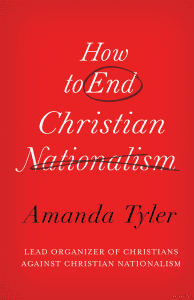
Amanda Tyler, How to End Christian Nationalism
Name and understand the threat of Christian Nationalism.
-
Ground yourself in God’s love.
-
Denounce violence.
-
Commit to the separation of church and state.
-
Take on Christian nationalism close to home.
-
Organize for change.
-
Protect religious freedom in public schools.
-
Take your place in the public square.
If we end Christian nationalism, what’s next?
Tyler wants to replace CN with religious liberty in an idealized pluralistic society.
“As Christians Against Christian Nationalism, we know we cannot only state what we are against but we also have to state what we are for…. Together we are imagining a world of justice, equity, and no fear, and together we are making that world possible through brave acts of love” (Tyler 2024, 212).
Her military strategy is to fight with weapons of love and non-violence.
How should we understand Christian Nationalism?
Tyler wants to end Christian Nationalism and replace it. What is CN as Amanda Tylor understands it? She tells us.
“Christian nationalism is a political ideology and cultural framework that seeks to fuse American and Christian identities…. Christian nationalism is a gross distortion of the Christian faith that I and so many others hold dear” (Tyler, 2024, p. 26).
Because CN is a pernicious ideology that distorts both the Christian faith as well as American patriotism, Tyler says, we should end Christian nationalism. I understand that. I even agree.
Nevertheless, I ask, what will happen to those people who today espouse CN after Tyler puts an end to it? Having replaced CN with pluralism, where will today’s CNers go tomorrow? Does Tyler anticipate a perpetual antagonism between CN supporters and those who support her vision of a religiously plural society governed by religious freedom? In Tyler’s pluralistic utopia, I ask, is there any room for CNers or post-CNers?
Again, how should we understand Christian Nationalism?
Let me add to Tyler’s polemical understanding of CN another layer of understanding. I’m thinking here of sympathetic or even empathetic understanding. Empathic understanding asks us to look at our existential situation from the point of view of the CNers themselves.

Amanda Tyler, How to End Christian Nationalism
Let’s ask: why might some Americans be motivated to embrace an ideology such as CN? While we’re at it let’s also ask: why might a large number of evangelical Christians express modest sympathy to CN and vote enthusiastically for MAGA candidates within the Republican Party?
For a couple of years in this Patheos column on Public Theology I have been asking such a question. I have proposed an answer that Amanda Tyler does not consider important in her understanding of CN. My answer has to do with anxiety seemingly out of control within certain segments of American society. In short, many Americans fear their place in society – their jobs, their roles in culture, their public respect – is about to be taken away. They fear being replaced. This fear of replacement prompts a flight to security in the symbolic citadel of being Christian and being American.
In trying to understand CN and its sympathizers empathically, I’ve found helpful a couple French terms – remplacement and ressentiment. People in France are undergoing cultural upheaval just as we in America are. And they’ve worked hard at understanding it.
Remplacement or ‘replacement’ identifies a widespread cultural anxiety precipitated by the perception that past securities are being eroded by too much change too fast. Those white racists driving pick-ups with American flags Tyler so despises actually fear that their jobs and their livelihoods and their purchase on culture are being replaced by women, immigrants, and affirmative action. They feel excluded from America’s future. And they become anxious over this existential threat. When anxiety is high, so is the potential for violence in both rhetoric and the back alley.
Remplacement and Ressentiment
Quickly remplacement becomes ressentiment. Those subject to resentment feel unjustly victimized by forces that seem beyond their control. Ressentiment becomes politically potent. “Resentment is an emotion that has a lot going for it in the realm of politics,” Patheos columnist Anthony Costello observes. When a group perpetually re-feels a real or imagined injustice, the group can become a mob.

What do we feel when joining a political mob? We feel “revenge, hatred, malice, envy, the impulse to detract, and spite.” That’s what public theologian Martin Marty observes.
Are we beginning to understand why someone might be attracted to either CN or to the MAGA wing of the Republican Party? When Amanda Tyler and the Baptist Joint Committee trumpets – you white male Christians are going to be replaced by pluralism! – the net product is remplacement anxiety expressed in ressentiment politics.
Even though Amanda Tyler and her anti-Christian Nationalist army march quite self-righteously to war against the CN enemy, the pursuit of serious understanding behooves us to try to empathize with CNers. And while were at it, to understand empathically those evangelicals who similarly feel threatened by remplacement and are tempted by ressentiment.
To end Christian nationalism
 Before we issue marching orders to the anti-Christian nationalist army to defeat CN, perhaps we should ask about the end *of CN—*that is, the end or goal of CN. Or at least we should try to understand CN and its sympathizers in terms of what they feel and how they perceive cultural threats.
Such efforts to understand should not threaten Amanda Tyler or other anti-Christian nationalists. In no way does a pause to understand those who feel victimized obstruct Christian moral denunciation of evil. So, if Tyler and other anti-Christian nationalists would pause a moment to understand, perhaps their cultural and political strategy might change.
If we want to end Christian nationalism, it seems to me, a political defeat in the voting booth would be great, to be sure. Yet, in the wake of the upcoming US presidential election, some kind of pastoral understanding should be summoned to bridge the chasm dug by the anti-Christian nationalists.
Envoi
In this Patheos series, I’ve been advancing the following thesis.
Several Ex-Evangelicals along with Progressive Protestants are displacing their anger at Donald Trump’s MAGA party onto evangelicals by painting evangelicals with the colors of Christian nationalism. That is, Anti-Christian Nationalism blames white evangelicals for Christian nationalism. This is a waste of healthy political energy that should be directed against MAGA Republicans.
If this thesis holds, it asks the Christians among us to attempt empathetically to understand both Christian nationalists and those evangelicals who find security in supporting MAGA Republicans. It’s consistent with Tyler’s emphasis on love and non-violence.
Conclusion
If Amanda Tyler is serious about creating a future democratic society characterized by pluralism governed by religious liberty, this ideal society should make room for those among us who are CNers and evangelicals. These segments of our society who now feel threatened must be absorbed into Tyler’s pluralism in such a way that the threat of exclusion is diminished if not eliminated. How should we go about that?
PT 3254 End Christian Nationalism
Christian Nationalism Resources
PT 3247 Anti-Anti-Christian Nationalism, Part 1
PT 3248 Anti-Anti-Christian Nationalism, Part 2
PT 3249 Anti-Anti-Christian Nationalism, Part 3
▓

Ted Peters
For Patheos, Ted Peters posts articles and notices in the field of Public Theology. He is a Lutheran pastor and emeritus professor at the Graduate Theological Union. His single volume systematic theology, God—The World’s Future, is now in the 3rd edition. He has also authored God as Trinity plus Sin: Radical Evil in Soul and Society as well as Sin Boldly: Justifying Faith for Fragile and Broken Souls. He recently published. The Voice of Public Theology, with ATF Press. See his website: TedsTimelyTake.com and Patheos blog site on Public Theology.
▓
References
Alberta, T., 2023. The Kingdom, the Power, and the Glory: American Evangelicals in an Age of Extremism. New York: Harper.
Butler, A., 2021. White Evangelical Racism. Chapel Hill NC: The University of North Carolina Press.
Cooper-White, P., 2021. The Psychology of Christian Nationalism: Why People Are Drawn In and How to Talk Across the Divide. Minneapolis MN: Fortress Press.
Decker, A., 2022. Red State Christians: A Journey into White Christian Nationalism and the Wreckage it leaves behind.. New York: Broadleaf.
DuMez, K. K., 2020. Jesus and John Wayne: How White Evangelicals Corrupted a Faith and Fractured a Nation. New York: Norton.
Gorski, P. & Perry, S., 2022. The Flag and the Cross: Christian Nationalism and the Threat to American Democracy. Oxford: Oxford University Press.
Hendrickson, O., 2023. Christians Against Christianity: How Right Wing Evangelicals are Destroying our Nation and our Faith. Boston: Beacon.
Heritage, 2023. Project 2025: Mandate for Leadership, Washington DC: Heritage Foundation.
Ingersoll, J., 2015. Building God’s Kingdom. Oxford: Oxford Academic; https://academic.oup.com/book/10399.
Miller, P. D., 2022. The Religion of American Greatness: What’s Wrong with Christian Nationalism?. s.l.:Christian Audio.
Peters, T., 2023. The Voice of Public Theology. Adelaide: ATF.
Tyler, A., 2024. How To End Christian Nationalism. Minneapolis MN: 1517 Media / Broadleaf.
Whitehead, A. & Perry, S., 2022. Taking Back America for God: Christian Nationalism in the United States. 2nd ed. Oxford: Oxford University Press.
Wolfe, S., 2023. The Case for Christian Nationalism. Moscow ID: Canon Press.
Politics and Religion
Christians Against Christian Nationalism

About Ted Peters
For Patheos, Ted Peters posts articles and notices in the field of Public Theology. He is a Lutheran pastor and emeritus professor at the Graduate Theological Union. His single volume systematic theology, God—The World’s Future, is now in the 3rd edition. He has also authored God as Trinity plus Sin: Radical Evil in Soul and Society as well as Sin Boldly: Justifying Faith for Fragile and Broken Souls. He recently published. The Voice of Public Theology, with ATF Press. See his website: TedsTimelyTake.com and Patheos blog site on Public Theology. You can read more about the author here.
Previous Post

October 19, 2024
The Public in Public Theology
Next Post

October 30, 2024 UAP, ETI, and David Bohm’s Physics
Browse Our Archives
Select a Category Afterlife America in Crisis Ancient Alien Apocalypse Art Artificial Intelligence Astrobiology Astrotheology Atheism Big History Buddhist Catholic Christian Nationalism Christmas Comparative Theology Death Ecology Ethics ETI Evangelical Evolution Existential Questions Free Will General Christian Hermeneutics Hindu https://www.patheos.com/blogs/allsetfree/2020/12/sins-we-need-to-talk-about/?utm_source=Newsletter&utm_medium=email&utm_campaign=Christians+For+a+Better+Christianity&utm_content=43&lct Interreligious Islam Jewish Justice Latter-Day Saints Literature Literature and Theology Lutheran Methodism Mormonism Nonreligious ontology Orthodox Pagam Prayer progressive Christian PT 6 Dignity Public Theology Race racial justice Religious Liberty Romance Satan Scapegoat Science & Religion Science and Religion social justice Spirituality SR 8 Transhumanism Systematic Theology Taoism Ted Peters UAP UFO Uncategorized War
Select a Month September 2026 August 2026 July 2026 June 2026 May 2026 April 2026 March 2026 February 2026 December 2025 November 2025 October 2025 September 2025 August 2025 July 2025 June 2025 May 2025 April 2025 March 2025 February 2025 January 2025 December 2024 November 2024 October 2024 September 2024 August 2024 July 2024 June 2024 May 2024 April 2024 March 2024 February 2024 January 2024 December 2023 November 2023 October 2023 September 2023 August 2023 July 2023 June 2023 May 2023 April 2023 March 2023 February 2023 January 2023 December 2022 November 2022 October 2022 September 2022 August 2022 July 2022 June 2022 May 2022 April 2022 March 2022 February 2022 January 2022 December 2021 November 2021 October 2021 September 2021
Follow Us!
TAKE THE
Religious Wisdom Quiz
What Christian group believes in a "Memorial" instead of a traditional communion?
Select your answer to see how you score.
Anglicans Jehovah’s Witnesses Catholics Lutherans
Related posts from Public Theology

Why Public Theology Needs a Theology of Nature

America's 250th Birthday Gift: Civic Renewal

Do You Believe in UFOs? A Theologian's Answer.

Free Will and Christian Freedom TWO
TRENDING AT PATHEOS Progressive Christian

What Being a Modern-Day Apostle Means to Me
In my last column, I discussed the ins and outs of modern-day...

Did Ancient China Once Worship the God of...
Across human history, a common thread weaves through the origins of the...

Love Your Neighbor – Including Earth-Kin: Lev. 19,...
God’s command to love your neighbor means acting in an ethical and...

Lead a Church Study of “Jesus and Lao...
Guest writer Jack Thomas (The Irreverent Reverend) reflects on leading his church...

Pastoral Wisdom for Responding to Sermon Pushback
Getting sermon pushback on your social justice sermon? Learn practical, Proverbs-based strategies...

Principles for Understanding the Apostolic Ministry Today
Whenever people discover that my formal ministry title is "apostle," as in...
view all Progressive Christian blogs
Ad-Free & Subscriber Log-In Subscription Support
- About Us
- 2026 Calendar
- Videos
- Podcasts
- Library of World Religions
- Faith In Media Tracker
- Advertise With Us
- Write for Us
- Privacy Policy
- Terms of Service
- Do Not Sell My Data
- Contact Us
- Radiant Digital
- Manage Newsletter Subscriptions
- Unsubscribe From Notifications
- Sitemap
Copyright 2008-2026, Patheos. All rights reserved.
Subscription Support Ad-Free & Subscriber Log-In
Follow Patheos