
BuddhistCatholicContemplativeEvangelicalGeneral ChristianHinduJewishLatter-day SaintMuslimNew VisionsProgressive Christian
Beliefs
- Buddhist
- Catholic
- Contemplative
- Evangelical
- General Christian
- Hindu
- Jewish
- Latter-day Saint
- More Voices
- Muslim
- New Visions
- Pagan
- Progressive Christian
Topics
- Religion News
- Food and Religion
- Sports and Religion
- Religious Art
- Religious Music and Entertainment
- Religious Events
- History and Religion
- Style and Religion
- Politics and Religion
- Women in Religion
- Recreation Outdoors and Religion
- Business Finance and Religion
- Careers Workplace and Religion
- Education and Religion
- Family Parenting and Religion
- Health Fitness and Religion
- Home and Religion
- Relationships and Religion
- Technology and Religion
- Travel and Religion
Columnists
- Buddhist Columnists
- Business Finance and Religion Columnists
- Careers Workplace and Religion Columnists
- Catholic Columnists
- Contemplative Columnists
- Education and Religion Columnists
- Evangelists Columnists
- Family Parenting and Religion Columnists
- General Christian Columnists
- Health Fitness and Religion Columnists
- Hindu Columnists
- History and Religion Columnists
- Home and Religion Columnists
- Jewish Columnists
- More Voices Columnists
- Latter Day Columnists
- Muslim Columnists
- New Visions Columnists
- Nonreligious Columnists
- Pagan Columnists
- Politics and Religion Columnists
- Progressive Columnists
- Recreation Outdoors and Religion Columnists
- Relationships and Religion Columnists
- Religion News Columnists
- Religious Art Columnists
- Religious Events Columnists
- Religious Music and Entertainment Columnists
- Sports and Religion Columnists
- Style and Religion Columnists
- Technology and Religion Columnists
- Travel and Religion Columnists
- Women in Religion Columnists
Resource Library
- 2026 Calendar
- Library of World Religions
- The 100 Most Holy Places on Earth
- Patheos Answers
- Podcasts
- Videos
- Faith Leaders Database
- Anglican Episcopalian
- Bahai
- Baptist
- Buddhism
- Christianity
- Confucianism
- Eastern Orthodoxy
- Hinduism
- Holiness and Pentecostal
- ISKCON
- Islam
- Judaism
- Lutheran
- Methodist
- The Church of Jesus Christ of Latter-day Saints
- New Age
- Paganism
- Presbytarian and Reformed
- Protestantism
- Religion Behind the Scenes
- Roman Catholic
- Scientology
- Shia Islam
- Sikhism
- Sufism
- Sunni Islam
- Taoism
- Zen
- See all religions
Research Tools
 Ad-Free & Subscriber Log-In Subscription Support
Ad-Free & Subscriber Log-In Subscription Support
Follow Patheos 

- Trending:
- Forgiveness
- |
- Marriage
- |
- Consciousness
- |
- Death Penalty
- |
- Election
- |
- Halloween

- Home
- Progressive Christian
- Religion News
- Nonreductive Physicalism. Soul 6
Nonreductive Physicalism. Soul 6
Last updated on: March 17, 2024 at 11:10 am by Ted Peters
Nonreductive Physicalism. Soul 6 2024-03-17T11:10:58-07:00 Ted Peters
Patheos Explore the world's faith through different perspectives on religion and spirituality! Patheos has the views of the prevalent religions and spiritualities of the world.
Nonreductive Physicalism. Soul 6

Professor Nancey Murphy. Nonreductive Physicalism.
We introduced Nonreductive Physicalism in previous Patheos posts such as Materialisms Soul 4 and Emergent Dualism Soul 5. The widely influential scholar who has developed nonreductive physicalism is Senior Professor of Christian Philosophy at Fuller Seminary, Nancey Murphy.
The nonreductive physicalist accepts the idea of emergence in emergent dualism. But this position rejects assigning independent substantial status for the emergent soul or mind.
Nonreductive physicalism affirms that (a) it is unnecessary to postulate a second, metaphysical entity, such as a soul or spirit, to account for human capacities, and that (b ) human behavior cannot be explained exhaustively with recourse to genetics or neuroscience. The metaphysical status of the soul here is closer to what the materialists affirm. No soul exists, though we certainly experience our minds. Nonreductive physicalists reject substance dualism in favor of materialism, yet the human mind is an emergent that is not reducible to its physical base.
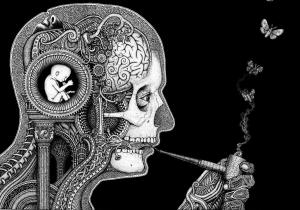
David Pearce. Nonreductive Physicalism or just materialism?
If you’re having a hard time right now distinguishing nonreductive physicalism from emergent dualism and materialism, try this. On the one hand, the nonreductive physicalist differs from the emergent dualist because, though he or she or they believes we have a mind or soul, it is of the same type of reality as our physical body. The dualism of two separate substances is rejected, so that the material or bodily realm is the only one deserving to be called a substance.
Looking the other direction, does this reduce the nonreductive physicalist to materialism? No. The nonreductive physicalist differs from the materialist because, though he or she or they believes the mind or soul is of the same metaphysical type as the body, still it experiences enough independence that it cannot be reduced to just a manifestation of the body.
Did you get that? If so, congratulations. If not, don’t worry. Just keep going.
Let’s try it again. According to the nonreductive physicalist, the mind is a coordinated product of brain activity. But it is more than mere brain activity. The picture drawn by the nonreductive physicalist looks like this: if there is no separate soul substance, then human higher capacities must be explained largely–though not exhaustively–as physical brain functions. But their full explanation requires attention to human social relations, to cultural factors, and most importantly, to God’s action in our lives.
Like emergent dualists, Christian nonreductive physicalists affirm resurrection of the body. They emphasize that immortality does not come from the immortal quality of a soul substance. Rather, it comes solely as an act of God whereby we will be raised. Some sort of physical identity as well as identity of internal consciousness must be carried into the resurrected life if it is we, and not someone else, who enjoys resurrection.
Nancey Murphy’s Nonreductive Physicalism

Professor Nancey Murphy. Nonreductive Physicalism.
The masterful potter molding the biblical clay into the conceptual shape of nonreductive physicalism is Nancey Murphy, as I said above. Nancey Murphy Startling to her disciples is her zeal at constructing a theological anthropology based on Genesis 2:7 which eschews a substantial soul.
“We are our bodies—there is no additional metaphysical element such as a mind or soul or spirit. But…this physicalist position need not deny that we are intelligent, moral, and spiritual. We are, at our best, complex physical organisms, imbued with the legacy of thousands of years of culture, and, most importantly, blown by the Breath of God’s Spirit: we are Spirited bodies” (Murphy 2006, ix).
Murphy need not collapse God into the physical domain. Only humans.
“The nonreductive physicalist says instead that if there is no soul then these higher human capacities must be explained in a different manner. In part, they are explainable as brain functions, but their full explanation creatures attention to human social relations, to cultural factors, and, most importantly, to our relationship with God” (Murphy 2006, 70).
When it comes to your and my resurrection, it will come as a decisive action by God in which we are raised into spirited bodies. Isn’t’ that what St. Paul says?
“It is sown a physical body, it is raised a spiritual body. If there is a physical body, there is also a spiritual body [soma pneumatikon] (1 Corinthians 15:44).
The key term here is soma pneumatikon or spiritualized body. Both Zimmerman and Murphy look forward to the resurrection of the spiritualized body.
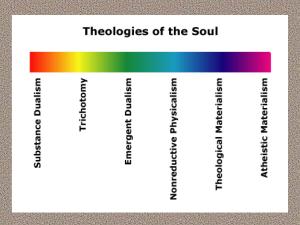
Theologies of the Soul. Table by Martinez Hewlett. Can you find nonreductive physicalism?
Conclusion
What most of the positions on this spectrum mentioned thus far have in common is the close connection between the soul and the mind. This means that the presence of soul applies to a large but limited segment of the human population, namely, those persons after fetal brain development in infancy and prior to brain deterioration in old age. What is missing, from my point of view, is the idea that the soul is more comprehensive than the mind. It is not unusual to believe that the human soul belongs to the essence of personhood, a personhood that is not reducible to active thinking.
Regardless, when we think about eternal life with God, we cannot dodge one incontrovertible fact: it is up to God and God alone to determine our resurrection. Christian theologians who flirt with either emergent dualism of nonreductive physicalism seem to be clear on this matter. Their task becomes one of constructing a coherent concept of the soma pneumatikon, spiritualized body.
Patheos ST 4136 Soul 6 Non-Reductive Physicalism
Patheos ST 4131 Soul 1 Theologies of the Soul
Patheos ST 4132 Soul 2 Substance Dualism
Patheos ST 4133 Soul 3 Trichotomy
Patheos ST 4134 Soul 4 Materialisms
Patheos ST 4135 Soul 5 Emergent Dualism
Patheos ST 4136 Soul 6 Non-Reductive Physicalism
Patheos ST 4137 Soul 7 Bodily Resurrection
Patheos ST 4138 The Soul of Benedict XVI
Patheos ST 4139 Blessed Mother Olga of Alaska knitted mittens
Patheos ST 4140 Supporting Husbands in Theology
▓

Ted Peters’ Teddy Bear.Ted Peters (Ph.D., University of Chicago) is a public theologian directing traffic at the intersection of science, religion, and ethics. Peters is an emeritus professor at the Graduate Theological Union, where he co-edits the journal, Theology and Science, on behalf of the Center for Theology and the Natural Sciences, in Berkeley, California, USA. He recently co-edited Astrobiology: Science, Ethics, and Public Policy (Scrivener 2021) as well as Astrotheology: Science and Theology Meet Extraterrestrial Intelligence (Cascade 2018). He also co-edited Religious Transhumanism and Its Critics (Lexington 2022) and The CRISPR Revolution in Science, Ethics, and Religion (Praeger 2023). Peters is author of Playing God: Genetic Determinism and Human Freedom (Routledge, 2nd ed, 2002) and The Stem Cell Debate (Fortress 2007). See his blogsite [https://www.patheos.com/blogs/publictheology/] and his website [TedsTimelyTake.com].
▓
Works Cited
Murphy, Nancey. Bodies and Souls, or Spirited Bodies? Cambridge UK: Cambridge University Press, 2006.
Religion News

About Ted Peters
Ted Peters (Ph.D., University of Chicago) is a public theologian directing traffic at the intersection of science, religion, and ethics. Peters is an emeritus professor at the Graduate Theological Union, where he co-edits the journal, Theology and Science, on behalf of the Center for Theology and the Natural Sciences, in Berkeley, California, USA. He recently co-edited Astrobiology: Science, Ethics, and Public Policy (Scrivener 2021) as well as Astrotheology: Science and Theology Meet Extraterrestrial Intelligence (Cascade 2018). He also co-edited Religious Transhumanism and Its Critics (Lexington 2022) and The CRISPR Revolution in Science, Ethics, and Religion (Praeger 2023). Peters is author of Playing God: Genetic Determinism and Human Freedom (Routledge, 2nd ed, 2002) and The Stem Cell Debate (Fortress 2007). See his blogsite [https://www.patheos.com/blogs/publictheology/] and his website [TedsTimelyTake.com]. You can read more about the author here.
Previous Post

March 10, 2024
Emergent Dualism. Soul 5
Next Post
March 19, 2024 Paul Lange on Abortion, Abortion 3
Browse Our Archives
Select a Category Afterlife America in Crisis Ancient Alien Apocalypse Art Artificial Intelligence Astrobiology Astrotheology Atheism Big History Buddhist Catholic Christian Nationalism Christmas Comparative Theology Death Ecology Ethics ETI Evangelical Evolution Existential Questions Free Will General Christian Hermeneutics Hindu https://www.patheos.com/blogs/allsetfree/2020/12/sins-we-need-to-talk-about/?utm_source=Newsletter&utm_medium=email&utm_campaign=Christians+For+a+Better+Christianity&utm_content=43&lct Interreligious Islam Jewish Justice Latter-Day Saints Literature Literature and Theology Lutheran Methodism Mormonism Nonreligious ontology Orthodox Pagam Prayer progressive Christian PT 6 Dignity Public Theology Race racial justice Religious Liberty Romance Satan Scapegoat Science & Religion Science and Religion social justice Spirituality SR 8 Transhumanism Systematic Theology Taoism Ted Peters UAP UFO Uncategorized War
Select a Month September 2026 August 2026 July 2026 June 2026 May 2026 April 2026 March 2026 February 2026 December 2025 November 2025 October 2025 September 2025 August 2025 July 2025 June 2025 May 2025 April 2025 March 2025 February 2025 January 2025 December 2024 November 2024 October 2024 September 2024 August 2024 July 2024 June 2024 May 2024 April 2024 March 2024 February 2024 January 2024 December 2023 November 2023 October 2023 September 2023 August 2023 July 2023 June 2023 May 2023 April 2023 March 2023 February 2023 January 2023 December 2022 November 2022 October 2022 September 2022 August 2022 July 2022 June 2022 May 2022 April 2022 March 2022 February 2022 January 2022 December 2021 November 2021 October 2021 September 2021
Follow Us!
TAKE THE
Religious Wisdom Quiz
Which official opposed Nehemiah's wall-building and sent open letters to Jerusalem?
Select your answer to see how you score.
Haggai Tobiah Sanballat Geshem
Related posts from Public Theology

Why Public Theology Needs a Theology of Nature

America's 250th Birthday Gift: Civic Renewal

Do You Believe in UFOs? A Theologian's Answer.

Free Will and Christian Freedom TWO
TRENDING AT PATHEOS Progressive Christian

What Being a Modern-Day Apostle Means to Me
In my last column, I discussed the ins and outs of modern-day...

Did Ancient China Once Worship the God of...
Across human history, a common thread weaves through the origins of the...

Love Your Neighbor – Including Earth-Kin: Lev. 19,...
God’s command to love your neighbor means acting in an ethical and...

Lead a Church Study of “Jesus and Lao...
Guest writer Jack Thomas (The Irreverent Reverend) reflects on leading his church...

Pastoral Wisdom for Responding to Sermon Pushback
Getting sermon pushback on your social justice sermon? Learn practical, Proverbs-based strategies...

Principles for Understanding the Apostolic Ministry Today
Whenever people discover that my formal ministry title is "apostle," as in...
view all Progressive Christian blogs
Ad-Free & Subscriber Log-In Subscription Support
- About Us
- 2026 Calendar
- Videos
- Podcasts
- Library of World Religions
- Faith In Media Tracker
- Advertise With Us
- Write for Us
- Privacy Policy
- Terms of Service
- Do Not Sell My Data
- Contact Us
- Radiant Digital
- Manage Newsletter Subscriptions
- Unsubscribe From Notifications
- Sitemap
Copyright 2008-2026, Patheos. All rights reserved.
Subscription Support Ad-Free & Subscriber Log-In
Follow Patheos