
BuddhistCatholicContemplativeEvangelicalGeneral ChristianHinduJewishLatter-day SaintMuslimNew VisionsProgressive Christian
Beliefs
- Buddhist
- Catholic
- Contemplative
- Evangelical
- General Christian
- Hindu
- Jewish
- Latter-day Saint
- More Voices
- Muslim
- New Visions
- Pagan
- Progressive Christian
Topics
- Religion News
- Food and Religion
- Sports and Religion
- Religious Art
- Religious Music and Entertainment
- Religious Events
- History and Religion
- Style and Religion
- Politics and Religion
- Women in Religion
- Recreation Outdoors and Religion
- Business Finance and Religion
- Careers Workplace and Religion
- Education and Religion
- Family Parenting and Religion
- Health Fitness and Religion
- Home and Religion
- Relationships and Religion
- Technology and Religion
- Travel and Religion
Columnists
- Buddhist Columnists
- Business Finance and Religion Columnists
- Careers Workplace and Religion Columnists
- Catholic Columnists
- Contemplative Columnists
- Education and Religion Columnists
- Evangelists Columnists
- Family Parenting and Religion Columnists
- General Christian Columnists
- Health Fitness and Religion Columnists
- Hindu Columnists
- History and Religion Columnists
- Home and Religion Columnists
- Jewish Columnists
- More Voices Columnists
- Latter Day Columnists
- Muslim Columnists
- New Visions Columnists
- Nonreligious Columnists
- Pagan Columnists
- Politics and Religion Columnists
- Progressive Columnists
- Recreation Outdoors and Religion Columnists
- Relationships and Religion Columnists
- Religion News Columnists
- Religious Art Columnists
- Religious Events Columnists
- Religious Music and Entertainment Columnists
- Sports and Religion Columnists
- Style and Religion Columnists
- Technology and Religion Columnists
- Travel and Religion Columnists
- Women in Religion Columnists
Resource Library
- 2026 Calendar
- Library of World Religions
- The 100 Most Holy Places on Earth
- Patheos Answers
- Podcasts
- Videos
- Faith Leaders Database
- Anglican Episcopalian
- Bahai
- Baptist
- Buddhism
- Christianity
- Confucianism
- Eastern Orthodoxy
- Hinduism
- Holiness and Pentecostal
- ISKCON
- Islam
- Judaism
- Lutheran
- Methodist
- The Church of Jesus Christ of Latter-day Saints
- New Age
- Paganism
- Presbytarian and Reformed
- Protestantism
- Religion Behind the Scenes
- Roman Catholic
- Scientology
- Shia Islam
- Sikhism
- Sufism
- Sunni Islam
- Taoism
- Zen
- See all religions
Research Tools
 Ad-Free & Subscriber Log-In Subscription Support
Ad-Free & Subscriber Log-In Subscription Support
Follow Patheos 

- Trending:
- Forgiveness
- |
- Marriage
- |
- Consciousness
- |
- Death Penalty
- |
- Election
- |
- Halloween

- Home
- Progressive Christian
- History and Religion
- No Soul? What do materialists say? Soul 4
No Soul? What do materialists say? Soul 4
Last updated on: March 23, 2024 at 10:03 am by Ted Peters
No Soul? What do materialists say? Soul 4 2024-03-23T10:03:10-07:00 Ted Peters
Patheos Explore the world's faith through different perspectives on religion and spirituality! Patheos has the views of the prevalent religions and spiritualities of the world.
No Soul? What do materialists say?

What do materialists say? Wassily Kadinsky (1866-1944)
No Soul? What do materialists say? They say, “When yer dead, yer dead.” Well, sorta.
The no-soul model of the afterlife is one we discussed in a previous series, Afterlife 2: Naturalism: When yer dead yer dead. We called it naturalism. Here we call it materialism or atheism. Watch for additional names such as physical monism, reductive physicalism, or scientism. All these are the same thing. Right? Well, sorta.
Actually, there are different forms of materialism. So let’s use the term, materialisms, in the plural. What the various materialisms share in common is a denial of an everlasting soul, the denial of substance dualism. The three main forms of materialism we will look at here are Western atheism, Buddhism, and Christian theological materialism.
Materialist Theologies of the Soul
Here’s the spectrum of soul models we’ve been looking at. Locate the materialist options near the right side. Might there be such a thing as a “theological materialism”? Let’s see.
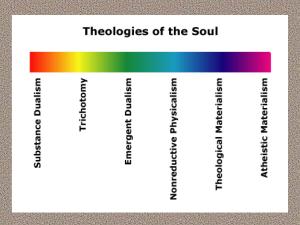
Theologies of the Soul. Table by Martinez Hewlett.
Atheistic Materialism
If we place substance dualism at one extreme end of a soul-talk spectrum, at the other extreme we place materialism. We’ll look briefly at two types of materialism, atheistic and religious.
Atheistic materialism dubs soul talk nonsense. Materialists answer to a number of different names such as naturalists, humanists, reductionists. The only reality is physical reality, say the materialists. No such thing as a spiritual substance exists. What we experience every day as mind or spirit is but an epiphenomenon of our brain’s activity. Here’s evolutionary biologist Jerry Coyne at the University of Chicago.
“There is, of course, no empirical evidence for either a soul or its unique presence in humans. It’s a superflous religious add-on to a scientific theory”(Coyne 133).
What we experience as a unity of consciousness or even rational thinking is only a byproduct of physicality. Materialists are confident that with enough research we will eventually be able to demonstrate that biological processes in the human brain exhaustively explain what happens in the human self or psyche. What we think of as soul activity can be reduced to biological activity. And human biology comes to us from the long history of evolution, not from God. Nature replaces God. So goes the argument of atheistic materialists.[1]
Can a Buddhist be an atheist and a materialist?

Buddha. China. Photo by Ted Peters
If we are Buddhists, we might want to place ourselves in the camp with the atheistic materialists. Metaphysically, Buddhists deny that there is such a thing as a human self. What we experience as our individual soul is a delusion.
The religious task for a Buddhist is to face the ultimate reality. And the ultimate reality is that we have no soul, no self (annata). What appears to be the person we think we are is actually only a heap of physical processes, physical processes that are finally hollow and empty of an inner essence.
Facing realistically the emptiness of inner essence would be a religious achievement for a Buddhist. Once we’ve faced this reality, we become released from the nexus of physical interactions. Then, what we took to be our inner self dissolves into the totality of reality. We experience nirvana.
Curiously, however, within Buddhism we also find the doctrine of reincarnation. On the one hand, Buddhists inherited from early Brahman pre-Hindus the concept of rebirth. The individual soul becomes reincarnated after death. On the other hand, Buddhists deny that such a thing as a spiritual substance transfers itself from one incarnation to the next. What Buddhism ends up with is a shambolic combination of substance dualism and atheistic materialism.
Christian theological materialism? Really?
Another variant still within the materialist camp is Christian theological materialism. Christian materialists find themselves quite at home with modern science. They are at home with biological reductionism, and quite at home with denying the existence of a separate soul substance. Eventually, we will see that everything that goes on in our minds can be explained by brain activity.
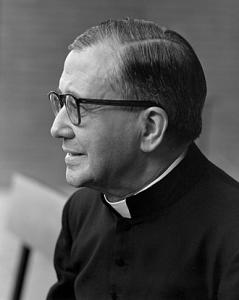
Christian materialism? Josemaria Escriva (1902-1975)
There’s a spirituality to Christian materialism, if this term does not cause confusion. Do you know Saint Josemaría Escrivá, (1902-1975), founder of Opus Dei? Escriva held that all temporal realities have a sanctifying power and Christians can find God in the most ordinary material things. Escriva complained that the Christian tradition had over-spiritualized things so that we’ve falsely come to believe we should remain aloof from the contemptible things of this world. Not so. Rather, we should highly value the material.
“Authentic Christianity which professes the resurrection of all flesh, has always quite logically opposed ‘dis-incarnation,’ without fear of being judged materialistic. We can, therefore, rightfully speak of a Christian materialism, which is boldly opposed to those materialisms which are blind to the spirit.”

Professor Nancey Murphy, Non-Reductive Physicalism.
For Escriva, Christian theological materialism is primarily a form of spirituality or way of living. But, what are the metaphysical implications? One implication is this: the afterlife requires resurrection of the body.
Perhaps the most erudite thinker on this topic is Christian philosopher Nancey Murpher at Fuller Seminary. Her position is called nonreductive physicalism. For a brief yet precise Closer to Truth interview that rejects sustance dualism in favor of resurection of the dead, see “Does a soul have an afterlife?”
Although Christian theological materialists can give up on the idea of a separate soul substance, they don’t give up on resurrection. They strongly emphasize that both Bible and tradition–tradition in the form of the Apostles’ and Nicene creeds–explicitly and unambiguously teach resurrection of the body, not immortality of the soul. No such thing as immortality is possible, say the materialists, unless God takes whatever action is necessary to raise the dead. If and when God takes such action, it will consist of raising the body. And the continuity of our identity in eternity will include bodily identity.
We will say more about resurrection of the body—the soma pneumatikon or spiritualized body—in future posts.
ST 4134. No soul? What do materialists say? Soul 4.
Where have we been? Where are we going?
Patheos ST 4131 Soul 1 Theologies of the Soul
Patheos ST 4132 Soul 2 Substance Dualism
Patheos ST 4133 Soul 3 Trichotomy
Patheos ST 4134 Soul 4 Materialisms
Patheos ST 4135 Soul 5 Emergent Dualism
Patheos ST 4136 Soul 6 Non-Reductive Physicalism
Patheos ST 4137 Soul 7 Bodily Resurrection
Patheos ST 4138 The Soul of Benedict XVI
Patheos ST 4139 Blessed Mother Olga of Alaska knitted mittens
Patheos ST 4140 Supporting Husbands in Theology
▓

Ted Peters
Ted Peters (Ph.D., University of Chicago) is a public theologian directing traffic at the intersection of science, religion, and ethics. Peters is an emeritus professor at the Graduate Theological Union, where he co-edits the journal, Theology and Science, on behalf of the Center for Theology and the Natural Sciences, in Berkeley, California, USA. He recently co-edited Astrobiology: Science, Ethics, and Public Policy (Scrivener 2021) as well as Astrotheology: Science and Theology Meet Extraterrestrial Intelligence (Cascade 2018). He also co-edited Religious Transhumanism and Its Critics (Lexington 2022) and The CRISPR Revolution in Science, Ethics, and Religion (Praeger 2023). Peters is author of Playing God: Genetic Determinism and Human Freedom (Routledge, 2nd ed, 2002) and The Stem Cell Debate (Fortress 2007). See his blogsite [https://www.patheos.com/blogs/publictheology/] and his website [TedsTimelyTake.com].
▓
Notes
[1] Many American atheists say that, despite their growing numbers in society, they often choose to hide their unbelief due to fear of social stigma, a recent study published by the University of Nebraska-Lincoln suggests.
Works Cited
Coyne, Jerry, 2015. Faith vs. Fact. New York: Viking.
Buddhism
History and Religion

About Ted Peters
Ted Peters (Ph.D., University of Chicago) is a public theologian directing traffic at the intersection of science, religion, and ethics. Peters is an emeritus professor at the Graduate Theological Union, where he co-edits the journal, Theology and Science, on behalf of the Center for Theology and the Natural Sciences, in Berkeley, California, USA. He recently co-edited Astrobiology: Science, Ethics, and Public Policy (Scrivener 2021) as well as Astrotheology: Science and Theology Meet Extraterrestrial Intelligence (Cascade 2018). He also co-edited Religious Transhumanism and Its Critics (Lexington 2022) and The CRISPR Revolution in Science, Ethics, and Religion (Praeger 2023). Peters is author of Playing God: Genetic Determinism and Human Freedom (Routledge, 2nd ed, 2002) and The Stem Cell Debate (Fortress 2007). See his blogsite [https://www.patheos.com/blogs/publictheology/] and his website [TedsTimelyTake.com]. You can read more about the author here.
Previous Post
March 1, 2024
Protecting Embryos in the Vatican, Abortion 2
Next Post

March 10, 2024 Emergent Dualism. Soul 5
Browse Our Archives
Select a Category Afterlife America in Crisis Ancient Alien Apocalypse Art Artificial Intelligence Astrobiology Astrotheology Atheism Big History Buddhist Catholic Christian Nationalism Christmas Comparative Theology Death Ecology Ethics ETI Evangelical Evolution Existential Questions Free Will General Christian Hermeneutics Hindu https://www.patheos.com/blogs/allsetfree/2020/12/sins-we-need-to-talk-about/?utm_source=Newsletter&utm_medium=email&utm_campaign=Christians+For+a+Better+Christianity&utm_content=43&lct Interreligious Islam Jewish Justice Latter-Day Saints Literature Literature and Theology Lutheran Methodism Mormonism Nonreligious ontology Orthodox Pagam Prayer progressive Christian PT 6 Dignity Public Theology Race racial justice Religious Liberty Romance Satan Scapegoat Science & Religion Science and Religion social justice Spirituality SR 8 Transhumanism Systematic Theology Taoism Ted Peters UAP UFO Uncategorized War
Select a Month September 2026 August 2026 July 2026 June 2026 May 2026 April 2026 March 2026 February 2026 December 2025 November 2025 October 2025 September 2025 August 2025 July 2025 June 2025 May 2025 April 2025 March 2025 February 2025 January 2025 December 2024 November 2024 October 2024 September 2024 August 2024 July 2024 June 2024 May 2024 April 2024 March 2024 February 2024 January 2024 December 2023 November 2023 October 2023 September 2023 August 2023 July 2023 June 2023 May 2023 April 2023 March 2023 February 2023 January 2023 December 2022 November 2022 October 2022 September 2022 August 2022 July 2022 June 2022 May 2022 April 2022 March 2022 February 2022 January 2022 December 2021 November 2021 October 2021 September 2021
Follow Us!
TAKE THE
Religious Wisdom Quiz
What Old Testament law was summarized as "love your neighbor as yourself"?
Select your answer to see how you score.
First five commandments Book of Leviticus only The whole law Only 10th commandment
Related posts from Public Theology

Why Public Theology Needs a Theology of Nature

America's 250th Birthday Gift: Civic Renewal

Do You Believe in UFOs? A Theologian's Answer.

Free Will and Christian Freedom TWO
TRENDING AT PATHEOS Progressive Christian

What Being a Modern-Day Apostle Means to Me
In my last column, I discussed the ins and outs of modern-day...

Did Ancient China Once Worship the God of...
Across human history, a common thread weaves through the origins of the...

Love Your Neighbor – Including Earth-Kin: Lev. 19,...
God’s command to love your neighbor means acting in an ethical and...

Lead a Church Study of “Jesus and Lao...
Guest writer Jack Thomas (The Irreverent Reverend) reflects on leading his church...

Pastoral Wisdom for Responding to Sermon Pushback
Getting sermon pushback on your social justice sermon? Learn practical, Proverbs-based strategies...

Principles for Understanding the Apostolic Ministry Today
Whenever people discover that my formal ministry title is "apostle," as in...
view all Progressive Christian blogs
Ad-Free & Subscriber Log-In Subscription Support
- About Us
- 2026 Calendar
- Videos
- Podcasts
- Library of World Religions
- Faith In Media Tracker
- Advertise With Us
- Write for Us
- Privacy Policy
- Terms of Service
- Do Not Sell My Data
- Contact Us
- Radiant Digital
- Manage Newsletter Subscriptions
- Unsubscribe From Notifications
- Sitemap
Copyright 2008-2026, Patheos. All rights reserved.
Subscription Support Ad-Free & Subscriber Log-In
Follow Patheos