
BuddhistCatholicContemplativeEvangelicalGeneral ChristianHinduJewishLatter-day SaintMuslimNew VisionsProgressive Christian
Beliefs
- Buddhist
- Catholic
- Contemplative
- Evangelical
- General Christian
- Hindu
- Jewish
- Latter-day Saint
- More Voices
- Muslim
- New Visions
- Pagan
- Progressive Christian
Topics
- Religion News
- Food and Religion
- Sports and Religion
- Religious Art
- Religious Music and Entertainment
- Religious Events
- History and Religion
- Style and Religion
- Politics and Religion
- Women in Religion
- Recreation Outdoors and Religion
- Business Finance and Religion
- Careers Workplace and Religion
- Education and Religion
- Family Parenting and Religion
- Health Fitness and Religion
- Home and Religion
- Relationships and Religion
- Technology and Religion
- Travel and Religion
Columnists
- Buddhist Columnists
- Business Finance and Religion Columnists
- Careers Workplace and Religion Columnists
- Catholic Columnists
- Contemplative Columnists
- Education and Religion Columnists
- Evangelists Columnists
- Family Parenting and Religion Columnists
- General Christian Columnists
- Health Fitness and Religion Columnists
- Hindu Columnists
- History and Religion Columnists
- Home and Religion Columnists
- Jewish Columnists
- More Voices Columnists
- Latter Day Columnists
- Muslim Columnists
- New Visions Columnists
- Nonreligious Columnists
- Pagan Columnists
- Politics and Religion Columnists
- Progressive Columnists
- Recreation Outdoors and Religion Columnists
- Relationships and Religion Columnists
- Religion News Columnists
- Religious Art Columnists
- Religious Events Columnists
- Religious Music and Entertainment Columnists
- Sports and Religion Columnists
- Style and Religion Columnists
- Technology and Religion Columnists
- Travel and Religion Columnists
- Women in Religion Columnists
Resource Library
- 2026 Calendar
- Library of World Religions
- The 100 Most Holy Places on Earth
- Patheos Answers
- Podcasts
- Videos
- Faith Leaders Database
- Anglican Episcopalian
- Bahai
- Baptist
- Buddhism
- Christianity
- Confucianism
- Eastern Orthodoxy
- Hinduism
- Holiness and Pentecostal
- ISKCON
- Islam
- Judaism
- Lutheran
- Methodist
- The Church of Jesus Christ of Latter-day Saints
- New Age
- Paganism
- Presbytarian and Reformed
- Protestantism
- Religion Behind the Scenes
- Roman Catholic
- Scientology
- Shia Islam
- Sikhism
- Sufism
- Sunni Islam
- Taoism
- Zen
- See all religions
Research Tools
 Ad-Free & Subscriber Log-In Subscription Support
Ad-Free & Subscriber Log-In Subscription Support
Follow Patheos 

- Trending:
- Forgiveness
- |
- Marriage
- |
- Consciousness
- |
- Death Penalty
- |
- Election
- |
- Halloween

- Home
- Progressive Christian
- Women in Religion
- Sin-Talk and Grace-Talk
Sin-Talk and Grace-Talk
Last updated on: December 3, 2023 at 12:41 pm by Ted Peters
Sin-Talk and Grace-Talk 2023-12-03T12:41:26-08:00 Ted Peters
Patheos Explore the world's faith through different perspectives on religion and spirituality! Patheos has the views of the prevalent religions and spiritualities of the world.
Sin-Talk and Grace-Talk in the Grammar of Faith
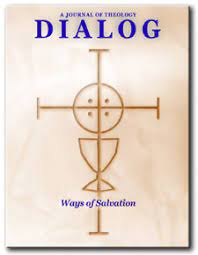
Dialog, A Journal of Theology, takes up Sin-Talk and Grace-Talk (Fall 2023)
Sin-Talk and Grace-Talk come together in a single grammar of faith. So, what’s the problem? The problem seems to be that sin-talk squashes self-worth.
Our family friend, Sharon, says repeatedly: “I don’t want to feel like I’m a worthless worm.” She reports that her childhood church experience emphasized that we sinful human beings should feel like worms over against the Almighty God. She experienced shame due to sin-talk. Now, as a grown-up, she wants to escape the worm self-understanding. “Stop talking so much about sin,” she says.
“Sin. Just the word is heavy. Like a brick. Especially when someone throws it at your head.” That’s the complaint of Patheos columnist Susan Cottrell.
But, I ask: why does sin-talk fill the room with spiritual miasma? If we are genuinely loved by the God who made heaven and earth, then we should feel affirmed, important, saved. “For God so loved the world,” we read in John 3:16, that God deigned to become one of us. Incarnation is affirmation. Does theological sin-talk nullify God’s affirmation of us?
No, I don’t think so. At least when sin-talk and grace-talk come together in the same grammatical package. Sin-talk without grace-talk makes us feel like worthless worms. Can we keep them together in a single grammar of faith?
Lions, not worms!
When it comes to sin-talk and grace-talk, theologians can learn a great deal from elementary school teachers. What our teachers have discovered is the liberal principle. To be liberal means to liberate the potential in each child so that it can become actualized. That’s the heart of liberal education.

Lucy and Aslan in Narnia
The equivalent of sin-talk without grace-talk in the first grade would be to tell incoming children they are weak, ignorant, and incompetent. But teachers do not do this. Teachers have learned that such criticism only represses a child’s sense of self-worth. And lack of self-worth blocks the learning process.
So, teachers routinely encourage young children by affirming their potential. “You can do it!” exclaims the teacher with a vigorous smile. This motivates. It works. Children learn. And they gain a sense of pride when they learn.
Worms become lions in the first grade. What can the theologian or pastor learn from this?
Evangelicals love to talk about sin-talk.
“Evangelicals love to talk about whether other people are talking about sin enough. It’s one of the litmus tests with which we evaluate preachers….Are they willing to throw in a few references to Satan?” This is the complaint of progressive Patheos columnist Morgan Guyton. Rather than talk about talking about sin, Guyton asks us to confess our own sin.
The word, sin-talk, is not a monosemy. Sin-talk is a polysemic term. So, confessing sin can get tricky in at least two ways. One way is to confess someone else’s sin in order to blame them. We all see this in political rhetoric. I call it self-justification and scapegoating.
The other way is to confess someone else’s sin and blame ourselves. This leads us to examine women’s experience.
Sin-Talk and Grace-Talk in Women’s Experience

Professor Marcia Blasi
When girls or women find themselves victimized in an abusive home, they easily feel shame. Even though the abuse is not their fault, girls or women may feel it is they who fail to measure up. They wonder if they are responsible for the abuse. Sin-talk without grace-talk at church may only reinforce a shameful self-definition.
Lutheran theologians ascribe to themselves a sense of pastoral urgency to confront this unnecessary self-deprecation in women’s experience. How can we preach the gospel of Jesus Christ so it is heard as good news?
Marcia Blasi, who teaches Feminist Theology at Faculdades Escola Superior de Teologia, in São Leopoldo, Brazil, sees dangers in conventional sin-talk without grace-talk. For women who suffer abuse at home, sin-talk prompts feelings of shame. Then in church to be told you’re a sinner exacerbates the feeling that one is not good enough. The victim gets tricked into feeling responsible for someone else’s sin.
“In my understanding, a Lutheran perspective is different. When a woman victimized by violence seeks help she should hear, ‘You are welcome here. You are saved by the grace of God; you are not responsible for the behavior of others. You don’t need to suffer to get God’s love’” (Blasi 2023, 286).
Sin-talk and grace-talk need to form a single grammar of faith. What is the meaning of grace in this grammar?
“So, what is grace for women? It’s to hear that you are loved as you are. You don’t need to be perfect, and you are doing a lot. You are also forgiven for not taking care of yourself. You are forgiven of not loving or not having time to yourself, of not doing things for you” (Blasi 2023, 287).

Our choir’s variant of “A Mighty Fortress” brought new meaning to Martin Luther’s admonition to sin boldly: “Let goods and kindred go, this moral life also…” p.76.
The grammar of faith first makes clear that one is not guilty of somebody else’s sin. It is not the fault of the wife when she’s beaten by her husband.
When it comes to our own sin, the grammar of faith assures us that by God’s grace we are forgiven and liberated from the shame of not measuring up. In theological language this means we are justified by God’s grace, not by our measuring up. “Justification by faith by grace is a free gift,” exclaims Reformation scholar Kirsi Stjerna (Stjerna 2021, 181).
Lutherans have no patent on the grammar of grace in faith. Here is Reformed theologian Karl Barth.
“Pardon–by God and therefore unconditionally pronounced and unconditionally valid–that is [hu]man’s justification” (Barth 1936-1962, IV/1: §61: 568).
Justifying faith provides boldness. Like filling the fuel tanks of a Bowing 747 with jet fuel, a faith-filled soul takes off and flies high.
The Lutheran Grammar of Faith on Sin-Talk and Grace-Talk
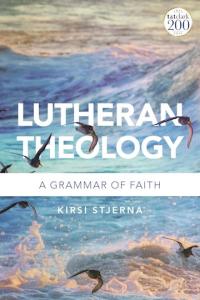
Kirsi Stjerna, Lutheran Theology. Sin-Talk and Grace-Talk within the grammar of faith.
My Berkeley colleague Kirsi Stjerna develops a grammar of faith language, including sin-talk and grace-talk. Take a look at her fine book, Lutheran Theology: A Grammar of Faith.
“Lutheran faith language offers a grace-centered and God-grounded approach to reality and a theological foundation for life where freedom is of utmost value” (Stjerna 2021, 66).
Grace yields freedom, touts Stjerna. Paradoxically, to be humbled by being declared a forgiven sinner yields a strong sense of self-worth and the initiative to live in liberty. Here’s Luther on unconditional grace.
“No human being can be thoroughly humbled until knowing that one’s salvation is utterly beyond one’s own powers, devices, endeavors, will, and works, and depends entirely on the choice, will, and work of another, namely, of God” (Luther 2016-2019, 1: 178).
God’s gracious gift of justification liberates the self to affirm itself as free. “For freedom Christ has set us free,” trumpets St. Paul (Galatians 5:1a). Sin-talk and grace-talk belong together in a single grammar of faith, I think (Peters 2015).
From Sin-Talk and Grace-Talk to Self-Worth
For pastoral reasons, sin-talk and grace-talk together should inspire a sense of self-worth. Not the opposite. The grammar of sin-talk and grace-talk should imbue the church’s language, at least according to Arnfríður Guðmundsdóttir, a University of Iceland systematic theologian.
“I believe Luther’s understanding of sin as misplaced trust, the distinction he makes between sin and sins, and his idea of a justified sinner can indeed make a significant contribution to a hopeful sin-talk within Christian communities today, when approached from a pastoral perspective” (Guðmundsdóttir 2023, 283).
The preacher has more responsibility than merely getting the doctrine right. There is a pastoral responsibility – that is, the preacher must try to speak with a grammar of faith that the forgiven sinner hears as an affirmation of divinely imputed self-worth.
There is more to sin-talk and grace-talk than self-worth.
Lutheran pundit and public theologian Nadia Bolz Weber says she actually likes to talk about sin. But honest sin-talk may be more difficult than is commonly realized. There is so much more to sin-talk than is requisite to enhance your or my sense of self-worth.

Lutheran pundit and public theologian Nadia Bolz Weber
“When sin is boiled down to low self esteem and immorality then it becomes something we can control or limit in some way rather than something we are bondage to. The reality is that I cannot free myself from the bondage of self. I cannot keep from being turned in on self. I cannot by my own understanding or effort disentangle myself from my self interest and when I think that I can …I am trying to do what is only God’s to do.
To me, there is actually great hope in admitting my mortality and brokenness because then I finally lay aside my sin management program and allow God to be God for me. Which is all any of us really need when it comes down to it.”
In short, for Nadia, sin-talk and grace-talk belong indispensibly to the one grammer of faith.
The Life of Beatitude
 Sin-talk can lead to repentence, to metanoia, argues Lutheran climate justice theologian Cynthia Moe-Lobeda (Moe-Lobeda, 2023). Grace-talk is also transformative. “Grace reorders the self and his or her relation to all other objects of love,” observes Roman Catholic theologian Stephen Pope (Pope 2007, 236). The graced person of faith loves and loves freely.
Faith’s grammar in sin-talk and grace-talk makes one thing unmistakably clear: because God justifies us, we don’t have to. Our salvation is like a Christmas present: all we need to do is open it up and make it our own. Then, of course, enjoy playing with it by loving ourselves, God, and our neighbors.
Playing with God’s gift befits the Life of Beatitude. God’s pardon becomes present in faith. God’s justification becomes present in faith. God’s promised future symbolized by new creation or the kingdom of God becomes present in faith. And faith expresses itself in beatitudinal living. “Blessed are those who hunger and thirst for justice,” says Jesus; “for they will be filled” (Matthew 5:6).
Conclusion
Yes, sin-talk should prompt confession repentance, and resolve. Grace-talk in addition should turn a worm into a liberated lion. If we have ears to hear it, that’s the grammar of faith.
This post is Patheos ST 2161. SIN 11. Sin-Talk and Grace-Talk
Here are other entries in this Patheos series on sin.
SIN 7 The true story of Satanic Panic
SIN 8 How can Satan cast out Satan?
SIN 9 Ted’s Tips on Satan and Demons
▓

Ted Peters
For Patheos, Ted Peters posts articles and notices in the field of Public Theology. He is a Lutheran pastor and emeritus professor at the Graduate Theological Union. He edited Dialog, A Journal of Theology, from 1993-2007. Today he co-edits the journal, Theology and Science, with Robert John Russell on behalf of the Center for Theology and the Natural Sciences, in Berkeley, California, USA. His single volume systematic theology, God—The World’s Future, is now in the 3rd edition. He has also authored God as Trinity plus Sin: Radical Evil in Soul and Society as well as Sin Boldly: Justifying Faith for Fragile and Broken Souls. See his website: TedsTimelyTake.com. His new 2023 book, The Voice of Public Theology, has just been published by ATF Press.
▓
References
Barth, Karl. 1936-1962. Church Dogmatics, 4 Volumes. Edinburgh: T&T Clark.
Blasi, Marcia, and Marit Trelsted. 2023. “A Cross-cultural conversation about sin and shame with Marcia Blasi and Marit Trelsted.” Dialog 62; 285-290 DOI: 10.1111/dial.12825.
Guðmundsdóttir, Arnfríður. 2023. “Why talk about sin? Luther’s understandingof sin and hopeful sin-talk in the 21st century.” Dialog 62: 277-284 DOI: 10.1111/dial.12822.
Luther, Martin. 2016-2019. The Bondage of the Will (1525) / The Annotated Luther, 6 Volumes. Minneapolis MN: Fortress Press.
Moe-Lobeda, Cynthia. 2023. “Paradox explored: Climate shame, moral agency, the church, and the birds.” Dialog 62: 244-252 doi.org/10.1111/dial.12818.
Peters, Ted. 2015. Sin Boldly! Minneapolis MN: Fortress Press.
Pope, Stephen. 2007. Human Evolution and Christian Ethics. Cambridge UK: Cambridge University Press.
Sevig, Julie B., 2007. Laughing with Lutherans. Bloomington MN: Skandisk.
Stjerna, Kirsi. 2021. Lutheran Theology: A Grammar of Faith. Edeinburgh: T & T Clark.
Women in Religion

About Ted Peters
For Patheos, Ted Peters posts articles and notices in the field of Public Theology. He is a Lutheran pastor and emeritus professor at the Graduate Theological Union. He edited Dialog, A Journal of Theology, from 1993-2007. Today he co-edits the journal, Theology and Science, with Robert John Russell on behalf of the Center for Theology and the Natural Sciences, in Berkeley, California, USA. His single volume systematic theology, God—The World’s Future, is now in the 3rd edition. He has also authored God as Trinity plus Sin: Radical Evil in Soul and Society as well as Sin Boldly: Justifying Faith for Fragile and Broken Souls. See his website: TedsTimelyTake.com. His new 2023 book, The Voice of Public Theology, has just been published by ATF Press. You can read more about the author here.
Previous Post

November 27, 2023
Evangelicals Against Christian Nationalism
Next Post

December 16, 2023 No! No! UFO
Browse Our Archives
Select a Category Afterlife America in Crisis Ancient Alien Apocalypse Art Artificial Intelligence Astrobiology Astrotheology Atheism Big History Buddhist Catholic Christian Nationalism Christmas Comparative Theology Death Ecology Ethics ETI Evangelical Evolution Existential Questions Free Will General Christian Hermeneutics Hindu https://www.patheos.com/blogs/allsetfree/2020/12/sins-we-need-to-talk-about/?utm_source=Newsletter&utm_medium=email&utm_campaign=Christians+For+a+Better+Christianity&utm_content=43&lct Interreligious Islam Jewish Justice Latter-Day Saints Literature Literature and Theology Lutheran Methodism Mormonism Nonreligious ontology Orthodox Pagam Prayer progressive Christian PT 6 Dignity Public Theology Race racial justice Religious Liberty Romance Satan Scapegoat Science & Religion Science and Religion social justice Spirituality SR 8 Transhumanism Systematic Theology Taoism Ted Peters UAP UFO Uncategorized War
Select a Month September 2026 August 2026 July 2026 June 2026 May 2026 April 2026 March 2026 February 2026 December 2025 November 2025 October 2025 September 2025 August 2025 July 2025 June 2025 May 2025 April 2025 March 2025 February 2025 January 2025 December 2024 November 2024 October 2024 September 2024 August 2024 July 2024 June 2024 May 2024 April 2024 March 2024 February 2024 January 2024 December 2023 November 2023 October 2023 September 2023 August 2023 July 2023 June 2023 May 2023 April 2023 March 2023 February 2023 January 2023 December 2022 November 2022 October 2022 September 2022 August 2022 July 2022 June 2022 May 2022 April 2022 March 2022 February 2022 January 2022 December 2021 November 2021 October 2021 September 2021
Follow Us!
TAKE THE
Religious Wisdom Quiz
I was fed by ravens at a brook and later by a widow whose oil and flour never ran out. Who am I?
Select your answer to see how you score.
Elisha Moses Elijah Samuel
Related posts from Public Theology

Why Public Theology Needs a Theology of Nature

America's 250th Birthday Gift: Civic Renewal

Do You Believe in UFOs? A Theologian's Answer.

Free Will and Christian Freedom TWO
TRENDING AT PATHEOS Progressive Christian

Why Christians Have a Sacred Duty to Vote:...
The Bible offers strong support for the sacred duty to vote. Here...

What Being a Modern-Day Apostle Means to Me
In my last column, I discussed the ins and outs of modern-day...

Did Ancient China Once Worship the God of...
Across human history, a common thread weaves through the origins of the...

Love Your Neighbor – Including Earth-Kin: Lev. 19,...
God’s command to love your neighbor means acting in an ethical and...

Lead a Church Study of “Jesus and Lao...
Guest writer Jack Thomas (The Irreverent Reverend) reflects on leading his church...

Principles for Understanding the Apostolic Ministry Today
Whenever people discover that my formal ministry title is "apostle," as in...
view all Progressive Christian blogs
Ad-Free & Subscriber Log-In Subscription Support
- About Us
- 2026 Calendar
- Videos
- Podcasts
- Library of World Religions
- Faith In Media Tracker
- Advertise With Us
- Write for Us
- Privacy Policy
- Terms of Service
- Do Not Sell My Data
- Contact Us
- Radiant Digital
- Manage Newsletter Subscriptions
- Unsubscribe From Notifications
- Sitemap
Copyright 2008-2026, Patheos. All rights reserved.
Subscription Support Ad-Free & Subscriber Log-In
Follow Patheos