
BuddhistCatholicContemplativeEvangelicalGeneral ChristianHinduJewishLatter-day SaintMuslimNew VisionsProgressive Christian
Beliefs
- Buddhist
- Catholic
- Contemplative
- Evangelical
- General Christian
- Hindu
- Jewish
- Latter-day Saint
- More Voices
- Muslim
- New Visions
- Pagan
- Progressive Christian
Topics
- Religion News
- Food and Religion
- Sports and Religion
- Religious Art
- Religious Music and Entertainment
- Religious Events
- History and Religion
- Style and Religion
- Politics and Religion
- Women in Religion
- Recreation Outdoors and Religion
- Business Finance and Religion
- Careers Workplace and Religion
- Education and Religion
- Family Parenting and Religion
- Health Fitness and Religion
- Home and Religion
- Relationships and Religion
- Technology and Religion
- Travel and Religion
Columnists
- Buddhist Columnists
- Business Finance and Religion Columnists
- Careers Workplace and Religion Columnists
- Catholic Columnists
- Contemplative Columnists
- Education and Religion Columnists
- Evangelists Columnists
- Family Parenting and Religion Columnists
- General Christian Columnists
- Health Fitness and Religion Columnists
- Hindu Columnists
- History and Religion Columnists
- Home and Religion Columnists
- Jewish Columnists
- More Voices Columnists
- Latter Day Columnists
- Muslim Columnists
- New Visions Columnists
- Nonreligious Columnists
- Pagan Columnists
- Politics and Religion Columnists
- Progressive Columnists
- Recreation Outdoors and Religion Columnists
- Relationships and Religion Columnists
- Religion News Columnists
- Religious Art Columnists
- Religious Events Columnists
- Religious Music and Entertainment Columnists
- Sports and Religion Columnists
- Style and Religion Columnists
- Technology and Religion Columnists
- Travel and Religion Columnists
- Women in Religion Columnists
Resource Library
- 2026 Calendar
- Library of World Religions
- The 100 Most Holy Places on Earth
- Patheos Answers
- Podcasts
- Videos
- Faith Leaders Database
- Anglican Episcopalian
- Bahai
- Baptist
- Buddhism
- Christianity
- Confucianism
- Eastern Orthodoxy
- Hinduism
- Holiness and Pentecostal
- ISKCON
- Islam
- Judaism
- Lutheran
- Methodist
- The Church of Jesus Christ of Latter-day Saints
- New Age
- Paganism
- Presbytarian and Reformed
- Protestantism
- Religion Behind the Scenes
- Roman Catholic
- Scientology
- Shia Islam
- Sikhism
- Sufism
- Sunni Islam
- Taoism
- Zen
- See all religions
Research Tools
 Ad-Free & Subscriber Log-In Subscription Support
Ad-Free & Subscriber Log-In Subscription Support
Follow Patheos 

- Trending:
- Forgiveness
- |
- Marriage
- |
- Consciousness
- |
- Death Penalty
- |
- Election
- |
- Halloween

- Home
- Progressive Christian
- Technology and Religion
- Buddhism and Science on Our Mind
Buddhism and Science on Our Mind
Last updated on: June 25, 2023 at 6:41 pm by Ted Peters
Buddhism and Science on Our Mind 2023-06-25T18:41:14-07:00 Ted Peters
Patheos Explore the world's faith through different perspectives on religion and spirituality! Patheos has the views of the prevalent religions and spiritualities of the world.
Buddhism and Science on Our Mind

Buddhism and Science on Mind
SR 1017
Buddhism and science on our mind. Are these three–Buddhism, science, mind–connected? Yes, if you’re a Buddhist. The Buddhist studies the mind with empirical methods and with the same impartial objectivity that modern science employs in the study of nature. But there’s a barrier blocking the road to dialogue between Buddhism and science.
What’s the barrier preventing Buddhism and science from engaging in dialogue?
In a previous post on Vedic Science, we saw that the most formidable barrier to dialogue between Hinduism and science is neither Hinduism nor science. The highest hurdle to jump is the doctrine of cultural particularism promulgated by postmodern and postcolonial philosophers. This is the complaint raised also by Buddhist scholar, B. Alan Wallace, founder of the Santa Barbara Institute for Consciousness Studies.
Postmodern and postcolonial philosophy tout “cultural particularism which asserts that different societies are culturally unique, incommensurable, and hence fundamentally unknowable by outsiders.”
Wallace objects to cultural particularism. Why? Because cultural particularism situates knowledge within its original context, denying any contextualized knowledge the right to claim universality. This doctrine of situated knowledge imprisons the intellectual insights of India to an Asian social context.
“This would imply that developed schools of Buddhism are culturally unique to the Asian societies in which they developed; therefore their theories and methods of inquiry cannot be compared to those of science” (Wallace, 2003, pp. 20-21).
In short, according to postcolonial and postmodern thought, no one living in a non-Asian context should consider the universal value of the Buddhist epistemé. Really? Such a maxim would prevent any serious dialogue between Buddhism and science. Ugh!
For the sake of discussion, let’s bracket out the doctrine of cultural particularism and proceed as if both science and Buddhism rightfully make universal claims. Let’s further assume that human minds in every cultural context share enough in common to be studied by a Buddhist scientist at work.
Buddhism and Science in Dialogue
Buddhism, better than other religious traditions, is ready to engage in dialogue with the natural sciences. Why? Well, because Buddhism is not really a religion. Rather, Buddhism is a kinda natural philosophy, sorta like science in its early stages. At least this is what Alan Wallace thinks.
“Buddhism does not define itself as a religion or as a science, and traditionally it has made no distinction between religious truths and scientific truths….Buddhism may be viewed as a form of natural philosophy” (Wallace, 2003, pp. 26-27).
Wallace wants to cancel Buddhism’s membership in the World Religions club.
Would declaring Buddhism to be a non-religion make scientists like Buddhists better? I don’t think so. A difference remains. What distinguishes Buddhist natural philosophy from Europe’s natural sciences is the subject matter of investigation and the methods of investigation.
What is Science?
Let’s ask NASA to define science.
“Science consists of observing the world by watching, listening, observing, and recording. Science is curiosity in thoughtful action about the world and how it behaves.”

Rene Descartes portrait by Franz Hals.
The “world” scientists observe is the extended world of things and objects and processes. When the father of modernity, René Descartes (1596-1650), formulated the modern method for obtaining knowledge, he distinguished sharply between objectivity and subjectivity. To the sciences Descartes and his progeny assigned the world of objectivity to be studied rationally and empirically. To the humanities Descartes and his progeny assigned subjectivity. Within the domain of subjectivity belong religion, ethics, art, music, and history. Just check your local university catalog to see how Cartesian Western intellectual life remains in effect.
Where does Buddhism fit? Well, to date Westerners study Buddhism in the humanities along with other religions. But will a Buddhist accept being consigned to the non-scientific or subjective side of the Cartesian divide?
No. At least according to His Holiness the Dalai Lama. But, it’s complicated.
What is Buddhism?

Dalai Lama on Buddhism and Science
The heart and center of Buddhist practice, the Dalai Lama tells us, is training the mind. “The Buddha said that if one trains the mind there is joy, and if the mind is undisciplined there is suffering” (Dalai Lama, 2003, p. 93).
Transforming the mind through training leads to nirvana. “If the mind is not subdued, there is saṃsāra, and if the mind is subdued, there is nirvana.” (Dalai Lama, 2003, p. 92).
So it appears that Buddhist mind training takes place solely within the domain of human subjectivity, within consciousness. This means–at least to all the Western European Cartesians among us–that Buddhism remains on the religious or subjective side of the divide.
The Mind of the Dalai Lama
Not so! At least according to the Dalai Lama. Why? Because the mind must subordinate itself rigorously to objective knowledge that rectifies misperceptions and prejudice.
“The mind is transformed when one ascertains and thoroughly acquaints oneself with fresh insights into the nature of reality, thoroughly acquaints oneself with fresh insights into the nature of reality that invalidates one’s previous misconceptions or false assumptions” (Dalai Lama, 2003, p. 96).
Is His Holiness telling us that our subjective mind should be transformed by objective knowledge? If so, would this render Buddhist mindfulness scientific? Yes, would be the Dalai Lama’s answer.
“In the course of scientific exploration and research one must also be objective … One’s research must be guided by the empirical findings themselves. The same is true in Buddhism: one must be objective…” (Dalai Lama, 2003, p. 103)
Buddhism and Science in Dialogue on Our Mind
Yes, would also be the answer of Trinh Xuan Than, a professor of astronomy at the University of Virginia.
“Buddhism is also a form of science, albeit a science of the mind. It is a contemplative science in which the mind investigates the mind” (Than, 2008, p. 31).
Than believes this readies Buddhism for fruitful dialogue with objective science.
“Can there be a basis for a dialogue between science and Buddhism? The answer is an unequivocal yes. A closer look reveals that Buddhism, just like science, relies also on the experiential method to find out about reality” (Than, 2008, p. 34).
The Buddhist looks at our mind from the inside out, from subjectivity learning from objectivity. The so-called Western scientist looks at the brain from the outside in, objectively with no interest in subjectivity.
Is there a self behind the mind?
When post-Cartesian Western scientists study the mind—actually they study the brain–, they employ objective tools and measures. They study our mental activity objectively, from a third person disinterested perspective. This method has left those of us with active interiority bereft of first person understanding. We are told by our reductionist friends that our mind is nothing more than an epiphenomenon produced by the neural activity of the brain. I’ve attempted to draw out the implications of scientizing of the mind in a series of Patheos 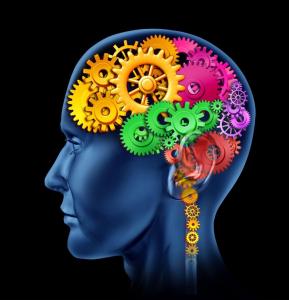 posts.
Did I lose my conscious mind to science?
Did I lose my free will to science?
Did I lose my self to my brain?
What I discovered is that laboratory brain researchers—the actual scientists–simply want to know how the brain works. Neurophilosophers who interpret the science, however, want us to believe that only the brain exists. Does this belief look at all like the Buddhist notion of non-self or anatta?[1]
Ann Harrington, a Harvard professor, has tried to open a gate between Tibetan Buddhist thinking about mind and the Western cognitive sciences. Even so, I still have methodlogical questions regarding the relationship of subjectivity to objectivity.
When Buddhists study the mind, they enter their subjective interior with disciplined self-reflection. On the one hand, whether disciplined or not, Buddhist meditation remains on the subjective side of the subject-object split. On the other hand, Buddhists import critical self-reflection to the extent that the very self engaged in the reflection disappears into the non-self. Does this match the disinterested objectivity of Western scientific methods?
Neurophilosophers—not brain researchers—assume that there is no self behind the mind. Buddhists want us to discover this same truth. Neurophilosophers assume what Buddhists want each of us to discover for ourselves.
Now, did I get that right?
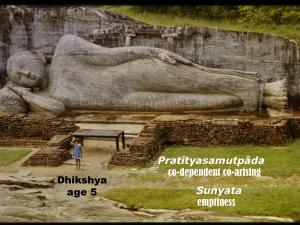
Buddha in repose. Diksha, age 5. Sri Lanka.
Conclusion
The triumph of Western science since the European Enlightenment is found in its prodigious production of new knowledge about our physical world. We can only sit back in awe and applaud our heroes of science.
Yet, we dare not make the mistake of thinking that scientific knowledge is exhaustive or complete. The entire realm of subjectivity replete with the mystery of consciousness remains nearly unexplored territory in the West.
Perhaps there are treasures in the Buddhist tradition that could intrigue if not enrich us non-Buddhists.
▓

Ted Peters
Ted Peters (Ph.D., University of Chicago) is a public theologian directing traffic at the intersection of science, religion, and ethics. Peters is an emeritus professor at the Graduate Theological Union, where he co-edits the journal, Theology and Science, on behalf of the Center for Theology and the Natural Sciences, in Berkeley, California, USA. He recently co-edited Astrobiology: Science, Ethics, and Public Policy (Scrivener 2021) as well as Astrotheology: Science and Theology Meet Extraterrestrial Intelligence (Cascade 2018). He also co-edited Religious Transhumanism and Its Critics (Lexington 2022) and The CRISPR Revolution in Science, Ethics, and Religion (Praeger 2023). Peters is author of Playing God: Genetic Determinism and Human Freedom (Routledge, 2nd ed, 2002) and The Stem Cell Debate (Fortress 2007). See his blogsite [https://www.patheos.com/blogs/publictheology/] and his website [TedsTimelyTake.com].
▓
Notes
[1] “Upon enlightenment, the ascription of intentionality dissolves in the face of a direct perception of the lack of reality of the intending ‘self’” (Gold, 2012, p. 526).
Works Cited
Dalai Lama, 2003. Understanding and Transforming the Mind. In: B. A. Wallace, ed. Buddhism and Science. New York: Columbia University Press, pp. 91-106.
Gold, J., 2012. Does the Buddha Have a Theory of Mind?. In: G. R. P. a. M. L. S. James W. Haag, ed. The Routledge Companion to Religion and Science. London: Routledge, pp. 520-528.
Than, T. X., 2008. Science and Buddhism: Two Complementary Modes of Knowledge. In: P. D. Numrich, ed. The Boundaries of Knowledge in Buddhism, Christianity, and Science. Göttingen: Vandenhoeck & Ruprecht, pp. 22-43.
Wallace, A., 2003. Introduction. In: B. A. Wallace, ed. Buddhism and Science. New York: Columbia University Press, pp. 1-29.
Buddhism
Technology and Religion

About Ted Peters
Ted Peters (Ph.D., University of Chicago) is a public theologian directing traffic at the intersection of science, religion, and ethics. Peters is an emeritus professor at the Graduate Theological Union, where he co-edits the journal, Theology and Science, on behalf of the Center for Theology and the Natural Sciences, in Berkeley, California, USA. He recently co-edited Astrobiology: Science, Ethics, and Public Policy (Scrivener 2021) as well as Astrotheology: Science and Theology Meet Extraterrestrial Intelligence (Cascade 2018). He also co-edited Religious Transhumanism and Its Critics (Lexington 2022) and The CRISPR Revolution in Science, Ethics, and Religion (Praeger 2023). Peters is author of Playing God: Genetic Determinism and Human Freedom (Routledge, 2nd ed, 2002) and The Stem Cell Debate (Fortress 2007). See his blogsite [https://www.patheos.com/blogs/publictheology/] and his website [TedsTimelyTake.com]. You can read more about the author here.
Previous Post

June 19, 2023
The proleptic power of new creation. Miracles 7
Next Post

June 29, 2023 UFO Whistleblowing
Browse Our Archives
Select a Category Afterlife America in Crisis Ancient Alien Apocalypse Art Artificial Intelligence Astrobiology Astrotheology Atheism Big History Buddhist Catholic Christian Nationalism Christmas Comparative Theology Death Ecology Ethics ETI Evangelical Evolution Existential Questions Free Will General Christian Hermeneutics Hindu https://www.patheos.com/blogs/allsetfree/2020/12/sins-we-need-to-talk-about/?utm_source=Newsletter&utm_medium=email&utm_campaign=Christians+For+a+Better+Christianity&utm_content=43&lct Interreligious Islam Jewish Justice Latter-Day Saints Literature Literature and Theology Lutheran Methodism Mormonism Nonreligious ontology Orthodox Pagam Prayer progressive Christian PT 6 Dignity Public Theology Race racial justice Religious Liberty Romance Satan Scapegoat Science & Religion Science and Religion social justice Spirituality SR 8 Transhumanism Systematic Theology Taoism Ted Peters UAP UFO Uncategorized War
Select a Month September 2026 August 2026 July 2026 June 2026 May 2026 April 2026 March 2026 February 2026 December 2025 November 2025 October 2025 September 2025 August 2025 July 2025 June 2025 May 2025 April 2025 March 2025 February 2025 January 2025 December 2024 November 2024 October 2024 September 2024 August 2024 July 2024 June 2024 May 2024 April 2024 March 2024 February 2024 January 2024 December 2023 November 2023 October 2023 September 2023 August 2023 July 2023 June 2023 May 2023 April 2023 March 2023 February 2023 January 2023 December 2022 November 2022 October 2022 September 2022 August 2022 July 2022 June 2022 May 2022 April 2022 March 2022 February 2022 January 2022 December 2021 November 2021 October 2021 September 2021
Follow Us!
TAKE THE
Religious Wisdom Quiz
Which Christian denomination emphasizes adult baptism over infant baptism?
Select your answer to see how you score.
Lutheran Catholic Methodist Baptist
Related posts from Public Theology

Why Public Theology Needs a Theology of Nature

Free Will and Christian Freedom TWO

Quantum Consciousness Theology: Response to Keith Giles

TRENDING AT PATHEOS Progressive Christian

What Being a Modern-Day Apostle Means to Me
In my last column, I discussed the ins and outs of modern-day...

Did Ancient China Once Worship the God of...
Across human history, a common thread weaves through the origins of the...

Love Your Neighbor – Including Earth-Kin: Lev. 19,...
God’s command to love your neighbor means acting in an ethical and...

Lead a Church Study of “Jesus and Lao...
Guest writer Jack Thomas (The Irreverent Reverend) reflects on leading his church...

Pastoral Wisdom for Responding to Sermon Pushback
Getting sermon pushback on your social justice sermon? Learn practical, Proverbs-based strategies...

Principles for Understanding the Apostolic Ministry Today
Whenever people discover that my formal ministry title is "apostle," as in...
view all Progressive Christian blogs
Ad-Free & Subscriber Log-In Subscription Support
- About Us
- 2026 Calendar
- Videos
- Podcasts
- Library of World Religions
- Faith In Media Tracker
- Advertise With Us
- Write for Us
- Privacy Policy
- Terms of Service
- Do Not Sell My Data
- Contact Us
- Radiant Digital
- Manage Newsletter Subscriptions
- Unsubscribe From Notifications
- Sitemap
Copyright 2008-2026, Patheos. All rights reserved.
Subscription Support Ad-Free & Subscriber Log-In
Follow Patheos