
BuddhistCatholicContemplativeEvangelicalGeneral ChristianHinduJewishLatter-day SaintMuslimNew VisionsProgressive Christian
Beliefs
- Buddhist
- Catholic
- Contemplative
- Evangelical
- General Christian
- Hindu
- Jewish
- Latter-day Saint
- More Voices
- Muslim
- New Visions
- Pagan
- Progressive Christian
Topics
- Religion News
- Food and Religion
- Sports and Religion
- Religious Art
- Religious Music and Entertainment
- Religious Events
- History and Religion
- Style and Religion
- Politics and Religion
- Women in Religion
- Recreation Outdoors and Religion
- Business Finance and Religion
- Careers Workplace and Religion
- Education and Religion
- Family Parenting and Religion
- Health Fitness and Religion
- Home and Religion
- Relationships and Religion
- Technology and Religion
- Travel and Religion
Columnists
- Buddhist Columnists
- Business Finance and Religion Columnists
- Careers Workplace and Religion Columnists
- Catholic Columnists
- Contemplative Columnists
- Education and Religion Columnists
- Evangelists Columnists
- Family Parenting and Religion Columnists
- General Christian Columnists
- Health Fitness and Religion Columnists
- Hindu Columnists
- History and Religion Columnists
- Home and Religion Columnists
- Jewish Columnists
- More Voices Columnists
- Latter Day Columnists
- Muslim Columnists
- New Visions Columnists
- Nonreligious Columnists
- Pagan Columnists
- Politics and Religion Columnists
- Progressive Columnists
- Recreation Outdoors and Religion Columnists
- Relationships and Religion Columnists
- Religion News Columnists
- Religious Art Columnists
- Religious Events Columnists
- Religious Music and Entertainment Columnists
- Sports and Religion Columnists
- Style and Religion Columnists
- Technology and Religion Columnists
- Travel and Religion Columnists
- Women in Religion Columnists
Resource Library
- 2026 Calendar
- Library of World Religions
- The 100 Most Holy Places on Earth
- Patheos Answers
- Podcasts
- Videos
- Faith Leaders Database
- Anglican Episcopalian
- Bahai
- Baptist
- Buddhism
- Christianity
- Confucianism
- Eastern Orthodoxy
- Hinduism
- Holiness and Pentecostal
- ISKCON
- Islam
- Judaism
- Lutheran
- Methodist
- The Church of Jesus Christ of Latter-day Saints
- New Age
- Paganism
- Presbytarian and Reformed
- Protestantism
- Religion Behind the Scenes
- Roman Catholic
- Scientology
- Shia Islam
- Sikhism
- Sufism
- Sunni Islam
- Taoism
- Zen
- See all religions
Research Tools
 Ad-Free & Subscriber Log-In Subscription Support
Ad-Free & Subscriber Log-In Subscription Support
Follow Patheos 

- Trending:
- Forgiveness
- |
- Marriage
- |
- Consciousness
- |
- Death Penalty
- |
- Election
- |
- Halloween

- Home
- Progressive Christian
- Technology and Religion
- How to see a miracle? Miracles 1
How to see a miracle? Miracles 1
Last updated on: June 28, 2023 at 2:54 pm by Ted Peters
How to see a miracle? Miracles 1 2023-06-28T14:54:49-07:00 Ted Peters
Patheos Explore the world's faith through different perspectives on religion and spirituality! Patheos has the views of the prevalent religions and spiritualities of the world.
How to see a miracle?
ST 4141 Miracles 1

Jesus healing a blind man. How to see a miracle?
How to see a miracle? Are miracles objective and real? Or, are miracles subjective, only wishful thinking?
This question is important. One of the main reasons Jesus was popular in ancient Palestine was that he had a reputation as a miracle worker. People from all around would bring their sick relatives to get healed. The more people Jesus healed, the more popular he became. So, let’s get straight on what a miracle is.
To begin our Patheos series on miracles, let me tell you a story. Here is the question to which this story speaks: how to see a miracle?
How to see a miracle?
This story begins in 2009. That year I served as a guest professor at St. Olaf College in Minnesota. I sat in the Martin E. Marty Chair in Religion in the Academy. It’s not actually a chair. I stood up in front of the class to lecture.
As part of my lectureship, I sponsored some all-campus conferences. One included Martin Marty himself, to be sure. Marty lectured on science and religion in American history.
But the conference I want to tell you about featured Chris Impey, an astrobiologist from the University of Arizona, and Paul Lange from the University of Washington Medical School in Seattle. The topic: science and religion.
A large audience of students and faculty attended. A student rock band entertained between lectures. What Chris and Paul said resonated with everyone. It was a good day by all measures.
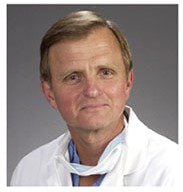
Dr. Paul H. Lange on how to see a miracle?
Important for our question—how to see a miracle?—is the informal conversation following dinner with faculty and students. I could tell by the glint in Paul’s eye that he was about to launch into something mischievous.
“So, Ted,” said Paul followed by a pause long enough to draw the attention of all those within hearing distance, “what’s this stuff about miracles? Are there such things? I’ve been a surgeon for thirty-five years, and I’ve never seen a miracle. I bet they don’t ever happen.”
I took the bait. “Well, Paul, let me ask you about your surgeries. Did you ever have a cancer patient whom you’d given up on? Your prognosis was death. Then, this patient’s family gathered to pray for healing. And those earnest prayers resulted in a healing. The patient survived. Perhaps the patient even went on to live a normal life. Did anything like that every happen to you?”
“Well, yes,” he murmured.
“How often? Once? Twice?” I asked.
“Oh, more than that,” he responded. “At least a dozen times. Maybe fourteen.”
Now, I thought I had him. “So, you witnessed a dozen perhaps even fourteen miracles. But you sit here and tell me that you never saw a miracle. I don’t get it.”
“No, those were not miracles,” he responded.
“If those were not miracles, then what do you call them?”
“Freaks,” he said.
“Freaks!” I exclaimed. “Is ‘freak’ a scientific term?”
“Well, yes. Freaks. Anomalies. You know what I mean,” he muttered.
I promulgated, “Paul, if you call these astonishing healing moments ‘freaks’, then you’ll never see a miracle.”
Well, I thought I’d won that argument decisively. Even if an objective event of divine healing would take place right before our eyes, we could dismiss God’s grace by simply giving it a prosaic name such as ‘freak’ or ‘anomaly’ or something on this order. Only if our eyes are open and willing to see, said Jesus repeatedly, will we discern God’s activity in our lives.
The Traumatic Diagnosis: Prostate Cancer
The story continues. While still in Minnesota in 2009, I had the opportunity to get a workup at the Mayo Clinic. The diagnosis: advanced prostate cancer.
I recall fretting in tears when I dialed Paul’s phone number. This existential crisis hit me like an atomic bomb.
Now, why would I call Paul? Because Paul Lange, urologist and oncologist, is one of the world’s leading scientists in the field of prostate cancer. As a research professor at the University of Washington Medical School and the Fred Hutchinson Cancer Center, Paul developed the PSA (Prostate-Specific Antigen) Test used the world over. The physician at the Mayo Clinic who gave me the diagnosis was formerly one of Paul’s students. So, I telephoned the master.
We arranged for me to fly to Seattle where Paul heroically operated—a radical prostatectomy—at the UW hospital. He said he “got it all.” Or, he “hoped he got it all.”
The healing process was long and complicated. But I will spare you the kind of medical details that I find very boring at cocktail parties. In short, I eventually recovered and today I live a normal life. Well, not if you ask my neighbors.
A half decade later
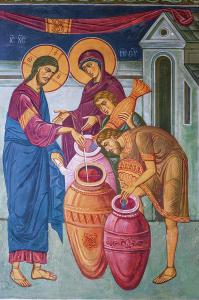
How to see a miracle? Jesus turns water into wine at Cana, (John 2:1-5) by Jenny Rainbow.
Maybe the year was 2016 or so. My wife, Karen, and I were in Seattle. Paul Lange drove us to a seafood restaurant for a fresh salmon lunch. As we were closing the car doors in the parking lot, Paul exclaimed, “Ted, you’re a miracle!”
“What?” I asked. The three of us gathered around the parked car for a pre-lunch conversation.
“You’re a miracle,” Paul repeated.
“What do you mean?” I pressed.
“Because, statistically, of patients with cancer as severe as yours, only 5% are alive after five years. You’re alive,” he said again. “You’re a miracle.”
Because Paul is a scientist, I noticed over the years how he regularly read journals and loved to invoke statistical studies in his research.
“Oh, Paul,” I cajoled. “I’m not a miracle. Those are just statistics.”
“Ted,” Paul responded with a sly grin, “if you use the word, ‘statistics’, you’ll never see a miracle.”
Conclusion
A miracle seems to have both an objective and subjective component. Maybe this is why Jesus so frequently asked rhetorically, “Do you have eyes but fail to see, and ears but fail to hear?” (Mark 8:18)
There’s more to come in this series on miracles.
Patheos ST 4141 How to see a miracle? Miracles 1
Patheos ST 4142 Two Healing Miracles for Sainthood. Miracles 2
Patheos ST 4143 Hume on Miracles. Miracles 3
Patheos ST 4144 Is Special Divine Action miraculous? Miracles 4
Patheos ST 4145 Jesus’ Nature Miracles. Miracles 5
Patheos ST 4146 Is resurrection the ultimate miracle? Miracles 6
Patheos ST 4147 The proleptic power of new creation. Miracles 7
Patheos ST 4148 Paul Lange on Miracles. Miracles 8
Patheos ST 4149 C.S. Lewis on Miracles. Miracles 9
▓

Ted Peters
For Patheos, Ted Peters posts articles and notices in the field of Public Theology. He is a Lutheran pastor and emeritus professor at the Graduate Theological Union. He co-edits the journal, Theology and Science, with Robert John Russell on behalf of the Center for Theology and the Natural Sciences, in Berkeley, California, USA. His single volume systematic theology, God—The World’s Future, is now in the 3rd edition. He has also authored God as Trinity plus Sin: Radical Evil in Soul and Society as well as Sin Boldly: Justifying Faith for Fragile and Broken Souls. See his website: TedsTimelyTake.com.
Watch for his new 2023 book, The Voice of Public Theology, published by ATF Press.
▓
General Christian
Technology and Religion

About Ted Peters
For Patheos, Ted Peters posts articles and notices in the field of Public Theology. He is a Lutheran pastor and emeritus professor at the Graduate Theological Union. He co-edits the journal, Theology and Science, with Robert John Russell on behalf of the Center for Theology and the Natural Sciences, in Berkeley, California, USA. His single volume systematic theology, God—The World’s Future, is now in the 3rd edition. He has also authored God as Trinity plus Sin: Radical Evil in Soul and Society as well as Sin Boldly: Justifying Faith for Fragile and Broken Souls. See his website: TedsTimelyTake.com. Watch for his new 2023 book, The Voice of Public Theology, published by ATF Press. ▓ You can read more about the author here.
Previous Post
May 2, 2023
AI Brinkmanship: A Prophetic Warning?
Next Post
May 17, 2023 Two Healing MIracles for Sainthood. Miracles 2
Browse Our Archives
Select a Category Afterlife America in Crisis Ancient Alien Apocalypse Art Artificial Intelligence Astrobiology Astrotheology Atheism Big History Buddhist Catholic Christian Nationalism Christmas Comparative Theology Death Ecology Ethics ETI Evangelical Evolution Existential Questions Free Will General Christian Hermeneutics Hindu https://www.patheos.com/blogs/allsetfree/2020/12/sins-we-need-to-talk-about/?utm_source=Newsletter&utm_medium=email&utm_campaign=Christians+For+a+Better+Christianity&utm_content=43&lct Interreligious Islam Jewish Justice Latter-Day Saints Literature Literature and Theology Lutheran Methodism Mormonism Nonreligious ontology Orthodox Pagam Prayer progressive Christian PT 6 Dignity Public Theology Race racial justice Religious Liberty Romance Satan Scapegoat Science & Religion Science and Religion social justice Spirituality SR 8 Transhumanism Systematic Theology Taoism Ted Peters UAP UFO Uncategorized War
Select a Month September 2026 August 2026 July 2026 June 2026 May 2026 April 2026 March 2026 February 2026 December 2025 November 2025 October 2025 September 2025 August 2025 July 2025 June 2025 May 2025 April 2025 March 2025 February 2025 January 2025 December 2024 November 2024 October 2024 September 2024 August 2024 July 2024 June 2024 May 2024 April 2024 March 2024 February 2024 January 2024 December 2023 November 2023 October 2023 September 2023 August 2023 July 2023 June 2023 May 2023 April 2023 March 2023 February 2023 January 2023 December 2022 November 2022 October 2022 September 2022 August 2022 July 2022 June 2022 May 2022 April 2022 March 2022 February 2022 January 2022 December 2021 November 2021 October 2021 September 2021
Follow Us!
TAKE THE
Religious Wisdom Quiz
What character trait is praised in the Parable of the Good Samaritan?
Select your answer to see how you score.
Selfishness Deceit Pride Compassion
Related posts from Public Theology

Why Public Theology Needs a Theology of Nature

Big Bang and the Bible: Hyung-Joo Lee
Working on Science and Religion: Update

TRENDING AT PATHEOS Progressive Christian

What Being a Modern-Day Apostle Means to Me
In my last column, I discussed the ins and outs of modern-day...

Did Ancient China Once Worship the God of...
Across human history, a common thread weaves through the origins of the...

Love Your Neighbor – Including Earth-Kin: Lev. 19,...
God’s command to love your neighbor means acting in an ethical and...

Lead a Church Study of “Jesus and Lao...
Guest writer Jack Thomas (The Irreverent Reverend) reflects on leading his church...

Pastoral Wisdom for Responding to Sermon Pushback
Getting sermon pushback on your social justice sermon? Learn practical, Proverbs-based strategies...

Principles for Understanding the Apostolic Ministry Today
Whenever people discover that my formal ministry title is "apostle," as in...
view all Progressive Christian blogs
Ad-Free & Subscriber Log-In Subscription Support
- About Us
- 2026 Calendar
- Videos
- Podcasts
- Library of World Religions
- Faith In Media Tracker
- Advertise With Us
- Write for Us
- Privacy Policy
- Terms of Service
- Do Not Sell My Data
- Contact Us
- Radiant Digital
- Manage Newsletter Subscriptions
- Unsubscribe From Notifications
- Sitemap
Copyright 2008-2026, Patheos. All rights reserved.
Subscription Support Ad-Free & Subscriber Log-In
Follow Patheos