
BuddhistCatholicContemplativeEvangelicalGeneral ChristianHinduJewishLatter-day SaintMuslimNew VisionsProgressive Christian
Beliefs
- Buddhist
- Catholic
- Contemplative
- Evangelical
- General Christian
- Hindu
- Jewish
- Latter-day Saint
- More Voices
- Muslim
- New Visions
- Pagan
- Progressive Christian
Topics
- Religion News
- Food and Religion
- Sports and Religion
- Religious Art
- Religious Music and Entertainment
- Religious Events
- History and Religion
- Style and Religion
- Politics and Religion
- Women in Religion
- Recreation Outdoors and Religion
- Business Finance and Religion
- Careers Workplace and Religion
- Education and Religion
- Family Parenting and Religion
- Health Fitness and Religion
- Home and Religion
- Relationships and Religion
- Technology and Religion
- Travel and Religion
Columnists
- Buddhist Columnists
- Business Finance and Religion Columnists
- Careers Workplace and Religion Columnists
- Catholic Columnists
- Contemplative Columnists
- Education and Religion Columnists
- Evangelists Columnists
- Family Parenting and Religion Columnists
- General Christian Columnists
- Health Fitness and Religion Columnists
- Hindu Columnists
- History and Religion Columnists
- Home and Religion Columnists
- Jewish Columnists
- More Voices Columnists
- Latter Day Columnists
- Muslim Columnists
- New Visions Columnists
- Nonreligious Columnists
- Pagan Columnists
- Politics and Religion Columnists
- Progressive Columnists
- Recreation Outdoors and Religion Columnists
- Relationships and Religion Columnists
- Religion News Columnists
- Religious Art Columnists
- Religious Events Columnists
- Religious Music and Entertainment Columnists
- Sports and Religion Columnists
- Style and Religion Columnists
- Technology and Religion Columnists
- Travel and Religion Columnists
- Women in Religion Columnists
Resource Library
- 2026 Calendar
- Library of World Religions
- The 100 Most Holy Places on Earth
- Patheos Answers
- Podcasts
- Videos
- Faith Leaders Database
- Anglican Episcopalian
- Bahai
- Baptist
- Buddhism
- Christianity
- Confucianism
- Eastern Orthodoxy
- Hinduism
- Holiness and Pentecostal
- ISKCON
- Islam
- Judaism
- Lutheran
- Methodist
- The Church of Jesus Christ of Latter-day Saints
- New Age
- Paganism
- Presbytarian and Reformed
- Protestantism
- Religion Behind the Scenes
- Roman Catholic
- Scientology
- Shia Islam
- Sikhism
- Sufism
- Sunni Islam
- Taoism
- Zen
- See all religions
Research Tools
 Ad-Free & Subscriber Log-In Subscription Support
Ad-Free & Subscriber Log-In Subscription Support
Follow Patheos 

- Trending:
- Forgiveness
- |
- Marriage
- |
- Consciousness
- |
- Death Penalty
- |
- Election
- |
- Halloween

- Home
- Progressive Christian
- Technology and Religion
- Thanksgiving Food Theology
Thanksgiving Food Theology
Last updated on: November 23, 2022 at 4:35 pm by Ted Peters
Thanksgiving Food Theology 2022-11-23T16:35:27-08:00 Ted Peters
Patheos Explore the world's faith through different perspectives on religion and spirituality! Patheos has the views of the prevalent religions and spiritualities of the world.
To Eat No-Kill Cultivated Meat
Part Eight: Thanksgiving Food Theology
By Brian Brozovic and Ted Peters

Table Grace, a moment of thanksgiving.
Is there such a thing as a Food Theology? Yes, indeed.
“No figure in the Bible is more associated with food that its central character, Jesus,” writes Rory Shiner. Jesus’ “first miracle was in response to a catering crisis at a wedding. (The couple had run out of wine. Jesus’ response was to turn four hundred and fifty liters of water into the best wine the guests had ever tasted.)” If Jesus feels responsible for making a banquet festive, we can do that too.
Breaking News, November 21, 2023
No-Kill Cultivated Meat approved in US by FDA. Until now, only Singapore had approved for human consumption no-kill cultivated meat. Is it coming to the U.S. too? How should we think about no-kill cultivated meat theologically?
A Public Food Theology of Thanksgiving
In this column on public theology, Ted has insisted that the theologian offer insights aimed at the global common good. The public theologian turns first to the globe and then to the dinner table. “We really must treat the planet as our commons,” writes sockdolager eco-theologian Larry Rasmussen; “and nurture human good and the good of others that share in the commons.” Now, we turn to the dinner table.
Der Mensch ist was er ißt ( we are what we eat), say our German friends. This is humorous. Yet, it’s more than a joke. Food theology prompts us to think about our food. Food comes into us. And, what we take in either nourishes our bodies or is jettisoned. Our environment is constantly passing through us. This pass through is what makes our very life possible. We are dependent on food. And, we are dependent on our Creator God who grants us food. Does this dependence belong to a food theology? Food theology leads to thanksgiving, among other concerns.
When you sit down to table, do you offer a prayer of thanksgiving? To pause to say grace before digging your fork into your salad would remind you of the sacredness of this dimension to the food cycle. We thank God. And, we thank the living plants and animals who’s lives were sacrificed for our good health.
The food theologian tells us what the Bible says about food, to be sure. But, we ask, what does the Bible inspire us to do in the face of our global food crisis, the challenges of food justice, our planet’s ecological flourishing, and emerging new food technologies? Let’s ask Norman Wirzba and Brian Brozovic.
Meet Norman Wirzba

Professor Norman Wirzba, Duke Divinity School on Food Theology
Norman Wirzba is a real live food theologian. Dr. Wirzba is Gilbert T. Rowe Distinguished Professor of Christian Theology and Senior Fellow at the Kenan Institute for Ethics. Where is that? At Duke Divinity School.
Professor Wirzba pursues research and teaching interests at the intersections of theology, philosophy, ecology, and–here’s what’s important for our discussion here–agrarian and environmental studies. In particular, his research is centered on a recovery of the doctrine of creation and a restatement of humanity in terms of its creaturely life.
Food Theology? Yes. “Theologically understood, food is not reducible to material stuff. It is the provision and nurture of God made pleasing and delectable. Food is God’s love made nutritious and delicious. Eating is the daily reminder that life comes to us as a gift” (Wirtzba 2019, 46).
Among his many scholarly publications, we’re particularly interested in his book, Food and Faith: A Theology of Eating. “To live, we must daily break the body and shed the blood of Creation” (Wirtzba 2019, 40). Note the sacramental feel of the tragedy that is our life, namely, to live requires death.
“Life as we know it depends on death, needs death, which means that death is not simply the cessation of life but its precondition” (Wirtzba 2019, 40).
That life-lives-off-death is the nature of God’s creation within which we live. What Norman wants us to get and get right is this: who we are as God’s creatures is utterly and thoroughly interdependent with everything else on Earth, including our fellow non-human animal creatures. Plants & Animals R Us, so to speak.
What does No-Kill Cultivated Meat prompt Norman Wirzba to think?
Norman Wirzba. The matter of feeding a growing population on less land and water, and in more difficult ecological and political conditions, is truly daunting. For this reason it is important not to foreclose on good ideas and innovations too quickly. We need creativity of mind, but also the recognition that past practices often hold great insight into what food production practices are valuable and should be retained (even if tweaked a bit). Farmers who honor the land and have cultivated good agricultural practices need to be at the center of discussions going forward.
I am not opposed to plant-based meat substitutes. They can play a valuable role in the diets people choose. Moreover, it is important to slow down meat consumption, especially when the meat consumed is produced through industrial and confinement production processes. But I do not believe that we can have a sustainable agriculture without animals. In part, this is because ecosystems always have animals (large and small) in them as vital players.
My worry about a meat-free agriculture is that it tempts people to think that we can be free of the messy entanglements of a fleshy life. Moreover, I often detect a gnostic/dualist urge in folks who want to be free of bodily limits and pains. The need going forward is to honor the bodies of animals (human and non-human) by exercising care and respect for the animals themselves, the land through which they live, and the farmers who take care of them. Humans have always lived with animals and by means of them. To think we can separate ourselves from them (with the perhaps occasional viewing of them from a distance) is to take one more step in the disastrous step to think that people can live apart from natural limits and blessings, and that they can live wholly according to an industrial logic.
Some Thoughts on Food Theology by Brian Brozovic

Brian Brozovic on Food Theology
Brian Brozovic. Wirtzba’s view is futuristic, yet reserved as well. Very reserved. The idea of a growing population and more mouths to feed with less resources, be it land, water, is proving to be daunting says Wirzba.
Growing up, I was not a huge history buff (things have since changed). My father told me that we study history to learn from our past mistakes and hopefully prevent making the same mistakes in the future. Somewhere in here is the street definition of insanity, doing the same thing more than once and expecting different results. Wirzba challenges us to consider good ideas and innovations as the nutrients we need to consider creative solutions while maintaining a green (Brian’s pun) thumb (Brian’s reference) on past practices and how they can inform paths forward.
I think the first principle of food theology is to connect with God through the calling to be good stewards of our resources. Farming, ranching, land sustaining, processing, cooking, sharing, feeding our neighbor (those hungry and those fed). Looking for ways to create more sustainable systems, reducing food waste, etc. It’s tough to say a “first principle” because food, in all its forms is LOVE. And when LOVE is GOD and God is Love, there is no second principle on the list.
A Thanksgiving Food Theology
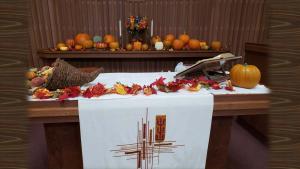
Thanksgiving Altar at Cross and Crown Lutheran Church, Rohnert Park CA
Brian Brozovic. This coming Thanksgiving Day, my family and I will be sitting down as our immediate family. My spouse and our three children to share our meal together. We share our appreciation and thankfulness each night in our table prayers. So, Thanksgiving Day doesn’t bring a thankfulness that we don’t feel and appreciate year round. Maybe that is because I am so closely connected with the food industry, local farmers, local ranchers.
What we do bring special to this meal is the uniqueness of the occasion. Blending together our family heritages into a meal brings the good out of family recipes, traditional foods from around the world, and an appreciation of cultures outside of our daily rat race.
Some Scientific Thoughts
Is the science ready? Some have doubts. “The Myth of Cultured Meat: A Review” by Sghaier Chriki and Jean-Francois Hocquette in Frontiers provides an encyclopedic review and assessment. Let us respond to one of the con’s raised in this article, namely, the continued use of fetal bovine serum (FBS) to nourish the meat culture.
So, what’s the problem? Once the cell culture has been isolated and immortalized, it must grow in a nutrient rich medium. What will be that medium? “The best medium is known to contain fetal bovine serum (FBS), a serum made from the blood of a dead calf, which is going to be rate-limiting, and not acceptable for vegetarians nor vegans.” FBS is the requisite medium, it is assumed by these writers in Frontiers. In addition to the problems raised here by Chriki and Hoquette, Brian and Ted note that FBS is expensive.
What’s the solution? A vegetable substitute for FBS. Believer Meats (formerly Future Meat Technologies) in Israel develops cell cultures from fibroblasts, not from undifferentiated stem cells. Furthermore, lead scientist Yaakov Nahmias has developed a strictly plant based medium that provides all necessary nutrients without bovine serum. And, it’s less expensive. Most importantly for Jewish religious practice, by taking a fibroblast from a kosher slaughtered animal he avoids violating a rabbinic law that proscribes eating the flesh of a living animal. This is a one-kill rather than no-kill or perpetual-kill practice. Nahmias resolves the kosher question, the cost question, and the perpetual animal-kill question.
Some Prayerful Thoughts
We recommend a Thanksgiving Food Theology. The practice of returning thanks at the dinner table expresses our attitude of gratitude.
Table grace prayers are legion. Here’s one suggested by Martin Luther to follow dinner, called “Returning Thanks.”
We thank You, Lord God, heavenly Father, for all Your benefits,
through Jesus Christ, our Lord,
who lives and reigns with You and the Holy Spirit forever and ever. Amen.
What’s Next?
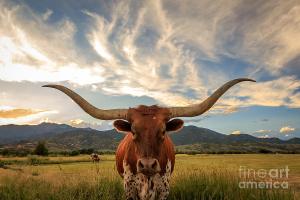
Long horn steer in Utah. Photo by Johnny Adolphson, 2019.
Here is what we’ve done so far.
To Eat No-Kill Cultivated Meat. Part One: The Science
To Eat No-Kill Cultivated Meat. Part Two: Kosher? Interview with Sam Shonkoff
To Eat No-Kill Cultivated Meat. Part Three: Hindu? Jain? Interview with Rita Sherma
To Eat No-Kill Cultivated Meat. Part Four: Mormon? Interview with Lincoln Cannon
To Eat No-Kill Cultivated Meat. Part Five: Muslim? Interview with Mahjabeen Dahla
To Eat No-Kill Cultivated Meat: Part Six: Catholic? Interview with Lisa Fullam
To Eat No-Kill Cultivated Meat. Part Seven: Christian Vegetarianism? Interview with John Ryder
To Eat No-Kill Cultivated Meat: Part Eight: Food Theology? Interview with Norman Wirzba & Brian Brozovic
What’s next? Nothing planned yet. Keep your clicker handy.
▓
 Brian Brozovic is a student at Pacific Lutheran Theological Seminary and Ted Peters is an emeritus professor at Pacific Lutheran Theological Seminary in Berkeley, California, USA. Visit Professor Peters’ website: TedsTimelyTake.com.
▓
References
Wirtzba, Norman, 2019. Food and Faith: A Theology of Eating. Cambridge UK: Cambridge University Press, 2nds ed.
Interfaith
General Christian
Evangelical
Eastern Orthodox
Contemplative
Catholic
Technology and Religion
Home and Religion
Food and Religion

About Brian Brosovic and Ted Peters
Brian Brozovic is a student at Pacific Lutheran Theological Seminary and Ted Peters is an emeritus professor at Pacific Lutheran Theological Seminary in Berkeley, California, USA. Visit Professor Peters’ website: TedsTimelyTake.com. You can read more about the author here.
Previous Post
November 16, 2022
Jack London 7: The Red One
Next Post

November 25, 2022 Anthea Butler, Public Theology, and Social Media
Browse Our Archives
Select a Category Afterlife America in Crisis Ancient Alien Apocalypse Art Artificial Intelligence Astrobiology Astrotheology Atheism Big History Buddhist Catholic Christian Nationalism Christmas Comparative Theology Death Ecology Ethics ETI Evangelical Evolution Existential Questions Free Will General Christian Hermeneutics Hindu https://www.patheos.com/blogs/allsetfree/2020/12/sins-we-need-to-talk-about/?utm_source=Newsletter&utm_medium=email&utm_campaign=Christians+For+a+Better+Christianity&utm_content=43&lct Interreligious Islam Jewish Justice Latter-Day Saints Literature Literature and Theology Lutheran Methodism Mormonism Nonreligious ontology Orthodox Pagam Prayer progressive Christian PT 6 Dignity Public Theology Race racial justice Religious Liberty Romance Satan Scapegoat Science & Religion Science and Religion social justice Spirituality SR 8 Transhumanism Systematic Theology Taoism Ted Peters UAP UFO Uncategorized War
Select a Month September 2026 August 2026 July 2026 June 2026 May 2026 April 2026 March 2026 February 2026 December 2025 November 2025 October 2025 September 2025 August 2025 July 2025 June 2025 May 2025 April 2025 March 2025 February 2025 January 2025 December 2024 November 2024 October 2024 September 2024 August 2024 July 2024 June 2024 May 2024 April 2024 March 2024 February 2024 January 2024 December 2023 November 2023 October 2023 September 2023 August 2023 July 2023 June 2023 May 2023 April 2023 March 2023 February 2023 January 2023 December 2022 November 2022 October 2022 September 2022 August 2022 July 2022 June 2022 May 2022 April 2022 March 2022 February 2022 January 2022 December 2021 November 2021 October 2021 September 2021
Follow Us!
TAKE THE
Religious Wisdom Quiz
What animals did Jesus ride into Jerusalem?
Select your answer to see how you score.
A horse A camel A donkey An ox
Related posts from Public Theology

Why Public Theology Needs a Theology of Nature

America's 250th Birthday Gift: Civic Renewal

Do You Believe in UFOs? A Theologian's Answer.

Free Will and Christian Freedom TWO
TRENDING AT PATHEOS Progressive Christian

Why Christians Have a Sacred Duty to Vote:...
The Bible offers strong support for the sacred duty to vote. Here...

What Being a Modern-Day Apostle Means to Me
In my last column, I discussed the ins and outs of modern-day...

Did Ancient China Once Worship the God of...
Across human history, a common thread weaves through the origins of the...

Love Your Neighbor – Including Earth-Kin: Lev. 19,...
God’s command to love your neighbor means acting in an ethical and...

Lead a Church Study of “Jesus and Lao...
Guest writer Jack Thomas (The Irreverent Reverend) reflects on leading his church...

Principles for Understanding the Apostolic Ministry Today
Whenever people discover that my formal ministry title is "apostle," as in...
view all Progressive Christian blogs
Ad-Free & Subscriber Log-In Subscription Support
- About Us
- 2026 Calendar
- Videos
- Podcasts
- Library of World Religions
- Faith In Media Tracker
- Advertise With Us
- Write for Us
- Privacy Policy
- Terms of Service
- Do Not Sell My Data
- Contact Us
- Radiant Digital
- Manage Newsletter Subscriptions
- Unsubscribe From Notifications
- Sitemap
Copyright 2008-2026, Patheos. All rights reserved.
Subscription Support Ad-Free & Subscriber Log-In
Follow Patheos