
BuddhistCatholicContemplativeEvangelicalGeneral ChristianHinduJewishLatter-day SaintMuslimNew VisionsProgressive Christian
Beliefs
- Buddhist
- Catholic
- Contemplative
- Evangelical
- General Christian
- Hindu
- Jewish
- Latter-day Saint
- More Voices
- Muslim
- New Visions
- Pagan
- Progressive Christian
Topics
- Religion News
- Food and Religion
- Sports and Religion
- Religious Art
- Religious Music and Entertainment
- Religious Events
- History and Religion
- Style and Religion
- Politics and Religion
- Women in Religion
- Recreation Outdoors and Religion
- Business Finance and Religion
- Careers Workplace and Religion
- Education and Religion
- Family Parenting and Religion
- Health Fitness and Religion
- Home and Religion
- Relationships and Religion
- Technology and Religion
- Travel and Religion
Columnists
- Buddhist Columnists
- Business Finance and Religion Columnists
- Careers Workplace and Religion Columnists
- Catholic Columnists
- Contemplative Columnists
- Education and Religion Columnists
- Evangelists Columnists
- Family Parenting and Religion Columnists
- General Christian Columnists
- Health Fitness and Religion Columnists
- Hindu Columnists
- History and Religion Columnists
- Home and Religion Columnists
- Jewish Columnists
- More Voices Columnists
- Latter Day Columnists
- Muslim Columnists
- New Visions Columnists
- Nonreligious Columnists
- Pagan Columnists
- Politics and Religion Columnists
- Progressive Columnists
- Recreation Outdoors and Religion Columnists
- Relationships and Religion Columnists
- Religion News Columnists
- Religious Art Columnists
- Religious Events Columnists
- Religious Music and Entertainment Columnists
- Sports and Religion Columnists
- Style and Religion Columnists
- Technology and Religion Columnists
- Travel and Religion Columnists
- Women in Religion Columnists
Resource Library
- 2026 Calendar
- Library of World Religions
- The 100 Most Holy Places on Earth
- Patheos Answers
- Podcasts
- Videos
- Faith Leaders Database
- Anglican Episcopalian
- Bahai
- Baptist
- Buddhism
- Christianity
- Confucianism
- Eastern Orthodoxy
- Hinduism
- Holiness and Pentecostal
- ISKCON
- Islam
- Judaism
- Lutheran
- Methodist
- The Church of Jesus Christ of Latter-day Saints
- New Age
- Paganism
- Presbytarian and Reformed
- Protestantism
- Religion Behind the Scenes
- Roman Catholic
- Scientology
- Shia Islam
- Sikhism
- Sufism
- Sunni Islam
- Taoism
- Zen
- See all religions
Research Tools
 Ad-Free & Subscriber Log-In Subscription Support
Ad-Free & Subscriber Log-In Subscription Support
Follow Patheos 

- Trending:
- Forgiveness
- |
- Marriage
- |
- Consciousness
- |
- Death Penalty
- |
- Election
- |
- Halloween

- Home
- Progressive Christian
- Education and Religion
- Did I lose my free will to Science?
Did I lose my free will to Science?
Last updated on: May 2, 2024 at 9:12 am by Ted Peters
Did I lose my free will to Science? 2024-05-02T09:12:54-07:00 Ted Peters
Patheos Explore the world's faith through different perspectives on religion and spirituality! Patheos has the views of the prevalent religions and spiritualities of the world.
Consciousness and Neuroscience in a Physical World
Did I lose my free will to Science?
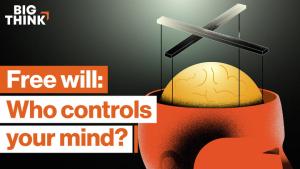
Big Think. Consciousness and Neuroscience.
I’ve been worrying. I’m worried that I’ve lost my free will to science. Here’s how philosophical theologian Nancey Murphy formulates my worry. “The worry is this: if human choices are essentially brain events, and if brain events are governed by the laws of neurobiology, then must it not be the case that all choices and all subsequent behavior are governed by the laws of neurobiology?” (Murphy, 2006, p. 103). Have I lost my free will to the deterministic laws of science?
This post extends a discussion previously begun in “The Danger of Free Will Denial” and “Did I lose my conscious mind to science?”
Free Will. Freedom of Choice. Libertarian Freedom.
What kind of freedom might I have lost to science? It goes by different names: free will (liberum arbitrium); freedom of choice; libertarian freedom; natural freedom; and, of course, disobeying your parents. Free will is the capacity to choose between alternatives unimpeded. According to philosopher Chelsea Haramia, “those who claim that we have libertarian free will argue that we make free choices when it is possible that we could have done otherwise than what we actually did.”
How could I possibly lose such libertarian free will? By having my materialist friends tell me that it’s only a delusion. Allegedly, automatic physical processes are exhaustively determinative of all free decisions. In short, it’s my brain—not my conscious mind—that determines what I do.

Free Will and Neuroscience.
Process theologian David Ray Griffin helps us get clear on this. “Freedom, in the sense of self-determination,” says Griffin, “involves a decision among genuine alternatives, so that it is true that the agent could have done otherwise” (Griffin, 1998, p. 37). What we need is a scientific theory or philosophical cosmology to explain freedom, not explain it away. “My argument has been that to be adequate to the facts of our experience a philosophy must provide for human freedom in the metaphysical sense, which involves the denial that antecedent causal forces totally determine our actions” (Griffin, 1998, p. 209).
As we postulated in a previous post, consciousness is a hard-core commonsense notion. We are autoptic witnesses to our own consciousness as well as the consciousness of those whom we know well. This is common sense. Like consciousness, Griffin tells us that freedom is a “hard-core commonsense intuition” (Griffin, 1998, p. 166). Any cosmology that explains freedom away fails to be adequate to reality.
Free Will as Self-Determination
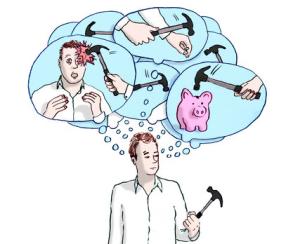 Note how Griffin connects freedom with self-determination. It has long been my contention that free will is best understood as self-determination. Each of us is a self with agency. We should recognize three components to our daily experience of free will: deliberation, decision, and action. First, we deliberate over alternatives. Second, we decide which alternative to actualize. Then, third, we take action which has an effect on the physical world. Our conscious decision affects the course of physical history.
What freedom understood as self-determination presupposes, then, is the existence of a self. Now, are our scientific materialists going to take away your and my self too? Well, they will certainly try.
Watch out for neurocentrist philosopher Thomas Metzinger. “Subjective experience is a biological data format, a highly specific mode of presenting information about the world by letting it appear as if it were an Ego’s knowledge. But, no such things as selves exist in this world” (Metzinger, 2009, p. 8). Ouch! This intellectual thief has stolen my self. Without a self, I can’t engage in self-determination. I’ve lost my free will to science. Woe is me.
Can any scholar come to my rescue? Neurotheologians such as Nancey Murphy and Warren S. Brown would counter with the likes of Metzinger. “Mental events are not reducible to brain events…mental events are constituted in action loops in which brain processes are interlocked with environmental context, with the history of the outcome of previous action loops playing a primary causal role” (Murphy, 2010, p. 209). Whew! I’ve got my self back again. Hooray![1]
The way to prevent a theft of our free will is to provide a precise definition. Here’s my armor plate: we understand free will as self-determination. Free will is a core autoptic human experience in which the self as agent deliberates, decides, and takes action. Now, I ask you: how could this be denied?
Conclusion
Just in the nick of time, systematic theologians such as David Ray Griffin and Nancey Murphy have rescued both our self and our free will from being jettisoned by neurocentrists defending scientific materialism. Because the self that determines itself and the world (in part) through deliberation, decision, and action is itself a hard-core commonsense intuition, it cannot be dislodged from concrete experience. We’re safe. Whew!
I believe that belief in human free will can be sustained in a deterministic cosmology. We simply need to posit a three factor determinism: nature, nurture, and self. The human self is itself a determinant. What we mean by free will is in fact self-determination.
Now, just to be clear, in this Patheos series we have protected only one kind of freedom, namely, libertarian free will.[3] What we have not done is address distinctively Christian freedom.[4] That will require another treatment in a later article. In the meantime, click on “Did I lose my inborn sense of God to Atheism?”
SR 2003 Free Will and Neuroscience in a Physical World
Here’s what’s coming on the implications of neuroscience and neurophilosophy for Christian anthropology.
Did I lose my Conscious Mind to Science?
Did I lose my Free Will to Science?
Did I lose my inborn sense of God to Atheism?
Did I lose my Self to my Brain?
Did I lose my Self to Determinism?
Did I lose my Self to Christian Freedom?
▓
Ted Peters
Ted Peters pursues Public Theology at the intersection of science, religion, ethics, and public policy. Peters is an emeritus professor at the Graduate Theological Union, where he co-edits the journal, Theology and Science, on behalf of the Center for Theology and the Natural Sciences, in Berkeley, California, USA. His book, God in Cosmic History, traces the rise of the Axial religions 2500 years ago. He previously authored Playing God? Genetic Determinism and Human Freedom? (Routledge, 2nd ed., 2002) as well as Science, Theology, and Ethics (Ashgate 2003). He is editor of AI and IA: Utopia or Extinction? (ATF 2019). Along with Arvin Gouw and Brian Patrick Green, he co-edited the new book, Religious Transhumanism and Its Critics hot off the press (Roman and Littlefield/Lexington, 2022). Soon he will publish The Voice of Christian Public Theology (ATF 2022). See his website: TedsTimelyTake.com. His fictional spy thriller, Cyrus Twelve, follows the twists and turns of a transhumanist plot.
▓
Notes
[1] Might a theologian wish to preserve the self who exercises freedom? Yes, indeed. “When God in His supernal goodness creates each soul in His own image,” wrote Maximus the Confessor in the seventh century, God “brings it into being endowed with self-determination” (Maximus, 1981, p. 2:116).
[2] Physicist Henry Stapp turns from the classical physics of Newton to quantum mechanics. Therein he finds at the subatomic level the opening he needs to integrate what we experience as consciousness, free will, and human meaning. “This quantum mechanical conception provides a rationally coherent science-based foundation for human lives suffused with purpose and meaning. A person’s mind acts first to construct, from the clues transmitted by sense organs to that observer’s brain, a conception of the physically described reality in which the person is locally embedded. The person’s mind then directs, in mentally intended ways (via mental efforts that exploit the quantum dynamical laws), that person’s bodily actions. Quantum mechanics thereby provides a rational science-based escape from the philosophical, metaphysical, moral, and explanatory dead ends [of the] classical materialistic conception of the world and our place in it” (Stapp, 2017, p. 80).
[3] Elsewhere I have delineated four concepts of freedom relevant to this discussion: (1) liberty or political freedom, that is, independence from external constraint or coercion; (2) free will or natural freedom, that is, self-determination or the power to choose between alternatives; (3) moral freedom, virtue, or Christian freedom, that is, the capacity to choose the good of God, virtue, or the neighbor over one’s selfish inclinations; and (4) future freedom, that is, creative initiatives that influence the course of future events (Peters, 2nd Ed, 2003, pp. 17-20).
[4] Do not confuse “Christian Freedom” with the libertarian free will debated among Calvinists and Arminians in light of predestination. See: Roger Olson, “Free Will or Not? Another Round in the Free Will Debate.”
References
Crick, F., 1994. The Astonishing Hypothesis: The Scientific Search for the Soul. New York: Scribners.
Griffin, D. R., 1998. Unsnarling the World-Knot. Berkeley CA: University of California Press.
Maximus, 1981. Two Hundred Texts on Theology and the Incarnate Dispensation of the Son of God. In: K. Ware, ed. Philokalia. London: Faber, pp. 2:114-284.
Metzinger, T., 2009. The Science of the Mind and the Myth of the Self. New York: Basic.
Murphy, N., 2006. Bodies and Souls, or Spirited Bodies?. Cambridge UK: Cambridge University Press ISBN 978-0-521-67676-2 pb.
Murphy, N. a. W. B., 2010. Did My Neurons Make Me Do It?. Oxford: Oxford University Press.
Peters, T., 2nd Ed, 2003. Playing God? Genetic Determinism and Human Freedom. London and New York: Routledge ISBN0-415-94248-0-415-94249-7.
Satel, S. a. S. L., 2013. Losing our Minds in the Age of Brain Science. Skeptical Inquirer 37:6, pp. 30-35.
Searle, J., 1986. Minds, Brains, and Science. Cambridge MA: Harvard University Press.
Stapp, H. P., 2017. Quantum Theory and Free Will. Switzerland: Springer.
Whitehead, A. N., 1925, 1997. Science and the Modern World. New York: Free Press.
Woollacott, M. H., 2017. Infinite Awareness. New York: Roman and Littlefield.
Education and Religion

About Ted Peters
Ted Peters pursues Public Theology at the intersection of science, religion, ethics, and public policy. Peters is an emeritus professor at the Graduate Theological Union, where he co-edits the journal, Theology and Science, on behalf of the Center for Theology and the Natural Sciences, in Berkeley, California, USA. His book, God in Cosmic History, traces the rise of the Axial religions 2500 years ago. He previously authored Playing God? Genetic Determinism and Human Freedom? (Routledge, 2nd ed., 2002) as well as Science, Theology, and Ethics (Ashgate 2003). He is editor of AI and IA: Utopia or Extinction? (ATF 2019). Along with Arvin Gouw and Brian Patrick Green, he co-edited the new book, Religious Transhumanism and Its Critics hot off the press (Roman and Littlefield/Lexington, 2022). Soon he will publish The Voice of Christian Public Theology (ATF 2022). See his website: TedsTimelyTake.com. His fictional spy thriller, Cyrus Twelve, follows the twists and turns of a transhumanist plot. You can read more about the author here.
Previous Post

November 7, 2022
Religious Transhumanism 15. Lutheran?
Next Post

November 8, 2022 Did I lose my Mind to Science?
Browse Our Archives
Select a Category Afterlife America in Crisis Ancient Alien Apocalypse Art Artificial Intelligence Astrobiology Astrotheology Atheism Big History Buddhist Catholic Christian Nationalism Christmas Comparative Theology Death Ecology Ethics ETI Evangelical Evolution Existential Questions Free Will General Christian Hermeneutics Hindu https://www.patheos.com/blogs/allsetfree/2020/12/sins-we-need-to-talk-about/?utm_source=Newsletter&utm_medium=email&utm_campaign=Christians+For+a+Better+Christianity&utm_content=43&lct Interreligious Islam Jewish Justice Latter-Day Saints Literature Literature and Theology Lutheran Methodism Mormonism Nonreligious ontology Orthodox Pagam Prayer progressive Christian PT 6 Dignity Public Theology Race racial justice Religious Liberty Romance Satan Scapegoat Science & Religion Science and Religion social justice Spirituality SR 8 Transhumanism Systematic Theology Taoism Ted Peters UAP UFO Uncategorized War
Select a Month September 2026 August 2026 July 2026 June 2026 May 2026 April 2026 March 2026 February 2026 December 2025 November 2025 October 2025 September 2025 August 2025 July 2025 June 2025 May 2025 April 2025 March 2025 February 2025 January 2025 December 2024 November 2024 October 2024 September 2024 August 2024 July 2024 June 2024 May 2024 April 2024 March 2024 February 2024 January 2024 December 2023 November 2023 October 2023 September 2023 August 2023 July 2023 June 2023 May 2023 April 2023 March 2023 February 2023 January 2023 December 2022 November 2022 October 2022 September 2022 August 2022 July 2022 June 2022 May 2022 April 2022 March 2022 February 2022 January 2022 December 2021 November 2021 October 2021 September 2021
Follow Us!
TAKE THE
Religious Wisdom Quiz
Which Christian festival begins with Ash Wednesday and ends at Easter?
Select your answer to see how you score.
Advent Pentecost Epiphany Lent
Related posts from Public Theology

Why Public Theology Needs a Theology of Nature

America's 250th Birthday Gift: Civic Renewal

Do You Believe in UFOs? A Theologian's Answer.

Free Will and Christian Freedom TWO
TRENDING AT PATHEOS Progressive Christian

What Being a Modern-Day Apostle Means to Me
In my last column, I discussed the ins and outs of modern-day...

Did Ancient China Once Worship the God of...
Across human history, a common thread weaves through the origins of the...

Love Your Neighbor – Including Earth-Kin: Lev. 19,...
God’s command to love your neighbor means acting in an ethical and...

Lead a Church Study of “Jesus and Lao...
Guest writer Jack Thomas (The Irreverent Reverend) reflects on leading his church...

Pastoral Wisdom for Responding to Sermon Pushback
Getting sermon pushback on your social justice sermon? Learn practical, Proverbs-based strategies...

Principles for Understanding the Apostolic Ministry Today
Whenever people discover that my formal ministry title is "apostle," as in...
view all Progressive Christian blogs
Ad-Free & Subscriber Log-In Subscription Support
- About Us
- 2026 Calendar
- Videos
- Podcasts
- Library of World Religions
- Faith In Media Tracker
- Advertise With Us
- Write for Us
- Privacy Policy
- Terms of Service
- Do Not Sell My Data
- Contact Us
- Radiant Digital
- Manage Newsletter Subscriptions
- Unsubscribe From Notifications
- Sitemap
Copyright 2008-2026, Patheos. All rights reserved.
Subscription Support Ad-Free & Subscriber Log-In
Follow Patheos