
BuddhistCatholicContemplativeEvangelicalGeneral ChristianHinduJewishLatter-day SaintMuslimNew VisionsProgressive Christian
Beliefs
- Buddhist
- Catholic
- Contemplative
- Evangelical
- General Christian
- Hindu
- Jewish
- Latter-day Saint
- More Voices
- Muslim
- New Visions
- Pagan
- Progressive Christian
Topics
- Religion News
- Food and Religion
- Sports and Religion
- Religious Art
- Religious Music and Entertainment
- Religious Events
- History and Religion
- Style and Religion
- Politics and Religion
- Women in Religion
- Recreation Outdoors and Religion
- Business Finance and Religion
- Careers Workplace and Religion
- Education and Religion
- Family Parenting and Religion
- Health Fitness and Religion
- Home and Religion
- Relationships and Religion
- Technology and Religion
- Travel and Religion
Columnists
- Buddhist Columnists
- Business Finance and Religion Columnists
- Careers Workplace and Religion Columnists
- Catholic Columnists
- Contemplative Columnists
- Education and Religion Columnists
- Evangelists Columnists
- Family Parenting and Religion Columnists
- General Christian Columnists
- Health Fitness and Religion Columnists
- Hindu Columnists
- History and Religion Columnists
- Home and Religion Columnists
- Jewish Columnists
- More Voices Columnists
- Latter Day Columnists
- Muslim Columnists
- New Visions Columnists
- Nonreligious Columnists
- Pagan Columnists
- Politics and Religion Columnists
- Progressive Columnists
- Recreation Outdoors and Religion Columnists
- Relationships and Religion Columnists
- Religion News Columnists
- Religious Art Columnists
- Religious Events Columnists
- Religious Music and Entertainment Columnists
- Sports and Religion Columnists
- Style and Religion Columnists
- Technology and Religion Columnists
- Travel and Religion Columnists
- Women in Religion Columnists
Resource Library
- 2026 Calendar
- Library of World Religions
- The 100 Most Holy Places on Earth
- Patheos Answers
- Podcasts
- Videos
- Faith Leaders Database
- Anglican Episcopalian
- Bahai
- Baptist
- Buddhism
- Christianity
- Confucianism
- Eastern Orthodoxy
- Hinduism
- Holiness and Pentecostal
- ISKCON
- Islam
- Judaism
- Lutheran
- Methodist
- The Church of Jesus Christ of Latter-day Saints
- New Age
- Paganism
- Presbytarian and Reformed
- Protestantism
- Religion Behind the Scenes
- Roman Catholic
- Scientology
- Shia Islam
- Sikhism
- Sufism
- Sunni Islam
- Taoism
- Zen
- See all religions
Research Tools
 Ad-Free & Subscriber Log-In Subscription Support
Ad-Free & Subscriber Log-In Subscription Support
Follow Patheos 

- Trending:
- Forgiveness
- |
- Marriage
- |
- Consciousness
- |
- Death Penalty
- |
- Election
- |
- Halloween

- Home
- Progressive Christian
- Women in Religion
- To Eat No-Kill Cultivated Meat. Part Six: Catholic?
To Eat No-Kill Cultivated Meat. Part Six: Catholic?
Last updated on: August 31, 2023 at 8:22 am by Ted Peters
To Eat No-Kill Cultivated Meat. Part Six: Catholic? 2023-08-31T08:22:34-07:00 Ted Peters
Patheos Explore the world's faith through different perspectives on religion and spirituality! Patheos has the views of the prevalent religions and spiritualities of the world.
No-Kill Cultivated Meat & Global Food Justice
Part Six: Catholic? An Interview with Lisa Fullam

Global Food Crisis & Food Justice
WORLD FOOD DAY was this past weekend. Where is our world headed? We–Brian Brosovic and Ted Peters—have been on a journey through twists ‘n’ turns toward a destination: no-kill cultivated meat. We began this odyssey with an article, “Meet the New Meat,” in the September 2022 issue of Pax Lumina.
We are guided by a food justice motto given us by sockdolager eco-theologian Larry L. Rasmussen. “WE REALLY MUST TREAT THE PLANET AS OUR COMMONS AND NURTURE HUMAN GOOD AND THE GOOD OF OTHERS THAT SHARE IN THE COMMONS.”
We imagine a food justice destination, a scenario. In the medium range future no-kill cultivated meat products become widely available; factory chicken production diminishes; cattle herding and slaughterhouses disappear; methane gas emissions drop; land previously used for animal cultivation decreases; and our planet’s ecosphere becomes healthier thereby. With this scenario we ask: what would a Roman Catholic bioethicist think?
Here is where we have been and where we plan to go.
To Eat No-Kill Cultivated Meat. Part One: The Science
To Eat No-Kill Cultivated Meat. Part Two: Kosher?
To Eat No-Kill Cultivated Meat. Part Three: Hindu? Jain?
To Eat No-Kill Cultivated Meat. Part Four: Mormon?
To Eat No-Kill Cultivated Meat. Part Five: Muslim?
To Eat No-Kill Cultivated Meat: Part Six: Catholic?
To Eat No-Kill Cultivated Meat: Part Seven: Food Theology?
Meet Lisa Fullam

Dr. Lisa Fullam
Lisa Fullam D.V.M., Th.D. is an Associate Veterinarian at New Baltimore Animal Hospital in West Coxsackie, NY. After Veterinary Studies at Cornell, she earned a doctorate in Ethics from Harvard Divinity School. She is Professor Emerita from Santa Clara University where she taught for 19 years at the Jesuit School of Theology. Research interests include Virtue Ethics, medical and sexual ethics, the intersection of ethics and spirituality, and Ignatian spirituality. In her spare time she trains and shows Boxers and plays guitar (though with more enthusiasm than skill). A few years back, she climbed Mt. Kilimanjaro. The view from the top is just glorious.
Question One. Lisa, you love animals. Professionally you are both a veterinarian and a bioethicist. Do you greet the prospect of no-kill cultivated meat with dread or hope?
LF. I think there’s room for a little of both. First, the hope. If cultivated meat lives up to its promise in terms of cost, it’d be a great addition to the resources available for feeding a hungry world, especially in regions where access to quality protein is limited. It’d provide meat without the need to kill animals to get it. In our contemporary world most of us are distant from the reality of the animals we consume for food. We think of meat as what shows up in the grocery store, and forget the life of the creature who provided it.
That distance serves to blind us to the horrific cruelty of factory farming, for one example. Part of the cruelty of factory farming is current livestock slaughter practices—economic pressures to “process” animals quickly raises the risk of causing unnecessary suffering for the animals, contamination of meat, and risk to the people who perform those difficult, dangerous, and poorly paid jobs. The destruction of rainforests and other delicate habitats for monoculture of livestock feed is an ecological crime. Cultivated meat would take out the “middle-steer,” that is, would transform nutrients directly into meat without involving animals at all, so would likely be more effect use of nutrients.
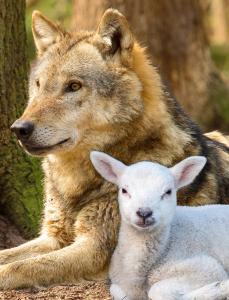
Isaiah 11:6, “the wolf will live with the lamb.” Wolf & Lamb Ethics?
However, I have some caveats: it’s not clear to me that we’re as close to cultivated meat as its proponents claim. Currently the efficiency of converting feed to chicken meat is about 2.5 lbs. grain/lb of chicken. Given the immense scale of infrastructure that’d be required, (buildings, roads, all the machinery needed to grow the stuff, trained personnel), and the ecological harm of such giant meat-growing factories, it might not turn out to be that much of an economic and environmental winner after all. (On greenhouse gas production of cultivated meat, (See: “Climate Impacts of Cultured Meat and Beef Cattle“).
The turn to cultivated meat takes us toward a more anthropocentric world that we currently inhabit—indeed, meat would come from “the store,” and school field trips would take kids to see the giant stainless steel tanks and be told that’s where meat comes from. There’s a loss in that increased distance of humans from non-human creation, even when the animals’ ultimate destination is the freezer. While factory farming is problematic in many ways, the loss of the family farm is a cultural loss. Farmers who work on small-scale farms, still the norm in much of the world, are dependent on the earth and non-human animals for their survival, a kind of partnership that would be lost with industrialized meat. Further, if factory farms are problematic, why would large-scale industrialization of meat cultivation improve matters, especially in terms of social-justice concerns such as worker safety and pay?
Question Two. Is there anything in Roman Catholic natural law theory that could provide guidance in sorting out the food justice issues raised by no-kill cultivated meat?
LF. The essence of natural law is that we flourish when we live in accord with what is natural for us. Humans are naturally omnivores, that is, we eat meat and vegetables. While humans certainly can live well as vegetarians, we are just not built for that dietary style as are the true herbivores. However, there’s nothing in that which that would distinguish cultivated from animal-sourced meat.

Dr. Lisa Fullam. Fine wine with a fine canine.
Catholics are just coming to an awareness of the interconnectedness of all creation. It’s not a new insight—St. Francis is one in a long history of seeing non-human creation as our brothers and sisters with intrinsic value to God. Pope Francis re-opened that line of thinking with Laudato Sí’, calling for a renewed reverence for the earth and its creatures, setting humankind within creation, not set above it. We are, naturally, part of creation, not its masters. However, the vast over-consumption of meat in the developed world has created vicious market incentives for a cheaper and more plentiful meat supply, which has proven to be ecologically destructive and often cruel to animals who are also precious to God. Too many people’s disconnection from–and indifference to—where their food comes from, is a spiritual problem of disconnection from incarnate, corporeal reality.
Virtues are the content of flourishing, the spelling out of the requisites of human nature. Here I have a couple questions: will access to cheap and cruelty-free cultivated meat only serve to feed an out-of-control appetite for animal protein in the first place? In other words, in the developed world, we eat too much meat to our ecological, social-justice, and nutritional ill already. It’s a form of intemperance, when we see what looks tasty and demand more and more of it. Cultivated meat, instead of bringing us to a more balanced kind of eating, will just make it easier to eat more meat with fewer qualms.
Then there’s the virtue of justice: What about the developing world, where protein is scarce? Years ago, for a short time, I worked as the local vet for an agricultural development project in Jamaica. We tried to help farmers in ways that are environmentally and economically sustainable, such as providing an imported Boer buck to help breed “beefier” local goats.
Industrialized meat will take meat production out of the hands of local farmers, make them dependent on (likely) foreign companies for infrastructure and jobs at the factories. Just as Dole, Nestle, and other companies exploit local labor for fruit, coffee, chocolate, et al., so it seems likely to me that cultivated meat risks following that same path of taking the ability to make one’s own living off the land away from local people and hand them over to the mercies of the multi-nationals. In my opinion, if the Catholic magisterium ever speaks about the question of cultivated meat, they’re likely to laud the possibility of feeding the hungry (a good thing!) without examining the questions of economic justice that could arise.
But another food justice question: when children are deprived of good quality protein, the result is both physical and intellectual stunting of growth—an intergenerational burden on those afflicted. If, somehow, cultivated meat might find its way preferentially to those communities most in need, that might break the cycle of suffering caused by lack of access to good nutrition.
Question Three. As you assess the future of Planet Earth’s ecological health, do you forecast that widespread use of no-kill cultivated meat products could have a positive impact on food justice?
Could they? Sure! Right now, the ecological impact of cultivated meat is unclear. One question I have is the sourcing of nutrient broth for brewing the meat. Is the nutrient broth a plant product? (That seems likely to me.) Where will it come from? If we replace animal agriculture with meat cultivation factories, will we find ourselves still growing huge monocultures of corn to feed them? If so, they’ll doubtless be more efficient, (cutting out the “middle-chicken,”) but will we run into the same problem on a larger scale? Even if so, the gain in efficiency might mitigate the planetary impact, if the greenhouse gas burden is lessened. We might do better to invite people to moderate the use of meat (animal or cultivated) as a step toward a healthier planet.
Question Four. Anything else you’d like to say about food justice?
As I think of these questions, I realize I’ve been thinking a lot about the distinction between “Big Ag” and the rapidly vanishing small farmer. Many of the issues I raise are intrinsic to factory farming, though not absent from small agriculture, including cruel treatment of animals, low wages for workers, dangerous working conditions, etc. But the small farmer is disappearing because it is impossible to compete with Big Ag without intensive government support, and there’s really no appetite for that.
Boutique farms are surviving, and while they do a much better job of understanding the relationship between the farmer and the land and the animals as a partnership, they also charge very high prices for their products. The day of the small self-sustaining farmer, at least in the developed world, is over, alas. We see them at the county fair but fewer and fewer in the overall agricultural world. In small farms, most of the livestock live decent lives, in part because of enlightened self-interest—happy animals eat more and grow faster—and in part because the farmers are connected to their livestock in ways that non-farmers don’t really understand.
A philosophical question from the animals’ point of view, that doesn’t really fit into what I’ve said above—is it better to live a decent life that ends with a quick death at the slaughterhouse, or never to exist at all, replaced by cultivated meat?
And the rise of cultivated meat, even though it would still likely come branded “Tyson” and “Perdue,” even if it came with the array of environmental and social-justice issues associated with those companies now, would at least cut out the suffering of the animals used for meat.
And imagine a world where the vast majority of meat is cultivated, and only a small portion animal-sourced. It would be a far more urban, anthropocentric, and industrialized world than we now live in. Intense intergovernmental cooperation would be required to actually feed the hungry—and it’s not clear to me that the political will to do so is widespread enough. But there’s always hope….
What’s Next?
 Thank you, Dr. Fullam, for such precise and provocative discourse about no-kill cultivated meat within the framework of global food justice. On the one hand, you provide hope that technology can contribute to stability in the global protein supply. On the other hand, you are aware of human sinfulness and the sidetracks that could derail the positive prospects.
Coming up next we will ask a Christian vegetarian about no-kill cultivated meat. At some point we will want to turn public theology to look at Food Theology. We’ll take a step in that direction with a future post. We will ask Norman Wirzba, who has written a book on this topic: Food and Faith: A Theology of Eating. Get ready to click.
Here is an illuminating video from TED.
Which is better for you: real meat or fake meat?
▓
Brian Brozovic is a student at Pacific Lutheran Theological Seminary and Ted Peters is an emeritus professor at Pacific Lutheran Theological Seminary in Berkeley, California, USA. Visit Professor Peters’ website: TedsTimelyTake.com.
▓
Women in Religion
Food and Religion
Business, Finance and Religion

About Brian Brosovic and Ted Peters
Brian Brozovic is a student at Pacific Lutheran Theological Seminary and Ted Peters is an emeritus professor at Pacific Lutheran Theological Seminary in Berkeley, California, USA. Visit Professor Peters’ website: TedsTimelyTake.com. You can read more about the author here.
Previous Post

October 17, 2022
Jack London 2: White Fang
Next Post

October 20, 2022 To Eat? Part Seven. Christian Vegetarian?
Browse Our Archives
Select a Category Afterlife America in Crisis Ancient Alien Apocalypse Art Artificial Intelligence Astrobiology Astrotheology Atheism Big History Buddhist Catholic Christian Nationalism Christmas Comparative Theology Death Ecology Ethics ETI Evangelical Evolution Existential Questions Free Will General Christian Hermeneutics Hindu https://www.patheos.com/blogs/allsetfree/2020/12/sins-we-need-to-talk-about/?utm_source=Newsletter&utm_medium=email&utm_campaign=Christians+For+a+Better+Christianity&utm_content=43&lct Interreligious Islam Jewish Justice Latter-Day Saints Literature Literature and Theology Lutheran Methodism Mormonism Nonreligious ontology Orthodox Pagam Prayer progressive Christian PT 6 Dignity Public Theology Race racial justice Religious Liberty Romance Satan Scapegoat Science & Religion Science and Religion social justice Spirituality SR 8 Transhumanism Systematic Theology Taoism Ted Peters UAP UFO Uncategorized War
Select a Month September 2026 August 2026 July 2026 June 2026 May 2026 April 2026 March 2026 February 2026 December 2025 November 2025 October 2025 September 2025 August 2025 July 2025 June 2025 May 2025 April 2025 March 2025 February 2025 January 2025 December 2024 November 2024 October 2024 September 2024 August 2024 July 2024 June 2024 May 2024 April 2024 March 2024 February 2024 January 2024 December 2023 November 2023 October 2023 September 2023 August 2023 July 2023 June 2023 May 2023 April 2023 March 2023 February 2023 January 2023 December 2022 November 2022 October 2022 September 2022 August 2022 July 2022 June 2022 May 2022 April 2022 March 2022 February 2022 January 2022 December 2021 November 2021 October 2021 September 2021
Follow Us!
TAKE THE
Religious Wisdom Quiz
What was Nehemiah's royal position?
Select your answer to see how you score.
Priest Cupbearer Governor Soldier
Related posts from Public Theology

Why Public Theology Needs a Theology of Nature

America's 250th Birthday Gift: Civic Renewal

Do You Believe in UFOs? A Theologian's Answer.

Free Will and Christian Freedom TWO
TRENDING AT PATHEOS Progressive Christian

What Being a Modern-Day Apostle Means to Me
In my last column, I discussed the ins and outs of modern-day...

Did Ancient China Once Worship the God of...
Across human history, a common thread weaves through the origins of the...

Love Your Neighbor – Including Earth-Kin: Lev. 19,...
God’s command to love your neighbor means acting in an ethical and...

Lead a Church Study of “Jesus and Lao...
Guest writer Jack Thomas (The Irreverent Reverend) reflects on leading his church...

Pastoral Wisdom for Responding to Sermon Pushback
Getting sermon pushback on your social justice sermon? Learn practical, Proverbs-based strategies...

Principles for Understanding the Apostolic Ministry Today
Whenever people discover that my formal ministry title is "apostle," as in...
view all Progressive Christian blogs
Ad-Free & Subscriber Log-In Subscription Support
- About Us
- 2026 Calendar
- Videos
- Podcasts
- Library of World Religions
- Faith In Media Tracker
- Advertise With Us
- Write for Us
- Privacy Policy
- Terms of Service
- Do Not Sell My Data
- Contact Us
- Radiant Digital
- Manage Newsletter Subscriptions
- Unsubscribe From Notifications
- Sitemap
Copyright 2008-2026, Patheos. All rights reserved.
Subscription Support Ad-Free & Subscriber Log-In
Follow Patheos