
BuddhistCatholicContemplativeEvangelicalGeneral ChristianHinduJewishLatter-day SaintMuslimNew VisionsProgressive Christian
Beliefs
- Buddhist
- Catholic
- Contemplative
- Evangelical
- General Christian
- Hindu
- Jewish
- Latter-day Saint
- More Voices
- Muslim
- New Visions
- Pagan
- Progressive Christian
Topics
- Religion News
- Food and Religion
- Sports and Religion
- Religious Art
- Religious Music and Entertainment
- Religious Events
- History and Religion
- Style and Religion
- Politics and Religion
- Women in Religion
- Recreation Outdoors and Religion
- Business Finance and Religion
- Careers Workplace and Religion
- Education and Religion
- Family Parenting and Religion
- Health Fitness and Religion
- Home and Religion
- Relationships and Religion
- Technology and Religion
- Travel and Religion
Columnists
- Buddhist Columnists
- Business Finance and Religion Columnists
- Careers Workplace and Religion Columnists
- Catholic Columnists
- Contemplative Columnists
- Education and Religion Columnists
- Evangelists Columnists
- Family Parenting and Religion Columnists
- General Christian Columnists
- Health Fitness and Religion Columnists
- Hindu Columnists
- History and Religion Columnists
- Home and Religion Columnists
- Jewish Columnists
- More Voices Columnists
- Latter Day Columnists
- Muslim Columnists
- New Visions Columnists
- Nonreligious Columnists
- Pagan Columnists
- Politics and Religion Columnists
- Progressive Columnists
- Recreation Outdoors and Religion Columnists
- Relationships and Religion Columnists
- Religion News Columnists
- Religious Art Columnists
- Religious Events Columnists
- Religious Music and Entertainment Columnists
- Sports and Religion Columnists
- Style and Religion Columnists
- Technology and Religion Columnists
- Travel and Religion Columnists
- Women in Religion Columnists
Resource Library
- 2026 Calendar
- Library of World Religions
- The 100 Most Holy Places on Earth
- Patheos Answers
- Podcasts
- Videos
- Faith Leaders Database
- Anglican Episcopalian
- Bahai
- Baptist
- Buddhism
- Christianity
- Confucianism
- Eastern Orthodoxy
- Hinduism
- Holiness and Pentecostal
- ISKCON
- Islam
- Judaism
- Lutheran
- Methodist
- The Church of Jesus Christ of Latter-day Saints
- New Age
- Paganism
- Presbytarian and Reformed
- Protestantism
- Religion Behind the Scenes
- Roman Catholic
- Scientology
- Shia Islam
- Sikhism
- Sufism
- Sunni Islam
- Taoism
- Zen
- See all religions
Research Tools
 Ad-Free & Subscriber Log-In Subscription Support
Ad-Free & Subscriber Log-In Subscription Support
Follow Patheos 

- Trending:
- Forgiveness
- |
- Marriage
- |
- Consciousness
- |
- Death Penalty
- |
- Election
- |
- Halloween

- Home
- Progressive Christian
- History and Religion
- Resentment vs Compassion 2: Reparations
Resentment vs Compassion 2: Reparations
Last updated on: July 4, 2023 at 3:15 pm by Ted Peters
Resentment vs Compassion 2: Reparations 2023-07-04T15:15:27-07:00 Ted Peters
Patheos Explore the world's faith through different perspectives on religion and spirituality! Patheos has the views of the prevalent religions and spiritualities of the world.
Resentment vs Compassion
PT 3202. Part 2: From Ressentiment to Reparations
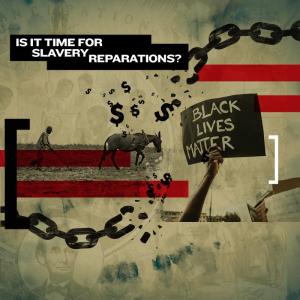 From ressentiment to retributive justice via reparation. This is our task here in Part 2 of Resentment vs. Compassion.
In Part 1, we borrowed the French notion of ressentiment from philosopher Max Scheler and theologian Bernard Lonergan. Ressentiment adds something to our English term, ‘resentment’. It adds the re-feeling of someone else’s experience of injustice, usually injustice perpetrated against an ancestor. Most often ressentiment is the sentiment of an underclass seeking to overthrow the class of privilege. Ressentiment easily becomes a revolutionary ideology that justifies the pursuit of retributive justice, mob spirit, and sometimes violence. One the one hand, we praise ressentiment because justice is at stake. On the other hand, self-justification becomes a threat to the social order. In this post, let’s look at some examples.
From Ressentiment to Reparations
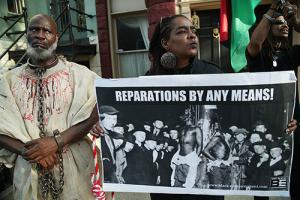
WASHINGTON, DC – JULY 01: Activists stage a protest to mark the National Reparations Day outside the residence of U.S. Senate Majority Leader Sen. Mitch McConnell (R-KY) July 1, 2019 on Capitol Hill in Washington, DC. Activists held a “First Amendment Speak-out” in protest of McConnell’s “offensive and dismissive remarks on reparations.” (Photo by Alex Wong/Getty Images)
“Following slavery, we continue to live under systemic racism,” said Love Maia in a speech before the Associated Students Senate at the University of California at Santa Barbara on May 11, 2022. “Recognition of this is something that’s extremely important, and between the reparations study and the struggles that our community have within the UC system, it’s really crucial for us to have support at this time.” The floor debate had to do with giving reparations to Black students.
Support for reparations is justified as support for retributive justice.
This speech in support of reparations for Black students provides an example of ressentiment at work. Please note that the rhetoric re-feels the oppression of slaves two centuries ago. Such re-feeling extends over time. It is a feeling of hostility, anger, indignation that is neither repudiated nor directly expressed. What it attacks is the value-quality that the superior class possesses. In this case, the superior class is white privilege pervading the University of California educational system. I submit that this demand for reparations gives voice to straightforward and perceptible ressentiment at work.[1]
Great Replacement Theory in France

Book “Le Grand Remplacement”
Jean Renaud Gabriel Camus, known in France as an “edgy gay writer”, published Le Grande Remplacement (The Great Replacement) in 2011. Camus complains that “replacement elites” are colluding against white French and Europeans. Camus alleges that these conspirators plan to replace the white race with foreigners brought to France from Africa and the Middle East. French history will be erased when it gets replaced with Muslim culture. Camus supports remigration–that is, a soft type of ethnic cleansing by sending immigrants and their families back to their country of origin and a complete cessation of future immigration.
Reparation in Great Replacement Theory takes the form of remigration, denying to foreigners the rights and opportunities of the traditional racial make-up of the country.
Camus’ critics accuse him of being a conspiracy theorist. The social power of Grand Replacement Theory is that it capitalizes on ressentiment, on the alleged injustice perpetrated against the white race and against French culture. What is missing in Grand Replacement Theory is compassion for the immigrant families. As Great Replacement Theory spreads around the world to other countries, so also does anti-immigrant sentiment.
What we do not see within Great Replacement Theory is re-feeling the feeling of others. African American supporters of reparation, recall, re-feel the feelings of unjustly treated slaves two centuries ago. Perhaps the English, ‘resentment’, more accurately describes replacement ideology than does ressentiment.
Deflected Ressentiment in President Donald Trump’s Xenophobic Rhetoric

Former U.S. President Donald Trump
Ressentiment is not limited to the underclass envying the dominant class. We turn to another example of ressentiment at work, one that similarly scapegoats immigrants. The Great Replacement Theory is now an immigrant in America.
In a campaign speech on June 21, 2017, then U.S. presidential candidate Donald J. Trump stirred the crowd with xenophobic rhetoric. Note how he opened by dividing the world’s peoples into two categories, ‘us’ and ‘them’. Note also how the word, ‘gangs’, is a dog whistle to alert us to Spanish speaking immigrants crossing into the United States through Mexico.
“We have tough people. Our people are tougher than their people. Our people are tougher and stronger and meaner and smarter than the gangs. One by one we are finding the illegal gang members, drug dealers, thieves, robbers, criminals and killers. And we are sending them the hell back home where they came from. And once they are gone, we will never let them back in. Believe me. The predators and criminal aliens who poison our communities with drugs and prey on innocent young people, these beautiful, beautiful, innocent young people will, will find no safe haven anywhere in our country. And you’ve seen the stories about some of these animals. They don’t want to use guns, because it’s too fast and it’s not painful enough. So they’ll take a young, beautiful girl, 16, 15, and others and they slice them and dice them with a knife because they want them to go through excruciating pain before they die. And these are the animals that we’ve been protecting for so long.”[2]
What is happening here? One would ordinarily expect the underclass–in this case the blue-collar working class or, in Marxist terms, the proletariat–to envy if not hate the more privileged wealthy class. One would expect working class voters to dub the rich Mr. Trump as their economic competitor, even their enemy. But, clever Mr. Trump deflected working class resentment away from himself and redirected it toward Spanish speaking immigrants. Like a radio relay station, Trump re-channeled the energy of ressentiment away from himself and toward a Latinex scapegoat. The entire scapegoat mechanism was almost imperceptible, yet still politically potent.
One scholar, Casey Ryan Kelly, places Trump squarely within the ressentiment category.
“Thus, I argue that ressentiment functions as a generative force—providing a link between emotions, ideology, and collective identity —that sustains the affective charge of detraction and revenge. My goal is to reframe Trump’s constant detractions, disavowals, and impulse to revel in pain as parts of a broader emotional-moral framework that seeks to constantly regenerate the felt intensities that underwrite demands for revenge and lamentations of victimhood” (Kelly 2020. 2-24, at 5).
Kelly further identifies within this presidential rhetoric a disguised form of justice. Not mere reparation, but vicious revenge. The immoral Latinx threaten to contaminate America, because they “poison our communities with drugs and prey on innocent young people.” Hispanic immigrants should be punished by denying them “safe haven.” Kelly surmises: “It is not simply that Trump demands retribution for injuries committed against him and his electorate—to be sure, he does—but that he contorts revenge into a civic virtue” (Kelly 2020. 2-24, at 16).
Ressentiment here has taken the form of a political ideology. This ideology is justified on the grounds that Central American immigrants threaten to “poison” the American ‘in’ group. In defense, America responds rightfully when taking revenge.
Ressentiment in Progressive Christian Confession

Progressive Christianity according to Lydia Sohn.
In his “A Liturgy for the Confession of Racial Injustice,” Patheos columnist Tim Shuttle prays that both our eyes and ears will become open.
Ldr: We confess that we are often blind to our own privilege.
All: Give us a holy curiosity about what being Black in America is really like; and what it means to suffer injustice because of race…[2]
Ldr: Open our ears to hear the cries of those wounded by racial discrimination, and their passionate appeals for change.
All: Strengthen our resolve to make amends for past injustices and to right the wrongs of history.
We white ‘n’ woke progressive Christians confess that we are blind and deaf toward those who are Black or Latinx. Yet, at the same time that we confess how we are blind and deaf, we want to re-feel what Black and Latinx people feel when they experience the short end of white privilege. What kind of ressentiment twisting is going on here?
The Near Imperceptibility of Ressentiment
Let’s sift out some of the nuances. Let’s try to show why ressentiment is sometimes imperceptible.
Our English term, resentment, applies to a social situation that generates frustration and acrimony. One familiar example would be the heavy-handed policing in American cities of black neighborhoods. This situation causes African American families to have “the talk” with their growing teenagers to mitigate prompting police violence. Frustration characterizes African American social understanding of racism that just never seems to get better.
The more complicated French term, ‘resentment’, relies on a past social situation that included domination and oppression. Today’s descendants of previous generations who were victimized by American slavery or South African Apartheid may re-feel the victimization of their ancestors. Ressentiment may become codified in ideological form such as demand for reparation or Grand Replacement Theory. In ideological form, ressentiment maintains a perpetual sense of alienation, injustice, and righteous indignation (Fassin 2013).

“Cain and Abel,” by Daniele Crespi. Cain resented Abel because Abel outclassed him.
Ordinarily, one would expect ideological ressentiment to take hold in the underclass who resents the privilege of the dominating class. Rhetoric denouncing the rich on behalf of the welfare of the poor is even biblical. According to Jesus, **“**it is easier for a camel to go through the eye of a needle than for someone who is rich to enter the kingdom of God” (Matthew 19:24). Does Jesus represent widespread ressentiment against the rich? I don’t believe so. But, let’s press forward.
Here is one of my observations. Underclass resentment is by no means merely an inevitable product of dialectical materialism, as the Marxists believe. To cite campaigning candidate Donald J. Trump again, he bragged repeatedly, “I’m rich. I’m very rich.” In no way did this discourage the proletariat. Blue collar working people voted for the rich man who boasted about his privilege. Why? These voters made no secret of their desire to become rich just like the candidate. They thought this president would pave their own road to wealth.
Immigrants and natives in the working class envied what the rich Donald Trump represented. Yet, they did not deny the value of wealth or renounce the dominant economic class. They did not scapegoat the rich. Rather, their envy led them to imitate, to hope, and to support the dominant economic class.
Somehow, enigmatically, Trump’s rhetoric was able to turn working class envy into xenophobia against Central American immigrants. Perhaps immigrants within the country along with their native co-workers thought that by scapegoating those wanting to enter the country created a bond, a sense of unity between the bourgeoisie and proletariat.
Self-Justification within Ressentiment
Ressentiment is characteristically present in what I frequently call, self-justification coupled with scapegoating. Ressentiment is where we find justification for mob violence.
Our friends at Wikipedia describe ressentiment as a sense of weakness or inferiority complex. Perhaps even jealousy. The resentful mob feels it has a “cause.” This feeling generates a rejecting/justifying value system, or morality, which attacks or denies the perceived source of one’s frustration. The mob’s value system is then used as a means of justifying one’s own weaknesses by identifying the source of envy as objectively inferior. Its actually a defense mechanism that prevents the resentful individual or group from addressing and overcoming their insecurities and flaws. The ego creates an enemy in order to insulate itself from culpability.
Might we say that Trump’s genius was this: he diverted acrimony that should have been directed against him toward the Central American migrants? America’s blue-collar class did not demand reparation from the rich New York real estate mogul. Rather, the underclass felt a bond with the “rich” man because both took a stand against Spanish speaking families knocking on America’s southern door. Scapegoating creates community. In this case, the community became a voters’ block that led to the election of a president.
What’s Next?
Here in Part 2 of our series of posts on “Resentment vs Compassion,” we reiterate that our English term, ‘resentment’, is like a single strand of fettuccini. It’s simple: when we envy someone else’s privilege we might be motivated to demand reparation or even to take revenge. When we turn to the French, ‘ressentiment‘, we get an entire bowlful of fettuccini with all strands intertwined. Our task is to untwine ressentiment‘s nuances, connotations, political ideologies, scapegoating, and perhaps mob violence.
Yet, we are asking: might there exist a dimension of ressentiment within compassion? After all, in both ressentiment and compassion we re-feel what victims of injustice felt?
Here’s where we are and where we’re going.
Resentment vs Compassion. Part 1: From Resentment to Ressentiment
Resentment vs Compassion Part 2: From Ressentiment to Reparations
Resentment vs Compassion Part 3: Russian Christian Nationalism
Resentment vs Compassion Part 4: American Christian Nationalism
Resentment vs Compassion. Part 5:” Ressentiment in the White ‘n’ Woke Unhappy Consciousness
Resentment vs Compassion. Part 6: Ressentiment with Copmpassion
Resentment vs Compassion Part 7: Christian Natiionalism’s Decline Narrative
Resentment vs Compassion Part 8: The Unhappy Consciousness Narrative
Resentment vs Compassion Part 9: To Slay the Christian Nationalist Dragon
Resentment vs Compassion Part 10: Don’t trust your pastor
Resentment vs Compassion Part 11: Christian Nationalism vs Anti-Christian Nationalism
What’s next? In Parts 3 and 4 we will watch the fettuccini strands tie together in Christian nationalism in both Russia and America. In Part 5 we will untwine the fettuccini strands of the unhappy consciousness pervading white ‘n’ woke progressive Christianity as our progressive friends try to handle ressentiment, Finally, we will try to construct a braided relationship between resentment and compassion.
▓

Ted Peters
Ted Peters is a Lutheran pastor and emeritus seminary professor, teaching theology and ethics. He is author of Short Prayers and The Cosmic Self. His one volume systematic theology is now in its 3rd edition, God—The World’s Future (Fortress 2015). His book, God in Cosmic History, traces the rise of the Axial religions 2500 years ago. He has undertaken a thorough examination of the sin-and-grace dialectic in two works, Sin: Radical Evil in Soul and Society (Eerdmans 1994) and Sin Boldly! (Fortress 2015). Watch for his forthcoming, The Voice of Christian Public Theology (ATF 2022). See his website: TedsTimelyTake.com.
Ted Peters’ fictional series of espionage thrillers features Leona Foxx, a hybrid woman who is both a spy and a parish pastor.
▓
Notes
[1] Appeal for reparations makes sense–whether one supports or rejects specific reparations proposals–because racial justice is the current cultural presumption. “Racism, sexism, and other social plagues are routinely denounced and marked as both aberrant and unacceptable” (Radford, 2022, p. 304). That is the norm.
[2] “Many in the public believe, incorrectly, that Trump’s opinions on the matter reflect those of most Americans. But data suggest that Trump is not nearly as influential as he—and both his supporters and critics—hope or fear. A Gallup poll released June 21, 2018, found that more Americans than ever—three-quarters, a record number, in fact—believe that immigration is a good thing for the United States” (Radford, 2022, p. 156).
References
Deane-Drummond, Celia. 2017. “Empathy and the Evolution of Compassion,” Zygon 51:1:258-178.
Fassin, Didier. 2013. “On Resentment and Ressentiment.” Current Anthropology 54:3 249-267.
Kelly, Casey Ryan. 2020. 2-24. “Donald J. Trump and the rhetoric of ressintement.” Quarterly Journal of Speech 106:1 file:///C:/Users/Ted/OneDrive/Documents/My%20Research/Kelly%20Trump%20Ressentiment.pdf.
Lonergan, Bernard. 1972. Method in Theology. New York: Herder and Herder.
Peters, Ted. 1993. Sin: Radical Evil in Soul and Society. Grand Rapids MI: Wm B Eerdmans.
Radford, Benjamin. 2022. America the Fearful. Jefferson NC: McFarland.
Rahner, Karl. 1961-1976. “Christology within an Evolutionary View of the World.” In Theological Investigations 22 Volumes, by Karl Rahner, 5:157-192. New York: Seabury.
—. 1978. Foundations of the Christian Faith. New York: Seabury Crossroad.
Scheler, Max. 1915, 1994. Ressentiment. Marquette: Marquette University Press: file:///C:/Users/Ted/OneDrive/Documents/My%20Research/Scheler%20Max%20Ressentiment.pdf.
History and Religion
Education and Religion

About Ted Peters
Ted Peters is a Lutheran pastor and emeritus seminary professor, teaching theology and ethics. He is author of Short Prayers and The Cosmic Self. His one volume systematic theology is now in its 3rd edition, God—The World’s Future (Fortress 2015). His book, God in Cosmic History, traces the rise of the Axial religions 2500 years ago. He has undertaken a thorough examination of the sin-and-grace dialectic in two works, Sin: Radical Evil in Soul and Society (Eerdmans 1994) and Sin Boldly! (Fortress 2015). Watch for his forthcoming, The Voice of Christian Public Theology (ATF 2022). See his website: TedsTimelyTake.com. Ted Peters’ fictional series of espionage thrillers features Leona Foxx, a hybrid woman who is both a spy and a parish pastor. You can read more about the author here.
Previous Post

October 24, 2022
Resentment vs Compassion 1: Ressentiment
Next Post

October 27, 2022 Resentment 3: Russian Christian Nationalism
Browse Our Archives
Select a Category Afterlife America in Crisis Ancient Alien Apocalypse Art Artificial Intelligence Astrobiology Astrotheology Atheism Big History Buddhist Catholic Christian Nationalism Christmas Comparative Theology Death Ecology Ethics ETI Evangelical Evolution Existential Questions Free Will General Christian Hermeneutics Hindu https://www.patheos.com/blogs/allsetfree/2020/12/sins-we-need-to-talk-about/?utm_source=Newsletter&utm_medium=email&utm_campaign=Christians+For+a+Better+Christianity&utm_content=43&lct Interreligious Islam Jewish Justice Latter-Day Saints Literature Literature and Theology Lutheran Methodism Mormonism Nonreligious ontology Orthodox Pagam Prayer progressive Christian PT 6 Dignity Public Theology Race racial justice Religious Liberty Romance Satan Scapegoat Science & Religion Science and Religion social justice Spirituality SR 8 Transhumanism Systematic Theology Taoism Ted Peters UAP UFO Uncategorized War
Select a Month September 2026 August 2026 July 2026 June 2026 May 2026 April 2026 March 2026 February 2026 December 2025 November 2025 October 2025 September 2025 August 2025 July 2025 June 2025 May 2025 April 2025 March 2025 February 2025 January 2025 December 2024 November 2024 October 2024 September 2024 August 2024 July 2024 June 2024 May 2024 April 2024 March 2024 February 2024 January 2024 December 2023 November 2023 October 2023 September 2023 August 2023 July 2023 June 2023 May 2023 April 2023 March 2023 February 2023 January 2023 December 2022 November 2022 October 2022 September 2022 August 2022 July 2022 June 2022 May 2022 April 2022 March 2022 February 2022 January 2022 December 2021 November 2021 October 2021 September 2021
Follow Us!
TAKE THE
Religious Wisdom Quiz
What happened when Peter tried to walk on water?
Select your answer to see how you score.
He sank when he doubted He led other disciples out The Spirit descended upon him He ran ahead of Jesus
Related posts from Public Theology

Why Public Theology Needs a Theology of Nature

America's 250th Birthday Gift: Civic Renewal

Do You Believe in UFOs? A Theologian's Answer.

Free Will and Christian Freedom TWO
TRENDING AT PATHEOS Progressive Christian

What Being a Modern-Day Apostle Means to Me
In my last column, I discussed the ins and outs of modern-day...

Did Ancient China Once Worship the God of...
Across human history, a common thread weaves through the origins of the...

Love Your Neighbor – Including Earth-Kin: Lev. 19,...
God’s command to love your neighbor means acting in an ethical and...

Lead a Church Study of “Jesus and Lao...
Guest writer Jack Thomas (The Irreverent Reverend) reflects on leading his church...

Pastoral Wisdom for Responding to Sermon Pushback
Getting sermon pushback on your social justice sermon? Learn practical, Proverbs-based strategies...

Principles for Understanding the Apostolic Ministry Today
Whenever people discover that my formal ministry title is "apostle," as in...
view all Progressive Christian blogs
Ad-Free & Subscriber Log-In Subscription Support
- About Us
- 2026 Calendar
- Videos
- Podcasts
- Library of World Religions
- Faith In Media Tracker
- Advertise With Us
- Write for Us
- Privacy Policy
- Terms of Service
- Do Not Sell My Data
- Contact Us
- Radiant Digital
- Manage Newsletter Subscriptions
- Unsubscribe From Notifications
- Sitemap
Copyright 2008-2026, Patheos. All rights reserved.
Subscription Support Ad-Free & Subscriber Log-In
Follow Patheos