
BuddhistCatholicContemplativeEvangelicalGeneral ChristianHinduJewishLatter-day SaintMuslimNew VisionsProgressive Christian
Beliefs
- Buddhist
- Catholic
- Contemplative
- Evangelical
- General Christian
- Hindu
- Jewish
- Latter-day Saint
- More Voices
- Muslim
- New Visions
- Pagan
- Progressive Christian
Topics
- Religion News
- Food and Religion
- Sports and Religion
- Religious Art
- Religious Music and Entertainment
- Religious Events
- History and Religion
- Style and Religion
- Politics and Religion
- Women in Religion
- Recreation Outdoors and Religion
- Business Finance and Religion
- Careers Workplace and Religion
- Education and Religion
- Family Parenting and Religion
- Health Fitness and Religion
- Home and Religion
- Relationships and Religion
- Technology and Religion
- Travel and Religion
Columnists
- Buddhist Columnists
- Business Finance and Religion Columnists
- Careers Workplace and Religion Columnists
- Catholic Columnists
- Contemplative Columnists
- Education and Religion Columnists
- Evangelists Columnists
- Family Parenting and Religion Columnists
- General Christian Columnists
- Health Fitness and Religion Columnists
- Hindu Columnists
- History and Religion Columnists
- Home and Religion Columnists
- Jewish Columnists
- More Voices Columnists
- Latter Day Columnists
- Muslim Columnists
- New Visions Columnists
- Nonreligious Columnists
- Pagan Columnists
- Politics and Religion Columnists
- Progressive Columnists
- Recreation Outdoors and Religion Columnists
- Relationships and Religion Columnists
- Religion News Columnists
- Religious Art Columnists
- Religious Events Columnists
- Religious Music and Entertainment Columnists
- Sports and Religion Columnists
- Style and Religion Columnists
- Technology and Religion Columnists
- Travel and Religion Columnists
- Women in Religion Columnists
Resource Library
- 2026 Calendar
- Library of World Religions
- The 100 Most Holy Places on Earth
- Patheos Answers
- Podcasts
- Videos
- Faith Leaders Database
- Anglican Episcopalian
- Bahai
- Baptist
- Buddhism
- Christianity
- Confucianism
- Eastern Orthodoxy
- Hinduism
- Holiness and Pentecostal
- ISKCON
- Islam
- Judaism
- Lutheran
- Methodist
- The Church of Jesus Christ of Latter-day Saints
- New Age
- Paganism
- Presbytarian and Reformed
- Protestantism
- Religion Behind the Scenes
- Roman Catholic
- Scientology
- Shia Islam
- Sikhism
- Sufism
- Sunni Islam
- Taoism
- Zen
- See all religions
Research Tools
 Ad-Free & Subscriber Log-In Subscription Support
Ad-Free & Subscriber Log-In Subscription Support
Follow Patheos 

- Trending:
- Forgiveness
- |
- Marriage
- |
- Consciousness
- |
- Death Penalty
- |
- Election
- |
- Halloween

- Home
- Progressive Christian
- History and Religion
- How does Jesus Save? Part One
How does Jesus Save? Part One
Last updated on: May 7, 2023 at 6:31 pm by Ted Peters
How does Jesus Save? Part One 2023-05-07T18:31:57-07:00 Ted Peters
Patheos Explore the world's faith through different perspectives on religion and spirituality! Patheos has the views of the prevalent religions and spiritualities of the world.
How does Jesus save?
Part One: Should we dump atonement?
ST 2101
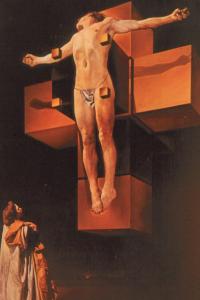
Cross. Salvador Dali
Shouldn’t progressive Christians jettison the doctrine of atonement like crumpled Christmas wrapping paper?
Penal Substitution Theory or PST is having a bad day. Theologians treat PST like Fox News treats the White House. Keith Giles posts complaints in Patheos, “7 Reasons Why Jesus Christ was NOT Sacrificed For Your Sins.” Matthew Distefano fears PST makes him ask whether he needs to be “Saved from God?” Emma Higgs tells us “why Penal Substitutionary Atonement Theory makes me want to throw up a little bit in my mouth.” Gene Veith feels he must defend atonement against accusations of “Cosmic Child Abuse.” Much less viscerally Pascal Emmanuel Gobry shares his “Thoughts Against Penal Substitutionary Atonement.”
[See Video: Models of Atonement]
Throwing Bible darts at Penal Substitution Atonement Theory
Let’s put these complaints up on the wall like a dart board and throw Bible verses at them. Here are some Bible missiles we can throw.
- Christ Jesus, whom God put forward as a sacrifice of atonement by his blood, effective through faith. He did this to show his righteousness/justification, because in his divine forbearance he had passed over the sins previously committed [Romans 3:25].
- For our paschal lamb, Christ, has been sacrificed [1 Corinthians 5:7].
- But when Christ had offered for all time a single sacrifice for sins, he sat down at the right hand of God [Hebrews 10:12].
- Jesus Christ the righteous/just, and he is the atoning sacrifice for our sins [1 John 2:1-2].
Every one of these Bible darts seems to hit and stick in the target. A key term frequently used by the New Testament for sacrifice, hilasteron, already connotes expiation or propitiation. So, it looks like the Bible dart throwers will win the prize. PST is biblical!
If PST is biblical, why can’t the systematic theologians just admit it and stop all their bad-mouthing and caliginous grousing?
From Biblical Exegesis to Systematic Theology
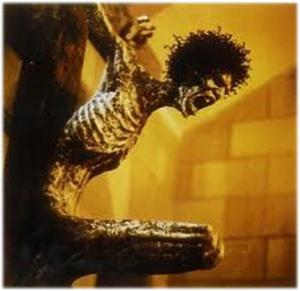
Cross. Minjung Theology. Korea.
Part of the impasse is due to this: there are some questions which the biblical exegete is not likely to be able to answer. Yet, they’re very important questions to the systematic theologian. Here they are. Does there exist a metaphysical mechanism of sacrifice? Does God require creaturely propitiation through blood to release forgiveness in response? Does God’s wrath need to be appeased? Did Jesus’ death on the cross trigger this mechanism of appeasement, obligating God to dispense with forgiveness?
My answer to all of these questions will be: No. No such sacrificial mechanism exists. God does not need blood sacrifice to forgive our sins.[1]
But, before I take a giant step toward that answer, let’s take some baby steps through the dispute over PST. The first baby step will be to remind us of just what PST says. The second step will be to recognize how both the Bible plus theologians reflecting on the Bible describe the Son’s atoning work in many different ways. Blood sacrifice is only one of many models of atonement. The third baby step will be to outline six different models of atonement that find their way from the Bible to systematic theology. We will then be able to place PST in a more inclusive context of interpretation. (For background: see Peters, God–The World’s Future, Chapter 7).
Let me reiterate an important point. The six motifs or models for explaining atonement theory all have a biblical basis. If you want to say, “the Bible clearly says,” you may have to say this about six or more quite different sets of biblical images.
So, how should we interpret the Bible theologically? Progressive Patheos columnist Keith Giles provides some hermeneutical advice for us. “The honest truth is: There is almost nothing that the Bible ‘clearly says’. What it does is represent a variety of views and perspectives about who God is and what God is like. Our challenge – and everyone’s personal challenge – is to accurately determine what voices in the Bible we should agree with and which voices in the Bible to be more skeptical about.” We begin where the fireworks are exploding. We begin with Penal Substitution Theory, which is clear in the Bible. Right?
What is Penal Substitution Theory (PST)?
First, what does the Penal Substitutionary Theory (PST) of Atonement posit? Adrian Warnack, writing in Patheos, provides for the systematic theologian the elements of Penal Substitution Theory.
Jesus died to take our punishment or penalty (i.e. penal), to substitute Himself (i.e. to take our place), and thereby to destroy sin and to turn away the wrath of God. This remedy is applied only to those who are “in Christ” — a union brought about through faith.
Christ needed to “become sin” so He could justly be punished for sin. Why was that necessary? Because it was the only way that God could be right to let us off the hook.
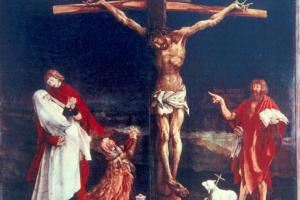
Cross. Matthias Grunwald
Note that for Warnack blood sacrifice is the “only way” God could be right to “let us off the hook.” It appears to me that Warnack assumes a metaphysical mechanism of sacrifice exists. Further, he assumes God pours sacrificial blood into the mechanism, pushes a button, and then grinds out forgiveness. The shedding of Jesus’ blood on the cross provided what the wheels needed to be put into motion.
Warnack reinforces what I just said: “It is only possible for God to forgive and lay aside his anger against us because he has punished sin in Christ.” Because Jesus is punished though he is innocent, his blood efficaciously becomes sacrificially potent.
Immediately, any garden variety systematic theologian would exclaim to Warnack: “now, wait just a doggone minute! If God must obey the laws of this metaphysical forgiveness dispenser, then God is not truly God. If God is subservient to a mechanism of sacrifice, then God is less than almighty.”
So, we find ourselves at the end of a tied dart game. On the one hand, we have lots of Bible darts sticking in the Double 2x Single segments that each make the point: Jesus blood was shed for our forgiveness. On the other hand, we have a systematic theologian protecting the Treble 3x Single goal squares from darts aimed at them. No missile, it seems, has hit the bullseye.
First Preliminary Prior to Proceeding
Should we Christians who believe that God is love (1 John 4:8) jettison atonement theory entirely on the grounds that the very concept of atonement makes God look violent? Even a child abuser? After all, God sacrificed his only begotten Son to satisfy his blood lust for punishment of sinners. Right?
To suggest that Christian theology eliminate atonement is not necessary for this particular complaint. This particular complaint adheres to only one of many accounts of the atonement. It applies secondarily to Satisfaction Theory and primarily to the Penal Substitution Theory, not to the others.
So, we need to explore two avenues. First, what are the other atonement theories? Second, is it the case that PST actually fosters belief in divine child abuse?
Second Preliminary Prior to Proceeding
Here is a relevant historical factoid: there exists a Christological dogma but no Soteriological dogma. Penal Substitution Theory does not have dogmatic status. Nor does any other model of atonement. What do I mean? Let me explain.
The Fourth Ecumenical Council meeting at Chalcedon (modern Kadiköy, Turkey) in 451 AD gave us the Christological Dogma. It dealt with the person of Christ: Jesus Christ is one person with two natures, a divine nature and a human nature.
…One and the Same Christ, Son, Lord, Only-begotten; acknowledged in Two Natures [ἐν δύο φύσεσιν], unconfusedly, unchangeably, indivisibly, inseparably; the difference of the Natures being in no way removed because of the Union, but rather the properties of each Nature being preserved, and (both) concurring into One Person and One Hypostasis [ἓν πρόσωπον καὶ µίαν ύπόστασιν] …
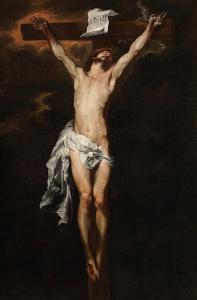
Cross. Antony van Dyck
This dogma has become for the systematic theologian a doctrine, belief, tenet, and accepted assumption.
No such dogma exists for Soteriology, the work of Christ. On the question of how Jesus saves, no ecumenical council has provided a parallel answer. Oh yes, the Christian tradition is unanimous that Jesus Christ is our savior. But, theological explanations vary without a canon to adjudicate between them.[2]
In what follows, I will offer my list of alternative atonement models. PST is one on that list. It claims no pride of place. PST must be evaluated side-by-side with the others, all of which rightly claim biblical authority.
Shall we get rid of atonement theory altogether?
The dartboard array of single goal squares displays many answers to the question: how does Jesus save? Penal Substitution Theory is only one of the six, as I have just said. Some dart throwers think that if they hit the bullseye, then the game will be over for all atonement theories. This logic is oblique at best.
This logic bothers evangelical theologian and Patheos columnist Roger E. Olson. In “Thoughts About Atonement,” he writes:
“The atonement was multifaceted and ultimately a mystery we cannot fully comprehend, but the substitutionary dimension should not be thrown out just because it is seemingly offensive and widely misunderstood and misrepresented as ‘divine child abuse’.”
Now, it’s time to look more closely at all the goal squares.
What’s Next?
Let’s ask a quidnunc for some theological gossip: who says what about what? Over the centuries, many answers have popped up to our question: how does Jesus save? Beginning with the next installment of this Patheos series, I will briefly outline six models of atonement rising out of the New Testament that have taken on coherent form in the history of Christian theology. We will refer to
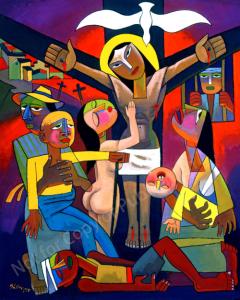
Cross. Artist: He Qi, China.
them as models, motifs, or theories.
-
Jesus as teacher of true knowledge
-
Jesus as moral influence
-
- 3.a. Jesus as victorious champion
- 3.b. Jesus as liberator
-
- 4.a. Recapitulation Theory
- 4.b. Satisfaction Theory
- 4.c. Penal Substitution Theory
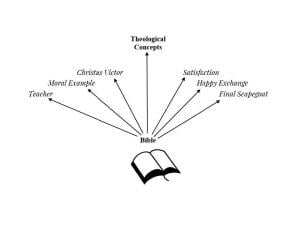
Each of these different models of atonement answers the question: how does Jesus save? Do they compete with one another? No. They complement one another. This very complementarity is decisive for the systematic theologian when trying to explain atonement. [See Video: Models of Atonement]
With this in mind, Orthodox theologian John Whiteford recommends we incorporate the full variety of biblical motifs. “Considering all the Biblical images that point to it [the atonement] — not by focusing on one or two to the exclusion of the rest, and certainly not by pressing those images beyond the point that they are intended to make.”
▓

Ted Peters
Ted Peters is a Lutheran pastor and emeritus seminary professor, teaching theology and ethics. He is author of Short Prayers and The Cosmic Self. His one volume systematic theology is now in its 3rd edition, God—The World’s Future (Fortress 2015). His book, God in Cosmic History, traces the rise of the Axial religions 2500 years ago. He has undertaken a thorough examination of the sin-and-grace dialectic in two works, Sin: Radical Evil in Soul and Society (Eerdmans 1994) and Sin Boldly! (Fortress 2015). Watch for his forthcoming, The Voice of Christian Public Theology (ATF 2022). See his website: TedsTimelyTake.com.
Ted Peters’ fictional series of espionage thrillers features Leona Foxx, a hybrid woman who is both a spy and a parish pastor.
▓
[1] PST belongs solely to the Latin tradition with its reliance on forensic metaphors and the satisfaction motif. From the Orthodox point of view: “the idea that God the Father required Christ to suffer punishment in order to somehow appease or satisfy His sense of righteousness or justice is an abhorrent idea, keeping many people from accepting the actual love and mercy of God and perverting a correct understanding of the nature of God the Father.”
[2 In “The Odious Penal Substitutionary Theory of Atonement,“ Patheos columnist James McGrath feels liberated by this historical factoid. “Atonement theories are, historically speaking, a result of Christians trying to make sense of the crucifixion of Jesus. Since there has never been a single creed stating a particular view of the cross as orthodox, on this topic more than any other, Christians should feel they have a lot of freedom to reflect and rethink.”
Bibliography
Aulén, Gustaf. 1967. Christus Victor. New York: Macmillan.
Calvin, John. 1535. Institutes of the Christian Religion . Tr. Thomas Norton: https://www.ccel.org/ccel/calvin/institutes.toc.html.
Girard, René. 1978. Things Hidden Since the Foundation of the World. Stanford CA: Stanford University Press.
Hultgren, Arland. 1987. Christ and His Benefits: Christology and Redemption in the New Testament. Minneapolis MN: Fortress.
Luther, Martin. 1955-1986. LW. Luther’s Works, American Edition, 55 Volumes: St. Louis and Minneapolis: Concordia and Fortress.
—. 2016-2019. The Bondage of the Will (1525) / The Annotated Luther, 6 Volumes. Minneapolis MN: Fortress Press.
Peters, Ted. 2015. God–The World’s Future: Systematic Theology for a New Era. 3rd. Minneapolis MN: Fortress Press.
Tanner, Kathryn. 2001. Jesus, Humanity, and the Trinity. Minneapolis MN: Fortress.
Latter-day Saint
General Christian
Evangelical
Eastern Orthodox
Catholic
History and Religion
Education and Religion

About Ted Peters
Ted Peters is a Lutheran pastor and emeritus seminary professor, teaching theology and ethics. He is author of Short Prayers and The Cosmic Self. His one volume systematic theology is now in its 3rd edition, God—The World’s Future (Fortress 2015). His book, God in Cosmic History, traces the rise of the Axial religions 2500 years ago. He has undertaken a thorough examination of the sin-and-grace dialectic in two works, Sin: Radical Evil in Soul and Society (Eerdmans 1994) and Sin Boldly! (Fortress 2015). Watch for his forthcoming, The Voice of Christian Public Theology (ATF 2022). See his website: TedsTimelyTake.com. Ted Peters’ fictional series of espionage thrillers features Leona Foxx, a hybrid woman who is both a spy and a parish pastor. You can read more about the author here.
Previous Post

August 19, 2022
Economism vs Common Good Part Three
Next Post
August 25, 2022 What is Creation?
Recent Comments
Browse Our Archives
Select a Category Afterlife America in Crisis Ancient Alien Apocalypse Art Artificial Intelligence Astrobiology Astrotheology Atheism Big History Buddhist Catholic Christian Nationalism Christmas Comparative Theology Death Ecology Ethics ETI Evangelical Evolution Existential Questions Free Will General Christian Hermeneutics Hindu https://www.patheos.com/blogs/allsetfree/2020/12/sins-we-need-to-talk-about/?utm_source=Newsletter&utm_medium=email&utm_campaign=Christians+For+a+Better+Christianity&utm_content=43&lct Interreligious Islam Jewish Justice Latter-Day Saints Literature Literature and Theology Lutheran Methodism Mormonism Nonreligious ontology Orthodox Pagam Prayer progressive Christian PT 6 Dignity Public Theology Race racial justice Religious Liberty Romance Satan Scapegoat Science & Religion Science and Religion social justice Spirituality SR 8 Transhumanism Systematic Theology Taoism Ted Peters UAP UFO Uncategorized War
Select a Month September 2026 August 2026 July 2026 June 2026 May 2026 April 2026 March 2026 February 2026 December 2025 November 2025 October 2025 September 2025 August 2025 July 2025 June 2025 May 2025 April 2025 March 2025 February 2025 January 2025 December 2024 November 2024 October 2024 September 2024 August 2024 July 2024 June 2024 May 2024 April 2024 March 2024 February 2024 January 2024 December 2023 November 2023 October 2023 September 2023 August 2023 July 2023 June 2023 May 2023 April 2023 March 2023 February 2023 January 2023 December 2022 November 2022 October 2022 September 2022 August 2022 July 2022 June 2022 May 2022 April 2022 March 2022 February 2022 January 2022 December 2021 November 2021 October 2021 September 2021
Follow Us!
TAKE THE
Religious Wisdom Quiz
What animal was used to represent the Holy Spirit?
Select your answer to see how you score.
Dove Sparrow Eagle Lamb
Related posts from Public Theology

Why Public Theology Needs a Theology of Nature

America's 250th Birthday Gift: Civic Renewal

Do You Believe in UFOs? A Theologian's Answer.

Free Will and Christian Freedom TWO
TRENDING AT PATHEOS Progressive Christian

What Being a Modern-Day Apostle Means to Me
In my last column, I discussed the ins and outs of modern-day...

Did Ancient China Once Worship the God of...
Across human history, a common thread weaves through the origins of the...

Love Your Neighbor – Including Earth-Kin: Lev. 19,...
God’s command to love your neighbor means acting in an ethical and...

Lead a Church Study of “Jesus and Lao...
Guest writer Jack Thomas (The Irreverent Reverend) reflects on leading his church...

Pastoral Wisdom for Responding to Sermon Pushback
Getting sermon pushback on your social justice sermon? Learn practical, Proverbs-based strategies...

Principles for Understanding the Apostolic Ministry Today
Whenever people discover that my formal ministry title is "apostle," as in...
view all Progressive Christian blogs
Ad-Free & Subscriber Log-In Subscription Support
- About Us
- 2026 Calendar
- Videos
- Podcasts
- Library of World Religions
- Faith In Media Tracker
- Advertise With Us
- Write for Us
- Privacy Policy
- Terms of Service
- Do Not Sell My Data
- Contact Us
- Radiant Digital
- Manage Newsletter Subscriptions
- Unsubscribe From Notifications
- Sitemap
Copyright 2008-2026, Patheos. All rights reserved.
Subscription Support Ad-Free & Subscriber Log-In
Follow Patheos