
BuddhistCatholicContemplativeEvangelicalGeneral ChristianHinduJewishLatter-day SaintMuslimNew VisionsProgressive Christian
Beliefs
- Buddhist
- Catholic
- Contemplative
- Evangelical
- General Christian
- Hindu
- Jewish
- Latter-day Saint
- More Voices
- Muslim
- New Visions
- Pagan
- Progressive Christian
Topics
- Religion News
- Food and Religion
- Sports and Religion
- Religious Art
- Religious Music and Entertainment
- Religious Events
- History and Religion
- Style and Religion
- Politics and Religion
- Women in Religion
- Recreation Outdoors and Religion
- Business Finance and Religion
- Careers Workplace and Religion
- Education and Religion
- Family Parenting and Religion
- Health Fitness and Religion
- Home and Religion
- Relationships and Religion
- Technology and Religion
- Travel and Religion
Columnists
- Buddhist Columnists
- Business Finance and Religion Columnists
- Careers Workplace and Religion Columnists
- Catholic Columnists
- Contemplative Columnists
- Education and Religion Columnists
- Evangelists Columnists
- Family Parenting and Religion Columnists
- General Christian Columnists
- Health Fitness and Religion Columnists
- Hindu Columnists
- History and Religion Columnists
- Home and Religion Columnists
- Jewish Columnists
- More Voices Columnists
- Latter Day Columnists
- Muslim Columnists
- New Visions Columnists
- Nonreligious Columnists
- Pagan Columnists
- Politics and Religion Columnists
- Progressive Columnists
- Recreation Outdoors and Religion Columnists
- Relationships and Religion Columnists
- Religion News Columnists
- Religious Art Columnists
- Religious Events Columnists
- Religious Music and Entertainment Columnists
- Sports and Religion Columnists
- Style and Religion Columnists
- Technology and Religion Columnists
- Travel and Religion Columnists
- Women in Religion Columnists
Resource Library
- 2026 Calendar
- Library of World Religions
- The 100 Most Holy Places on Earth
- Patheos Answers
- Podcasts
- Videos
- Faith Leaders Database
- Anglican Episcopalian
- Bahai
- Baptist
- Buddhism
- Christianity
- Confucianism
- Eastern Orthodoxy
- Hinduism
- Holiness and Pentecostal
- ISKCON
- Islam
- Judaism
- Lutheran
- Methodist
- The Church of Jesus Christ of Latter-day Saints
- New Age
- Paganism
- Presbytarian and Reformed
- Protestantism
- Religion Behind the Scenes
- Roman Catholic
- Scientology
- Shia Islam
- Sikhism
- Sufism
- Sunni Islam
- Taoism
- Zen
- See all religions
Research Tools
 Ad-Free & Subscriber Log-In Subscription Support
Ad-Free & Subscriber Log-In Subscription Support
Follow Patheos 

- Trending:
- Forgiveness
- |
- Marriage
- |
- Consciousness
- |
- Death Penalty
- |
- Election
- |
- Halloween

- Home
- Progressive Christian
- Religious Transhumanism 8: UU? Yes
Religious Transhumanism 8: UU? Yes
Last updated on: July 1, 2023 at 10:45 am by Ted Peters
Religious Transhumanism 8: UU? Yes 2023-07-01T10:45:06-07:00 Ted Peters
Patheos Explore the world's faith through different perspectives on religion and spirituality! Patheos has the views of the prevalent religions and spiritualities of the world.
 Religious Transhumanism? Yes
UU Transhumanism? Yes.
H+ 8 / 2018
Religious transhumanism? How about Unitarian Universalism (UU)? Might these two be compatible? Convivial? Convergent? Yes, indeed, if you’re James “J” Hughes. UU transhumanism is a shoe that fits.
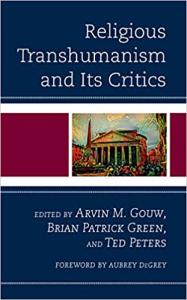
Religious Transhumanism and Its Critics
With enthusiasm we have greeted the March 18, 2022 publication of Religious Transhumanism and Its Critics. It’s published by Roman and Littlefield/Lexington. It’s edited by Arvin Gouw, Brian Patrick Green, and Ted Peters. We’ve been paving the road for this discussion for six years now. Finally, we can take this topic for a drive.
Here in this Patheos series on public theology, we are constructing a scientifically informed vision of humanity’s future in light of God’s eschatological promises for ultimate transformation and renewal. In H+ 1, we asked whether AI could provide a shortcut to virtue or holiness? In H+ 2, we parsed the transhuman, the posthuman, and the truly human. In H+ 3, we distinguished Radical Life Extension, Cybernetic Immortality, and Resurrection of the Body. We asked Micah Redding about Evangelical Transhumanism in H+ 4 and Lincoln Cannon about Mormon Transhumanism in H+ 5. Then, in H+ 6, we asked Hava Tirosh-Samuelson to critique H+ from a Jewish perspective. And, in H+ 7 Michael LaTorra introduced us to Buddhist Transhumanism. Now, we turn to UU Transhumanism. James Hughes will light our path.
Meet James “J” Hughes
 James “J.” Hughes Ph.D. is a bioethicist and sociologist who serves as the Associate Provost for the University of Massachusetts Boston (UMB), and as Senior Research Fellow at UMB’s Center for Applied Ethics. He holds a doctorate in Sociology from the University of Chicago where he taught bioethics at the MacLean Center for Clinical Medical Ethics. Since then Dr. Hughes has taught health policy, bioethics, medical sociology and research methods at Northwestern University, the University of Connecticut, and Trinity College. Dr. Hughes is author of Citizen Cyborg: Why Democratic Societies Must Respond to the Redesigned Human of the Future (2004) and is co-editor of Surviving the Machine Age: Intelligent Technology and the Transformation of Human Work (2017). In 2005 Dr. Hughes co-founded the Institute for Ethics and Emerging Technologies (IEET) with Oxford philosopher Nick Bostrom, and since then has served as its Executive Director. Dr. Hughes serves as Associate Editor of the Journal of Ethics and Emerging Technologies, and as co-founder of the Journal of Posthuman Studies. Dr. Hughes speaks on medical ethics, health care policy and future studies worldwide.
UU Transhumanism
TP. J, in your chapter in Religious Transhumanism and Its Critics, you confidently lift up the following: “The transhumanists aspire to transcendence through individual adoption of human enhancing technologies, while the UUs encourage transcendence through the critical, selective construction of personal spiritualities.” Could you briefly compare and contrast H+ transcendence and UU transcendence? Can technology contribute to spiritual transcendence?
JJH. Both traditions–Unitarian Universalism and Transhumanism–are shaped by Enlightenment rationalism and empiricism. So, both reject efforts to root transcendence in faith, dogma, ritual or church authority. But the UUs believe that individuals can find transcendence by engaging with the wisdom traditions of the world in an open-minded way, in a community that encourages spiritual individualism. Not all UUs are in fact “spiritual.” But, those who are tend towards naturalistic mysticism based on the “interdependent web of all existence of which we are a part.”
 Only a minority of transhumanists are self-consciously “spiritual.” But, the forms of transcendent experience many are drawn to draw on scientific wonder, like quantum mechanics and astrophysics, and eschatological expectations about our evolution into posthumanity. Transhumanists see emerging technologies as the path to transcendence – wisdom and eternal life – and science and reason as the path of wisdom. UUs see wisdom traditions as the path to transcendence, once they have been distilled and alchemically transformed by Enlightenment reason, but with no role for technology. So the UUs are more compatible with transhumanism than most religious traditions, but they are still quite different. Hence, the prospect of UU transhumanism.
TP. Both techno-skepticism and techno-utopianism are rife. Are you a utopian for theological reasons?
JJH. Not exactly. I see utopian aspirations as intrinsic to being human. As soon as our ancestors were capable of it, they started imagining how nice it would be if there was less violence, hunger and disease. They imagined people and supernatural beings with powers beyond the human. And they told stories about how people in the past, or future, or after death would have immortal bodies free of pain and toil. One of those stories is the Buddhist one that I gravitated to. The Buddhist story is about a man who looked at his own life and mind, and discovered the secrets of existence, true happiness and maybe superpowers, all without the assistance of gods. Then he built a community, the Sangha, that was the “wheel of righteousness” intended to influence lay society and governments to end poverty and violence. That story also has an eschatological component, the story of the coming Buddha, that is all about the utopian civilization we will build as a prelude to the next Buddha. Those kinds of stories fuel and shape our utopian imaginations, even Buddhist transhumanism.
 The UU story is more complicated. This is because it is basically the story of the liberal wing of the European Enlightenment. In the Enlightenment and UU story, we can all find our own version of the ideal life. Here, utopia is the achievement of a liberal world, with different cultures and beliefs, all accepting reason, dialogue and the democratic process. That is a better utopian vision than the more monolithic utopias that came before or after.
In both the Buddhist and UU social gospel there is a connection between individual spirituality and a better society. For the Buddhists there is a synergy between our personal efforts to let go of greed, hatred and ignorance, and a righteous society. In UU utopianism our personal efforts to overcome prejudice and listen to others helps build, and is supported by, a “world community with peace, liberty, and justice for all.” I have found both kinds of utopianism inspirational, just as I find both Buddhist transhumanism and UU transhumanism.
But our theological and utopian imaginations can also lead us astray. And, this a big problem in the technology debates. Some are drawn to apocalyptic narratives, and some to utopian ones, and I think both sides could use more introspection about the cultural or psychological forces that pushed them there.
TP. What is your message to bioconservatives who would oppose UU transhumanism?
JJH. Most bioconservative opposition to human enhancement is focused on straw men. For instance UU transhumanists and even secular transhumanists don’t want to condemn people to immortality. Rather, they want people to be able to lead healthy, fulfilling lives until they don’t want to live anymore. All transhumanists want people to have choice over the timing and manner of their death.
 But there are deeper roots to bioconservativism that are beyond argument. Bioconservatives tend to believe in some kind of natural law. So, they reject change that threatens “the ways things should be.” An example that is common today is the horror a transgender and non-binary people, who are kind of transhumanist shock troops. Bioconservatives have a reified idea about what humans are and should be. They feel threatened by the idea of the kind of radical change transhumanists greet with glee.
Instead of arguing about this, I usually try the Socratic approach. When did we become human? What are the core elements of your idea of the human? Just getting some of those deep assumptions on the table tends be more productive than arguing about human enhancement. I also assure bioconservatives that I as a UU transhumanist am just as concerned about the safety of technologies, the prospect of corporate or governmental authoritarianism, and the importance of using technologies to make society more equal. Most bioconservatives are not opposed to individuals choosing safe medical therapies. And, in the end, that is what a lot of enhancement involves.
TP. Any final words?
JJH. As I write, bombs are falling on Ukraine. Authoritarians are in power around the world. Reason is under attack on multiple fronts. And, the world is much darker than I ever imagined it would be in 2022. Promote critical reason and a liberal future!
Conclusion
TP. Like siblings born to Enlightenment parents, both Unitarian Universalism and transhumanism inherited a reliance on science, reason, and liberal values. Both are naturalistic. Both pursue transcendence through technological transformation. That these two would give birth to UU transhumanism should come as no surprise.
▓
 Ted Peters directs traffic at the intersection of science, religion, and ethics. Peters is an emeritus professor at the Graduate Theological Union, where he co-edits the journal, Theology and Science, on behalf of the Center for Theology and the Natural Sciences, in Berkeley, California, USA. He authored Playing God? Genetic Determinism and Human Freedom? (Routledge, 2nd ed., 2002) as well as Science, Theology, and Ethics (Ashgate 2003). He is editor of AI and IA: Utopia or Extinction? (ATF 2019). Along with Arvin Gouw and Brian Patrick Green, he co-edited the new book, Religious Transhumanism and Its Critics hot off the press (Roman and Littlefield/Lexington, 2022). Soon he will publish The Voice of Christian Public Theology (ATF 2022). See his website: TedsTimelyTake.com.
This fictional spy thriller, Cyrus Twelve, follows the twists and turns of a transhumanist plot.
▓

About Ted Peters
Ted Peters directs traffic at the intersection of science, religion, and ethics. Peters is an emeritus professor at the Graduate Theological Union, where he co-edits the journal, Theology and Science, on behalf of the Center for Theology and the Natural Sciences, in Berkeley, California, USA. He authored Playing God? Genetic Determinism and Human Freedom? (Routledge, 2nd ed., 2002) as well as Science, Theology, and Ethics (Ashgate 2003). He is editor of AI and IA: Utopia or Extinction? (ATF 2019). Along with Arvin Gouw and Brian Patrick Green, he co-edited the new book, Religious Transhumanism and Its Critics hot off the press (Roman and Littlefield/Lexington, 2022). Soon he will publish The Voice of Christian Public Theology (ATF 2022). See his website: TedsTimelyTake.com. The fictional spy thriller, Cyrus Twelve, follows the twists and turns of a transhumanist plot. You can read more about the author here.
Previous Post

March 28, 2022
Religious Transhumanism 7: Buddhist? Yes.
Next Post

April 7, 2022 The Public Theologian as Ecumenical & Ecumenic Pluralist
Recent Comments
Browse Our Archives
Select a Category Afterlife America in Crisis Ancient Alien Apocalypse Art Artificial Intelligence Astrobiology Astrotheology Atheism Big History Buddhist Catholic Christian Nationalism Christmas Comparative Theology Death Ecology Ethics ETI Evangelical Evolution Existential Questions Free Will General Christian Hermeneutics Hindu https://www.patheos.com/blogs/allsetfree/2020/12/sins-we-need-to-talk-about/?utm_source=Newsletter&utm_medium=email&utm_campaign=Christians+For+a+Better+Christianity&utm_content=43&lct Interreligious Islam Jewish Justice Latter-Day Saints Literature Literature and Theology Lutheran Methodism Mormonism Nonreligious ontology Orthodox Pagam Prayer progressive Christian PT 6 Dignity Public Theology Race racial justice Religious Liberty Romance Satan Scapegoat Science & Religion Science and Religion social justice Spirituality SR 8 Transhumanism Systematic Theology Taoism Ted Peters UAP UFO Uncategorized War
Select a Month September 2026 August 2026 July 2026 June 2026 May 2026 April 2026 March 2026 February 2026 December 2025 November 2025 October 2025 September 2025 August 2025 July 2025 June 2025 May 2025 April 2025 March 2025 February 2025 January 2025 December 2024 November 2024 October 2024 September 2024 August 2024 July 2024 June 2024 May 2024 April 2024 March 2024 February 2024 January 2024 December 2023 November 2023 October 2023 September 2023 August 2023 July 2023 June 2023 May 2023 April 2023 March 2023 February 2023 January 2023 December 2022 November 2022 October 2022 September 2022 August 2022 July 2022 June 2022 May 2022 April 2022 March 2022 February 2022 January 2022 December 2021 November 2021 October 2021 September 2021
Follow Us!
TAKE THE
Religious Wisdom Quiz
Which official opposed Nehemiah's wall-building and sent open letters to Jerusalem?
Select your answer to see how you score.
Haggai Tobiah Sanballat Geshem
Related posts from Public Theology

Why Public Theology Needs a Theology of Nature

America's 250th Birthday Gift: Civic Renewal

Do You Believe in UFOs? A Theologian's Answer.

Free Will and Christian Freedom TWO
TRENDING AT PATHEOS Progressive Christian

What Being a Modern-Day Apostle Means to Me
In my last column, I discussed the ins and outs of modern-day...

Did Ancient China Once Worship the God of...
Across human history, a common thread weaves through the origins of the...

Love Your Neighbor – Including Earth-Kin: Lev. 19,...
God’s command to love your neighbor means acting in an ethical and...

Lead a Church Study of “Jesus and Lao...
Guest writer Jack Thomas (The Irreverent Reverend) reflects on leading his church...

Pastoral Wisdom for Responding to Sermon Pushback
Getting sermon pushback on your social justice sermon? Learn practical, Proverbs-based strategies...

Principles for Understanding the Apostolic Ministry Today
Whenever people discover that my formal ministry title is "apostle," as in...
view all Progressive Christian blogs
Ad-Free & Subscriber Log-In Subscription Support
- About Us
- 2026 Calendar
- Videos
- Podcasts
- Library of World Religions
- Faith In Media Tracker
- Advertise With Us
- Write for Us
- Privacy Policy
- Terms of Service
- Do Not Sell My Data
- Contact Us
- Radiant Digital
- Manage Newsletter Subscriptions
- Unsubscribe From Notifications
- Sitemap
Copyright 2008-2026, Patheos. All rights reserved.
Subscription Support Ad-Free & Subscriber Log-In
Follow Patheos